Given Friday’s Supreme Court ruling on tariffs and Trump’s condemnation of the decision and his move forward under different laws, it strikes me that the way the parties are regarding tariffs these days are laser-focused on what Donald Trump thinks. And neither of the directions the Democrats or the Republicans are going are ones that have been consistent with what the parities have been standing for for the past few decades. Below I am going to show you the splits on trade agreements, and you will see where the parties have been standing and to what degree:
House
North American Free Trade Agreement
Passed 234-200: D 102-156; R 132-43; 1 0-1, 11/17/93.
China Trade Normalization
Passed 237-197: R 164-57; D 73-139; I 0-1, 5/24/00.
Andean Trade Bill
Passed 215-212: R 190-27; D 25-184; I 0-1, 7/27/02.
Trade Facilitation and Trade Enforcement Act (Conference Report)
Adopted 75-20: R 47-3; D 28-17, 2/11/16.
As you can see, strong majorities of Republicans have consistently favored trade agreements and Democrats have opposed them, although their margins of opposition are a bit more variable. Interestingly, the Senate tends to be more favorable to trade agreements than the House. However, part of the Trump base are people who are deeply opposed to “globalism” and part of this means trade agreements. Whether we like it or not, Trump is the center of the US political universe for the time being, and the parties’ stances on this issue are increasingly motivated by where he stands and what he is doing on trade. Most Republicans are scared to death of being primaried by someone who promises 100% loyalty to Trump, while Democrats by and large want to make showings of opposition to Trump, especially since many of their base supporters are outraged with them based on a perception that Democrats don’t do enough against him. Since Democratic base voters are a dime a dozen in my part of Washington, I’ve noticed that they don’t seem to have a real idea of what would be sufficient against him aside from immediate removal from office, but they don’t have a legal means to do it within reach (they would have to win 2/3’s of the Senate or short enough of that for a few Republican rebels to vote for conviction).
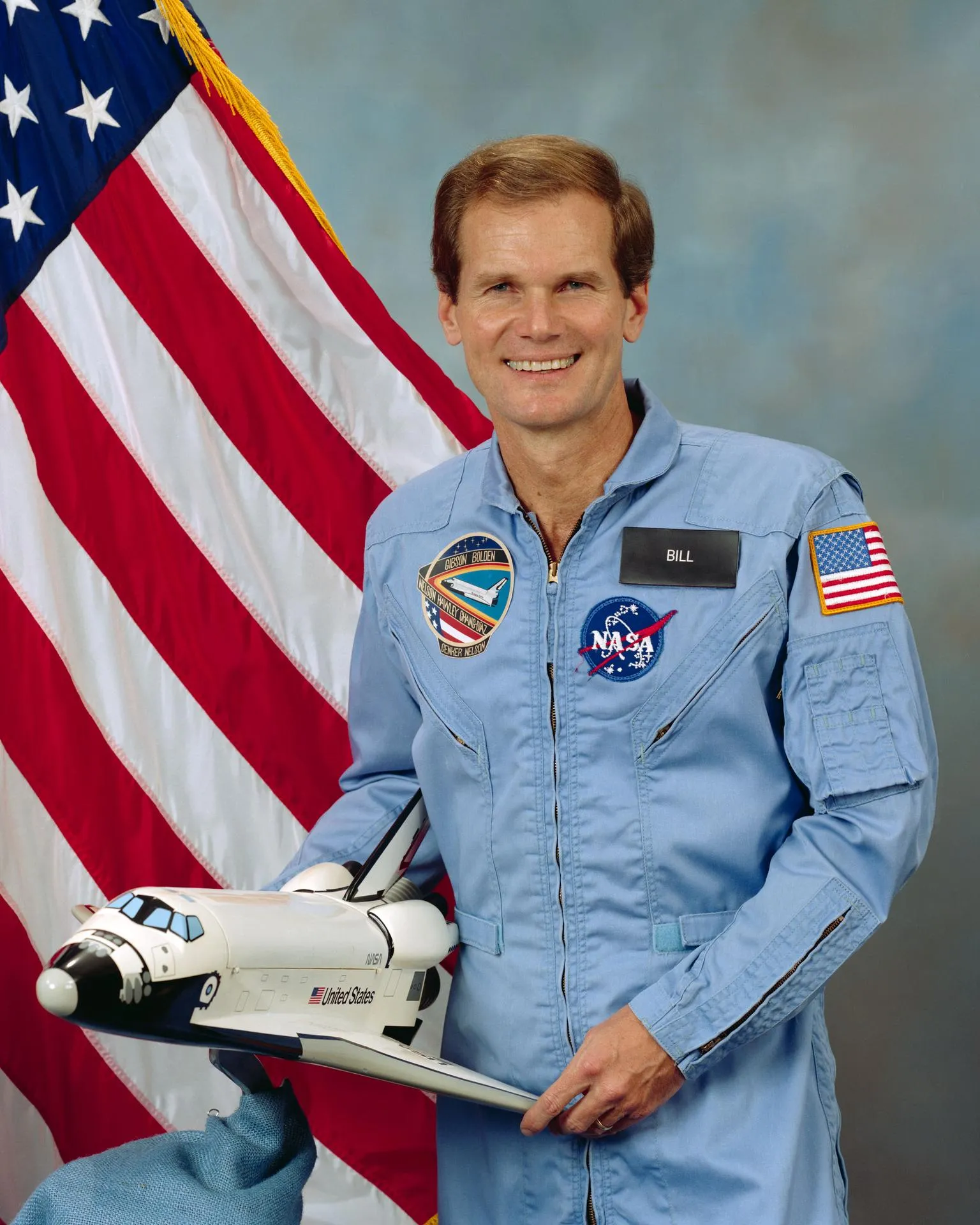
Some people of a conservative mindset may ask what happened to the Democratic Party. Interestingly, there are people whose records were considerably more moderate or even conservative before the politics of the 21st century. Some would say that a lot of Democrats back then would be Republicans now. However, this doesn’t account for politicians adapting to the directions of their parties. A prominent example of this is a recent politician in Clarence William “Bill” Nelson (1942- ).
An attorney by profession, Bill Nelson got his start in politics by working as a legislative assistant to Governor Reuben Askew with his election to the state legislature in 1972. He won reelection in 1974 and 1976, and this time put him in a good position to run for Congress. In 1978, Republican Lou Frey announced that he would not run for another term. Nelson was an ideal candidate for his time and place; a man of 36 with a model American family running against a politician who although had avoided jail-time was tied to a campaign fundraising scandal in 64-year old Republican Edward Gurney. Although this Florida district had been electing Republicans since 1962, when it first elected Gurney, Democrats had a 60-40 party registration advantage (Peterson). Furthermore, Nelson was running as a conservative Democrat thus Gurney couldn’t pin the label of liberal on him. He won the election by 24 points and established a record that was moderate to moderately conservative. Nelson opposed government funding of abortion, supported the death penalty, and backed the Reagan tax cuts in 1981. However, he supported rolling them back considerably with his support of the proposed 1983 Tax Equity bill and was supportive of funding increases for domestic programs and opposed to limiting food stamps. In 1986, Nelson was the second member of Congress and the first representative to travel into space in Space Shuttle Columbia. After all, he represented Florida’s Space Coast where Cape Canaveral is located.
In 1990, he opted against running for another term for Congress to run for governor. However, Nelson had a formidable primary opponent in former Senator Lawton Chiles Jr., and miscalculated in his campaign against him when he made Chiles’ health an issue, particularly his use of Prozac to treat depression, which was made worse by his running mate suggesting that Chiles was suicidal, a suggestion Nelson disavowed (Orlando Sentinel). Running against Chiles on mental health didn’t stick to the man that Floridians had thrice elected to the Senate, and he easily prevailed.
If his 1990 gubernatorial race was the end of his national career, I would be fine with the common view of him that he was a centrist or even a moderately conservative Democrat. From 1979 to 1984, he sided with the conservative Americans for Constitutional Action 63% of the time. However, Nelson’s career had quite a way to go and in 1994 the reelection of Governor Chiles also saw the election of Nelson as Treasurer, Insurance Commissioner, and Fire Marshal of Florida (yes, it is all one office). He won reelection in 1998, and his experience positioned him for a Senate run. In early 2000, Nelson resigned to run for the Senate, and just like the state’s presidential race, its Senate race was close and heated. His opponent was conservative Republican Congressman Bill McCollum, and both ran strongly negative campaigns against each other. Nelson repeatedly labeled his opponent as an extremist who would sacrifice the elderly, the poor, and the working class to coddle the rich while McCollum labeled him as “a liberal who would tax everything that moves, and some things that don’t” (Bragg). At the time, Nelson had the more solid case for the political center given his record in the House while McCollum had a pretty consistent conservative record. As political science professor Aubrey Jewitt noted, “he was known as a fairly moderate Democrat and right now that’s a good ideological place to be” (Bragg). Although Bush very narrowly officially won the state by 537 votes in one of the nation’s most controversial elections, Nelson edged out McCollum in the Senate election by 5 points.
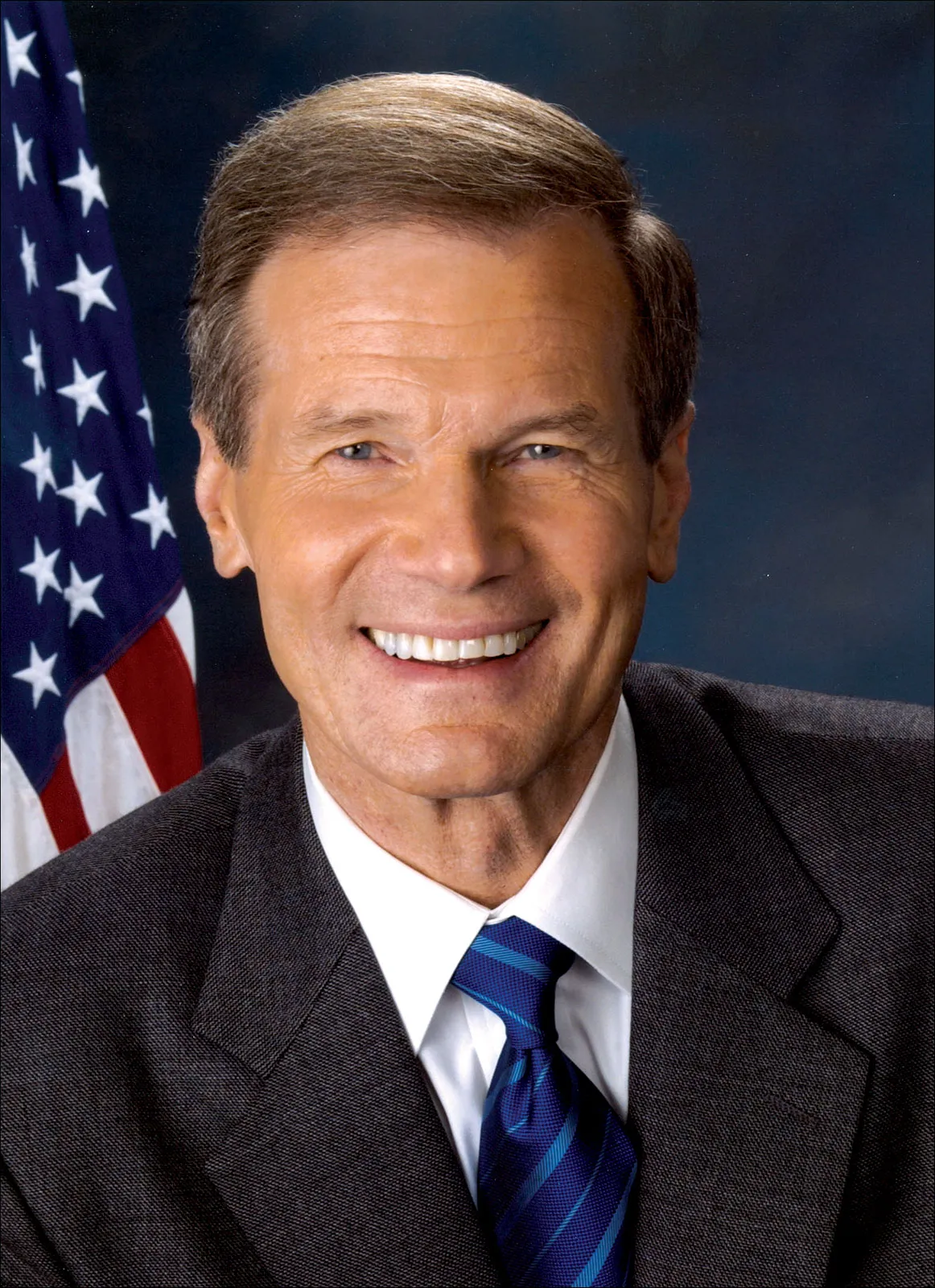
Senator Nelson
It should be noted that representing a district and representing a state can be a different ballgame and some politicians indeed have shifted left from when they represented a district as opposed to a state. Prominent examples include Senator Kirsten Gillibrand of New York who as a representative of an upstate district was pro-gun rights and now is pro-gun control and even more dramatically Charles Goodell of New York who went from moderately conservative establishment Republican to staunchly liberal anti-Vietnam War Republican in the Senate in what seems to have been an unsuccessful effort to make a Republican-Liberal Party coalition run for a full term in 1970. Indeed, the contrasts between Nelson as a representative and Nelson as a senator are considerable. Although in his first term in the Senate, you could make an argument that he seemed to represent was he was selling to Floridians, and contrary to what McCollum claimed he did vote for some tax reductions, notably ending the estate tax and extending the Bush tax cuts (although he had originally opposed them). However, in his first term he nonetheless sided with the American Conservative Union (ACU) 20% of the time and liberal Americans for Democratic Action (ADA) 79% of the time. As a representative, he had agreed with the ACU 55% of the time and ADA only 34% of the time. The 2006 election gave him a green light to be a party loyalist even more as he was reelected by 22 points not only due to a poor political climate for Republicans but also due also a weak candidate in Congresswoman Katherine Harris.
In his second term, Nelson was strongly with the liberal position and a loyalist to the agenda of the Obama Administration. He even stated his support for a “public option” for healthcare in 2009, an issue of contention among Senate Democrats (Dunkelberger). Indeed, Nelson sided with ACU 8% of the time in this term. Now wait…you might say, that’s just a conservative skew! However, he also sided with ADA positions 93% of the time! Thus, again, both conservatives and liberals agreed on where he stood on the American political spectrum. One area in which he was consistent over time on the conservative position was on favorability to free trade agreements. Furthermore, with Obama winning reelection not only nationally but also in Florida in 2012, Nelson pulled off an 11-point win. Once again, Republicans had run a weak candidate, this time in Congressman Connie Mack IV. A Florida Republican operative had said about Mack, “He’s a weak candidate. Let’s just be honest. He is a pale shadow of his father’s greatness as a politician” (Miller). Nelson’s third term represented more agreement with the Obama Administration as after all, Florida voters had opted to return him to office!
His siding with ACU and ADA differed a bit in his third term: 3% for the former and 87% for the latter. I should note that it is my opinion based on what I’ve seen of their ratings that ACU under Matt Schlapp has made their grading of politicians tougher and more oriented towards the politics of Rand Paul. However, Nelson’s loyalty to the Obama Administration was noted by journalist Ledyard King (2014) when he wrote that a new analysis showed that along with 16 other Senate Democrats he “voted in line with President Barack Obama’s positions 100 percent of the time last year”. In 2018, although Nelson in theory had the benefit of a good political environment given that this was looking to be a backlash election against Trump, he undoubtedly lacked the benefit of a weak candidate. Rick Scott was reasonably popular as Florida’s two-term governor, and better yet for the Republicans they were making inroads with Hispanic voters overall and not just increasing their support among Cuban-Americans (Ogles). Furthermore, Florida was increasingly moving to Republicans and Nelson’s loyalist record to President Obama as well as his opposition to nearly all Trump policies wasn’t playing so well in Florida now. This was highlighted with his announcement before Trump picked a Supreme Court nominee in 2018 that he expected to vote against the nominee based on protecting Roe v. Wade (Smith). The issue of abortion was yet another way in which Nelson had flipped; as a representative he had had an almost entirely anti-abortion record while as a senator, he had a record almost entirely supportive of abortion rights, only voting to prohibit taking minors across State lines without parental consent for abortions in 2006. This election was so close that it was decided by just over 10,000 votes, or 0.13% of the vote, with Scott prevailing. Nelson subsequently served as the administrator of NASA from 2021 to 2025.
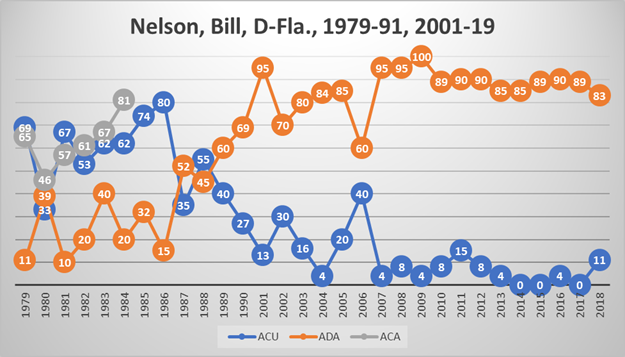
In his overall Senate career, Nelson sided with ACU 10% of the time and ADA 86% of the time. Both ADA and ACU found Senator Nelson’s peak year of dissent from the liberal position as 2006, when he only sided with the liberal position on 60% of the votes they considered to be most important. Over his entire career, he sided with ACU 27% of the time and ADA 65% of the time, with his DW-Nominate score standing at -0.193. While his overall record does paint him as a moderately liberal Democrat, it makes more sense to see Representative Nelson as distinct from Senator Nelson, much like it made sense to see Representative Goodell of New York as distinct from Senator Goodell of New York.
The change of Bill Nelson overtime:
References
ADA Voting Records. Americans for Democratic Action.
Back in 1986, Ronald Reagan is on his second term as president, having won a 49-state landslide and only narrowly losing Minnesota, the home state of his opponent, Walter Mondale. Like Trump, Reagan had the benefit of a Republican Senate although unlike Trump he never had the benefit of a Republican House. The composition of the Senate during this time presents a fascinating contrast to today. For one thing, although by this point the South is on presidents in the Republican column, it has yet to move there in its Senate composition. Today, the South’s senators are Republican save for Georgia and Virginia. In the 99th Congress, Democrats held one seat in Alabama, both of Arkansas’ seats, one of Florida’s, one of Georgia’s, both of Louisiana’s, one of Mississippi’s, one of North Carolina’s, one of South Carolina’s, both of Tennessee’s, and one of Texas’s. That’s right, in 1984 Tennessee overwhelmingly elected Al Gore to the Senate. Republicans actually hold both of Virginia’s Senate seats as back then it was a conservative state. Virginia and West Virginia have switched places since then, as both of their senators are Democrats. Another bizarre feature of this time was that Democrats held both of Nebraska’s seats! For reference, Nebraska has not voted for a Democrat for president since 1964 and its senators were among the conservative wing of the Democratic Party. Some of the social stances they held would have gotten them a quick cancellation among the base.
New England was different too, as Republicans held a seat in Connecticut, one of Maine’s, both of New Hampshire’s, one of Rhode Island’s, and one of Vermont’s. The West Coast is downright bizarre; although Democrats have held all of the West Coast states’ Senate seats since 2009, in 1985-1986 they only have California’s Alan Cranston. However, the Republicans who hold these seats would, save for Pete Wilson and perhaps Slade Gorton, be although to the right of Democrats holding these seats today, far from tolerable for the modern Republican base. In truth, 48 Senate seats are different in party affiliation between this time and now. Kentucky at that time has freshman Senator Mitch McConnell, now in his last year of service, and the last Democrat to represent the state in the Senate in Wendell Ford. In Delaware, Joe Biden is there as a Democrat, but his colleague is Republican William Roth, who played a significant role in the crafting and passage of the Reagan tax cuts and is the Roth in the Roth IRA savings account. As hard as it may be to believe, both of Minnesota’s senators are Republican! One of them, Rudy Boschwitz, had a double-digit reelection in the same year Mondale won the state. How voters viewed the president and his party varied considerably and voters were far more willing to split their tickets than now. The states that remain the same partisan composition then as they are now are Alaska, Hawaii, Idaho, Illinois, Indiana, Kansas, Massachusetts, Michigan, New Jersey, North Carolina, South Dakota, Utah, Wisconsin, and Wyoming. However, a look at the agreement rates I have put up with the senators should indicate to you that the parties were far more ideologically diverse. For instance, many of the Southern senators would not pass muster in today’s Democratic Party. One of them, John C. Stennis of Mississippi, had first been elected to the Senate in 1947! Many of the New England Republicans would not be in today’s Republican Party; Lowell Weicker of Connecticut was a bane of Reagan Republicans and later identified as an Independent and supported Democratic candidates and even Gordon Humphrey of New Hampshire, the staunch Reagan conservative of the group, has been strongly anti-Trump in recent years. Neither John Chafee of Rhode Island or Robert Stafford of Vermont would be palatable to modern Republicans. I have below senators who served in both years of the 99th Congress and included are agreement rates from the liberal Americans for Democratic Action and the conservative American Conservative Union. These are a little bit different from their official ratings; I do not count absences either way unlike ADA, I count documented legislative pairs and opinions for, and I do not double-count votes unlike ACA. Each vote is weighted equally for position agreement.
The popular perception of Bill Clinton during his presidency was that he was a moderate, and indeed to liberals looking back, he was that or even a conservative. Indeed, the term “New Democrat” came into being to describe Clinton’s form of Democratic politics and the politics of his supporters. One figure who was not a liberal who echoed this idea of him as a conservative of some sort was conservative David Harsanyi, who wrote, “Despite bringing some big liberal ideas, earthy debauchery and all manner of corruption to the Oval Office”, he “presided over a thriving economy, declared the era of big government over and signed more consequential conservative legislation than any president since – and perhaps, anyone before him” (BBC News). Today I intend to show why this take is wrong, and the traditional view of Clinton as a liberal, not a moderate or conservative, is the accurate one, and what’s more I will do so from the liberal perspective by using the votes selected as ideologically relevant by the liberal lobbying group Americans for Democratic Action.
Issues in which Bill Clinton was liberal included:
Support of and signing into law the Family and Medical Leave Act, the Motor-Voter Law, The Brady Bill, and the National Community and Service Act in 1993.
Support of and signing into law the Goals 2000 Educate America Act, adding funds for education grants to schools.
Opposed an amendment for school choice and reducing overall spending on education in 1994.
Opposing a Republican amendment to reduce domestic spending and protect defense from more cuts in 1994.
Supported banning “assault weapons”, supported an abortion clinic access bill, and a Montana Wilderness bill designating 1.6 million acres as protected wilderness.
Opposed the original welfare reform bill in 1995 (before signing another version in 1996 as it was close to election time), opposed Republican legislation to permit the creation of “company unions” without union presence.
Pro-choice in his record of preferred positions, including his veto of a “partial birth” abortion ban.
Opposition to proposed Balanced Budget and Tax Limitation Constitutional amendments.
Support of the Caesar Chavez Workplace Fairness Act and the admission of Washington D.C. as the state of New Columbia.
Opposed Republican efforts to end the estate tax, gift taxes, and the marriage penalty.
Supported hate crime legislation.
Supported campaign finance reform legislation.
Opposed income tax reduction.
Supported closing the “gun show” loophole in gun control laws.
Supported the Comprehensive Nuclear Test Ban Treaty.
Supported increasing the federal minimum wage.
Opposed the creation of education savings accounts.
Supported preferential treatment for minority-owned businesses by government in 1998.
Issues in which Bill Clinton was conservative included:
He went against ADA’s judgment in his opposition to ending funding for the superconducting super-collider project.
Clinton supported NAFTA, opposed efforts to impose steel tariffs, and supported normalizing trade relations with China.
Although his budget called for defense cuts, he opposed several additional Congressional efforts to do so, such as opposing the deletion of funds for the Trident II submarine missile, opposing cutting the Ballistic Missile Defense program, and opposing cutting funding for U.S. forces in Europe. The trade parts may be considered controversial to consider conservative today, especially in the environment of a Trump-led GOP.
For the Senate, this translates to Clinton supporting the liberal position 56 times out of 60 that he was recorded as having a position on a vote counted by Americans for Democratic Action, while in the House he supported the liberal position 63 times out of 74. The former renders his Senate agreement rate at 93% and the latter his House agreement rate at 84%. When we combine the two, Clinton comes out supporting the liberal position 88% of the time. Not moderate, and not conservative…by liberal standards! Further backing this is Clinton’s DW-Nominate score of -0.438. Something to bear in mind, however, is that DW-Nominate scores are not as reliable for presidents as they are for members of Congress, and Clinton had a lot more selectivity in his selection of legislative issues to register an opinion on than legislators do. But, with the information we have available based on actual votes cast, Clinton comes out a liberal who makes exceptions for trade and national defense. The “New Democrat” still is supportive of unions, still supports tax increases on upper incomes, supports social liberalism, and makes an exception to what is considered liberalism in the United States here and there, primarily on trade and national defense.
References
ADA Voting Records. Americans for Democratic Action.
The subject of the war powers of the president have again arisen with the Saturday U.S. raid on Caracas and the capturing of Venezuelan dictator Nicolas Maduro and his wife for trial. President Trump did not invoke the War Powers Resolution, although neither did President George H.W. Bush for his invasion of Panama in 1989-1990. The War Powers Resolution is definitely a subject of discussion, though, for this most notable event and today I am looking into the circumstances of the adoption of the War Powers Resolution.
Clement J. Zablocki (D-Wis.) and Nixon.
By 1973, the U.S. was in the process of withdrawing from Vietnam and many members of Congress were critical of how both Presidents Johnson and Nixon had used their war powers. For the latter, it was when Nixon ordered secret bombings of Cambodia without seeking Congressional consent. In the House, Clement J. Zablocki (D-Wis.), chairman of the House Foreign Affairs Committee, introduced the War Powers Resolution. The measure had bipartisan support as well as drafting, with Paul Findley (R-Ill.) being the resolution’s main author. The resolution requires the president to notify Congress within 48 hours of military action and bars forces from remaining for more than 60 days. The first body to vote on this resolution would be the House. On July 18, 1973, they voted for 244-170 (D 171-61, R 73-109). The central architect of the resolution in the Senate was Jacob Javits (R-N.Y.), one of the most liberal members of Nixon’s party who had repeatedly been in opposition to the Nixon Administration on Vietnam. He considered the measure as “a critical departure from the past” (CQ Almanac 1973). However, the measure attracted broad support, and a key senator to come out in favor was the chairman of the Senate Armed Services Committee and known conservative John C. Stennis (D-Miss.), who expressed that “It is of the utmost importance to the future of this nation that we not again slip gradually into a war that does not have the moral support and sanction of the American people” (CQ Almanac 1973). However, the measure did not have the support of another prominent figure from the South, a legal authority on the Constitution, Sam Ervin (D-N.C.). Ervin held that the measure was unconstitutional, stating, “Here is a power and a duty which the Constitution clearly imposes upon the President of the United States, to use the armed forces to protect this country against invasion. And here is a bill which says expressly that the President of the United States cannot perform his constitutional duty and cannot exercise his constitutional power to protect this country against invasion for more than 30 days without the affirmative consent of Congress” (CQ Almanac 1973). There was also a small cadre of liberals who opposed the War Powers Resolution as not being sufficiently strong. Thomas Eagleton (D-Mo.) objected to the absence of a provision disallowing the use of intelligence agencies or other actors to engage in hostilities against other nations (CQ Almanac 1973). On July 20th, the resolution was adopted 72-18 (D 50-4, R 22-14), but because it was different from the House version, the measure had to go into conference. October 10th, the equation did not change in the Senate with a vote of 75-20 (D 49-6, R 26-13, C 0-1), still a veto-proof margin. However, original passage in the House had not been veto-proof. This, however, would not remain so as President Nixon’s popularity was declining from the continuing sore on his presidency that was Watergate.
Majority Leader Tip O’Neill (D-Mass.) argued for the resolution, holding that “If the President can deal with the Arabs, and if he can deal with the Soviets, then he ought to be able and willing to deal with the U.S. Congress. That is all we ask of him” (CQ Almanac 1973). Democratic leadership was united in favor, and Republican leadership was mostly united against. The exception was Senate Minority Leader Hugh Scott (R-Penn.), thus the foremost opponent in the House was Minority Leader Gerald Ford (R-Mich.). Ford, less than a year away from being president, expressed his concerns, “We may be a long ways from being out of the woods. I am very, very concerned that the approval of this legislation over the President’s veto could affect the President’s capability to move forward from cease-fire and to achieve a permanent peace” (CQ Almanac 1973). The resolution passed on October 12th 238-122 (D 163-38, R 75-84). President Nixon, as no one doubted he would, vetoed the resolution. Further eroding Nixon’s popularity, however, between final passage and his veto of the resolution, the “Saturday Night Massacre” had occurred, in which Attorney General Elliot Richardson resigned after refusing Nixon’s order to fire special prosecutor Archibald Cox, and Deputy Attorney General William Ruckelshaus was fired after refusing to fire Cox. Solicitor General Robert Bork ultimately agreed to fire Cox.
The real battle to override the President’s veto occurred in the House, as supporters had more than enough on passage in the Senate to get the resolution through. To achieve an override, eleven opponents of the president had to be lobbied to switch their votes from “nay” to “yea”. Bella Abzug (D-N.Y.), one of the most left-wing members of Congress, had opposed, stating before the conference report that “I shall vote against this bill because it is patently unconstitutional and gives the President power he does not now have…I fear that it does exactly the opposite of what we set out to do: that is, to prevent the President, any president, from usurping the power of Congress to declare war” (CQ Almanac 1973). Speaker Carl Albert (D-Okla.) and the liberal group Americans for Democratic Action actively lobbied these legislators to switch. Their efforts were successful, as eight did so, including Abzug. The House vote of 284-135 (D 197-32, R 87-103) to override on November 7th was four votes above the threshold needed to override President Nixon’s veto.
In the Senate, with an override now inevitable, a few members switched their votes later that day: Republican Howard Baker of Tennessee and Democrats James Allen of Alabama, Harold Hughes of Iowa, and Gaylord Nelson of Wisconsin switched from “nay” to “yea” while Republicans Ted Stevens of Alaska and Henry Bellmon of Oklahoma switched from “yea” to “nay”. The vote was 75-18 (D 50-3, R 25-14, C 0-1). On a side note, the vote on the resolution as reported by Voteview has an error, as Senators Tunney (D-Calif.) and Tower (R-Tex.) have their votes swapped; Tower opposed the War Powers Resolution while Tunney supported. Overall, most of the resolution’s opponents were conservative, but there were some interesting conservative votes in favor on overriding the president’s veto, such as John Ashbrook (R-Ohio), who had run a quixotic primary campaign in 1972 to Nixon’s right, the legendary penny-pincher H.R. Gross (R-Iowa), and John Rousselot (R-Calif.), the only member of the John Birch Society in Congress at the time. In the Senate, conservative Republicans were a bit more unified against with Barry Goldwater (R-Ariz.) and Jesse Helms (R-N.C.) being among the dissenters, but you did have guys like James McClure (R-Idaho) and William Scott (R-Va.) as votes in favor. In another indication of how poorly the Nixon Administration was doing on popularity, among Southern Democrats, a key group that Nixon sought to court support, only Sam Ervin voted against overriding Nixon’s veto.
There have been critics of this resolution, both as being too strong and too weak. Law Professor Robert F. Turner argued in a Fall 2012 journal article that the War Powers Resolution was unwise, unconstitutional, and even resulted in a reduction of American security to the point that it directly contributed to the 9/11 attacks. However, Scott R. Anderson, a fellow of the Brookings Institution, holds that although the War Powers Resolution is imperfect, it was a good undertaking that had a positive result in constraining the executive in getting the US into prolonged wars.
References
Anderson, S.R. (2023, November 9). The Underappreciated Legacy of the War Powers Resolution. Lawfare.
To Agree to the Conference Report on H.J. Res. 542, to Govern the Use of the Armed Forces by the President During the Absence of a Declaration of War. Voteview.
To Override the President’s Veto of H.J. Res. 542, Concerning the War Powers of the Congress and the President Concerning the War Powers of the Congress and the President. Voteview.
To Override the President’s Veto of H.J. Res. 542, to Govern the Use of the Armed Forces by the President During the Absence of a Declaration of War. Voteview.
Turner, R.F. (2012, Fall). The War Powers Resolution at 40: Still an Unconstitutional, Unnecessary, and Unwise Fraud that Contributed Directly to the 9/11 Attacks. Case Western Reserve Journal School of Law, 45(1).
Tariffs have been figuring strongly in recent politics thanks to President Trump’s repeated changes in course throughout the year on the imposition or removal of tariffs and certain decisions surrounding them that have been questionable at best. Trump’s policies on tariffs, although more erratic than Republicans of past, given his positive mention of William McKinley does make me think of the McKinley Tariff of 1890, which was at the time a crowning partisan achievement of the GOP and one that helped bring about swift political consequences.
The 1888 election was very close, but a great success for the Republican Party. For the first time since the Grant Administration, they had achieved unified government, and under the highly capable Speaker Thomas Brackett Reed of Maine, they sought to make the most of it. At the forefront of the agenda was the bread and butter of economic Republicanism of the time…protective tariffs. Leading this charge was the popular Representative William McKinley (R-Ohio), known as the “Napoleon of Protection” for his strong advocacy. The Republican Party was at the time strongly unified behind increasing tariffs while the Democratic Party was just as if not more strongly unified against.
A key concept introduced by this legislation was the reciprocal tariff or empowering the executive to raise tariffs on commodities after their addition to the free list to disincentivize other nations from raising their tariffs on these goods. Furthermore, Harrison persuaded the Senate to adopt a provision permitting the president to sign agreements opening foreign markets (U.S. House). These provisions would be upheld unanimously by the Supreme Court as a constitutionally permissible delegation of power in the 1892 decision Field v. Clark.
The initial version of the McKinley Tariff passed 164-142 on May 21st on a highly partisan vote as only three representatives defected: Republicans Hamilton Coleman of Louisiana and Oscar Gifford of South Dakota and Democrat Charles Gibson of Maryland. In the Senate, the bill was managed by Nelson Aldrich (R-R.I.), perhaps the foremost representative of industry in the Senate. On tariffs, in which 138 votes on the subject were held that covered numerous commodities from salt to sponges, the Senate passed the bill 40-29 on September 10th a completely partisan vote. However, there were differences between the House and Senate versions and thus the measure went to conference to resolve them. On September 27th, the House voted on the conference report, which was passed 151-81, with only Republicans Harrison Kelley of Kansas and again Coleman of Louisiana breaking with party. In the Senate, however, there was some more dissent among Republicans, with Senators Preston Plumb of Kansas, Algernon Paddock of Nebraska, and Richard Pettigrew of South Dakota voting against. In its’ final form, this law raised tariffs on average from 38% to 49.5%. Certain commodities were heavily focused on for protective tariffs like manufactured goods such as tin plates to appeal to factories in the East, while wool was jacked up to appeal to the sheep farmers of the rural West. Other tariffs, however, were removed, such as those on sugar, molasses, coffee, tea, and hides, but the president was authorized to raise them should other nations choose to impose on these goods for the United States.
Puck cartoon mocking McKinley.
Although quite the achievement for the Republican Congress, it went into effect on October 6th, less than a month before the 1890 election, and prices promptly rose in response to the tariffs. The Democratic newspaper skewered the bill, and since the benefits of the tariffs (increase in domestic worker wages and jobs) had little time to take effect while the negative side took effect promptly, this resulted in a surge of disapproval of the Republicans. Eleven days after the tariff took effect, The Cleveland Plain Dealer (1890) wrote, “The consumers are finding out that they are compelled to pay the tax, and that fact will grow daily more apparent. A gentleman walked into a hardware store a few days ago and asked to see some pocketknives. A number were placed upon the show case and prices were given. “Are these McKinley prices?” he inquired. “No,” said the clerk, “but we will be compelled to raise prices. We have been busy and have not made any change in our prices yet, but we shall soon do so.” This is only one of many occurrences of which one hears on the streets, and to offset it all there is nothing but prattle about imaginary tin plate factories and other McKinley air castles”. Such unpopularity contributed a great deal to the utter slaughter the Republicans faced in the 1890 midterms including McKinley himself losing his seat, although his loss was in good part due to unfavorable redistricting. Democrats won the popular vote by 8 points in the House, which produced a gain of 86 seats for them and Republicans sustained a 93 seat loss; they also lost seats to the newly formed Populist Party. The Indianapolis Journal (1890), contrary to The Cleveland Plain Dealer, wrote in defense of the tariffs after the election, attributing much of the unpopularity to “falsehoods” propounded about the McKinley Tariff by the “importers’ press”, for instance attributing a price increase in fruits and vegetables to tariffs without mentioning that there were crop failures that produced shortages. Although Republicans continued to be for higher tariffs, they sought to proceed more carefully in the future than they had in 1890, and McKinley would have an astounding comeback, being elected Ohio’s governor in 1891, be reelected in 1893, and then be elected president in 1896. Although a high tariff man, he would embrace the idea of reciprocal tariff reductions, and the Dingley Tariff Act of 1897, although it enacted the highest tariffs on average in American history, would contain a provision permitting the president to reduce duties by up to 20%. McKinley even came around to the idea of reciprocal trade treaties shortly before his assassination.
References
Gould, L.L. William McKinley: Domestic Affairs. UVA Miller Center.
For a long time there has been a debate about what side of an issue the late Abraham Lincoln would be on; in the 1930s numerous New Deal politicians expressed their belief that Lincoln would be on their side with some Republicans asserting that Lincoln would have done things differently than FDR. While we can never be totally what Lincoln’s social views would be in different times given that his changed over the course of his life, including on civil rights, there is a bit more certainty on economic issues, and on this question, there are two Henrys who can help us answer this question, both who greatly influenced Lincoln. The first is Henry Clay, the much-admired founder and three-time candidate of the Whig Party for president. The second is a considerably less known figure but one who shines light on Lincoln’s economic views in Henry Carey (1793-1879), a major advocate of the “American School” of economics who is largely forgotten today but was quite prominent in his day.
The American School of Economics
Carey did not start off as an economist, rather as a businessman in the publishing industry, but the Panic of 1837 inspired him, at the age of 44, to study economics. He was something of a gadfly in the world of economics in his day, as British economists were overwhelmingly on the side of pure lassiez-faire, and this is where Carey was initially. However, he was persuaded by economic crises in the 1830s and 1840s that this approach fell short. Carey would start arguing in 1848 that free trade served to benefit the British empire (indeed its most prominent advocates were from Britain) and that the United States should at that stage as a nation be developing its home markets and achieving economic independence (Cowan). Thus, he would argue for tariffs to help develop the nation and build up American industry so they could compete fairly with Great Britain, a more powerful nation than the US in his time. Carey would also argue that tariffs were a mutually beneficial policy as they helped both the profits of industry and the wages of labor (Cowan). He was also a critic of economists David Ricardo and Thomas Malthus, and wrote against their views in this three volume Principles of Social Science (1858-1860). On Malthus, he wrote that he “teaches that a monopoly of the land is in accordance with a law of nature. Admiring morality, he promotes profligacy by encouraging celibacy. … Desirous to uplift the people, he tells the landowner and the laborer that the loss of the one is the gain of the other. His book is the true manual of the demagogue, seeking power by means of agrarianism, war and plunder” (Levermore, 562-66). In the late 1850s, Carey blamed tariff reductions passed and signed into law by President Franklin Pierce for the Panic of 1857, and some historians have shared his judgment. Carey was also an opponent of unions as an instrument of collective bargaining, regarding the tariff as the proper mechanism for wage growth. However, Carey was supporting tariffs for the US based on its present conditions. He hoped for a future in which the nations of the world could trade without tariffs, writing, “Of the advantage of perfect free trade there can be no doubt. What is good between the states ought to be good the world over. But free trade can be successfully administered only after an apprenticeship of protection. Strictly speaking, taxation should all be direct. Tariff for revenue should not exist. Interference with trade is excusable only on ground of self-protection. A disturbing force of prodigious power pre- vents the loom and spindle from taking and keeping their proper places by the plow and harrow. When the protective regime has counteracted the elements of foreign opposition, obstacles to free trade will disappear and the tariff will pass out of existence. Wars will cease; for no chief magistrate will dare to recommend an increase of direct taxation” (Levermore, 570).
Carey was the lead editor on articles regarding political economy for Horace Greeley’s New-York Tribune from 1849 to 1857. At that time, another economist contributed from abroad who wrote under a pen name, this other economist being none other than Karl Marx. Marx considered Carey, a staunch opponent of socialism, to be the only notable American economist and also his ideological rival, considering himself to be engaging in “hidden warfare” against him through his work for the Tribune (Marx & Engels, 78-79). Indeed, Marx even thought that Carey’s philosophy was the central impediment to a communist revolution in the United States.
Carey was a supporter of Abraham Lincoln and upon his election to the presidency, he served as an economic advisor to both him and Secretary of the Treasury Salmon P. Chase. He helped draft Republican tariff bills, including the Morrill Tariff of 1861 and was influential in getting the National Bank Act of 1863 adopted. Carey was a consistent supporter of greenbacks, supporting both the Legal Tender Act of 1862 (which along with distribution of greenbacks unbacked by gold or silver and achieved the Whig goal of a unified national currency) and postwar currency inflation. The former got the support of the Republican establishment as an emergency measure for the war, but the latter was opposed as the Republican establishment was fundamentally conservative on issues of economics and finance. Whether Lincoln would have heeded Carey had he lived I think is an open question. On one hand, he was influenced by Carey in numerous facets of policy, but on the other hand, shortly before his death he had tapped Hugh McCulloch as Secretary of the Treasury, who pursued a policy of contraction of greenbacks. Would Lincoln have sought to rein in his own Secretary of the Treasury or heeded his advice?
Influence Today?
Although Henry Carey is a figure who is generally seen as a modern conservative’s go-to economist, Professor Adam Rowe, writing for Compact Magazine, argues that Henry Carey is an explaining figure for Trump’s tariffs. If Carey has any influence, this is a full circle back to the earliest days of the Republican Party.
References
Cowan, D.A. (2022, September 8). Henry C. Carey’s Practical Economics. The American Conservative.
Levermore, C.H. (1890). Henry C. Carey and his Social System. Political Science Quarterly, 5(4), 553-582.
Marx, K. & Engels, F. (1975). “Notes”. In Ryazanskyaya, S.W. (ed.). Selected Correspondence. Translated by Lasker, I. (3rd edt.). Moscow, USSR: Progress Publishers.
Perhaps the most famous people in the United States to have made the jump from actor to politician are Ronald Reagan and Arnold Schwarzenegger. Donald Trump is not primarily an actor, rather he was the host of The Apprentice and has had numerous film cameos and TV appearances. Rather, he is a celebrity businessman turned politician. All of them identify or identified as Republicans during their political careers. The first actor, however, to make the jump from actor to Republican politician was John Davis Lodge (1903-1985).
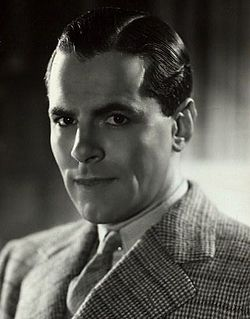
To be perfectly clear, Lodge’s family background set him up to be a politician. After all, he was descended from multiple families that produced politicians. The Lodge family, for instance, was one of the most prominent early families of Boston, and both his grandfather and older brother, Henry Cabot Lodge Sr. and Jr., were both prominent and influential politicians. Although Lodge studied law at Yale and became a lawyer, the call of Hollywood had him drop his lucrative legal practice. Naturally handsome, he would appear in numerous films from 1933 to 1940. Lodge later recalled his time in Hollywood, stating that he had known Ronald Reagan although never acted in the same film with him, explaining, “We were involved in different aspects of acting. I was leading man for Marlene Dietrich, and I acted with Katharine Hepburn in ‘Little Women,’ and I played Shirley Temple’s father in ‘The Little Colonel’” (Folkart). By the way, does this not look like a movie star to you?
During World War II, Lodge served as a lieutenant and lieutenant commander in the Navy, acting a liaison between the American and French forces. He served with distinction, being awarded the rank of Chevalier in the French Legion of Honor and the Croix de Guerre with Palm by Charles de Gaulle (National Governors Association). In 1946, a political opportunity opened up when Clare Boothe Luce of Connecticut’s 4th Congressional district decided not to run for reelection after the death of her daughter. This was an excellent year to be a Republican, and they won majorities in the House and Senate as well as had a complete sweep of the state’s House delegation.
Congressman Lodge
Lodge was without doubt a moderate Republican, as opposed to being among the conservative Old Guard. He sided with Americans for Democratic Action 40% of the time, and his DW-Nominate score was a 0.063, which indicates centrism. While in Congress, Lodge supported income tax reduction, the Taft-Hartley Act, aid to Greece and Turkey, the Marshall Plan, reducing the power of the Rules Committee to bottle up legislation, and public housing. Although the 1948 election was more difficult for Republicans, he won reelection by 12 points, easily the best performance among the state’s House Republicans. Lodge was also one of the strongest Republican internationalists, opposing foreign aid reductions and supporting Point IV aid to poor nations. Although he supported amendments weakening rent control, he supported extending it in 1950. That year, he opted not to run for reelection to run for governor against incumbent Chester Bowles, and campaigned against him as extremely left-wing (Krebs). Bowles in turn was dismissive of him, publicly regarding him as merely an actor. This was a political error as numerous retired actors lived in Connecticut (Folkart). The election was close, with Lodge winning by two points with a plurality of the vote. Had the votes for the Socialist candidate gone to Bowles, he would have won the election.
Governor Lodge
Lodge was the first governor for which the four-year term applied. Previously, Connecticut governors had served two-year terms. This gave him time to enact some measures, such as enhancing unemployment and worker’s compensation, increasing funds for education and the construction of public buildings, as well as the construction of the Lodge Turnpike (National Governors Association). However, the latter is often regarded as the reason behind his loss of reelection in 1954 to Abraham Ribicoff by just over 3,000 votes. After his loss, Republicans would have a tough time winning gubernatorial elections over the next forty years. Until 1994, the only time in which Republicans won the governorship was Congressman Thomas J. Meskill’s 1970 win.
Ambassador Lodge
Like his brother, Henry Cabot Lodge Jr., John was a friend of President Eisenhower, and he was tapped to the post of Ambassador to Spain. In this capacity, he played a role in the increasing normalization of relations between the US and Franco, serving until 1961. In 1964, Lodge attempted to revive his electoral career by running against Democratic Senator Thomas J. Dodd. Although he was far from being a Goldwater Republican, Dodd’s combination of domestic liberalism and anti-communism on foreign policy played well and Goldwater at the top of the ticket dragged down his campaign. Dodd won reelection by nearly 30 points, with Lodge only outperforming Goldwater by 3 points. Lodge did not run for political office again, but Republican presidents continued to find use for him. In 1969, President Nixon called him back into service as Ambassador to Argentina, a role he served in until 1973. Lodge’s last role would be as President Reagan’s Ambassador to Switzerland, serving from 1983 until his resignation in 1985. On October 29th, he delivered a speech at the Women’s National Republican Club in New York City but after he finished, he suffered a heart attack and was pronounced dead on arrival at St. Clare’s Hospital.
References
ADA Voting Records. Americans for Democratic Action.
Trump is president for a second time, and while there hasn’t been anyone with his exact last name in Federal office before, there was an oddly named fellow named Philadelph Van Trump (1810-1874), although unlike Trump he was never a Republican.
The mid-19th century was a strange time in American politics. Before the existence of the Republican Party the major rival of the Democratic Party was the Whig Party. The Whigs were a broad coalition of politicians who had come together in opposition to President Andrew Jackson and his groundbreaking use of executive power. Indeed, in 1850 you could find Abraham Lincoln in the same party as Alexander Stephens, who would be vice president of the Confederacy. However, over time the differences within this coalition only grew. The most vital of these issues was of slavery, with an increasingly intractable divide between “conscience Whigs” and “cotton Whigs”. Van Trump started in the Whig Party and in 1852 he participated in last Whig National Convention, which nominated General Winfield Scott. However, the Whigs tried too hard to appeal to everyone and thus ended up having little appeal; the ticket only won the states of Massachusetts, Kentucky, Tennessee, and Vermont, a result that, with the enactment of the Kansas-Nebraska Act, spelled the death of the Whig Party. Many Whigs flocked to the rapidly growing American (“Know Nothing”) Party, as did Van Trump, and in 1856 he ran for governor of Ohio on the American Party ticket. However, this made the gubernatorial race three-way, splitting the Democratic vote and resulting in the election of Republican Salmon P. Chase. In 1860, Van Trump strongly supported the Constitutional Union Party’s ticket which ran John Bell for president and Edward Everett as vice president. The platform was maintaining the union but leaving slavery alone. Van Trump’s movement between parties is one way in which he actually was similar to current President Donald Trump, as Trump has in the past been in the Democratic Party as well as in the Reform Party for when he was running for that party’s nomination for president in 2000.
During the War of the Rebellion, Van Trump was a staunch opponent of President Lincoln and the Republicans. From 1862 to 1867, he served as a judge of the court of common pleas, commanding a lot of respect in this role for acting as he saw fit under the law even under threat of imprisonment. As the newspaper The Stark County Democrat described in his obituary, “His career as a Judge was a marked one, and perhaps no jurist ever more completely commanded respect of the bar. He was profoundly learned in the law, possessed iron firmness and the greatest suavity. The celebrated kidnapping case of Dr. [E. B.] Olds came before him, but he fearlessly enforced the law, although surrounded with bayonets and himself threatened with military arrest and imprisonment. But for the hasty intervention of the Supreme Court, he would have imprisoned Gov. [David] Tod under the kidnapping act” (DiBacco). For context, Dr. Olds was considered among the leading Copperheads of Ohio, or those who wanted a peace agreement with the Confederacy for an amicable break. Governor Tod had recommended him for arrest for his activities, which were regarded as siding with Confederates, and he was himself arrested for kidnapping briefly until freed by the Supreme Court (Roseboom & Wisenburger, 190-192). His efforts at higher judicial office met with little success, as he thrice lost elections to the Ohio Supreme Court. Instead of again seeking a post on the court, in 1866 Van Trump ran for Congress and won in the at-the-time Democratic 12th district.
Congressman Van Trump
During his time in office, Van Trump not only opposed the impeachment of President Andrew Johnson but also delivered a speech against it in Congress. As a member of the Committee on Railroads, he was a consistent opponent of the Republican policy of generous land grants to railroads. Van Trump was also consistently against high tariffs, an economic bread and butter policy of the GOP at the time. However, during his time in office he developed heart disease, and he did not seek reelection in 1872. Van Trump’s DW-Nominate score was -0.591, or one of the most liberal per that system in his time. He did not live long in retirement, dying on July 31, 1874. Van Trump also has a rather interesting connection to Washington State, where I live, in that his son, Philemon Beecher Van Trump, was the first person to document climbing Mt. Rainier in 1870.
Van Trump was different in many ways than current President Trump, and yet another one of those was in his riches. As his obituary in The Stark County Democrat read, “he died comparatively poor because he was too generous to accumulate wealth” (DiBacco).
References
DiBacco, T.V. (2018, May 4). The other Trump in history. Orlando Sentinel.
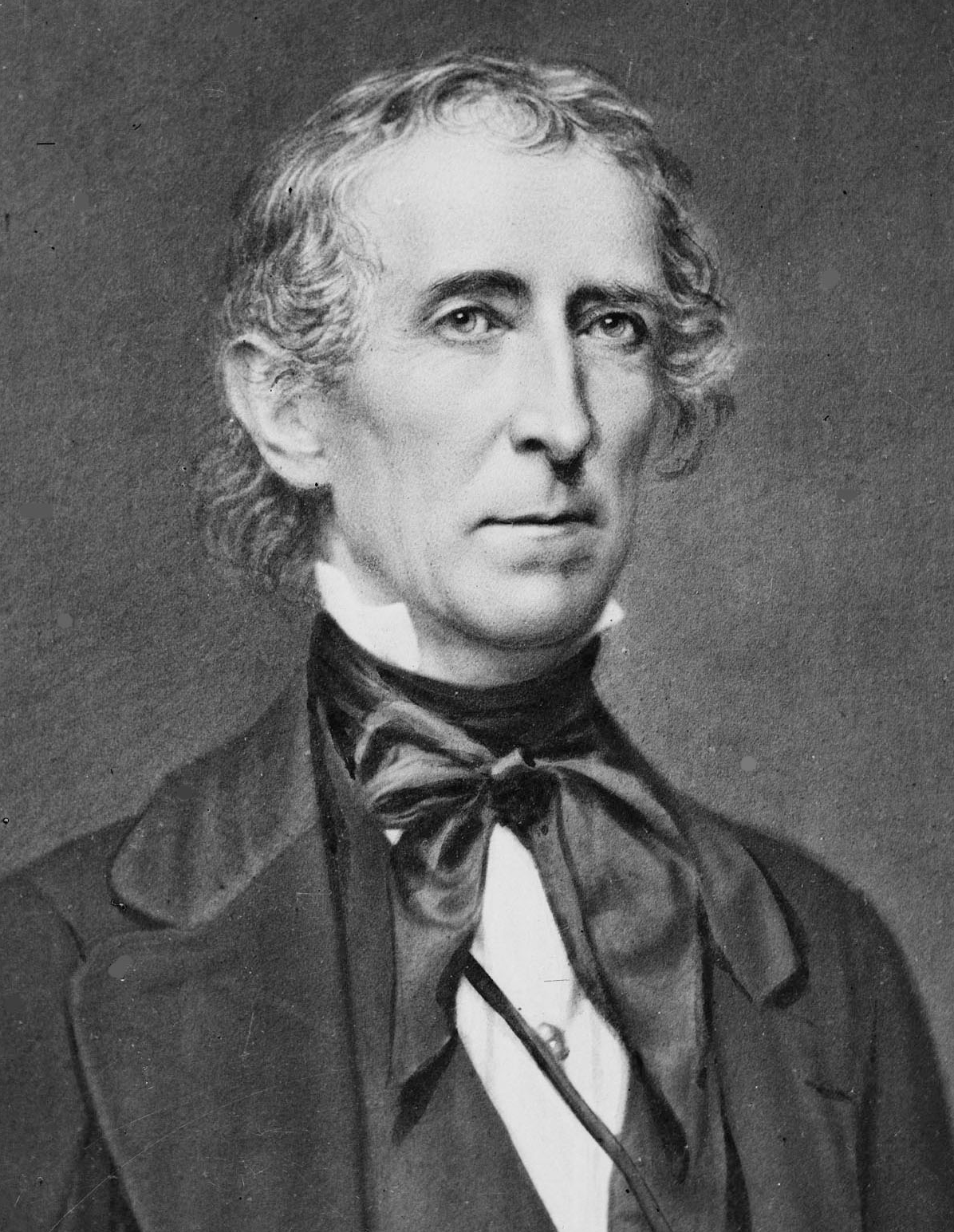
President John Tyler, whose nominees were most rebuked by a vote of the Senate.
At first, the people president-elect Donald Trump announced he would nominate after being sworn in seemed like the sort of picks you’d expect, Marco Rubio for Secretary of State or Elise Stefanik for Ambassador to the UN. However, three of his recent announcements have provoked shock, doubt, and opposition. These are Matt Gaetz for Attorney General, RFK Jr. for Secretary of Health and Human Services, and Tulsi Gabbard for National Intelligence Director. Gaetz has been a bomb-thrower in Congress for Trump and has made many enemies in the GOP for his leading role in the ouster of House Speaker Kevin McCarthy (R-Calif.), not to mention there was a House Ethics Committee report due to be released on his personal conduct before his resignation from the House. Kennedy has had a history of expressing many views that are out there, but most notorious have been his anti-vaccine stances. Furthermore, his personal record regarding marital fidelity makes Donald Trump look like a saint by comparison. Gabbard has in the past expressed support for Syrian President Bashar al-Assad and has previously repeated Russian propaganda surrounding the ongoing Russo-Ukrainian War. These announcements have certainly given some who would otherwise be supporting Trump nominations pause. Leading Senate Republicans have pledged that Trump’s nominees will go through the regular Senate vetting process as opposed to recessing the Senate thereby allowing Trump to install his cabinet for a maximum of nearly two years without Senate scrutiny. Believe it or not, only nine people have ever been rejected for a cabinet post by a vote of the Senate.
The first cabinet nomination in the history of the United States to be rejected was none other than Roger B. Taney, who would be most known as chief justice from 1836 until his death in 1864. Much like Trump is proposing to do, Andrew Jackson used a recess appointment to confirm Attorney General Taney as Secretary of the Treasury. However, as Treasury Secretary Taney was Jackson’s point man for the destruction of the Second Bank of the United States, which included advising transferring funds out of the bank and into state banks and authored a lot of President Jackson’s veto message (Encyclopedia Britannica). In retaliation, the Senate rejected continuing him in this position 18-28 in June 1834.
John Tyler’s Nominees
John Tyler has the dubious distinction of having the most cabinet nominees rejected by a vote of the Senate, with four getting rejected. This is certainly a least in part attributable to him considered by his party to be a rogue president. Indeed, him assuming the presidency instead of simply serving as acting president was considered questionable in his time, and some saw him as illegitimate. Yet, this precedent stuck. As a Whig, Tyler was dissenting on a lot of Whig policy, including vetoing restoring the Second Bank of the United States and vetoing two tariff increases. The defeated were Caleb Cushing for Secretary of the Treasury (who was voted on three times as Tyler stubbornly resubmitted his nomination twice), David Henshaw for Secretary of the Navy, James M. Porter for Secretary of War, and James S. Green for Secretary of the Treasury. The defeats of these candidates can broadly be attributed to President Tyler’s unpopularity.
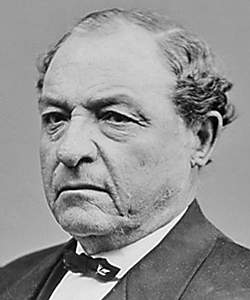
Henry Stanbery
In 1866, the Senate confirmed Henry Stanbery as Attorney General for the Johnson Administration without fanfare or drama. However, relations between the Senate and Stanbery soured. He had backed President Johnson’s Reconstruction policy that gave no focus on rights for freedmen, and he had helped draft Johnson’s veto message of the first Reconstruction Act and on March 12, 1868 he resigned his post to join the defense team for President Andrew Johnson in the Senate’s impeachment trial. After Johnson was acquitted by one vote, he renominated Stanbery for his old post. The Senate, however, wasn’t having it, and his nomination was rejected 11-29 on June 2nd.
Charles B. Warren
In 1925, President Coolidge nominated Charles B. Warren to replace Attorney General Harlan F. Stone, who had been confirmed to the Supreme Court. Something to be understood about the Republican Party at this time was that although conservatives were strongly in the majority in the party, there was a staunch progressive wing and this wing in particular had clout in the Senate as they were able to team up with Democrats to oppose many policies of the Republican administrations of the 1920s. Warren was seen as too friendly to business interests, especially the “sugar trust”. The vote on this was going to be close, and Vice President Charles G. Dawes was going to be needed. Dawes thought he had time to take a nap at the Willard Hotel as he was told by the Senate leadership that a vote wouldn’t be held that day. However, the Senate abruptly decided to proceed to the vote…while Dawes was napping. Although Dawes was awoken and rushed to the Capitol to cast the tie-breaking vote, it was too late by the time he had arrived, as a senator had changed his mind to opposition with the vote failing 39-41. However, when the vote was held again on March 16th, it was rejected 39-46. President Coolidge was quite put off indeed by his vice president. This is also the last time that the Senate ever voted to reject a president’s nominee when the president’s party was in control.
Lewis Strauss
This rejection is the one that certainly has had the most public attention lately, given that it figured in the film Oppenheimer. Indeed, Strauss’s role in pushing of Oppenheimer out contributed to his defeat. However, there were other factors. Strauss’s competence was not in question, rather it was his polarizing personality that had become clear when he was a member and later chairman of the Atomic Energy Commission…while he had the full confidence and friendship of President Eisenhower, he made numerous enemies. Time Magazine (1959) described the variance of the views on him thusly, “Strauss, by the extraordinary ingredients of his makeup, is one to arouse superlatives of praise and blame, admiration and dislike. In the eyes of friends, he is brilliant, devoted, courageous and, in his more relaxed moments, exceedingly charming. His enemies regard him as arrogant, evasive, suspicious-minded, pride-ridden, and an excessively rough battler”. One of these enemies was Senator Clinton Anderson (D-N.M.), who led the charge against Strauss’s confirmation. Anderson made sure that committee hearings on Strauss went on for weeks, and he admitted that this was a strategy, “I thought if the committee members saw enough of him, he would begin to irritate them, just as he has me” (Time Magazine). Another factor was that Strauss, a staunch conservative, had repeatedly worked against public generation of power, supporting instead private industry. Although his nomination survived in committee by a vote of 9-8, this did not translate to confirmation, especially not in the strongly Democratic Senate. Strauss was rejected on a vote of 46-49, with 15 Democrats in support, and 2 Republicans in opposition. Strauss’s high level of defensiveness, an insistence on addressing every point of contention instead of admitting to a few errors, also harmed his nomination (Time Magazine).
John Tower
In 1989, President Bush nominated John Tower to serve as Secretary of Defense. Tower had served in the Senate from 1961 to 1985 as the first Republican to represent Texas since Reconstruction, and he had become an expert on national defense, serving as the chairman of the Armed Services Committee from 1981 to 1985. He had also served as the lead negotiator in the Strategic Arms Reduction Talks with the USSR and chaired the Tower Commission on Iran-Contra, which had issued a strongly critical report of the Reagan Administration. Tower was not known to suffer fools, and this made numerous senators on the Democratic side less than sanguine about his nomination. However, an unexpected opponent of his nomination came to testify before the Senate in Heritage Foundation’s Paul Weyrich. Weyrich opposed his nomination on the grounds of his moral character, stating, “I have encountered the senator in a condition lacking sobriety as well as with women he was not married to”, and adding to this Tower’s second wife, Lila Burt Cummings, alleged “marital misconduct” in her divorce filing (Los Angeles Times). The nomination became a highly partisan issue, and on March 9, 1989, Tower was rejected 47-53, with three Democrats (Dodd of Connecticut, Heflin of Alabama, and Bentsen of Texas) voting for, and one Republican voting against (Nancy Kassebaum of Kansas). The odd man out in support was Dodd, who although he denied it, it seems likely that he had Tower’s vote against his father’s censure in 1967 in mind. Tower’s defeat by vote of the Senate is the only one to have happened at the start of a president’s time in office.
I find it possible that the Senate rejects one Trump nominee in a vote, but more likely that a far more common event occurs: the nomination is withdrawn, either by Trump or the nominee him or herself. Indeed, there is a long list of announced nominations that were withdrawn during the first Trump Administration, including Andy Puzder for Secretary of Labor and Patrick M. Shanahan for Secretary of Defense. Count on some of those rather than a series of dramatic Senate rejection votes.
References
Conservative Tells of Seeing Tower Drunk: Senate Panel Hears Activist Oppose Defense Nomination. Los Angeles Times.




 Mad Politics: The Bizarre, Fascinating, and Unknown of American Political History