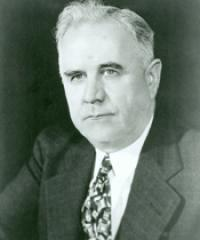
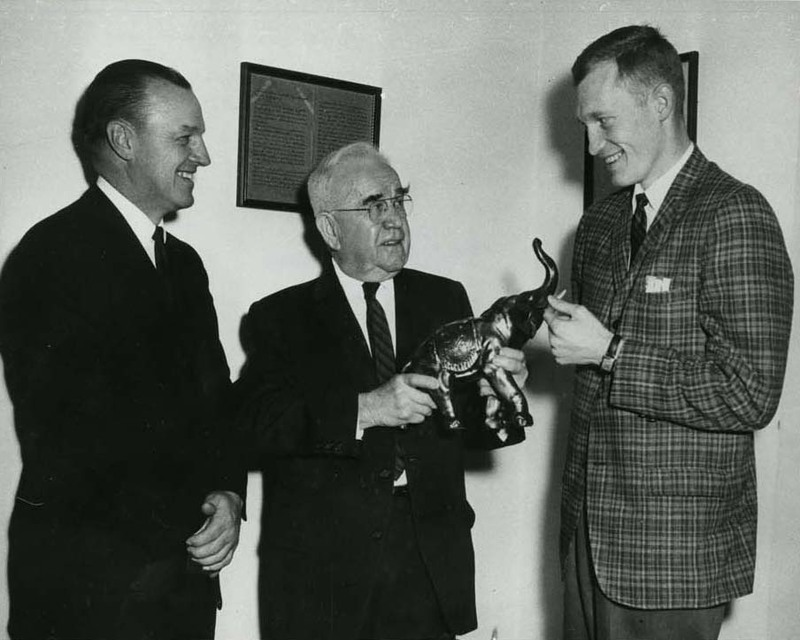
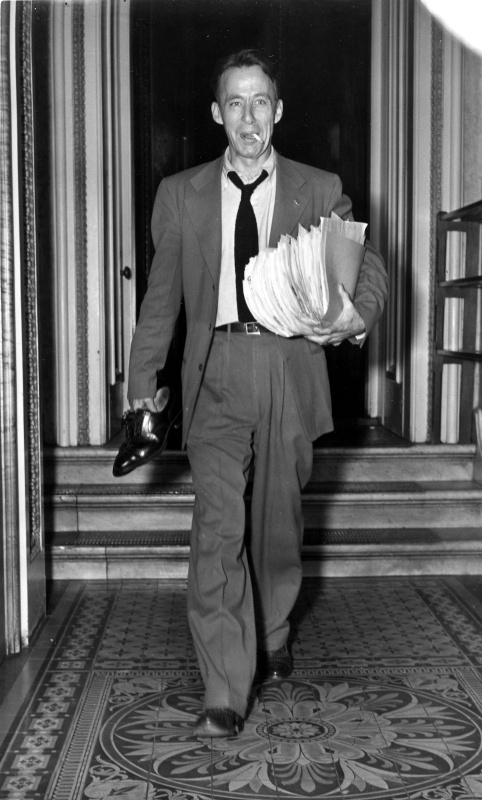
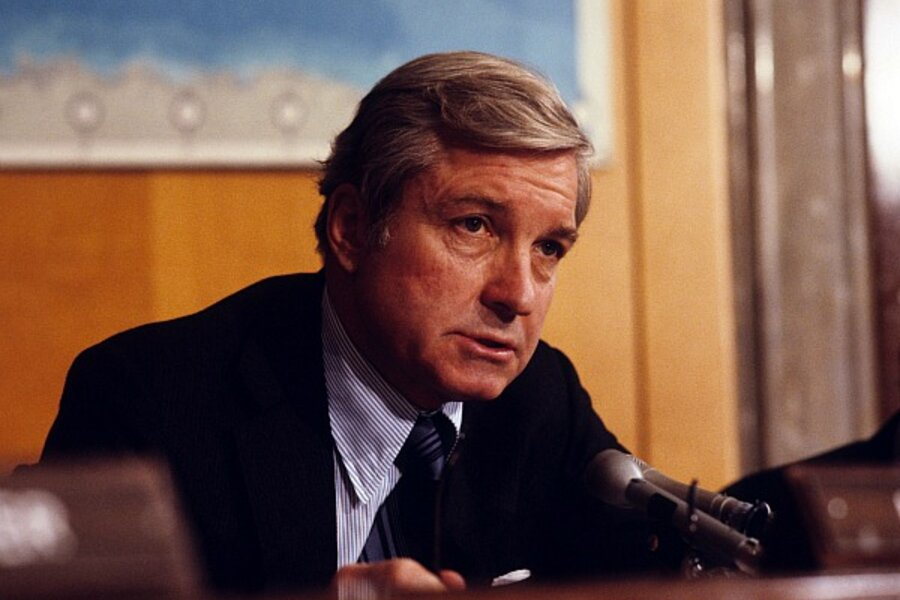
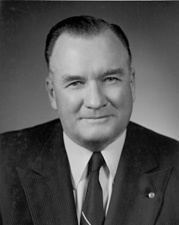
The Storied Career of the Principled, Unpredictable, and Individualistic Harry P. Cain

The state of Washington is not known as a Republican much a less conservative place, but 1946 was an exception. That year was the first time the GOP won control of both the House and the Senate since 1928, and numerous people were elected who in other circumstances would not have likely won. This could be said for Harry Pulliam Cain (1906-1979).

A banker by profession, Cain did not start his life in politics on the Republican side, rather he was a New Deal Democrat, fervently backing FDR in 1932 and becoming the chairman of the Pierce County Young Democrats. However, he became disillusioned with Roosevelt’s second-term policies and his “court-packing plan” and would recall, “I had respect for Roosevelt at first. His program was bold and imaginative – just what we needed when the country was sick. But he continued to treat us sick even when we had become well again. I thought the third term was a terrible thing” (Smith, 2023). From 1935 to 1936, Cain and his wife took a long trip to Europe, and he was in the audience of several Nazi mass rallies. The speeches he heard from Hitler and other leading Nazis convinced him that the Nazis were a danger to the world, and made over 150 speeches on the subject back in the US (Smith, 2011, 28-37). In 1940, Cain was elected Tacoma’s mayor and although the mayoral position in Tacoma was not a strong one, he increased his power by making direct appeals to the people, hosting a weekly radio program, and engaging in a few publicity stunts, such as walking across the newly rebuilt Tacoma Narrows Bridge. Cain also stood out as one of only two elected officials on the West coast to oppose Japanese internment, consistent with his core belief in individual freedom. This translated to him protecting Tacoma’s Japanese business district (Smith, 2023). He was also a reformer as he wanted to crack down on vice and pushed for long-term city planning. Reelected in 1942, Cain would take a leave of absence in 1943 to serve in the military, where he would serve with heroism and distinction, rising to the rank of colonel. In 1945, he delivered a tremendously impactful speech to 5,000 Germans at a former concentration camp on the massive extent of the crimes of Nazi Germany, which brought the crowd to tears (Smith, 2023).

Eyes on the Senate

In 1944, Cain announced his candidacy for the Republican nomination for the Senate. However, his principled nature by insisting on not answering political questions and not personally campaigning while serving in the army contributed to his loss to Congressman Warren G. Magnuson. 1944 was also not the best year for the GOP, but the next election…that would be a different story.

In 1946, Cain ran for the Senate as a Republican, and the Democrats were in a uniquely poor position in Washington for multiple reasons. First, the unpopularity of Truman in 1946 given meat shortages, and incumbent Hugh Mitchell, who was not charismatic, was in a weak position as he had not been elected to his position, rather appointed after the resignation of Senator Mon C. Wallgren as he had been elected governor. This combination of factors resulted in the election of Cain.

Senator Cain

As a senator, Cain stood as more conservative than the standard Republican from Washington. He was the only Washington politician, for instance, who voted against funding a new Tennessee Valley Authority steam plant in 1948. Many voters in the state of Washington were supportive of public ownership and generation of power rather than private, and Cain was firmly on the side of private development. Indeed, he was a strong supporter of the free market as opposed to government regulation and control. Cain also gained a reputation as the staunchest supporter of the real estate industry in the Senate, and this translated into him being prominent in opposition to rent control and public housing. In 1948, he unsuccessfully attempted to kill the Taft-Ellender-Wagner Housing bill. This would instead be done in the House, but the bill would become law in the next Congress. Cain also voted for the Taft-Hartley Act, which was not a popular statewide position in given that Washington was the second-highest unionized state in the nation. However, he saw himself as a Burkean legislator who does not surrender his judgment to the voters, and stated in 1949, “I had decided to listen only to my conscience and my instinct and do what seemed right at the time. Why not? A man in public office might as well play it the way he thinks he should. There is no sure way to stay in public office” (Derieux, 65).

On foreign policy, Cain did back aid to Greece and Turkey and supported the Marshall Plan while opposing efforts to cut the program. However, he would not be in favor of Point IV aid to poor nations and would support foreign aid cuts. Cain stood opposed to the US taking in generous numbers of displaced persons from Europe, and in 1950 he voted against a bill taking in an increased number of such people. Yet, he also supported civil rights at home, voting to end a Southern filibuster against a Fair Employment Practices bill and opposing a Southern effort to undermine army desegregation.

Cain also notably held two solo filibusters: a six-and-a-half hour nonstop filibuster against Mon C. Wallgren to head the National Security Resources Board, which was successful as he withdrew after the Senate Armed Services Committee voted to reject the nomination. Cain believed that Wallgren was unqualified for the role, but this would harm his standing among Washington voters. The following year, Cain performed another solo filibuster, for 12 hours and 8 minutes against legislation extending rent control, but rent control would be extended.

Cain, after his filibuster of Wallgren.

In the 1952 election, even though Eisenhower won resoundingly including in the state of Washington, four Republican senators lost reelection, and Cain lost the biggest of all of them, with Congressman Henry Jackson winning the election by 13 points. He would later reflect that he had talked too much and listened too little (Smith, 2023). Cain’s DW-Nominate score was a 0.352, higher than that of other Washington Republicans serving at the time, and he only sided with the liberal Americans for Democratic Action 18% of the time. Cain would in 1971 letter to C.J. Skreen explain how he voted thusly, “as a reactionary I reacted strongly against measures believed to be adverse to the public interest. It seldom bothered me that a number of my positions were supported only by a small minority. Had I been concerned with self rather than country I would have acted much differently. I was often angry and too impatient for my own good”.

Post-Senate

After departing the Senate, President Eisenhower appointed him to head the Subversive Activities Control Board. Although Cain had been a staunch supporter of Senator Joseph McCarthy (R-Wis.) and was a close personal friend, he turned into a liberal reformer on the board. He came to oppose the Eisenhower Administration’s internal security program, found the Attorney General’s List of Subversive Organizations too broad to be relied on in loyalty cases, and came out against the loyalty oath that all government employees were required to take (Smith, 2023). He did so publicly, and this became known as the “Cain Mutiny”. He also criticized McCarthy for his term “Fifth Amendment communist” as disrespecting the Constitution (Bird). Despite this, Cain and McCarthy remained friends until the latter’s death. Cain was not reappointed, although he read the writing on the wall and had not sought to be reappointed.

Florida Politics

In 1957, Cain moved to Florida where he continued his work in the banking sector and was active in the state’s Republican Party. He decided to run for public office again in 1972, when he determined that his position of County Commissioner of Dade County would not be confined to a mere interim role, finding the call to public service irresistible, “…I was struck by the great need for public services – sewers, transportation and so forth – and I concluded that unless something is done, within 10 years this government will be unmanageable and this splendid community will be undesirable to live in” (The New York Times). His philosophy was although still economically conservative, more liberal on social issues, particularly civil rights. That year, he described himself as “basically a political pragmatist – from time to time and for different reasons a conservative, militant, liberal, moderate, purist, radical and now and again what some call a populist. The record consists of doing the best I could when confronted by any situation demanding action” (Cardwell). Cain won the election. While commissioner, he successfully pushed for bilingualism given the considerable Cuban population and was even an early supporter of gay rights. Cain also successfully pushed for a smoking ban in all indoor public facilities. The latter was quite personal for him, as he had for many years smoked two packs a day. Unfortunately, Cain had not quit in time to avoid serious consequences for his health. By 1976, his health was in decline and he lost reelection. Cain would make return trips to Tacoma throughout his later years, and he did so one last time in December 1977 to accept an award honoring his stand against Japanese-American internment. He died from complications of emphysema on March 3, 1979.

References

12 Hours, 8 Minutes. (1950, June 19). Time Magazine, 20.

Bird, M. (1979, March 4). Ex-Senator Harry Cain Dies at 73; A Critic of McCarthy-Era Excesses. The New York Times.

Retrieved from
 https://www.nytimes.com/1979/03/04/archives/exsenator-harry-cain-dies-at-73-critic-of-mccarthyera-excesses.htmlrom

Derieux, J.C. (1949, August 13). Hurry Cain Out of the West. Collier’s.

Cardwell, R. (1972, July 16). He’s Back in Politics. Tacoma News Tribune.

Ex-Senator Runs for County Post. (1972, September 10). The New York Times.

Retrieved from

Harry P. Cain, letter to C.J. Skreen, December 9, 1971. C.M. Smith collection.

Smith, M.C. (2011). Raising Cain: the life and politics of Senator Harry P. Cain. Book Publishers Network.

Smith, M.C. (2023, May 15). Cain, Harry Pulliam. History Link.

Retrieved from

https://www.historylink.org/file/22698

The 1920 Election: A Massive Mandate

I’ve noticed these days that any win gets portrayed as some great mandate for leadership in a presidential election, both for the president and his party. However, there have been no elections that I would call a major mandate since Barack Obama’s win in 2008. Democrats expanded on their House majority and turned a slight Senate majority into one that could overcome a filibuster. Obama also won the states of Indiana and North Carolina, not ones that have landed in the Democratic column since. Since that election, wins have either been narrow or in the case of Obama in 2012, still having one of the House of Congress in the control of the opposing party. The 1920 election, however, was one for the ages.

Given the unpopularity of the defeated Versailles Treaty as well as a mini-depression that was occurring, it was nigh impossible for anyone to take up Woodrow Wilson’s mantle and win. Ohio’s Governor, James M. Cox, attempted it anyway. Ohio Senator Warren Harding’s call for “normalcy” resounded across the nation as the nation stood disillusioned with progressivism, tired of extensive involvement in foreign affairs, alarmed by race riots, strikes, and an anarchist bombing of Wall Street, and hurting from the depressed economy. Although old rumors that Harding had black ancestry made their way to the public, it didn’t seem to have much of an impact, and he won in a landslide, getting 404 to Cox’s 127 electoral votes. Only the states of the former Confederacy plus Kentucky backed Cox. The Solid South also had a breakaway in Tennessee, the first former Confederate state to vote for a Republican presidential candidate since Reconstruction.  Harding could fully claim a mandate, especially with the legislative results that accompanied his election.

House

The House results were catastrophic for Democrats in the North, with Republicans, already having a majority, gaining 63 seats. The following House delegations became or remained entirely Republican after the 1920 election:

Connecticut, Delaware, Idaho, Indiana, Iowa, Kansas, Maine, Michigan, Minnesota, Montana, Nebraska, Nevada, New Hampshire, New Mexico, North Dakota, Ohio, Oregon, Rhode Island, South Dakota, Utah, Vermont, Washington, West Virginia, Wisconsin, Wyoming

Pennsylvania was with one exception entirely Republican, and that exception, Guy Campbell, would vote like a Republican in the 67th Congress and subsequently switch parties.

Outside the South and Border States, Democrats were reduced to 19 representatives:

Carl Hayden, Ariz.

Clarence Lea, Calif.

John Raker, Calif.

Edward Taylor, Colo.

John Rainey, Ill.

Adolph Sabath, Ill.

Thomas Gallagher, Ill.

Peter Tague, Mass.

James Gallivan, Mass.

Charles O’Brien, N.J.

John Kindred, N.Y.

Thomas Cullen, N.Y.

Christopher Sullivan, N.Y.

Daniel Riordan, N.Y.

W. Bourke Cockran, N.Y.

John Carew, N.Y.

Anthony Griffin, N.Y.

Peter Ten Eyck, N.Y.

James Mead, N.Y.

Guy Campbell, Penn.

The Urban Areas

Republicans had massive success in urban areas, particularly shocking being in New York City, where they won a majority of the city’s districts in Congress. This feat has not been repeated since and was achievable because Tammany Hall largely sat on their hands in this election as well as some of the left-wing vote going to Socialist Party candidates arguably cost Democrats victories in New York’s 3rd, 7th, 8th, and 23rd districts. By contrast, today the only New York City district that Republicans often win is Staten Island. New York’s 12th district once again elected Socialist Meyer London, one of only two members of the Socialist Party to ever win a seat in Congress. In neighboring New Jersey, a Republican won a seat in the Northern portion of Jersey City, a feat that has only been repeated once since.

In Illinois, Republicans won all but three of Chicago’s House seats, although Chicago was considerably more Republican than it is now. Outside of Chicago, this election produced future House Speaker Henry T. Rainey’s only reelection loss.

In Ohio, Republicans won both seats in Cleveland, a feat they have yet to achieve again.

Ethnic Germans and Irish, usually rich sources for the Democratic vote in major cities, were hostile to the Versailles Treaty and to President Wilson. These groups had beefs with Britain, and yes, at that time anti-British politics were still something that could be capitalized on in the US. The result was many ethnic Germans and Irish either voted Republican or stayed home in 1920, and the Democratic machines that served these groups were not particularly willing to help the Cox/Roosevelt ticket. The degree of success Republicans had in the 1920 election in urban areas has been unheard of since.

The Border states were a disaster for Democrats too, with them only holding the staunchly Democratic 2nd and 11th districts in Missouri, the latter based in St. Louis. In Maryland, Democrats only won Maryland’s 1st and 4th districts, the latter based in Baltimore. In Oklahoma, Republicans won five of the eight House seats. The norm was for Republicans to only hold the 8th district while the 1st district, based in Tulsa, was highly competitive. The Socialist Party in Oklahoma arguably cost Democrats the 2nd, 4th, and 6th districts. Kentucky was the only state in which things were fairly normal for Democrats, with them holding 8 of 11 of the state’s House seats.  

The South remained mostly solid for Democrats, but Republicans won three seats in Tennessee that they didn’t usually win, putting Republicans on par with Democrats. The status quo of only two Republican representatives from East Tennessee would return with the 1922 election. They also won a single seat in Texas based in San Antonio, which they managed to win a few more times, as well as kept a seat in Virginia.

The Senate

The Senate Democrats took a bad lump, but the six-year terms of the Senate shielded them from worse. One retiring Democrat, Edwin Johnson of South Dakota, was succeeded by Republican Peter Norbeck, while 12 incumbents either lost reelection or renomination.

Arizona: Democrat Marcus A. Smith was defeated for reelection by Republican Ralph Cameron, making Cameron the first ever Republican elected to Congress from the young state, which at the time was usually strongly Democratic.

Arkansas – Democrat William F. Kirby lost renomination to Congressman Thaddeus Caraway, and in the South statewide the Democratic nomination contest was the real election.

California – Democrat James Phelan lost reelection to Republican Samuel Shortridge.

Colorado – Democrat Charles Thomas’s political independence resulted in him refusing to run for renomination with Democrat Tully Scot winning the primary, and then Thomas lost reelection as a member of the Nationalist Party.

Georgia – Democrat Hoke Smith lost renomination to fiery populist Thomas E. Watson.

Idaho – Democrat John F. Nugent lost reelection to Republican Frank Gooding.

Kentucky – Democrat J.C.W. Beckham lost reelection to Republican Richard P. Ernst.

Maryland – Democrat John W. Smith lost reelection to Republican Ovington Weller.

Nevada – Democrat Charles Henderson lost reelection to Republican Tasker Oddie.

North Dakota – Republican Asle Gronna lost renomination to Edwin F. Ladd, who won the election.

Oklahoma – Democrat Thomas P. Gore’s independence from the Wilson Administration cost him renomination to Congressman Scott Ferris, who lost the election to Republican Congressman John W. Harreld.

Oregon – Democrat George E. Chamberlain lost reelection to Republican Robert N. Stanfield.

The major gains of this election would result in many Republican policies being passed in the 1920s, but the extent of them would prove temporary as in 1922 Republicans would more than lose their 1920 House gains. Senate Republicans would lose seven seats. However, a Republican majority would persist in the House until the 1930 election and the Senate until the 1932 election, when the United States was in the Great Depression.

RINOs from American History #22: Charles Percy

The state of Illinois is not exactly the friendliest ground for Republicans these days, but Illinois’ prominent Republican figures was Charles Harting Percy (1919-2011), who was a big name in Rockefeller Republican circles. His life before politics was a series of great successes. At the age of 30, after working for the Bell & Howell Corporation for several years (with an interruption for service in the Navy from 1942 to 1945), he became its president. He served for 15 years, and Percy proved an astute businessman, growing the company and multiplying revenues by 32 and the number of employees by 12 and making the company go public (The San Diego Union-Tribune). The Bell & Howell Corporation, which makes cameras, camera lenses, and other film equipment, still exists today. During his time as president, he became involved in politics, supporting President Dwight Eisenhower, who encouraged him to write Decisions for a Better America, a book outlining policies for Republicans to promote for the future.

In 1964, Percy resigned his post to run for governor, but the national environment weighed too heavily with Barry Goldwater’s unpopularity and his endorsement of him and he narrowly lost to Democratic incumbent Otto Kerner. The 1966 campaign would prove more successful for him. Percy ran against 74-year old Senator Paul Howard Douglas, long a prominent and principled independent liberal voice in Illinois. He benefited from a backlash to the Johnson Administration’s social policies, including support for a fair housing law. Although Percy also favored a fair housing law and civil rights legislation overall, some voters saw voting for him as a way to stick it to the Johnson Administration. Percy also received sympathetic support because of the brutal murder of his 21-year-old daughter and campaign manager, Valerie, by a home intruder. The case remains officially unsolved. Percy won the election by 11 points, and he was almost immediately considered a strong candidate for a possible future presidential run, with many seeing him as Kennedy-esque. In late 1967, a Louis Harris poll placed Percy ahead of Lyndon B. Johnson for the 1968 election (Clymer). Johnson was not the only big name who Percy was a potential threat. Richard Nixon thought him a potential threat in the Republican primary in 1968, noting, “Percy and Nixon are two to one…Percy has a good forum in Washington and he’s smart, but he doesn’t have a delegate base” (Chicago Tribune). However, Percy did not think himself sufficiently experienced to run for president, and endorsed Nelson Rockefeller. Nixon gave Percy some consideration as a running mate, but he did not land on his list of finalists due to him having endorsed Rockefeller during the primary. In 1968, he sponsored a proposal to permit communities to use federal law enforcement grants to recruit, train, and pay young people to aid the police in community relations, which attracted the support of many moderate and liberal Republicans. Percy was a rising star among Rockefeller Republicans to the point that he was considered a contender for the Republican nomination for president in 1968. His record in the Senate reflected his moderate liberalism. The Chicago Tribune (1985) wrote in a retrospective of his career, “As a Senator, Percy was good but not great. Early in his legislative career, Ralph Nader’s Congress Project described Percy as “one of the most diligent, well-prepared and effective men in the Senate””. Percy was effective in altering how federal judges were picked in Illinois, considering selection on a merit basis, to the consternation of Illinois Republican leaders (Chicago Tribune).

Like Percy did with many Republicans in Illinois, he also crossed President Nixon on numerous occasions. He voted against the nominations of both Clement Haynsworth and G. Harrold Carswell to the Supreme Court, but he did vote for William Rehnquist in 1971. Percy also supported both the Cooper-Church Amendment in 1970 to pull out of Laos and Cambodia but he also opposed the McGovern-Hatfield “End the War” Amendment, the first to establish a timetable for withdrawal from Vietnam. In 1972, Percy decided to leave the Appropriations Committee for the Foreign Relations Committee, seeing this as a more optimal committee for which to boost himself for a presidential run. On the Foreign Relations Committee, Percy advocated for pulling out of Vietnam and in support of détente (Chicago Tribune). Despite all the talk of him being president, he only seriously considered running once, and that was in 1973 when he formed an exploratory committee for the 1976 presidential election. That year, Percy sponsored a resolution for an independent prosecutor to investigate the Watergate break-in and called on President Nixon to “tell the whole truth” about Watergate (Naughton). However, Nixon’s resignation and Ford’s succession to the presidency ended Percy’s presidential ambitions. He would instead endorse Ford for a full term. Americans for Constitutional Action regarded Percy poorly, with him supporting their positions only 34% of the time during his career, with him at worst backing ACA positions only 7% of the time in 1969 and 71% at most in 1984. The liberal group Americans for Democratic Action, on the contrary, found a good deal more to like about him. He agreed with them on the issues 57% of the time and his agreement ranged from 35% in 1981 to 79% in 1968. DW-Nominate scores him at 0.099, lower than any Republicans serving in Congress today. Percy described himself as “a conservative on money issues but a liberal on people issues” (Hawkins, 2011).

In 1974, Percy introduced legislation to make 55 miles per hour the limit for national freeways as a fuel conservation measure and this became law in 1975, lasting until 1987. In 1975, Percy recommended John Paul Stevens for the Supreme Court to President Ford. Stevens was Ford’s only pick for the Supreme Court. In 1978, Percy, at first thought to have an easy road to reelection, was surprised when relatively unknown Democrat Alex Seith proved to be a more formidable challenger than he thought. Polling had originally put Percy at 20 points ahead of Seith, but Seith embraced some hardline anti-communist stances and fiscal conservatism, which resulted in some conservative defections and a Chicago Sun-Times poll had Seith up by seven points in the week before the election. Percy had to campaign hard in the last week, airing a blitz of TV ads and using his own money to fund his reelection (Time Magazine). Percy pulled through by roughly the reverse of the Chicago Sun-Times poll.

Final Term

Although often a liberal on foreign policy including voting for the Panama Canal Treaties, he also tried to push through an amendment to make clear to China in 1979 that aggression to Taiwan would be considered against the interests of U.S. national security. The amendment failed to pass, but Percy’s pushing of this amendment was a clear indicator that he at least wanted to appear tougher on the international stage. The 1980 election would elevate him to the chairmanship of the Foreign Relations Committee. Despite his chairmanship, his historical approach to foreign relations was considerably different from that of the Reagan Administration, and President Reagan often went to Majority Leader Howard Baker (R-Tenn.) instead for help on his foreign policy initiatives. Percy, perhaps seeing the writing on the wall of the party’s direction, was a bit more accommodating to Reagan Republicanism than he would have been in the past. However, he maintained a significant degree of independence, and in 1981 he spearheaded opposition to the construction of the Tennessee-Tombigbee Waterway, a project that Reagan had gotten behind and environmentalists had gone against. Ironically, one of the ways in which he did help Reagan harmed him when he sought reelection. In 1981, Percy had voted for President Reagan’s sale of Airborne Warning and Control Systems radar planes to Saudi Arabia, which supporters of Israel had opposed as a potential threat to the nation’s security.  Percy also crossed Israel and its supporters the next year when he condemned Israel’s invasion of Lebanon (Broder). Due to Percy’s sometimes critical stance on Israel, he was now a target for defeat. It also didn’t help that Percy had once described Yasser Arafat as a “relative moderate” (Cornwell). Despite President Reagan coming to Illinois to campaign for him, the Israel factor as well as Illinois having a weak economy and becoming an increasingly Democratic state, resulted in his narrow 1984 defeat for reelection by liberal Democratic Congressman Paul Simon. Percy, like the man he beat for reelection, had served three terms. Percy’s loss has been interpreted by some as having significant future implications as it showed the power of the pro-Israel lobby.

References

Broder, J. (2003, December 10). The battle of the Mideast lobbies. NBC News.

Retrieved from

https://www.nbcnews.com/id/wbna3071599

Clymer, A. (2011, September 17). Charles Percy, Former Ill. Senator, Is Dead at 91. The New York Times.

Retrieved from

Cornwell, R. (2011, September 22). Charles Percy: Politician hailed early in his career as the Republicans’ answer to John F. Kennedy. The Independent.

Retrieved from

https://www.independent.co.uk/news/obituaries/charles-percy-politician-hailed-early-in-his-career-as-the-republicans-answer-to-john-f-kennedy-2358670.html

Former Illinois Sen. Charles Percy dies at 91. (2011, September 17). The San Diego Union-Tribune.

Retrieved from

Hawkins, K. (2011, September 17). Former US Sen. Charles Percy of Illinois was ‘fervently moderate’. The Christian Science Monitor.

Retrieved from

Nation: Percy’s Problem. (1978, November 6). Time Magazine.

Retrieved from

Naughton, J.M. (1973, June 3). Percy Calls on Nixon to Tell Truth About Watergate. The New York Times.

Retrieved from

Percy, Charles Harting. Voteview.

Retrieved from

https://voteview.com/person/11205/charles-harting-percy

Percy Endured and Endeared, But Was Nagged By Career as Might-Have-Been. (1985, January 13). Chicago Tribune.

Retrieved from

To Agree to That Portion of a Percy Amendment to S. 917 Which Adds to the Stated Purpose of Grants to Improve Law Enforcement the Purpose of Recruiting and Training of Community Service Officers to Assist Police in Discharge of Certain Duties. Voteview.

Retrieved from

https://www.voteview.com/rollcall/RS0900414

To Amend S. 245 By Stating That the Security Interests of the U.S. Would Be Threatened if Taiwan Were To Be Attacked. (Motion Failed). Voteview.

Retrieved from

https://www.voteview.com/rollcall/RS0960013

The Battle on the Battle Act

John F. Kennedy, the man who defeated the Battle Act

By 1951, the Cold War had heated up quite a bit with the Korean War, and as part of the Mutual Defense Assistance Control Act, a provision was included by Rep. Laurie C. Battle (D-Ala.), which prohibited foreign aid to any nations that traded with the USSR. Although this was accepted in the heat of the Korean War, over time internationalists thought that this tied the president’s hands excessively when it came to Cold War maneuvering. India, for instance, sold a small amount of Thorium nitrate to China in 1953 after a deal fell through with the US, prohibited under the Battle Act for receiving aid. India was a tricky nation for the US to deal with at the time as it was one of the non-aligned nations, and its government under Jawaharlal Nehru was left-wing, nationalizing many industries and subjecting others to tight bureaucratic regulations. Yet, India was not a nation that the United States wanted to make a foe either, even though they were more aligned with Pakistan at the time, which was with the Western Bloc. Multiple efforts were made subsequently to cut aid to India, including a successful one in 1955 cutting $10 million by a vote of 68-16 on July 22nd, and an effort by staunchly anti-Communist Senator Styles Bridges (R-N.H.) to cut aid to India by 50% the following year which was rejected 23-56 on June 29th.

Given complications with India as well as Stalin no longer being a factor in the USSR, it was thought that perhaps American aid to Soviet satellite nations may push them to break way from Soviet control. This thought was shared by President Dwight Eisenhower and Senator John F. Kennedy (D-Mass.), who sponsored such a proposal. The Kennedy Amendment stipulated that aid could be extended to these nations if the President believed that it would loosen the grip of “Sino-Soviet domination” (Time Magazine). This proposal was also endorsed by Eisenhower’s Secretary of State, John Foster Dulles. However, Eisenhower could not wave a wand for this provision to come into law, as it had to go through Congress. Although it is true that many Republicans lined up to support Eisenhower on foreign aid, less were willing to support granting aid to communist nations, and these included the previously mentioned Bridges as well as Senate Minority Leader William F. Knowland (R-Calif.) and Everett Dirksen (R-Ill.). All three were influential and willing to vote against foreign aid cuts, but they were not willing to provide aid to Soviet satellites. Dirksen and Bridges had voted against Eisenhower’s nomination of Chip Bohlen as Ambassador to the USSR in 1953 as they regarded him as too accommodating to the Soviets and all three voted against censuring Joseph McCarthy in 1954. These three pressured Eisenhower with the threat of foreign aid cuts to back down on revision of the Battle Act, with him instead calling for the measure as a separate bill instead of an amendment to Mutual Security legislation. Senator Knowland’s motion to table Kennedy’s amendment prevailed by a single vote, and Eisenhower being on record opposing Kennedy’s amendment undoubtedly sunk it. However, President Eisenhower would back a separate bill to revise the Battle Act the following year, which met an easier time in a significantly more Democratic Senate. However, the House declined to act. President Kennedy tried again as president in 1961 with a separate bill that passed the Senate 45-36, but the House once again declined to act. However, the Battle Act itself was ended as the Mutual Security program was replaced with the Foreign Assistance Act in 1961 later in the year, and this measure stipulated that the president could provide aid to any Communist nation if he regarded it as vital to the security of the United States.

References

Foreign Relations of the United States, 1952-1954, Africa and South Asia, Volume XI, Part 2. State Department Office of the Historian.

Retrieved from

https://history.state.gov/historicaldocuments/frus1952-54v11p2/d1047

HR 11356. Foreign Aid. Amendment to Reduce Development Assistance and Technical Cooperation Funds to India. Govtrack.

Retrieved from

https://www.govtrack.us/congress/votes/84-1956/s183

HR 12181. Mutual Security Act of 1958. Amendment to Strike Language Giving the President Authority to Approve Aid to Communist Nations Other Than Soviet Union, Communist China, and North Korea. Govtrack.

Retrieved from

https://www.govtrack.us/congress/votes/85-1958/s185

HR. 7724. Mutual Security Appropriations for Fiscal 1956. Committee Amendment to Reduce by $10 Million Funds for Development Assistance for India. Govtrack.

Retrieved from

https://www.govtrack.us/congress/votes/84-1955/s74

Nomination of Charles Bohlen to be Ambassador to Russia. Govtrack.

Retrieved from

https://www.govtrack.us/congress/votes/83-1953/s9

S. 1215. Amend 1951 Battle Act to Give President Authority to Give Aid to Countries Other Than U.S.S.R. and Communist Far East. Govtrack.

Retrieved from

https://www.govtrack.us/congress/votes/87-1961/s36

S. 1697. Give President Authority to Approve Economic Aid for Communist-Dominated Countries Other Than Soviet Union & Those in the Far East When Important for National Security. Govtrack.

Retrieved from

https://www.govtrack.us/congress/votes/86-1959/s210

S. Res. 301. Passage. Govtrack.*

Retrieved from

https://www.govtrack.us/congress/votes/83-1954/s271

* – This source has an error on the vote of Nebraska senators, it was Hazel Abel who voted to censure McCarthy while the hardcore conservative Roman Hruska voted against.

The Congress: Retreat & Defeat. (1958, June 16). Time Magazine.

Retrieved from

https://time.com/archive/6800916/the-congress-retreat-defeat/

Power-Balancing and Peaceful Relations in the Middle East: Jimmy Carter and Military Aircraft Sales

The McDonnell-Douglas F-15 Eagle

President Carter’s foremost achievement in the Middle East is widely regarded as the Camp David Accords, but a critical part of the strategy of the Carter Administration in the Middle East was for the United States to be friendly with all the Middle Eastern nations that they could. After all, OAPEC (Organization of Arab Petroleum Exporting Countries) had flexed its economic muscle in October 1973 with an oil embargo in response to the Nixon Administration and other nations that supported Israel in the Yom Kippur War, the US shipment of arms having been credited with saving the nation. This produced an oil shock in the United States that resulted in oil shortages and higher prices and ended in March 1974. The US thus sought to find ways to improve their relations with Arab nations while continuing their historic support for Israel. One of these ways was through military sales.

Israel had asked the Carter Administration in early 1978 to sell it 25 McDonnell-Douglas F-15 Eagles, but the Administration only agreed to 15 as well as 75 F-16s, which were less powerful models of military aircraft. Egypt was to get 50, and Saudi Arabia 60 F-15s, the total sale amounting to $4.8 billion (Hovey). Israel had previously been sold 25, so their total arsenal of F-15s would stand at 40 by 1981, when deliveries were to occur. The Carter Administration had in mind a balance of power in the Middle East with the inclusion of Saudi Arabia and Egypt. However, this was before the Camp David Accords and advocacy groups for Israel saw this arrangement as on net against its interests, fearing that Egypt and Saudi Arabia would use their F-15s against Israel, and campaigned against it. How the politics of the Middle East looked in 1978 as compared to today is a marked contrast; the foremost critic of Israel in the Senate at the time was North Carolina’s Jesse Helms (he would change his tune after the 1984 election), while liberals tended to be the strongest defenders of Israel. Liberal Republican Lowell Weicker of Connecticut issued a scathing critique of this new approach in May 1978, accusing Carter’s national security advisor Zbigniew Brzezinski of exchanging a “balance of power” approach for a “world order” approach, and that Jews were an obstacle to this, darkly warning that “We know from history that time and again, when national leaders ran into difficulties, they found it convenient to blame their problems on the Jews. And we know what were the results” (Wald). However, Carter had more to contend with on his own side of the aisle in opposition. Senator Daniel Patrick Moynihan (D-N.Y.), for instance, commented that “It certainly seems to be an ill‐timed intrusion into the peacemaking process” (Hovey). This measure also met the total opposition of Rep. Clarence Long (D-Md.), chairman of the House Appropriations subcommittee on foreign operations.

Opponents introduced Senate Continuing Resolution 86 to disapprove of the sale, and there was considerable support for the resolution. In response, President Carter wrote a letter to the Senate, urging them to accept the deal, arguing, “The long-term interests of Israel are served by the proposed sales to Egypt and Saudia Arabia. It is in Israel’s interest to encourage the forces of moderation in the Middel East, and to promote their close relationship with the United States. It would not serve Israel’s interest if we were to fail to keep bi-partisan commitments, made by the prior Administration as well as by mine, to provide aircraft for the defense of Saudi Arabia. It would be against Israel’s interest if moderate nations are brushed aside by the United States, opening vast possibilities for the intrusion of hostile influences” (Carter).

On May 15, 1978, the Senate voted on the resolution disapproving of the sale, and they were persuaded of the Carter Administration’s position, with the resolution failing 44-54 (D 33-27; R 11-26; I 0-1). The conservative Americans for Constitutional Action counted a “yea” on this resolution as against their position while the liberal Americans for Democratic Action counted a “yea” as for their position. This was one issue in which conservatives and the Carter Administration were in accord, with Senate conservatives by and large backing the sale, and even some normally quite liberal people went to bat for Carter, including Maine’s Edmund Muskie and South Dakota’s George McGovern. Senator John J. Sparkman (D-Ala.), the aging chairman of the Committee on Foreign Relations and 1952 candidate for vice president, came to the sale’s defense. However, a young Joe Biden of Delaware, who had been the first of the Democratic senators to endorse Jimmy Carter in the 1976 primary, voted for the resolution, as did Frank Church of Idaho, who would succeed Sparkman as chairman and had been a strong supporter of the Panama Canal Treaties. Neither Egypt nor Saudi Arabia would use their planes to attack Israel, as opponents of the sale had feared as a possibility, and Israel would make great use of F-15s in military operations. The Reagan Administration, interestingly enough, would have a similar controversy surrounding military aircraft sales to the Middle East only three years later, and would have an even tougher battle on the matter. However, that’s a post for another time.

References

Carter, J. (1978, May). Letter to Members of Congress on Middle East Arms Sales. Jewish Virtual Library.

Retrieved from

https://www.jewishvirtuallibrary.org/president-carter-letter-to-members-of-congress-on-middle-east-arms-sales-may-1978#google_vignette

Hovey, G. (1978, February 15). U.S. Plans First Jet Sale to Cairo, Reduces Israeli Order for Craft; Saudis Get 60. The New York Times.

Retrieved from

To Agree to S. Con. Res. 86, The Resolution Expressing Disapproval of the President’s Proposal to Sell Aircraft and Related Defense Articles to Egypt, Israel, and Saudi Arabia. Govtrack.

Retrieved from

https://www.govtrack.us/congress/votes/95-1978/s797

Wald, M.L. (1979, September 23). Weicker Still Jousting With All Comers. The New York Times.

Retrieved from

Differing Interpretations of Jimmy Carter’s Record

Although many obituaries on Jimmy Carter are laudatory, he is generally much better regarded for his post-presidency than his presidency. President Carter had an interesting way about him in being a source of dissatisfaction for both conservatives and liberals, although considerably more for the former than the latter. While obviously liberals would prefer his policies to those of his successor, the characterization of Carter as a liberal Democrat does have some contesting from them, and dissatisfaction with Carter was sufficient for Senator Ted Kennedy (D-Mass.) to challenge him for renomination in 1980. One article that caught my eye was that from liberal columnist Timothy Noah writing for Politico, who regards labeling Carter as a liberal a mistake, and although the headline of his article seems to point to Carter being labeled a conservative, he gets labeled instead a liberal Southerner within the article. However, this seems to be considered some form of conservatism, although a lesser form than practiced by the GOP. Liberals not counting Carter as one of their own does have a degree of basis in one of the three standards I like to use in examining politicians, Americans for Democratic Action. ADA finds Carter to have embraced their position on issues 75% of the time, with him at lowest embracing their positions 63% of the time in the Senate in 1979 and at highest, the House in the same year at 90%. Although clearly backing what ADA regards as the “liberal” position 3 in 4 times is not acceptable to conservatives, it also unsatisfactory for liberals. One notable issue in which Carter sided with conservatives was in the retaining of the Hyde Amendment in 1977, a big no-no for contemporary Democrats. Interestingly, Carter by his own admission related better to Southern Democrats and Republicans than he did his liberal allies, who voted with him more (Noah). This is similar to Lyndon B. Johnson when he was Senate Majority Leader. Although he was much more with liberals in how he voted than conservatives and he would prove even more liberal in his presidency, his personal relations with liberals were testier than his chummy relations with fellow Southern Democrats. What this translates to, however, is that liberals largely get the wheat and conservatives largely get the chaff. Carter agrees with Americans for Constitutional Action, ADA’s conservative counterpart, 13% of the time. However, there are a few interesting aspects to this judging of Carter, including on three occasions ADA and ACA taking the same position on an issue! This occurred twice for the Senate in 1980, when both ADA and ACA objected to Senator Dan Moynihan’s (D-N.Y.) proposal for federal funds for private school tuitions and supported Senator Jake Garn’s (R-Utah) amendment maintaining the status quo for housing instead of a new housing subsidy program. President Carter was on the same page as both organizations. In the House that year, both ADA and ACA approved of Representative Samuel Devine’s (R-Ohio) motion to recommit and thus kill the bill establishing the Energy Mobilization Board. This board, if put in place, would have empowered the president to override environmental laws on a federal, state and local level. While overturning environmental laws might appeal to conservatives eager to promote development for economic growth, the full implications of what this could establish for federalism (meaning proper relations between the federal government and states) became clear to most by 1980. Liberal Democrats found this objectionable for two reasons. The first is the environmental angle, and the second was the very real possibility at the time that came true that the next president would be Ronald Reagan. Contrary to the position of both organizations, Jimmy Carter opposed killing the bill. I always find these incidents in which on major issues the most conservative and the most liberal people align to be fascinating. Those weren’t the only votes ADA counted that are questionable from an ideological standpoint. Counting the vote for lifting controls on gas by 1985 is questionable given that many conservatives opposed the proposal as too long retaining controls, and senators from the oil-rich Louisiana, Oklahoma, and Texas were against. If anything, this vote is a vote of the political center against the strong left and right. It should also be noted that DW-Nominate gives Jimmy Carter a score of -0.504, which is quite liberal indeed! However, it should be noted that I’ve noticed that the ideological bent of presidents does seem exaggerated by this standard and this is because presidents don’t weigh in on every or sometimes even a lot of issues that Congress votes on that have ideological salience. I will proceed with examining Carter’s stances on the issues of his time.

Foreign Policy

Jimmy Carter was a supporter of the postwar consensus surrounding foreign aid, backing foreign aid bills and he also sought to present to the world you might say a kinder, gentler United States. He supported sanctions for the white minority ruled Rhodesia in 1977 and opposed lifting them to support the government of the black majority government of Bishop Abel Muzorewa elected in 1979, opening the path for China-backed Robert Mugabe’s election in an election fraught with violence in 1980. Mugabe, although considered a symbol of Pan-Africanism, brought Zimbabwe to ruin with his economic and social policies. Although many people point to the Camp David Accords, normalizing relations between Israel and Egypt, as a great accomplishment of the Carter Administration, the more consequential action of his was the Panama Canal Treaties. The first treaty scrapped the old 1903 treaty that granted the US rights in perpetuity over the canal, instead turning over control to Panama by December 31, 1999, and the second was the neutrality treaty, which mandated that the canal be neutral and that the US was authorized to militarily intervene to enforce neutrality. Carter also ceased support to the Somoza regime in Nicaragua, which allowed the Marxist Sandinistas to have a successful coup and he then supported providing aid to the new government.  Carter also dropped support for the Shah of Iran in the fall of 1978 after Black Friday, in which 88 religious demonstrators were gunned down for failing to disperse, and the national strike of October which shut down the nation’s petroleum industry. Unlike Rhodesia, Nicaragua, and the Panama Canal Treaties, there was no Congressional vote regarding the situation in Iran.

Domestic Policy

Carter was fairly strong with liberals on domestic policy. He supported the creation of the Department of Education, opposed weakening an increase in the minimum wage, opposed maintaining the requirement that food stamp recipients pay for part of it, supported a windfall profits tax, supported retaining the 1969 credit control law, and backed conservation measures reserving lands in Alaska, California, and Idaho for national parks and wildlife refuges. Carter also backed a set of mandatory and voluntary price controls for the healthcare industry in response to inflation, which died in Congress. He opposed conservative efforts to end price controls on natural gas in 1977 on new onshore that year and new offshore by 1982, instead supporting a compromise proposal the following year to end price controls on all newly discovered gas by 1985. Although Carter indicated support for budget reductions, he opposed several conservative proposals at budget reduction and budget balancing. Although Carter supported trucking deregulation and opposed an effort by Senator Warren Magnuson (D-Wash.) to weaken it with an amendment placing a “burden of proof” on applicants for a trucking certificate to demonstrate that their proposed service works towards present or future public needs, he also opposed allowing Congress to check the executive on this matter by having the ability to vote to overturn regulations that might stem from the legislation. Carter was also opposed to efforts to end gas rationing and supported bailing out the Chrysler Corporation. Carter did oppose a consumer co-op bank bill in 1977, but backed a subsequent proposal. Despite being portrayed as a fiscal conservative, Carter backed Appropriations Committee Chairman Robert Giamo’s (D-Conn.) budget for fiscal year 1981 increasing the deficit.

Jimmy Carter on Civil Rights and Women’s Rights

Carter supported strengthening the fair housing act in a way that gave authority for enforcement to administrative law judges instead of jury trials and supported the Equal Rights Amendment, with the latter he signed into law the measure extending the deadline for its ratification to 1982, but no additional states ratified between then and the deadline. Ronald Reagan had supported the ERA while California’s governor but by 1980 he had turned against it, and Reagan would sign a measure strengthening the fair housing act that provided for jury trials for violations in 1988.

Jimmy Carter on Military Issues

On military issues, Carter had a mixed record. He opposed the construction of five B-1 Bombers and managed to get support for this from some politicians who were usually defense hawks such as Armed Services Committee chairman John C. Stennis (D-Miss.) and Appropriations Committee chairman George Mahon (D-Tex.). Carter tended to oppose stronger measures to cut military spending, including Rep. Ted Weiss’s (D-N.Y.) 1977 attempt to delete all funds for the neutron bomb and Rep. Paul Simon’s (D-Ill.) 1980 effort to delete funds for the MX Missile Basing System.

Jimmy Carter was more liberal than Ronald Reagan on every issue during the 1980 election…except the institution of the Selective Service. Carter was receptive to arguments that this measure was needed in case the US had to mobilize for a full-scale war. Although instituting the selective service is the conservative position, there were numerous conservatives who opposed it as opening the door to the government viewing the nation’s youth as their property, and Reagan was among them. Liberals were opposed to this measure, not wanting to potentially bring back the draft, with many of the Vietnam War doves against. However, after the 1980 election he would decide instead to form a commission to investigate the issue and then he would decide whether to continue supporting ending it. They advised him to keep the selective service, and he did. In 1978, Carter backed sales of aircraft and other munitions to Egypt, Israel, and Saudi Arabia, but supporters of Israel were opposed to this measure as on balance benefiting its at the time enemies. Indeed, the original arrangement had Israel being sold more arms and Egypt and Saudi Arabia were not in the arrangement. The Senate rejected the effort to overturn this sale, the effort being supported by ADA and opposed by ACA. Conservatives at this time supported an approach to the Middle East that was comprehensive…or backing both Israel and Islamic nations in the region.

I think that with this I have largely if not entirely dismantled the notion that Carter was not a liberal. Perhaps you could say he was a moderate liberal as that’s what ADA puts him at, but ACA and DW-Nominate find him to be considerably stronger in liberalism than Timothy Noah gives him credit.

References

ADA’s 1977 Voting Record. Americans for Democratic Action.

Retrieved from

ADA’s 1978 Voting Record. Americans for Democratic Action.

Retrieved from

ADA’s 1979 Voting Record. Americans for Democratic Action.

Retrieved from

ADA’s 1980 Voting Record. Americans for Democratic Action.

Retrieved from

Carter, James Earl, Jr. Voteview.

Retrieved from

https://voteview.com/person/99906/james-earl-carter-jr

Noah, T. (2024, December 30). Jimmy Carter Wasn’t a Liberal. Politico.

Retrieved from

https://www.politico.com/news/magazine/2024/12/30/jimmy-carter-conservative-00084028

George W. Malone: The Silver State Nationalist

I have covered George Wilson Malone (R-Nev.) a little bit in the past as one of Joseph McCarthy’s closest allies in the Senate, but he is rather interesting to me because of his parochial and somewhat odd record in the Senate. Malone, although known by the effeminate nickname “Molly”, was actually rather masculine, having been an amateur boxer in his youth. An interesting personal detail, a bit of a bombshell you might say, arises about him upon research. He was married since 1921 to Katie Moslander, who was fifteen years his junior. They had a daughter in 1920, when she was 15 years old! The age of consent in Nevada was 18 years old at the time (today it is 16). Professionally, Malone was a civil and hydraulic engineer, and as the state water engineer of Nevada from 1927 to 1935 he was involved in the planning and construction of the Hoover Dam. During World War II, he was an engineering consultant for the U.S. Senate.

His first try for the Senate was in 1934, and a newspaper ad for him pledged that “A Vote for George W. Malone will be a Vote For The State of Nevada, First, Last and All of the Time” (Nevada State Journal). As his Senate career later would prove, this was a truthful ad, as he would be criticized for focusing too much on the interests of Nevada. Nevada voters would not go for his pitch this time around, as Republicans were deeply unpopular generally nationwide and Key Pittman was a giant in Nevada politics. Malone would get only 33.4% of the vote. He would try for the Senate again ten years later, this time against Democrat Pat McCarran on a staunchly pro-tariff platform, but McCarran was far too powerful, and Malone was not a better alternative for liberals displeased with McCarran, and thus he netted 41.6% of the vote.

1946 – The Year of the GOP…and Malone

For Malone, third time was the charm, and it greatly helped that 1946 was an excellent year for Republicans, who had not held a legislative majority in either chamber since the Hoover Administration. Also helping was that the Democratic primary was bitter, and enough Democrats who had voted for incumbent Edward P. Carville were unwilling to back Berkeley Bunker, and Malone won with 55.6% of the vote.

In the Senate, Malone was considered an Old Guard Republican, which included support for income tax reduction, high tariffs, and a resolute opposition to internationalism. While his colleague, McCarran, had been non-interventionist before World War II, he voted for aid to Greece and Turkey as well as the Marshall Plan, this was not so with George Malone. In his career, he never met a foreign aid measure he liked, and this contributed to his low influence in the majority internationalist Senate. He opposed the Marshall Plan on the grounds that the United States was harming its international goodwill by backing European “colonial” powers (Evening Star). Malone’s strong focus on tariffs and regional issues did not help him either in influence. His parochialism resulted in Time Magazine regarding him as one of the Senate’s eight worst members in 1950 alongside Kenneth McKellar (D-Tenn.), Pat McCarran (D-Nev.), Harry P. Cain (R-Wash.), William Jenner (R-Ind.), Glen Taylor (D-Idaho), William Langer (R-N.D.), and Elmer Thomas (D-Okla.). Time Magazine’s (1950) entry read, “His Senate office is a rat’s nest of statistics on the West’s mineral resources and little else; his chair on the Senate floor is often vacant. Fifty-nine-year-old “Molly” Malone once represented the Western mining and industrial interests in the Capitol lobby; as a Senator, he still does”. One must admit, however, that foreign aid is generally far from the priorities of landlocked Nevada voters. However, Malone was not a down-the-line conservative. Contrary to what his entry on One Nevada Encyclopedia states, he was one of three Republican senators to vote against overriding President Truman’s veto of the Taft-Hartley Act and he backed extending rent control in 1950, although for the latter issue he had voted to cut funds for rent control enforcement the previous year as well as for a “local option” amendment strongly opposed by the Truman Administration. Regarding organized labor, Malone voted for the Americans for Democratic Action position on both votes counted on union reform and against the Americans for Constitutional Action position on five of five votes they counted on the subject in 1958. His record on civil rights was not terribly favorable. Although Malone voted for the Civil Rights Act of 1957 (as did all Senate Republicans), he supported both the jury trial amendment and striking 14th Amendment enforcement by the attorney general from the 1957 act, which served to water it down.

In 1950, he succeeded in killing a bill that would have permitted the interstate shipment of slot machines with an 11-hour filibuster, and after he was finished, he said, “I could still go 10 rounds and if they bring this bill up again, I’ll talk against it again” (Evening Star).  That year, Malone weighed in on two civil rights issues: army desegregation and the Fair Employment Practices bill. For the former, Senator Richard Russell (D-Ga.) had managed to get an amendment in the draft bill that permitted “voluntary segregation” for drafted troops. Majority Leader Scott Lucas (D-Ill.) motioned to delete this amendment, which carried 42-29, and essentially serves as a vote to continue army desegregation. Malone voted with the majority. However, on voting to end debate on the Fair Employment Practices bill, a vote that was about breaking Southern obstruction on civil rights legislation, Malone was one of six Republican senators to vote against. Senators from the west most of the time voted against ending debate as a way of protecting themselves from what they regarded as domination from the east. Nevada senators had a state-specific motive for this, as there was always the potential threat of a federal crackdown on the casino industry. 

Malone was also notable as a figure who was a pain for most senators to hear speak, as his speeches tended to be dull, verbose, and lengthy. As columnist Holmes Alexander (1950) wrote while noting that Malone did make some good points in his speeches, “Agoraphobia – fear of open spaces – does not afflict George W. Malone, junior senator from Nevada. Whenever Senator Malone takes the Senate floor, its inhabitants run for the cloakrooms and leave him there talking to the vacant seats and a fistful of Midwest isolationists. He doesn’t seem to mind. At least he’s used to it. The Nevadan always talks too long – seldom less than three hours. And he usually talks on the same subject – the bipartisan foreign policy. He is against it”. Although I hesitate to use the word “isolationist” to describe opponents of internationalism, it does seem to fit in Malone’s case. In 1956, he proposed that the United States remove all its troops from abroad and deploy them for defense in North America (Evening Star).

The cause for which Malone was identified with the most regarded one of the oldest planks in the history of the Republican Party, and that was support for high tariffs. His fundamental belief on trade was that relying on goods produced by low wages in other nations would in the long run wreck American business and labor alike (Evening Star). Malone was perhaps the staunchest protectionist in the entire Senate, going as far as to be one of only two senators to vote against a compromise extension of the Reciprocal Trade Act in 1951 that included a “peril points” (setting a floor on tariff reduction) provision GOP senators had unanimously pushed for.

The 1952 Election and the Eisenhower Years

Malone’s election in 1946 could perhaps be seen as a fluke given that he was prone to extreme stances on certain issues that set him apart from political modernity, such as trade and foreign aid. However, the Democratic primary didn’t go the way Senator Pat McCarran wanted, with Democrats voting to nominate liberal Thomas Mechling, an opponent of his machine. Thus, McCarran surreptitiously lent campaign staff and resources to Malone, and he won reelection while several of his 1946 Republican freshmen lost. As a consequence, the Senate was Republican-controlled.

Malone’s stances, while opposed to most of what President Truman stood for, were not that much better aligned with the Eisenhower Administration. In 1953, he was one of 13 senators to vote against confirming Charles Bohlen as Ambassador to the USSR, a group comprised of Joseph McCarthy and his hard-core supporters. He would support McCarthy down the line, voting against his censure and in 1957 called for striking his censure from the record. In 1956, he had a notable outburst when he leapt over a table at a British diplomat in San Francisco in response to an insult during a dignified luncheon (The Evening Star). That year, Malone was noted by internationalist Paul Hoffman as one of the troublesome senators who should be read out of the GOP, with columnist George Sokolsky (1956) writing, “Senator George Malone is opposed because no one can control him. He goes his own way really not belonging wholly to one side or another. Independence of that sort is not welcomed and although George Malone spoke well of the Russians after his visit to their country, it has not won for him the support of those in our government who prefer Zhukov to Khruschev, which is none of our business”. He could sometimes go his own way through persuasion. Majority Leader Lyndon B. Johnson (D-Tex.) would occasionally court Malone for his vote on issues he wasn’t known to be a hardliner on. Some instances of him changing his mind included on the prevailing wage for the Interstate Highway Act in 1956, having initially voted against applying the prevailing wage but then voting for it. In 1958, Malone voted against an effort to kill the anti-preemption bill being considered (I have discussed this bill in an earlier post), but then voted to send the bill back to committee for the session. He also could be persuaded to vote for some social welfare measures, including being one of six Republicans to vote for Senator Walter George’s (D-Ga.) 1956 amendment starting disability payments under Social Security at age 50, which passed 47-45. In 1958, Malone was one of only three Republicans to vote for Senator John F. Kennedy’s (D-Mass.) amendment to expand coverage of unemployment compensation and weekly payments as well as mandating 39 weeks of unemployment benefits for states.

The 1958 election year was terrible for the GOP, and Malone faced a strong challenger in Las Vegas city attorney Howard W. Cannon and did not have the benefit of Pat McCarran being around. Although Eisenhower cabinet secretaries Fred Seaton and Ezra Taft Benson backed his reelection and Malone touted his seniority as well as his opposition to a federal tax on gambling, he lost reelection to Las Vegas’s city attorney Howard Cannon, getting only 42% of the vote, being one of 12 Republican senators defeated. His DW-Nominate score was a 0.312, and his Americans for Democratic Action scores were overall low with a cumulative of 14% when counting pairs and not counting absences against, with him thrice scoring zeroes. Malone’s Americans for Constitutional Action cumulative score was, including counting pairs, a 68% based on his record from 1955 to 1958. After his time in the Senate, he would achieve a dubious distinction; being the only former senator to ever work for Willis Carto. Like Malone, Carto was a protectionist, and he brought him on as a trade expert for Liberty Lobby’s Trade Policy Committee, where he lobbied for the adoption of a “scientific tariff”. Carto would later write glowingly of Malone in his book, Populism vs. Plutocracy: The Universal Struggle, in which he praised numerous figures from American history who opposed internationalism and/or banking interests, which also included Andrew Jackson, Robert La Follette, and Robert Taft.

Malone attempted a comeback in 1960, running for Nevada’s at-Large Congressional seat held by Walter Baring, but he was easily defeated. The following year, he was diagnosed with cancer, and died on May 19, 1961, after a week of hospitalization. Although not influential, Malone was far from unpopular, as 27 of his Senate colleagues attended his funeral. One thing that is clear to me is that the current Republican Party has a far greater home for Malone than the one in his day had.

References

Alexander, H. (1950, March 8). Unheard Talk. Fort Worth Star-Telegram.

Retrieved from

https://www.newspapers.com/image/638165950/

George Malone. Online Nevada Encyclopedia.

Retrieved from

http://www.onv-dev.duffion.com/articles/george-malone

George Malone Dies; Ex-Senator of Nevada. (1961, May 20). Evening Star (Washington, D.C.).

Retrieved from

https://www.newspapers.com/image/871152400/

Malone, George Wilson. Voteview.

Retrieved from

https://www.voteview.com/person/5944/george-wilson-malone

National Affairs: The Senate’s Most Expendable. (1950, March 20). Time Magazine.

Retrieved from

https://time.com/archive/6796166/national-affairs-the-senates-most-expendable/

Political Ad for George W. Malone. (1934, August 29). Nevada State Journal (Reno, NV).

Retrieved from

https://www.newspapers.com/image/78816810/

Sokolsky, G.E. (1956, December 28). GOP at Odds With Itself. Ledger-Dispatch and Star (Norfolk, VA).

Retrieved from

https://www.newspapers.com/image/952390129/

FDR vs. Veterans Benefits

The Department of Government Efficiency (DOGE) is aiming to find waste, inefficiency, and areas to cut government spending. One subject that they have touched on is veterans benefits as has prospective Trump nominee to the post of Secretary of Defense Pete Hegseth. On that one from a historical perspective, they are in for one hell of a fight! Veterans’ benefits have a long history of being politically difficult to resist. In 1949, for instance, the House by only one vote rejected Veterans Affairs Committee chairman John Rankin’s (D-Miss.) measure that would have provided for a massive pension program for World War I and World War II veterans at $90 a month (or $1,193.69 in October 2024 dollars) starting at age 65 that at the same time would have served to fiscally prevent President Truman from expanding Social Security as he planned (Time Magazine). The measure’s defeat was in no small part due to the vocal opposition of certain World War II veterans in Congress, most notably Olin “Tiger” Teague of Texas, the second-highest decorated soldier of the war. Even President Roosevelt at the height of his power struggled with the issue.

Speaker Henry Rainey (D-Ill.) was perfectly willing to let the executive branch write laws and have the House rubber stamp them, but there was a fight in the early New Deal that Roosevelt lost, and not even the opposition of Speaker Rainey could overcome this, and this was on funding New Deal programs in part through cuts in veterans’ benefits.

The first New Deal law to pass, and one that actually got substantial support from conservatives, was the Economy Act, which cut spending for the purposes of making room in the budget for FDR’s New Deal programs and served to effectively repeal all laws passed after the War of the Rebellion for veterans’ pensions, granting FDR the power to restructure veterans’ benefits, and he did so by cutting benefits by over $400 million. This provoked a lot of bipartisan opposition, including from individuals thought of as progressive in this time, such as Senator Burton Wheeler (D-Mont.). On June 14, 1933, the Senate responded to FDR’s veterans’ benefits reduction with the Steiwer (R-Ore.)-Cutting (R-N.M.) amendment 51-39 (D 19-39; R 31-0; P 1-0) to the Independent Offices Appropriations bill, which if enacted into law would have only permitted Roosevelt to cut up to 25% of an individual veteran’s benefits, amounting to a maximum overall reduction between $100-160 million. Interestingly, this vote presaged further opposition to Roosevelt’s agenda in the future, most notably on foreign policy, from certain senators who were at least nominally for the New Deal at this point, including Wheeler, Pat McCarran of Nevada, and Robert R. Reynolds of North Carolina. This was also a point of contention between the flamboyant Huey Long of Louisiana and the president. Roosevelt was prepared to veto the bill if the amendment remained, but the House came to his rescue and refused to adopt Steiwer-Cutting 177-209 (D 79-201; R 93-8; FL 1-0) the following day. However, the battle was far from over on veterans’ benefits, the most hotly contested part of the Economy Act, and the House voted to increase veterans benefits to largely offset Roosevelt’s cuts. Although President Roosevelt vetoed the bill, the House overrode his veto of the bill 310 to 72 (D 209-70; R 97-2; FL 4-0) on March 27, 1934. Among Republicans, only Robert Luce and George Tinkham of Massachusetts, normally opponents of Roosevelt and the New Deal, voted against this effort. Although Majority Leader Robinson (D-Ark.) was more successful at persuading his fellow Democrats to sustain Roosevelt’s veto, his veto was overridden the following day 63-27 (D 29-27; R 33-0; FL 1-0) that same day. This would be predictive of the override of another of President Roosevelt’s vetoes, on the Patman Bonus bill. Like President Hoover before him, Roosevelt opposed the Patman Bonus bill, which permitted veterans to collect their bonuses at any time as opposed to 1945 as established by the 1924 World War Adjusted Compensation Act as a budget-busting measure. Unlike with the appropriations bill, he got some sizeable conservative Republican support for his position. Although the House overrode President Roosevelt’s veto on May 22, 1935, 322-98 (D 248-60; R 64-38; P 7-0; FL 3-0), Majority Leader Joseph Robinson (D-Ark.) was successful in getting the Senate to sustain the veto the following day 54-40 (D 41-28; R 12-12; P 1-0). However, a compromise Patman bill was pressed into 1936. This one managed to pass over President Roosevelt’s veto, with members of Congress feeling more pressure as the next election approached. The House voted to do so on January 24th 326-61 (D 249-32; R 67-29; P 7-0; FL 3-0) and the Senate voted to do so 76-19 (D 57-12; 17-7; P 1-0; FL 1-0) three days later. Although veterans’ organizations advised veterans to wait until 1945 to collect, many chose to do so right away. This measure would essentially serve as a stimulus for veterans. Roosevelt would later do quite well for veterans in his signing of the GI Bill in 1944.

References

Ortiz, S.R. (2009). Beyond the Bonus March and GI Bill: How Veteran Politics Shaped the New Deal Era. New York, NY: NYU Press.

Retrieved from

https://academic.oup.com/nyu-press-scholarship-online/book/16388/chapter-abstract/171539464?redirectedFrom=fulltext

Senate Votes 51 to 39; Adopts New Increases for Veterans Despite Leaders’ Pleas. (1933, June 15). The New York Times.

Retrieved from

https://www.nytimes.com/1933/06/15/archives/senate-votes-51-to-39-adopts-new-increases-for-veterans-despite.html

The Congress: Rankin’s Revenge. (1949, February 28). Time Magazine.

Retrieved from

https://time.com/archive/6602178/the-congress-rankins-revenge/

To Amend H.R. 5389, by Amending Sec 20, Authorizing President to Establish Review Boards Dealing with Veterans Pensions. Govtrack.

Retrieved from

https://www.govtrack.us/congress/votes/73-1/s97

To Concur in an Amendment to H.R. 5389. Govtrack.

Retrieved from

https://www.govtrack.us/congress/votes/73-1/h61

To Override the President’s Veto of H.R. 3896. Govtrack.

Retrieved from

https://www.govtrack.us/congress/votes/74-1/s69

To Override the Veto of H.R. 9870. Govtrack.

Retrieved from

https://www.govtrack.us/congress/votes/74-2/s138

To Pass H.R. 3896, the Objections of the President of the United States Notwithstanding. Govtrack.

Retrieved from

To Pass H. 9870 Over the Objections of the President of the United States. Govtrack.

Retrieved from

https://www.govtrack.us/congress/votes/74-2/h138

Worcester v. Georgia: The Ignored Supreme Court Decision

The idea of defiance of the Supreme Court is one that seems remote in the minds of many, although the court is certainly unpopular among liberals right now, an outright defiance of any one decision still seems remote. The closest that a president came to defying the Supreme Court as far as my memory goes was if the Supreme Court had ruled against FDR in the Gold Clause Cases in 1935. They ruled for the Administration 5-4, but Roosevelt had every intention to defy the court if they ruled otherwise, and the Supreme Court had ruled against numerous New Deal laws without FDR defying their verdicts. Andrew Jackson and the state of Georgia, however, did in 1832.

Samuel A. Worcester

One of President Jackson’s priorities, which really appealed to the South at the time, was moving the five civilized tribes out of their ancestral lands to make room for settlers to farm. Although popular in the South, the issue was highly controversial, and the Whig Party was opposed. The vote in the House was exceptionally close at 102 to 97. In the meantime, the tribes had a number of white sympathizers, which included missionaries. One of these missionaries was Samuel A. Worcester, who was helping the Cherokee, and Georgia’s state government didn’t appreciate their efforts. The state in response passed a law that prohibited whites from living in tribal land unless they got a special license from Georgia’s governor and swore an oath to the state. Worcester and his fellow missionaries were subsequently arrested, convicted, and imprisoned. He appealed his imprisonment to the Supreme Court, and in 1832 they ruled 5-1 in Worcester v. Georgia that Georgia had no authority to make laws regarding Cherokee land, and that treating tribal land as separate nations was consistent with the history of treaties by the United States with the tribes. Chief Justice Marshall wrote the opinion of the court, holding that “the nations had always been considered as distinct, independent political communities, retaining their original natural rights as the undisputed possessors of the soil” (31 U.S. 515) Marshall conceded that the Cherokee had surrendered some sovereignty with treaties, that this was not sufficient for enacting such a law.

John Marshall

That was all well and good, except who was going to enforce it? Georgia refused to comply, and President Jackson refused to enforce the ruling. Although Jackson is famously reputed to have said to Brigadier General John Coffee, “John Marshall has made his decision; now let him enforce it”, what he actually said was, “The decision of the supreme court has fell still born, and they find that it cannot coerce Georgia to yield to its mandate” (Garrison). Not as defiant, memorable, or smooth, right? After intense public pressure and criticism, the missionaries were pardoned the following year, and Indian removal would proceed in the coming years in what was infamously known as the Trail of Tears. That subject undoubtedly warrants a separate post.  Andrew Jackson would have greater appreciation of the Supreme Court, however, when it came to the Nullification Crisis, another subject that warrants a separate post in which South Carolina nullified two tariff laws as it found them unconstitutional, and Jackson proclaimed that South Carolina had no authority to determine constitutionality of federal legislation and that the Supreme Court had the ultimate authority on constitutionality (Rosen). The full stories of the Trail of Tears and nullification will be written about at a later date. Overall, it would be quite foreign and scandalous to us if a Supreme Court decision was actively defied and the White House would not enforce the ruling, indeed it would produce a Constitutional crisis. However, Worcester was not in vain and remains good law, thus it has served as a precedent for numerous Indian rights cases.

References

Garrison, T.A. (2004, April 27). Worcester v. Georgia. New Georgia Encyclopedia.

Retrieved from

https://www.georgiaencyclopedia.org/articles/government-politics/worcester-v-georgia-1832/

Rosen, J. (2006, December). The Supreme Court – The First Hundred Years. PBS 13.

Retrieved from

https://www.thirteen.org/wnet/supremecourt/antebellum/history2.html

Worcester v. Georgia. Encyclopedia Britannica.

Retrieved from

https://www.britannica.com/topic/Worcester-v-Georgia

Worcester v. Georgia, 31 U.S. 515 (1832). Justia.

Retrieved from

https://supreme.justia.com/cases/federal/us/31/515/

Warren Austin: Conservative Internationalist

In 1930, Senator Frank Greene died during an operation, and selected to succeed him by Governor John E. Weeks was Frank C. Partridge, a personal friend and longtime presence in Vermont politics. The following year, however, there was to be an election to finish out the term, and prominent attorney Warren Austin (1877-1962) of St. Albans was persuaded to challenge Partridge, announcing shortly before the end of 1930. Although incumbency is often an advantage, in Partridge’s case it was not; he had to attend to the Senate while Austin was free to campaign across the state, delivering 60 speeches (Mazuzan, 130). Austin’s age was also to his advantage as he was 15 years younger than the 68-year old Partridge, and he won the Republican nomination for the election to finish the late Greene’s term. In 1931, winning the Republican nomination was tantamount to election, as Vermont was the Wyoming of its day in Republicanism.

Austin became a quick study of the Senate, and he thought there was some room for procedural change, namely that his fellow senators had too much room to bloviate (Mazuzan, 130-131). He voted like a traditional Republican, with a wariness of a largesse in federal government, spending, and the powers of the executive. This translated to a strong opposition to FDR’s New Deal, with him voting against all major “first 100 days” legislation except the Economy Act. As Austin wrote to his mother, “I am very apprehensive of the arbitrary powers which are being placed in the hands of one man” (Mazuzan, 131). Austin was opposed to measures he saw as intruding on states and localities as well as on individuals, and saw this in the New Deal. In particular, Austin strongly opposed the cancellation of air mail contracts based on ultimately unsubstantiated charges of fraud and collusion, writing “However unfortunate may seem the material and intimate results of the cancellations of the air-mail contracts and the acts which have succeeded that, the poignancy of the event was the grave and serious doubt excited in the minds of men and women of the purpose of the “New Deal” which is neither Republican nor Democratic. Is it an emergency policy? Or is it a permanent departure from free institutions and a surreptitious establishment, without the knowledge or consent of the people of ideas of government which are in conflict with the breeding, the traditions, and the settled purpose of the American people” (Mazuzan, 134). However, the politics of old were under increasing fire, even in Vermont. Austin’s opponent for reelection in 1934 was Fred C. Martin, FDR’s IRS collector for the state, who ran as a New Dealer and challenged Austin’s record as well as touted areas of Vermont that were assisted by New Deal programs. In a portend of Vermont’s future, this message got a lot of traction, particularly in the state’s western portion. In response Austin touted Vermont’s traditions, regarded the administration as pushing “foreign doctrines and socialistic ideas”, and asserted that there was a need for an independent voice from that of the Roosevelt Administration (Mazuzan, 138-139). Although the election result of Austin winning reelection was “business as usual”, he only won with 51% of the vote, and three western counties had voted for Martin. He would not change his ways for the most part in his next term on domestic issues and in 1935 he voted against Social Security. Only seven other senators either voted or paired against. In 1937, Austin would participate in the drafting of the Conservative Manifesto, a ten-point document proposing alternative policies to the New Deal that emphasized private enterprise and state as opposed to federal authority (Moore). In 1939, he was elected assistant minority leader and would serve as acting minority leader while Oregon’s Charles McNary was running for vice president.

Foreign Policy

Austin was well-versed in dissent, but this dissent was not confined to the ruling Democratic Party. Unlike most of his Republican colleagues before World War II, Austin was an internationalist. In 1935, he had voted for the US joining the World Court (one of FDR’s few policy defeats in his first term), and this debate largely portended the internationalist/anti-interventionist divide. Austin would vote for repealing the arms embargo in 1939, vote for the peacetime draft, be the Senate’s strongest supporter of Lend-Lease, and support permitting merchant ships to enter belligerent ports. He was even one of two Senate Republicans to oppose an amendment to the Lend-Lease bill striking aid for the USSR. He was interestingly at odds with his new colleague George Aiken both from right and left, as Aiken was significantly more liberal than him on domestic policy but was opposed to FDR’s foreign policy before World War II and more willing to permit age-based deferments to the draft. Austin strongly supported the creation of the United Nations, but kept national sovereignty in mind when he voted for the Connally Reservation, which excludes domestic disputes from the jurisdiction of the International Court of Justice. During the 1940s, Austin also moderated somewhat on domestic issues, for instance supporting retaining the National Youth Administration in 1943 and his support (albeit limited) of wartime price control. On August 2, 1946, Austin resigned from the Senate as President Truman announced his appointment as Ambassador to the United Nations. Austin’s DW-Nominate score was a 0.106, which seemed to strongly reflect his internationalism given that his record was mostly oppositional to the New Deal.

UN Ambassador

As Ambassador to the UN, Austin became known as a forceful advocate of the West as a cold warrior. During this time, he allegedly gaffed, “I hope Arabs and Jews will settle their differences in a truly Christian spirit”, but his assistant who was present held that what Austin was communicating was that as a Christian he would be impartial towards Muslims and Jews regarding the creation of Israel (Traveling for History). In 1951, Austin presented to the United Nations Security Council a Soviet submachine gun found in possession of captured North Korean troops to demonstrate that the Soviets were providing arms to them.

He served until two days after the end of the Truman Administration, with President Eisenhower picking another New England internationalist who had served in the Senate to replace him in Henry Cabot Lodge Jr.

Austin retired from public service after and was forced to curb his activities after suffering a stroke in October 1956. He died on December 25, 1962. Times have changed much in Vermont since he left office in 1946. For instance, his old Senate seat is held by none other than Bernie Sanders, a marked contrast to Austin’s anti-New Deal politics.

References

Austin, Warren Robinson. Voteview.

Retrieved from

https://voteview.com/person/296/warren-robinson-austin

Mazuzan, G.T. (1971). Vermont’s Traditional Republicanism vs. the New Deal: Warren Austin and the Election of 1934. Vermont Historical Society, 39(2).

Retrieved from

Moore, J.R. (1965). Senator Josiah W. Bailey and the “Conservative Manifesto” of 1937. The Journal of Southern History, 31 (1), 21-39.

Retrieved from

https://www.jstor.org/stable/2205008

Warren Robinson Austin: First UN Ambassador Representing US. (2022, May 8). Traveling for History.

Retrieved from