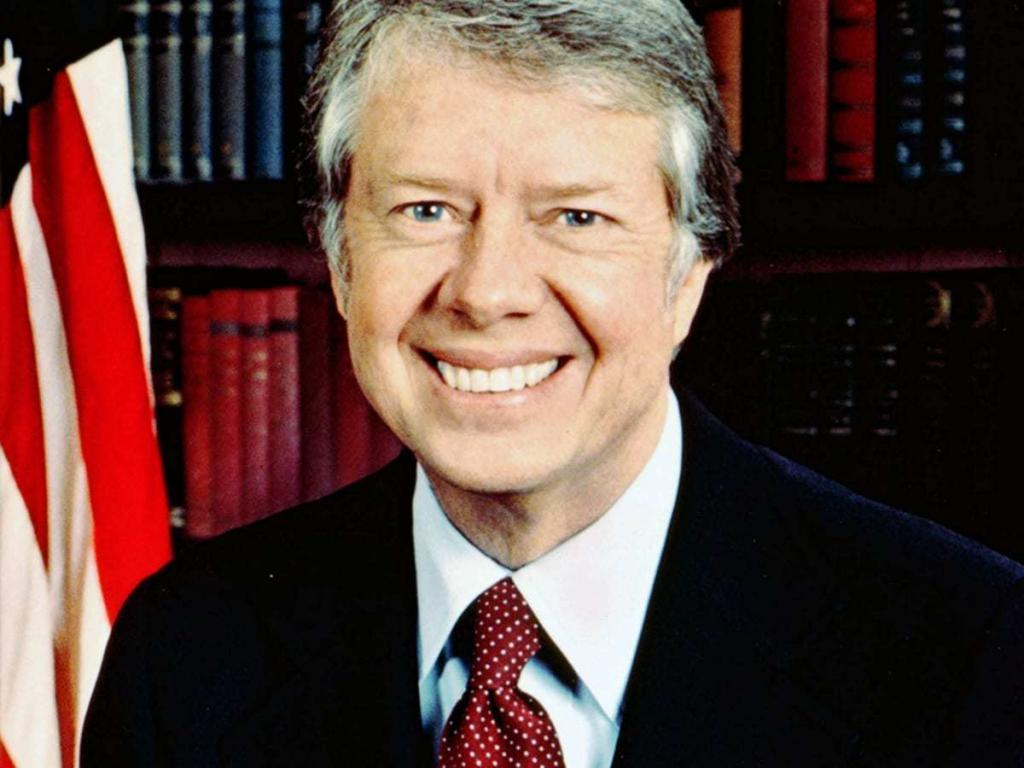
Power-Balancing and Peaceful Relations in the Middle East: Jimmy Carter and Military Aircraft Sales

The McDonnell-Douglas F-15 Eagle

President Carter’s foremost achievement in the Middle East is widely regarded as the Camp David Accords, but a critical part of the strategy of the Carter Administration in the Middle East was for the United States to be friendly with all the Middle Eastern nations that they could. After all, OAPEC (Organization of Arab Petroleum Exporting Countries) had flexed its economic muscle in October 1973 with an oil embargo in response to the Nixon Administration and other nations that supported Israel in the Yom Kippur War, the US shipment of arms having been credited with saving the nation. This produced an oil shock in the United States that resulted in oil shortages and higher prices and ended in March 1974. The US thus sought to find ways to improve their relations with Arab nations while continuing their historic support for Israel. One of these ways was through military sales.

Israel had asked the Carter Administration in early 1978 to sell it 25 McDonnell-Douglas F-15 Eagles, but the Administration only agreed to 15 as well as 75 F-16s, which were less powerful models of military aircraft. Egypt was to get 50, and Saudi Arabia 60 F-15s, the total sale amounting to $4.8 billion (Hovey). Israel had previously been sold 25, so their total arsenal of F-15s would stand at 40 by 1981, when deliveries were to occur. The Carter Administration had in mind a balance of power in the Middle East with the inclusion of Saudi Arabia and Egypt. However, this was before the Camp David Accords and advocacy groups for Israel saw this arrangement as on net against its interests, fearing that Egypt and Saudi Arabia would use their F-15s against Israel, and campaigned against it. How the politics of the Middle East looked in 1978 as compared to today is a marked contrast; the foremost critic of Israel in the Senate at the time was North Carolina’s Jesse Helms (he would change his tune after the 1984 election), while liberals tended to be the strongest defenders of Israel. Liberal Republican Lowell Weicker of Connecticut issued a scathing critique of this new approach in May 1978, accusing Carter’s national security advisor Zbigniew Brzezinski of exchanging a “balance of power” approach for a “world order” approach, and that Jews were an obstacle to this, darkly warning that “We know from history that time and again, when national leaders ran into difficulties, they found it convenient to blame their problems on the Jews. And we know what were the results” (Wald). However, Carter had more to contend with on his own side of the aisle in opposition. Senator Daniel Patrick Moynihan (D-N.Y.), for instance, commented that “It certainly seems to be an ill‐timed intrusion into the peacemaking process” (Hovey). This measure also met the total opposition of Rep. Clarence Long (D-Md.), chairman of the House Appropriations subcommittee on foreign operations.

Opponents introduced Senate Continuing Resolution 86 to disapprove of the sale, and there was considerable support for the resolution. In response, President Carter wrote a letter to the Senate, urging them to accept the deal, arguing, “The long-term interests of Israel are served by the proposed sales to Egypt and Saudia Arabia. It is in Israel’s interest to encourage the forces of moderation in the Middel East, and to promote their close relationship with the United States. It would not serve Israel’s interest if we were to fail to keep bi-partisan commitments, made by the prior Administration as well as by mine, to provide aircraft for the defense of Saudi Arabia. It would be against Israel’s interest if moderate nations are brushed aside by the United States, opening vast possibilities for the intrusion of hostile influences” (Carter).

On May 15, 1978, the Senate voted on the resolution disapproving of the sale, and they were persuaded of the Carter Administration’s position, with the resolution failing 44-54 (D 33-27; R 11-26; I 0-1). The conservative Americans for Constitutional Action counted a “yea” on this resolution as against their position while the liberal Americans for Democratic Action counted a “yea” as for their position. This was one issue in which conservatives and the Carter Administration were in accord, with Senate conservatives by and large backing the sale, and even some normally quite liberal people went to bat for Carter, including Maine’s Edmund Muskie and South Dakota’s George McGovern. Senator John J. Sparkman (D-Ala.), the aging chairman of the Committee on Foreign Relations and 1952 candidate for vice president, came to the sale’s defense. However, a young Joe Biden of Delaware, who had been the first of the Democratic senators to endorse Jimmy Carter in the 1976 primary, voted for the resolution, as did Frank Church of Idaho, who would succeed Sparkman as chairman and had been a strong supporter of the Panama Canal Treaties. Neither Egypt nor Saudi Arabia would use their planes to attack Israel, as opponents of the sale had feared as a possibility, and Israel would make great use of F-15s in military operations. The Reagan Administration, interestingly enough, would have a similar controversy surrounding military aircraft sales to the Middle East only three years later, and would have an even tougher battle on the matter. However, that’s a post for another time.

References

Carter, J. (1978, May). Letter to Members of Congress on Middle East Arms Sales. Jewish Virtual Library.

Retrieved from

https://www.jewishvirtuallibrary.org/president-carter-letter-to-members-of-congress-on-middle-east-arms-sales-may-1978#google_vignette

Hovey, G. (1978, February 15). U.S. Plans First Jet Sale to Cairo, Reduces Israeli Order for Craft; Saudis Get 60. The New York Times.

Retrieved from

To Agree to S. Con. Res. 86, The Resolution Expressing Disapproval of the President’s Proposal to Sell Aircraft and Related Defense Articles to Egypt, Israel, and Saudi Arabia. Govtrack.

Retrieved from

https://www.govtrack.us/congress/votes/95-1978/s797

Wald, M.L. (1979, September 23). Weicker Still Jousting With All Comers. The New York Times.

Retrieved from

Jimmy Carter’s Most Controversial Achievement: The Panama Canal Treaties

In 1903, the US sought to carve an interoceanic canal in Central America, and negotiated the Hay-Herran Treaty with Colombia, which at the time had Panama as a province. However, the Colombian legislature rejected the treaty, and the US subsequently gave support to the cause of Panamanian independence, which was declared that year and recognized by the US, resulting in the Hay-Bunau-Varilla Treaty, which granted the US the rights to a canal zone in perpetuity, and Panama getting $10 million from the US as well as an annual rental payment. The Canal Zone that resulted was an American enclave in the otherwise sovereign nation of Panama, and tensions rose between Canal Zoners and Panamanians over the next sixty years, and this resulted in two more treaties in 1936 and 1955.

Cold War tensions in Central and South America changed the political equation, and on January 9, 1964, an anti-American riot occurred at the canal after a scuffle between American and Panamanian high school students and Canal Zone police resulted in the tearing of a deeply symbolic Panamanian flag. The matter of who instigated the scuffle is a subject of dispute to this day. The riot resulted in the deaths of 4 US soldiers and at least 22 Panamanians. One of the deaths of the soldiers was accidental, and among the Panamanian deaths, some were killed by Canal Zone police after demonstrators threw rocks in response to tear gassing, but at least six were killed in a fire set by Panamanian rioters. This event resulted in the Panamanian government breaking off diplomatic relations with the US, to be renewed only when negotiations were opened for a new treaty regarding the Panama Canal, and President Johnson started negotiations. Although an agreement on three treaties was reached in 1967, political uncertainty in Panama resulted in a setback. The talks, however, continued during the Nixon and Ford Administrations. Secretary of State Henry Kissinger advised President Ford that “If these [Canal] negotiations fail, we will be beaten to death in every international forum and there will be riots all over Latin America” (Department of State). Gerald Ford was thus in favor of relinquishing the Panama Canal during the 1976 campaign. However, Jimmy Carter signaled opposition at the time, pledging not to surrender “practical control of the Panama Canal any time in the foreseeable future” (Department of State). Despite Carter’s initial opposition, his advisors were for it, and they ended up convincing him to be for it too.

The Carter Administration finalized the talks with Panama, signing two treaties on September 7, 1977. The first was that the 1903 treaty was to be scrapped, that the Canal Zone would cease to exist as a separate entity on October 1, 1979, and that the US would turn over control of the Panama Canal by December 31, 1999. The second was that the Panama Canal would be neutral and that the US would have the authority to defend its neutrality with military force. Thus, the US sought to ensure instead of ownership in perpetuity, use in perpetuity.

Carter managed to get the support of Senate Majority Leader Robert Byrd (D-W.V.) and Senate Minority Leader Howard Baker (R-Tenn.). For both men, neither among the staunchest partisans in their respective parties, this was an early test of their leadership abilities, as this was the first session of Congress that both men were their party leaders. As Byrd would recount, it was his “trial by fire” (U.S. Senate). Baker definitely had a lot more to lose; he was up for reelection in 1978, and he had presidential aspirations for 1980. Byrd, on the other hand, had been reelected in 1976. The political establishment of Washington faced major headwinds over this issue; 38 senators signaled their opposition to the Panama Canal Treaty, and public opinion was against, with only 23% of Americans supporting while 50% opposed. Ronald Reagan strongly opposed the treaties, famously stating, “We bought it, we paid for it, it’s ours, and we’re going to keep it” (Lindsay). He had also used this issue against Gerald Ford in the 1976 Republican primary, and Reagan had come close to winning. The Senate’s top opponent was James B. Allen (D-Ala.), an ally of George Wallace who frequently championed conservative causes and had even received one vote for vice president at the 1976 Republican National Convention. Senator Strom Thurmond (R-S.C.) declared that “The loss of this canal would contribute to the encirclement of the United States” (Department of State). Indeed, conservative legislators were suspicious of Panamanian dictator Omar Torrijos, who was thought to be favorable to communism.

Although 38 senators signaled their opposition to the Panama Canal Treaty, Democrat Ed Zorinsky, the first to be elected to the Senate from Nebraska since the Great Depression, indicated his private support for the treaty, but that Nebraskans were strongly opposed and that he would only vote for it if President Carter could convince Nebraskans to support it. Carter, Byrd, and Baker proceeded to lobby senators, and for the first time in the Senate’s history, the proceedings of the Senate for the treaty debate were live on radio in an effort to educate the public on the treaty (U.S. Senate). They also got support from a few unexpected people: famously conservative actor John Wayne as well as National Review’s William F. Buckley Jr. came out in favor of the treaties. Wayne was a friend of General Omar Torrijos, and accused Reagan of misinforming people in his arguments (Lindsay). One of the senators who played a significant role in trying to shape the treaty in the Senate was Dennis DeConcini (D-Ariz.). Arizona didn’t typically elect Democrats, and DeConcini’s election in 1976 had been the product of an unusually bitter Republican primary. He thus sought to add language that would make his vote in favor easier for him to explain to his conservative constituents, and proposed a reservation giving the United States the explicit right to use military force to defend the Panama Canal, which threatened Panamanian support for the treaty. Ultimately, this reservation was adopted but with language added that nothing in the treaty was to be “interpreted as a right” of intervention in the domestic affairs of Panama (Time Magazine). Senator Ed Brooke (R-Mass.) sought and got some minor technical reservations to the treaty, winning his vote. A senator with a bit of a different angle on this matter was James Abourezk (D-S.D.). Abourezk, who was staunchly liberal, was not actually against the treaty, but wanted to make a deal with President Carter that he would vote for the treaty if he would veto a bill deregulating natural gas, but Carter was not inclined to be cutting deals (Time Magazine). A senator the Carter Administration hotly pursued was California’s Republican S.I. Hayakawa. Hayakawa was an interesting fellow to say the least, and he had in his 1976 campaign said regarding the canal that we “stole it fair and square” (Lindsay). However, he turned out to be persuadable and Carter buttered up his ego by voicing an eagerness to consult Hayakawa on foreign policy regularly. He came to support the treaties, and, contrary to a budding consultative partnership forming, neither man spoke to the other again. One senator who was in a difficult position was Byrd’s West Virginia colleague, Jennings Randolph. Randolph was well into his seventies, and he was facing a tough reelection, with Republicans having recruited their strongest candidate yet against him in Governor Arch Moore. He was one of three or four senators would only vote for if his vote was needed, and it turns out it wasn’t. He would narrowly survive his reelection in 1978. The vote on the Neutrality Treaty on March 16th was 68-32 (D 52-9; R 16-22; I 0-1).

https://voteview.com/rollcall/RS0950702

This would be followed up with an identical vote for the Panama Canal Treaty on April 18th. This was one more vote than was needed to ratify, and although this vote was close, the pro-side actually had three to four more senators they could have flipped if their votes were needed. This would be Senator Allen’s last battle; he died less than two months after Senate ratification of a heart attack on June 1st.

The Fight Over Funding and Consequences for Pro-Treaty Senators

This was a tough vote, and the battle wasn’t over. Congress had to approve funds to implement the Panama Canal Treaties, and by the time Congress was considering the measure, a midterm had occurred. While it wasn’t too shabby for Carter and the Democrats given the history of midterms, he nonetheless faced a less friendly Congress, and there had been senators who lost reelection at least in part over their vote for the Panama Canal Treaties. These included Democrats Floyd Haskell of Colorado, Dick Clark of Iowa, William Hathaway of Maine, Wendell Anderson of Minnesota, and Thomas J. McIntyre of New Hampshire. Republican Clifford Case of New Jersey, long a frequent dissenter from Republican positions, lost renomination to anti-tax activist Jeffrey Bell. This would also contribute to the Republican sweep of the Senate in 1980, with pro-treaty senators Herman Talmadge of Georgia (although his segregationist past and his censure for ethics violations hurt him more), John Culver of Iowa, John A. Durkin of New Hampshire, and Robert B. Morgan of North Carolina. Perhaps the most notable loss among the Democrats up for 1980, though, was Frank Church of Idaho, who had been the floor manager of the treaties and lost to Congressman Steve Symms, an ultra-conservative who was critical of the treaties. Minority Leader Howard Baker (R-Tenn.), however, managed to handily win his bid for a third term in 1978, but his leadership on the Panama Canal Treaties cost him any hope of winning a Republican nomination for president. The vote to implement the Panama Canal Treaties lacked the need for the 2/3’s majority the treaties had, and indeed it fell just short of 2/3’s when the Senate voted for it 63-32 on September 25, 1979. However, it also had to be approved by the House unlike with the treaties, and the House was a bit less persuadable. Congressman John Dingell (D-Mich.), for instance, was far from receptive, stating, “We in the House are tired of you people in the State Department going to your tea-sipping friends in the Senate. Now you good folks come up here and say you need legislation [to implement the treaties] after you ignored the House. If you expect me to vote for this travesty, you’re sorely in error” (Lindsay). Adoption of the conference report was on a narrower margin of 232-188 the following day, with President Carter signing the law on the day after. Carter said in his statement on signing the Panama Canal Act into law that the treaties “express the commitment of the United States to the belief that fairness, and not force, should lie at the heart of our dealings with the nations of the world” (The American Presidency Project).

Although a staunch opponent of the Panama Canal Treaties had been elected to the presidency in Ronald Reagan, he did not attempt to undo the treaties…he had enough on his plate in Central America with the situations in Nicaragua and El Salvador. Although many analysts regard the Panama Canal Treaties as a success given the fears of what would happen if they were not ratified, there are still issues surrounding the canal, notably China’s growing influence through the subsidiary of a Chinese business managing two ports and Chinese businesses funding the construction of a new bridge over the canal.

References

Lindsay, J.M. (2011, March 16). TWE Remembers: The Fight over the Panama Canal Treaties. Council on Foreign Relations.

Retrieved from

https://www.cfr.org/blog/twe-remembers-fight-over-panama-canal-treaties

Nation: How the Treaty Was Saved. (1978, May 1). Time Magazine.

Retrieved from

https://time.com/archive/6853512/nation-how-the-treaty-was-saved/

Panama Canal Act of 1979 Statement on Signing H.R. 111 Into Law. The American Presidency Project.

Retrieved from

https://www.presidency.ucsb.edu/documents/panama-canal-act-1979-statement-signing-hr-111-into-law

Senate Leaders and the Panama Canal Treaties. United States Senate.

Retrieved from

https://www.senate.gov/about/powers-procedures/treaties/senate-leaders-and-the-panama-canal-treaties.htm

The Panama Canal and the Torrijos-Carter Treaties. Department of State.

Retrieved from

https://history.state.gov/milestones/1977-1980/panama-canal#:~:text=One%20of%20President%20Jimmy%20Carter%27s,control%20of%20the%20Panama%20Canal.

Differing Interpretations of Jimmy Carter’s Record

Although many obituaries on Jimmy Carter are laudatory, he is generally much better regarded for his post-presidency than his presidency. President Carter had an interesting way about him in being a source of dissatisfaction for both conservatives and liberals, although considerably more for the former than the latter. While obviously liberals would prefer his policies to those of his successor, the characterization of Carter as a liberal Democrat does have some contesting from them, and dissatisfaction with Carter was sufficient for Senator Ted Kennedy (D-Mass.) to challenge him for renomination in 1980. One article that caught my eye was that from liberal columnist Timothy Noah writing for Politico, who regards labeling Carter as a liberal a mistake, and although the headline of his article seems to point to Carter being labeled a conservative, he gets labeled instead a liberal Southerner within the article. However, this seems to be considered some form of conservatism, although a lesser form than practiced by the GOP. Liberals not counting Carter as one of their own does have a degree of basis in one of the three standards I like to use in examining politicians, Americans for Democratic Action. ADA finds Carter to have embraced their position on issues 75% of the time, with him at lowest embracing their positions 63% of the time in the Senate in 1979 and at highest, the House in the same year at 90%. Although clearly backing what ADA regards as the “liberal” position 3 in 4 times is not acceptable to conservatives, it also unsatisfactory for liberals. One notable issue in which Carter sided with conservatives was in the retaining of the Hyde Amendment in 1977, a big no-no for contemporary Democrats. Interestingly, Carter by his own admission related better to Southern Democrats and Republicans than he did his liberal allies, who voted with him more (Noah). This is similar to Lyndon B. Johnson when he was Senate Majority Leader. Although he was much more with liberals in how he voted than conservatives and he would prove even more liberal in his presidency, his personal relations with liberals were testier than his chummy relations with fellow Southern Democrats. What this translates to, however, is that liberals largely get the wheat and conservatives largely get the chaff. Carter agrees with Americans for Constitutional Action, ADA’s conservative counterpart, 13% of the time. However, there are a few interesting aspects to this judging of Carter, including on three occasions ADA and ACA taking the same position on an issue! This occurred twice for the Senate in 1980, when both ADA and ACA objected to Senator Dan Moynihan’s (D-N.Y.) proposal for federal funds for private school tuitions and supported Senator Jake Garn’s (R-Utah) amendment maintaining the status quo for housing instead of a new housing subsidy program. President Carter was on the same page as both organizations. In the House that year, both ADA and ACA approved of Representative Samuel Devine’s (R-Ohio) motion to recommit and thus kill the bill establishing the Energy Mobilization Board. This board, if put in place, would have empowered the president to override environmental laws on a federal, state and local level. While overturning environmental laws might appeal to conservatives eager to promote development for economic growth, the full implications of what this could establish for federalism (meaning proper relations between the federal government and states) became clear to most by 1980. Liberal Democrats found this objectionable for two reasons. The first is the environmental angle, and the second was the very real possibility at the time that came true that the next president would be Ronald Reagan. Contrary to the position of both organizations, Jimmy Carter opposed killing the bill. I always find these incidents in which on major issues the most conservative and the most liberal people align to be fascinating. Those weren’t the only votes ADA counted that are questionable from an ideological standpoint. Counting the vote for lifting controls on gas by 1985 is questionable given that many conservatives opposed the proposal as too long retaining controls, and senators from the oil-rich Louisiana, Oklahoma, and Texas were against. If anything, this vote is a vote of the political center against the strong left and right. It should also be noted that DW-Nominate gives Jimmy Carter a score of -0.504, which is quite liberal indeed! However, it should be noted that I’ve noticed that the ideological bent of presidents does seem exaggerated by this standard and this is because presidents don’t weigh in on every or sometimes even a lot of issues that Congress votes on that have ideological salience. I will proceed with examining Carter’s stances on the issues of his time.

Foreign Policy

Jimmy Carter was a supporter of the postwar consensus surrounding foreign aid, backing foreign aid bills and he also sought to present to the world you might say a kinder, gentler United States. He supported sanctions for the white minority ruled Rhodesia in 1977 and opposed lifting them to support the government of the black majority government of Bishop Abel Muzorewa elected in 1979, opening the path for China-backed Robert Mugabe’s election in an election fraught with violence in 1980. Mugabe, although considered a symbol of Pan-Africanism, brought Zimbabwe to ruin with his economic and social policies. Although many people point to the Camp David Accords, normalizing relations between Israel and Egypt, as a great accomplishment of the Carter Administration, the more consequential action of his was the Panama Canal Treaties. The first treaty scrapped the old 1903 treaty that granted the US rights in perpetuity over the canal, instead turning over control to Panama by December 31, 1999, and the second was the neutrality treaty, which mandated that the canal be neutral and that the US was authorized to militarily intervene to enforce neutrality. Carter also ceased support to the Somoza regime in Nicaragua, which allowed the Marxist Sandinistas to have a successful coup and he then supported providing aid to the new government.  Carter also dropped support for the Shah of Iran in the fall of 1978 after Black Friday, in which 88 religious demonstrators were gunned down for failing to disperse, and the national strike of October which shut down the nation’s petroleum industry. Unlike Rhodesia, Nicaragua, and the Panama Canal Treaties, there was no Congressional vote regarding the situation in Iran.

Domestic Policy

Carter was fairly strong with liberals on domestic policy. He supported the creation of the Department of Education, opposed weakening an increase in the minimum wage, opposed maintaining the requirement that food stamp recipients pay for part of it, supported a windfall profits tax, supported retaining the 1969 credit control law, and backed conservation measures reserving lands in Alaska, California, and Idaho for national parks and wildlife refuges. Carter also backed a set of mandatory and voluntary price controls for the healthcare industry in response to inflation, which died in Congress. He opposed conservative efforts to end price controls on natural gas in 1977 on new onshore that year and new offshore by 1982, instead supporting a compromise proposal the following year to end price controls on all newly discovered gas by 1985. Although Carter indicated support for budget reductions, he opposed several conservative proposals at budget reduction and budget balancing. Although Carter supported trucking deregulation and opposed an effort by Senator Warren Magnuson (D-Wash.) to weaken it with an amendment placing a “burden of proof” on applicants for a trucking certificate to demonstrate that their proposed service works towards present or future public needs, he also opposed allowing Congress to check the executive on this matter by having the ability to vote to overturn regulations that might stem from the legislation. Carter was also opposed to efforts to end gas rationing and supported bailing out the Chrysler Corporation. Carter did oppose a consumer co-op bank bill in 1977, but backed a subsequent proposal. Despite being portrayed as a fiscal conservative, Carter backed Appropriations Committee Chairman Robert Giamo’s (D-Conn.) budget for fiscal year 1981 increasing the deficit.

Jimmy Carter on Civil Rights and Women’s Rights

Carter supported strengthening the fair housing act in a way that gave authority for enforcement to administrative law judges instead of jury trials and supported the Equal Rights Amendment, with the latter he signed into law the measure extending the deadline for its ratification to 1982, but no additional states ratified between then and the deadline. Ronald Reagan had supported the ERA while California’s governor but by 1980 he had turned against it, and Reagan would sign a measure strengthening the fair housing act that provided for jury trials for violations in 1988.

Jimmy Carter on Military Issues

On military issues, Carter had a mixed record. He opposed the construction of five B-1 Bombers and managed to get support for this from some politicians who were usually defense hawks such as Armed Services Committee chairman John C. Stennis (D-Miss.) and Appropriations Committee chairman George Mahon (D-Tex.). Carter tended to oppose stronger measures to cut military spending, including Rep. Ted Weiss’s (D-N.Y.) 1977 attempt to delete all funds for the neutron bomb and Rep. Paul Simon’s (D-Ill.) 1980 effort to delete funds for the MX Missile Basing System.

Jimmy Carter was more liberal than Ronald Reagan on every issue during the 1980 election…except the institution of the Selective Service. Carter was receptive to arguments that this measure was needed in case the US had to mobilize for a full-scale war. Although instituting the selective service is the conservative position, there were numerous conservatives who opposed it as opening the door to the government viewing the nation’s youth as their property, and Reagan was among them. Liberals were opposed to this measure, not wanting to potentially bring back the draft, with many of the Vietnam War doves against. However, after the 1980 election he would decide instead to form a commission to investigate the issue and then he would decide whether to continue supporting ending it. They advised him to keep the selective service, and he did. In 1978, Carter backed sales of aircraft and other munitions to Egypt, Israel, and Saudi Arabia, but supporters of Israel were opposed to this measure as on balance benefiting its at the time enemies. Indeed, the original arrangement had Israel being sold more arms and Egypt and Saudi Arabia were not in the arrangement. The Senate rejected the effort to overturn this sale, the effort being supported by ADA and opposed by ACA. Conservatives at this time supported an approach to the Middle East that was comprehensive…or backing both Israel and Islamic nations in the region.

I think that with this I have largely if not entirely dismantled the notion that Carter was not a liberal. Perhaps you could say he was a moderate liberal as that’s what ADA puts him at, but ACA and DW-Nominate find him to be considerably stronger in liberalism than Timothy Noah gives him credit.

References

ADA’s 1977 Voting Record. Americans for Democratic Action.

Retrieved from

ADA’s 1978 Voting Record. Americans for Democratic Action.

Retrieved from

ADA’s 1979 Voting Record. Americans for Democratic Action.

Retrieved from

ADA’s 1980 Voting Record. Americans for Democratic Action.

Retrieved from

Carter, James Earl, Jr. Voteview.

Retrieved from

https://voteview.com/person/99906/james-earl-carter-jr

Noah, T. (2024, December 30). Jimmy Carter Wasn’t a Liberal. Politico.

Retrieved from

https://www.politico.com/news/magazine/2024/12/30/jimmy-carter-conservative-00084028

Jimmy Carter at 100: How He Was Ideologically Viewed During His Presidency


On October 1st, 1924, Jimmy Carter was born, and he still lives today. This makes him the first centenarian president in American history. An interesting minor coincidence is that on the day Carter turned 100 the debate between Walz and Vance was occurring. Like Carter’s running mate Mondale, Walz is from Minnesota. Maybe that’s a good portend for Democrats in this election? I don’t know. But what I do know is how Carter was seen ideologically during his presidency.

Unfortunately, I cannot at this time produce a proper Americans for Democratic Action rating for him, and this is because ADA’s 1979 page lacks descriptions of the first four Senate votes. I certainly can find out what those are, but not in time to post this before midnight PST. Liberals from what I’ve seen so far seem to regard him as a moderate liberal, and sometimes have counted as against the liberal position measures that most Republican conservatives went against. For instance, the 1978 administration-backed proposal to deregulate natural gas by 1985. This was unsatisfactory in its slowness for conservative Republicans, and deregulation itself of natural gas was unsatisfactory to liberals. Thus, Carter’s liberalism may be lessened in ways that conservatives wouldn’t agree with. I will also note later on in this post some votes on which ADA actually sided with Americans for Constitutional Action! DW-Nominate scores him a -0.504, which is pretty solidly liberal and places him to the left of many, many Democrats of his day (and today).

As for ACA…

If Jimmy Carter’s official positions on votes were to be counted as votes, he would score for his presidency a 13%. I can offer far more details here, because I have already compiled ACA votes for the Carter era. Areas in which Carter took a liberal position on issues were:

. $23.3 billion in federal programs for anti-recession purposes, which included public works financing (1977).

. Weakening the Hatch Act through the Federal Employees’ Political Rights Act, permitting greater allowances for participation in politics by Federal employees (1977).

. Opposing an effort by Congressman Beard (R-Tenn.) to prohibit VA funds to benefit individuals upgraded by his special discharge program that allowed certain individuals discharged as less than honorable to be upgraded (1977).

. Opposed a House and Senate effort to sunset price controls on natural gas, for new onshore in 1977 and new offshore in 1982 (1977).

. Supported House and Senate efforts to delete funds for five B-1 Bombers (1977).

. Opposed Congressman Erlenborn’s (R-Ill.) amendment for a more gradual increase in the federal minimum wage than the committee bill (1977).  

. Supported Majority Leader Byrd’s (D-W.V.) motion to table the Allen (D-Ala.) resolution expressing the opposition of the Senate to pardoning draft resisters and evaders (1977).

. Supported his nomination of Paul Warnke as chief negotiator of the Strategic Arms Limitation talks with the USSR. Warnke had previously called for reducing military spending by a third, and his nomination was a clear signal of continuing détente (1977).

. Opposed Senator Curtis’s (R-Neb.) amendment keeping the requirement that food stamp recipients pay for part of their cost (1977).

. Supported Majority Leader Byrd’s (D-W.V.) motion to end debate on the bill permitting public financing of Senate campaigns (1977).

. Supported an increase in the federal minimum wage (1977).

. Opposed Congressman Breaux’s (D-La.) substitute for outer continental shelf legislation that grants the states more money and limits government intervention in exploratory drilling (1978).

. Supported the proposed creation of the Office of Consumer Representation for consumer protection (1978).

. Supported deleting Senator Stennis’s (D-Miss.) motion to rescind funds for the production of two additional B-1 Bombers (1978).

. Supported the enactment of the Panama Canal Treaties, as well as supported tabling an effort to authorize the disposal of all US property before the treaties took effect (1978).

. Supported Appropriations Committee Chairman Mahon’s (D-Tex.) motion for the House to rescind funds for the production of three B-1 Bombers (1978).

. Opposed Congressman Young’s (R-Alaska) proposal to permit Alaska to choose lands to be conserved under the Alaska Lands bill and to remove five million acres from coverage (1978).

. Opposed Congressman Stratton’s (D-N.Y.) amendment to maintain troops at a minimum of 26,000 in South Korea (1978).

. Supported up to $1.65 billion in federal loan guarantees to New York City (a bailout, in other words) (1978).

. Supported Senate and House efforts to retain indirect U.S. Aid to Uganda, Cambodia, Laos, and Vietnam (1977, 1978).

. Opposed Congressman Hansen’s (R-Idaho) amendment prohibiting funds for Panama in the Foreign Aid Appropriations bill (1978).

. Supported an alternative version of the Consumer Cooperative Bank bill (1978).

. Opposed Senator Lugar’s (R-Ind.) proposed reduction in funding of food stamps by $250 million (1978).

. Opposed Congressman Kramer’s (R-Colo.) amendment reaffirming the position the US took in the 1955 mutual defense treaty regarding aggression against Taiwan (1979).

. Opposed an anti-busing amendment to the U.S. Constitution (1979).

. Supported the bill implementing the Panama Canal Treaties (1979).

. Supported the creation of the Department of Education (1979).

. Supported the Emergency Energy Conservation Act (1979).

. Opposed Congressman Courter’s (R-N.J.) amendment to prohibit funds for controlling the price of gasoline (1979).

. Supported $1.5 billion in federal loan guarantees to be matched by $2.1 billion from other sources to bail out the Chrysler Corporation (1979).

. Opposed Senator Percy’s (R-Ill.) amendment declaring that aggression against Taiwan by China would be considered a threat to U.S. security interests (1979).

. Opposed Senator Stennis’s (D-Miss.) effort to end sanctions against Zimbabwe-Rhodesia (1979).

. Opposed Senator Helms’s (R-N.C.) effort to retain a spending ceiling on food stamps for fiscal 1980-81 (1979).

. Supported Majority Leader Byrd’s (D-W.V.) tabling of Sen. Armstrong’s (R-Colo.) amendment for a higher military pay raise (1979).

. Supported the bill imposing a windfall profits tax (1979, 1980).

. Opposed Congressman Broyhill’s (R-N.C.) motion to provide for a legislative veto for Federal Trade Commission regulations (1980).

. Opposed Congressman Symms’s (R-Idaho) limited substitute for the Idaho Wilderness bill (1980).

. Supported Congressman Obey’s (D-Wis.) increasing in funds of domestic programs and oil tax credit reform to raise funds for the increase (1980).

. Opposed Congresswoman Holt’s (R-Md.) proposed transfer of funds from domestic programs for increases in defense spending (1980).

. Supported the International Development Bank bill (1980).

. Supported extending the debt ceiling at $879 billion through June 30, 1980 (1980).

. Supported Majority Leader Wright’s (D-Tex.) amendment providing $425 million in aid to Nicaragua (1980).

. Opposed Congressman Sensenbrenner’s (R-Wis.) motion to delete administrative (as opposed to judicial) enforcement of fair housing laws (1980).

. Supported Congressman Giaimo’s (D-Conn.) budget resolution (1980).

. Opposed Congressman Levitas’s (D-Ga.) amendment permitting a Congressional veto of trucking regulations (1980).

. Opposed Congressman Pritchard’s (R-Wash.) amendment reducing by $200 million funds for the Tennessee-Tombigbee Waterway (1980).

. Supported the Defense Production Act amendments, providing for funds for synthetic and alcohol fuels as well as the creation of a conservation bank (1980).

. Opposed Congressman Devine’s (R-Ohio) motion to kill the proposed Energy Mobilization Board (1980). Note: ADA supported this motion too!

. Opposed disapproving of his gasoline rationing plan (1980).

. Opposed Senator Schmitt’s (R-N.M.) amendment permitting a one-house veto of Federal Trade Commission regulations (1980).

Opposed Senator Dole’s (R-Kan.) motion to recommit the windfall profits tax bill for hearings (1980).

. Opposed Senator Hollings’s (D-S.C.) motion to table Senator Nelson’s (D-Wis.) proposed deletion of $2 billion from defense spending and $400 million in interest payments, transferring the funds to domestic priorities (1980).

. Opposed Senator Armstrong’s (R-Colo.) amendment to repeal the Credit Control Act of 1969 (1980).

. Supported Senator Hollings’s (D-S.C.) budget resolution (1980).

. Opposed Senator Stone’s (D-Fla.) motion to block funds for military aid to Nicaragua (1980).

Areas in which Carter took a conservative position included:

. Opposing the National Consumer Cooperative Bank bill, which would have provided $750 million for a bank and a self-help development fund to issue loans to consumer cooperatives and to assist inner-city residents to start consumer cooperatives respectively (1977).

. Opposed Congressman Weiss’ (D-N.Y.) amendment blocking funds for research and development of neutron bombs (1977).

. Opposed the emergency farm bill for wheat, corn, and cotton (1978).

. Opposed a resolution disapproving his sale of jet fighters to Middle Eastern nations (1978).

. Supported outlining U.S. policy on settling the dispute between Greece and Turkey over Cyprus as part of repealing the arms embargo on Turkey (1978).

. Supported implementation of the Selective Service (1980).

. Opposed Congressman Simon’s (D-Ill.) reduction by $500 million for the MX intercontinental missile system (1980).

. Opposed Senator Magnuson’s (D-Wash.) amendment to place the burden of proof on an applicant for a trucking certificate to demonstrate that their proposed service is consistent with present or future public needs (1980).

. Supported Senator Garn’s (R-Utah) amendment to delete middle-income housing subsidies, instead having the funds go to current housing programs (1980). Note: ADA supported Senator Garn’s amendment too!

. Opposed Senator Moynihan’s (D-N.Y.) amendment to allow students in private elementary and secondary schools to receive Basic Educational Opportunity Grants of up to $750 annually (1980). Note: ADA opposed Senator Moynihan’s amendment too!

Carter was overall a liberal man who most often dissented from liberalism on matters regarding military policy. His opposition to Senator Magnuson’s burden of proof amendment serves to highlight his support for deregulation that conservatives see as a positive of his presidency.

References

Carter, James Earl, Jr. Voteview.

Retrieved from

For the votes I described, check out my posts on the ACA-Index for the 95th and 96th Congresses.