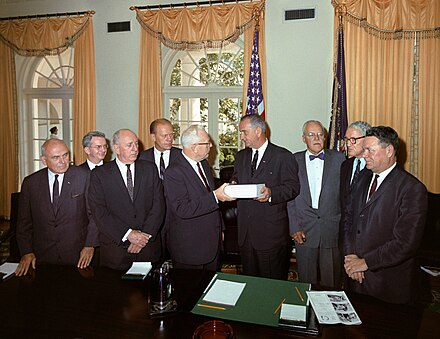
The Warren Commission presents their report to President Johnson
While today few who investigate the Kennedy assassination walk away believing that the Warren Commission was adequate, the outcome of the Warren Commission initially seemed uncontroversial. Time Magazine’s (1964) appraisal was even laudatory, “In its final form, the Commission’s report was amazing in its detail, remarkable in its judicious caution and restraint, yet utterly convincing in its conclusions. The wonder was that the commission took such a long time to complete its report but that it did so much so swiftly”. However, even within the commission itself there was a lot of disagreement despite Earl Warren getting a unanimous vote on the report. This unanimous vote papered over the fact that three of the commissioners did not agree with the single bullet theory: Richard Russell, John Sherman Cooper, and Hale Boggs. Russell mistrusted CIA testimony based on past dealings with the agency and was deeply unsatisfied with what he saw as the lack of depth with the Warren Commission’s investigation (Wilkes, 3). History would vindicate Russell’s mistrust and criticism. Furthermore, in 1970, he told The Washington Post that he believed that Oswald had encouragement to kill Kennedy and asserted that the members of the Commission “weren’t told the truth about Oswald”. Russell also reiterated that he supported the conclusion that Oswald was the assassin. Interestingly, LBJ agreed with Russell when he expressed his disbelief that a single bullet went through Kennedy and Connally (The New York Times, 1994). This wasn’t the only conclusion that Johnson doubted on the commission. He also believed, contrary to the Warren Commission’s conclusion that no conspiracies foreign or domestic were responsible for Kennedy’s assassination, that Castro had masterminded the conspiracy (Davison). Commissioner John J. McCloy, whose long career was due in part to his mastery at building consensus, also did so with the final report of the Warren Commission. Although he initially had doubts about the single bullet theory, he came around to it, siding with Allen Dulles and Gerald Ford. However, the most influential figure to dissent from the Warren Commission would be one of the people who testified as a witness, Mark Lane.
Rush to Judgment
In 1966, the consensus bubble surrounding the Kennedy assassination burst with the publication of Rush to Judgment by Mark Lane. Lane had had a short stint in the New York State Assembly as a liberal Democrat whose candidacy was endorsed by Kennedy and Eleanor Roosevelt and had publicly expressed skepticism about Lee Harvey Oswald’s guilt as far back as December 19, 1963, and subsequently twice testified before the Warren Commission. In this book, he serves essentially as the defense for Lee Harvey Oswald and challenged numerous narratives of the Kennedy assassination, including the “single-bullet theory”, questioned that Oswald was the killer of officer J.D. Tippit based on a witness testimony of the perpetrator that was inconsistent with Oswald’s appearance, and introduced witness accounts of hearing shots coming from a nearby grassy knoll. It should be noted that of the witnesses of the Kennedy assassination, less than 12% heard the shot as coming from the grassy knoll, with more reporting hearings shots either from the Texas School Book Depository or another building (National Archives, 492). Earl Warren himself did not think highly of Lane. He dismissed him as “a publicity seeker who played fast and loose with the subject” (Cray, 430-431). This view on him was bolstered by JFK assassination journalist and researcher Gene Russo. Russo found that what Lane wrote was “completely inaccurate, there were a lot of falsehoods in it…it was total fiction” and that he had been fed disinformation without his knowledge from a KGB source (The Mob Museum). Nonetheless, with the doubts that he presented to the public, Lane became the father of JFK conspiracy theories, and his aim to sow doubt over the Warren Commission’s conclusions was undoubtedly a roaring success by the 1970s. In 1976, 81% of the public did not believe that Oswald acted alone according to a Gallup poll (Swift). Lane would write a total of ten books on the subject, with the last one being Last Word: My Indictment of the CIA (2013).
Criticisms of the Commission
One of the major criticisms of the Warren Commission was that the investigation was incomplete, with numerous witnesses not interviewed and questions remaining to this day about Lee Harvey Oswald’s visit to Mexico City several weeks before the assassination. Indeed, the commission did not make a conclusion on Oswald’s motives to kill Kennedy. In Mexico City, he had visited both the Soviet and Cuban embassies in an effort to get a visa to Cuba. What Oswald said at those embassies and whether he had indicated that he wanted to kill Kennedy to them or whether he had been encouraged to do so is up for debate. Indeed, per author and researcher Philip Shenon, this was never sufficiently investigated by the CIA, FBI, or the Warren Commission. FBI Director Clarence Kelley wrote in his memoirs in 1987 that he believed that Mexico City held the key to Oswald’s motives, writing “Oswald’s stay in Mexico City apparently shaped the man’s thinking irrevocably” (Shenon). Furthermore, there was a desire to provide closure for the American public in time for the 1964 election with the conclusion that had pretty quickly been reached by FBI director J. Edgar Hoover. As Edward Jay Epstein wrote of the Warren Commission in Inquest: The Warren Commission and the Establishment of Truth (1966), “sincerely convinced that the national interest would best be served by the termination of rumors, and predisposed by its make-up and by pressure of time not to search more deeply, failed to answer some of the essential questions about the tragedy” (Wilkes, 4).
Other major criticisms of the commission stem from the testimony of the FBI and the CIA, as both organizations were seeking to cover their operations and behinds. The FBI concealed how much was known about Oswald, with Hoover testifying under oath that “there was nothing up to the time of the assassination that gave any indication that this man was a dangerous character who might do harm to the president” (Shenon). However, the Kennedy assassination was not the first time Oswald had come up on the FBI’s radar. In 1975, FBI director Clarence Kelley revealed that the FBI’s Dallas office had only days before the Kennedy assassination received a threatening letter from Oswald in response to FBI agent James Hosty’s inquiries into his wife, Marina (The New York Times, 1975). Two days after the Kennedy assassination, Hosty destroyed the letter on the orders of his superior.
The CIA did not tell the Warren Commission that they had been surveilling Oswald in Mexico City and they also omitted that they had engaged in numerous operations to try to assassinate Fidel Castro. Indeed, these multiple attempts on Castro’s life was why President Johnson suspected that Cuba was behind President Kennedy’s assassination. The presence of Allen Dulles on the Warren Commission was for the purpose of making sure that other Commissioners didn’t ask CIA operatives questions that would imperil operations.
Journalist and professor Edward Jay Epstein discovered after the Warren Commission Report’s release that of the seven commissioners, Russell, Cooper, and Boggs disagreed with the “single bullet theory”, believing that separate bullets had penetrated Kennedy’s throat and hit Governor Connally (Bickel). None of the three, however, had made secret their issues with the commission.
John Sherman Cooper publicly criticized the conclusion of the Warren Commission as “premature and inconclusive” and doubted that Kennedy and Governor Connally were hit by the same bullet, or the “single-bullet theory” and told Robert and Ted Kennedy in 1964 that he didn’t believe Oswald had acted alone (Simkin, Cooper). Cooper did, however, agree with the Warren Commission’s conclusion that Oswald was the only assassin in a 1980 interview. He said, “We’ve all said if someone could find something that we didn’t, we want it to be found because the truth is what we want. But I think all of us believe and I still believe, even after the last investigation by the House, that our decision will stand. There are some places in it which are hard to explain but every evidence pointed to Oswald as the sole assassin and no conspiracy” (Gerth).
Hale Boggs of Louisiana was critical of FBI director J. Edgar Hoover in this matter. He believed that Hoover had “lied his eyes out” to the commission (Simkin, Boggs). By the early 1970s Boggs was an overall critic of J. Edgar Hoover, and his criticisms would be bolstered by revelations about the FBI’s activities after his death. Incidentally, John Connally, whose injuries were severe enough for him to have nearly joined Kennedy, also doubted the single bullet theory.
Earl Warren suppressed key evidence from other commissioners. For instance, he was the only commissioner to see Kennedy autopsy photos and did not allow the commission to interview certain people Oswald knew in Mexico, notably an employee at the Cuban consulate in Mexico, Sylvia Duran. Warren would not hear her testimony with the rationale that the commission could not count on truthful testimony from communists, which may have shed more light on his activities there and what he was talking to the Cubans about (Andrews). However, Warren kept all but one investigator in the dark that the commission had managed to interview Fidel Castro, who denied all involvement. So much for no testimony from communists!
Gerald Ford, His Defense of the Warren Commission, and His Role
Gerald Ford would consistently defend the conclusions of the Warren Commission. On February 5, 1999, he issued the following statement, “In 1964, the Warren Commission unanimously decided:
- Lee Harvey Oswald was the assassin, and
- The Commission found no evidence of a conspiracy, foreign or domestic.
As a member of the Commission, I endorsed those conclusions in 1964 and fully agree now as the sole surviving Commission member” (UA University Archives).
He would do so until the day he died. Interestingly, in 1997 it was revealed that Ford had pushed for changing the description of where the bullet entered Kennedy from “A bullet had entered his back at a point slightly below the shoulder to the right of the spine” to “A bullet had entered the back of his neck slightly to the right of the spine”, with the final report reading, “A bullet had entered the base of the back of his neck slightly to the right of the spine” (UPI). Ford had sought to alter the description to make it higher on his body to give further credence to the “single bullet theory”. Ford regarded the change as minor, but this certainly added to the view that the single bullet theory was cooked up. What’s more, while the CIA had a man on the commission in Allen Dulles, Ford was the FBI’s man on the commission, secretly providing information to Hoover about its proceedings (Andrews).
It is entirely possible that the Warren Commission got the big picture conclusion correct that Lee Harvey Oswald acted alone in killing Kennedy, but there was an undisputably political nature to the investigation, and numerous stones were left unturned in the process. The incompleteness of the Warren Commission would result in the also flawed House Committee on Assassinations in the 1970s and the proliferation of Kennedy assassination conspiracy theories. The effort to tamp down on rumors long run completely and utterly backfired. One element that was not ruled on in the investigation, but we now have information for is Oswald’s motivation.
Motivation of Lee Harvey Oswald
I do not wish to dive too deeply into the possibility of conspiracy, as that itself would require A LOT more coverage than this post, but I do want to say that the Warren Commission was quite incomplete and this is due not only to some self-imposed limitations by Chairman Earl Warren, the FBI and CIA misleading in their testimony, and failing to ascertain a motive for Oswald. The failure to ascertain a motive and the misleading by the CIA, however, are connected.
Ever since the Warren Commission’s conclusion, a convincing motive for Oswald has since been revealed. There is clear evidence indicating that he was a staunch supporter of Castro’s communist regime in Cuba, and this was a known fact to the Warren Commission. Indeed, he was a member of the Fair Play for Cuba Committee and there is a photograph that exists of him passing out literature from said committee in New Orleans. He also invented the New Orleans branch of the Fair Play for Cuba Committee and despite his claims of having 35 members, he was the only member. Oswald had engaged in activities he’d hoped would please the Cubans, including taking a shot at the right-wing activist General Edwin A. Walker.
Seven weeks before the Kennedy assassination, Oswald visited the Cuban embassy in Mexico, and he went to the Soviet and Cuban embassies, including meeting the KGB’s chief of assassinations in the region. The CIA as well as Cuban intelligence were monitoring him, and the Cubans had been keeping tabs on him since the past year. It has since been alleged, particularly by author and journalist Gus Russo, who wrote in his book on the Kennedys and Castros, Brothers in Arms, that representatives of the Cuban government egged him on to kill Kennedy, although they did not act beyond that. LBJ, as I noted earlier, thought that the Cubans were behind the assassination and feared that if the American public came to that conclusion that they would demand vengeance, potentially resulting in nuclear war. This, plus the CIA not wanting the public to know about its multiple operations to assassinate Castro, were reasons for the possibility of conspiracy to be tossed and for the CIA to mislead the Warren Commission. Furthermore, the FBI and CIA wished to avoid potential blame for failing to prevent President Kennedy’s assassination.
References
Andrews, E. (2013, November 18). 9 Things You May Not Know About the Warren Commission. History Channel.
Retrieved from
https://www.history.com/news/9-things-you-may-not-know-about-the-warren-commission
Assassination Expert Says Cubans Encouraged Oswald to Kill JFK. (2021, November 22). The Mob Museum.
Retrieved from
https://themobmuseum.org/blog/assassination-expert-says-cubans-encouraged-oswald-to-kill-jfk/
Bickel, A. (1966, October). The Failure of the Warren Report. Commentary Magazine.
Retrieved from
Bush, B. (2024, September 24). 60 years on, Warren Commission witness testimony adds intrigue to story of JFK death. The Columbus Dispatch.
Retrieved from
Cray, E. (1997). “Facts So Simple”. Chief justice: a biography of Earl Warren. New York, NY: Simon & Schuster.
Davison, P. (1997, October 11). LBJ thought Cuba had Kennedy killed. The Independent.
Retrieved from
https://www.the-independent.com/news/lbj-thought-cuba-had-kennedy-killed-1235502.html
Erickson, M. (2013, November 8). JFK: Why JFK’s assassination has spawned so much speculation. The State Journal-Register.
Retrieved from
F.B.I. Says Oswald Threatened Agent. (1975, August 31). The New York Times.
Retrieved from
Gerald Ford Reaffirms Warren Commission Conclusion That Oswald Assassinated JFK. UA University Archives.
Retrieved from
Gerth, J. (2013, November 22). Cooper said serving on Warren Commission “too personal”. The Courier-Journal.
Retrieved from
Johnson Said He Doubted Finding on Assassination. (1994, April 17). The New York Times.
Retrieved from
Kaplan, R. (2013, October 27). New book reveals how much FBI, CIA knew about Oswald before Kennedy assassination. CBS News.
Retrieved from
Report: Ford edited JFK report. (1997, July 3). UPI.
Retrieved from
https://www.upi.com/Archives/1997/07/03/Report-Ford-edited-JFK-report/9274867902400/
Sabato, L.J. (2013, November 21). Is there more to JFK assassination? CNN.
Retrieved from
https://www.cnn.com/2013/11/15/opinion/sabato-jfk-assassination/index.html
Senator Clarifies His View On Oswald. (1970, January 20). The New York Times.
Retrieved from
Shenon, P. (2015, February 2). What the Warren Commission Didn’t Know. Politico.
Retrieved from
https://www.politico.com/magazine/story/2015/02/warren-commission-jfk-investigators-114812/
Shenon, P. (2015, March 18). What Was Lee Harvey Oswald Doing in Mexico? Politico.
Retrieved from
https://www.politico.com/magazine/story/2015/03/jfk-assassination-lee-harvey-oswald-mexico-116195/
Simkin, J. (1997). John Sherman Cooper. Spartacus Educational.
Retrieved from
https://spartacus-educational.com/USAcopperJS.htm
Simkin, J. (1997). Thomas Hale Boggs. Spartacus Educational.
Retrieved from
https://spartacus-educational.com/JFKboggs.htm
Special Section: The Warren Commission Report. (1964, October 2). Time Magazine.
Retrieved from
https://time.com/3422341/the-warren-commission-report/
Swift, A. (2013, November 15). Majority in U.S. Still Believe JFK Killed in a Conspiracy. Gallup.
Retrieved from
https://news.gallup.com/poll/165893/majority-believe-jfk-killed-conspiracy.aspx
Views and Dissent of Members of the Committee. National Archives.
Retrieved from
https://www.archives.gov/research/jfk/select-committee-report/part-4.html
Wilkes, D.E. (2003, November 8). Sen. Richard Russell and the Great American Murder Mystery. University of Georgia School of Law.
Retrieved from

 Mad Politics: The Bizarre, Fascinating, and Unknown of American Political History