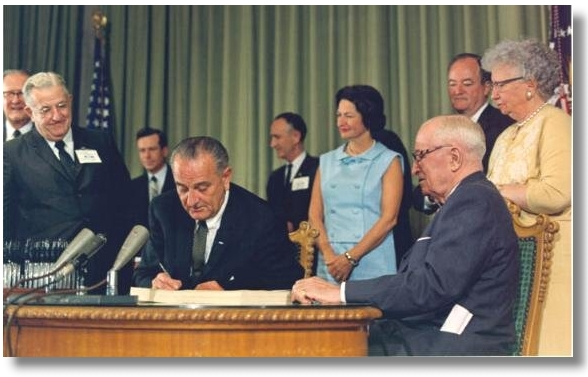
President Johnson signing Medicare into law at the Truman Library in Independence, Missouri.
During the Truman Administration, the Wagner-Murray-Dingell bill was proposed with the support of President Truman. If enacted, it would have created the equivalent of Britain’s National Health Service in the United States. However, opposition in Congress was too strong, so proponents of government-run healthcare turned to a more gradual approach, and Medicare became the starting policy. The first major effort to pass Medicare was in 1960, but it failed in the Senate and the bill that passed instead was the Kerr-Mills Act, instituting federal grants to states that started their own health insurance programs for the elderly. However, efforts to pass Medicare did not cease, and another effort in 1962 also failed. In 1964, the Senate voted for a Medicare amendment to the pending Social Security bill, but the House and Senate were not able to agree on a final bill in time, thus the measure had to be postponed to the next session.
The measure’s chief advocates in the Senate were Clinton Anderson (D-N.M.) and Albert Gore (D-Tenn.), and its chief advocate in the House was Cecil King (D-Calif.). The former’s specialty in health care made a lot of sense from a personal perspective, as he had had to contend with health issues since his miraculous recovery from a terminal diagnosis of tuberculosis in 1917. They did, however, have a formidable foe in Senate Finance Committee Chairman Harry F. Byrd (D-Va.). It had been decades since Byrd was last even remotely on board with the national Democrats on issues great and small, and it was not easy to surpass him in his fiscal conservatism. However, given the Democratic majorities in both houses, Byrd could be surpassed. The chairman of the House Ways and Means Committee, Wilbur Mills (D-Ark.), had been a sponsor of the Kerr-Mills Act and had originally opposed Medicare, but decided it was better for him to steer the ship rather than get steamrolled by the liberal majority.
Although Republicans had long opposed Medicare, there was a fear of missing out on political capital that came out of supporting this popular measure. A Republican motion to recommit and insert a voluntary private insurance plan, sponsored by the ranking Republican on the House Ways and Means Committee John W. Byrnes of Wisconsin, failed 191-236 with 63 Democrats voting for and 226 against, while 128 Republicans voted for and 10 against. That same day, the Social Security Act Amendments were passed on a vote of 313-115. Democrats had supported at 248-42, and the Republican vote went 65-73. Some supporters included those who would be normally thought of as among the conservatives, such as J. Edward Hutchinson of Michigan and Frank Bow of Ohio. However, more Republicans, including a few big names, voted against. Future President Gerald Ford was the only Michigander to vote against, House Whip Leslie Arends of Illinois voted against, future presidential contenders John B. Anderson of Illinois and Bob Dole of Kansas voted against, and future Secretary of Defense Donald Rumsfeld of Illinois did so as well. There were five Democrats who voted against the Republican substitute but also against the bill in Paul C. Jones of Missouri, Earle Cabell of Texas, Olin Teague of Texas, William Poage of Texas, and George Mahon of Texas. The Senate next considered the bill, and it was going to be a shoo-in there too. However, Senator Carl Curtis (R-Neb.), a man who battled against the New Deal and its works throughout his 40 years in Washington, proposed an amendment in one final but futile effort to gut the bill by striking Medicare Parts A and B, which was rejected 26-64 on July 9th. Democrats overwhelmingly rejected this effort 8-53, while Republicans supported it 18-11. That same day, Medicare was passed 68-21, with Democrats going 55-7 for and Republicans very narrowly against at 13-14. Because there were differences between the House and Senate bills, Congress had to go into conference to resolve them, and the conference report passed the House on July 27th 307-116 (D 237-48, R 70-68) with the Senate following suit the next day on a vote of 70-24 (D 57-7, R 13-17). In the House, Republicans Alphonzo Bell of California, Robert Ellsworth of Kansas, Tim Lee Carter of Kentucky, Joel Broyhill of Virginia, and John W. Byrnes of Wisconsin as well as Democrat Tom Steed of Oklahoma flipped from opposition to support. Flipping from support to opposition were Democrats James A. Haley of Florida, Lawrence Fountain of North Carolina, Harold Cooley of North Carolina, Ralph Scott of North Carolina, Basil Whitener of North Carolina, Tom Murray of Tennessee, John Dowdy of Texas, and Walter Rogers of Texas as well as Republican Peter Frelinghuysen of New Jersey. No senators changed their minds on the bill. President Johnson signed the measure into law on July 30, 1965, at the Truman Library in Independence, Missouri, with former President Harry S. Truman, now 81 years old, being issued the first Medicare card. How popular was this measure? Although public opinion was a bit divided in the early 1960s, by August 1965 82% of Americans approved of Congress passing this law (Roper Center). In the 60 years since its passage, Medicare remains a popular program that people don’t want to change, but its future is uncertain and fraught with fiscal difficulties as it currently pays out more than the revenue than it takes in, which makes the status quo a long-term impossibility.
References
Public Opinion and the Passage of the Medicare Bill. (2017, February 22). Roper Center.
Retrieved from
https://ropercenter.cornell.edu/public-opinion-and-passage-medicare-bill
To Agree to Conference Report on H.R. 6675, a Bill to Provide a Hospital Insurance Program. Voteview.
Retrieved from
https://voteview.com/rollcall/RH0890097
To Agree to Conference Report on H.R. 6675, the Social Security Amendments of 1965. Voteview.
Retrieved from
https://voteview.com/rollcall/RS0890174
To Amend H.R. 6675, the 1965 Social Security Act Amendments, by Striking from the Bill its Medicare Provisions, Parts A and B. Voteview.
Retrieved from
https://voteview.com/rollcall/RS0890145
To Pass H.R. 6675, a Bill to Provide a Hospital Insurance Program for the Aged Under the Social Security Act. Voteview.
Retrieved from
https://voteview.com/rollcall/RH0890035
To Pass H.R. 6675, the Social Security Amendments of 1965. Voteview.
Retrieved from
https://voteview.com/rollcall/RS0890151
To Recommit H.R. 6675, a Bill to Provide a Hospital Insurance Program for the Aged Under the Social Security Act, to the Ways and Means Committee. Voteview.
Retrieved from
 Mad Politics: The Bizarre, Fascinating, and Unknown of American Political History