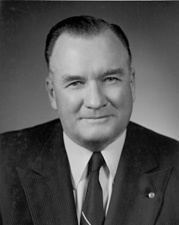
George W. Malone: The Silver State Nationalist

I have covered George Wilson Malone (R-Nev.) a little bit in the past as one of Joseph McCarthy’s closest allies in the Senate, but he is rather interesting to me because of his parochial and somewhat odd record in the Senate. Malone, although known by the effeminate nickname “Molly”, was actually rather masculine, having been an amateur boxer in his youth. An interesting personal detail, a bit of a bombshell you might say, arises about him upon research. He was married since 1921 to Katie Moslander, who was fifteen years his junior. They had a daughter in 1920, when she was 15 years old! The age of consent in Nevada was 18 years old at the time (today it is 16). Professionally, Malone was a civil and hydraulic engineer, and as the state water engineer of Nevada from 1927 to 1935 he was involved in the planning and construction of the Hoover Dam. During World War II, he was an engineering consultant for the U.S. Senate.

His first try for the Senate was in 1934, and a newspaper ad for him pledged that “A Vote for George W. Malone will be a Vote For The State of Nevada, First, Last and All of the Time” (Nevada State Journal). As his Senate career later would prove, this was a truthful ad, as he would be criticized for focusing too much on the interests of Nevada. Nevada voters would not go for his pitch this time around, as Republicans were deeply unpopular generally nationwide and Key Pittman was a giant in Nevada politics. Malone would get only 33.4% of the vote. He would try for the Senate again ten years later, this time against Democrat Pat McCarran on a staunchly pro-tariff platform, but McCarran was far too powerful, and Malone was not a better alternative for liberals displeased with McCarran, and thus he netted 41.6% of the vote.

1946 – The Year of the GOP…and Malone

For Malone, third time was the charm, and it greatly helped that 1946 was an excellent year for Republicans, who had not held a legislative majority in either chamber since the Hoover Administration. Also helping was that the Democratic primary was bitter, and enough Democrats who had voted for incumbent Edward P. Carville were unwilling to back Berkeley Bunker, and Malone won with 55.6% of the vote.

In the Senate, Malone was considered an Old Guard Republican, which included support for income tax reduction, high tariffs, and a resolute opposition to internationalism. While his colleague, McCarran, had been non-interventionist before World War II, he voted for aid to Greece and Turkey as well as the Marshall Plan, this was not so with George Malone. In his career, he never met a foreign aid measure he liked, and this contributed to his low influence in the majority internationalist Senate. He opposed the Marshall Plan on the grounds that the United States was harming its international goodwill by backing European “colonial” powers (Evening Star). Malone’s strong focus on tariffs and regional issues did not help him either in influence. His parochialism resulted in Time Magazine regarding him as one of the Senate’s eight worst members in 1950 alongside Kenneth McKellar (D-Tenn.), Pat McCarran (D-Nev.), Harry P. Cain (R-Wash.), William Jenner (R-Ind.), Glen Taylor (D-Idaho), William Langer (R-N.D.), and Elmer Thomas (D-Okla.). Time Magazine’s (1950) entry read, “His Senate office is a rat’s nest of statistics on the West’s mineral resources and little else; his chair on the Senate floor is often vacant. Fifty-nine-year-old “Molly” Malone once represented the Western mining and industrial interests in the Capitol lobby; as a Senator, he still does”. One must admit, however, that foreign aid is generally far from the priorities of landlocked Nevada voters. However, Malone was not a down-the-line conservative. Contrary to what his entry on One Nevada Encyclopedia states, he was one of three Republican senators to vote against overriding President Truman’s veto of the Taft-Hartley Act and he backed extending rent control in 1950, although for the latter issue he had voted to cut funds for rent control enforcement the previous year as well as for a “local option” amendment strongly opposed by the Truman Administration. Regarding organized labor, Malone voted for the Americans for Democratic Action position on both votes counted on union reform and against the Americans for Constitutional Action position on five of five votes they counted on the subject in 1958. His record on civil rights was not terribly favorable. Although Malone voted for the Civil Rights Act of 1957 (as did all Senate Republicans), he supported both the jury trial amendment and striking 14th Amendment enforcement by the attorney general from the 1957 act, which served to water it down.

In 1950, he succeeded in killing a bill that would have permitted the interstate shipment of slot machines with an 11-hour filibuster, and after he was finished, he said, “I could still go 10 rounds and if they bring this bill up again, I’ll talk against it again” (Evening Star).  That year, Malone weighed in on two civil rights issues: army desegregation and the Fair Employment Practices bill. For the former, Senator Richard Russell (D-Ga.) had managed to get an amendment in the draft bill that permitted “voluntary segregation” for drafted troops. Majority Leader Scott Lucas (D-Ill.) motioned to delete this amendment, which carried 42-29, and essentially serves as a vote to continue army desegregation. Malone voted with the majority. However, on voting to end debate on the Fair Employment Practices bill, a vote that was about breaking Southern obstruction on civil rights legislation, Malone was one of six Republican senators to vote against. Senators from the west most of the time voted against ending debate as a way of protecting themselves from what they regarded as domination from the east. Nevada senators had a state-specific motive for this, as there was always the potential threat of a federal crackdown on the casino industry. 

Malone was also notable as a figure who was a pain for most senators to hear speak, as his speeches tended to be dull, verbose, and lengthy. As columnist Holmes Alexander (1950) wrote while noting that Malone did make some good points in his speeches, “Agoraphobia – fear of open spaces – does not afflict George W. Malone, junior senator from Nevada. Whenever Senator Malone takes the Senate floor, its inhabitants run for the cloakrooms and leave him there talking to the vacant seats and a fistful of Midwest isolationists. He doesn’t seem to mind. At least he’s used to it. The Nevadan always talks too long – seldom less than three hours. And he usually talks on the same subject – the bipartisan foreign policy. He is against it”. Although I hesitate to use the word “isolationist” to describe opponents of internationalism, it does seem to fit in Malone’s case. In 1956, he proposed that the United States remove all its troops from abroad and deploy them for defense in North America (Evening Star).

The cause for which Malone was identified with the most regarded one of the oldest planks in the history of the Republican Party, and that was support for high tariffs. His fundamental belief on trade was that relying on goods produced by low wages in other nations would in the long run wreck American business and labor alike (Evening Star). Malone was perhaps the staunchest protectionist in the entire Senate, going as far as to be one of only two senators to vote against a compromise extension of the Reciprocal Trade Act in 1951 that included a “peril points” (setting a floor on tariff reduction) provision GOP senators had unanimously pushed for.

The 1952 Election and the Eisenhower Years

Malone’s election in 1946 could perhaps be seen as a fluke given that he was prone to extreme stances on certain issues that set him apart from political modernity, such as trade and foreign aid. However, the Democratic primary didn’t go the way Senator Pat McCarran wanted, with Democrats voting to nominate liberal Thomas Mechling, an opponent of his machine. Thus, McCarran surreptitiously lent campaign staff and resources to Malone, and he won reelection while several of his 1946 Republican freshmen lost. As a consequence, the Senate was Republican-controlled.

Malone’s stances, while opposed to most of what President Truman stood for, were not that much better aligned with the Eisenhower Administration. In 1953, he was one of 13 senators to vote against confirming Charles Bohlen as Ambassador to the USSR, a group comprised of Joseph McCarthy and his hard-core supporters. He would support McCarthy down the line, voting against his censure and in 1957 called for striking his censure from the record. In 1956, he had a notable outburst when he leapt over a table at a British diplomat in San Francisco in response to an insult during a dignified luncheon (The Evening Star). That year, Malone was noted by internationalist Paul Hoffman as one of the troublesome senators who should be read out of the GOP, with columnist George Sokolsky (1956) writing, “Senator George Malone is opposed because no one can control him. He goes his own way really not belonging wholly to one side or another. Independence of that sort is not welcomed and although George Malone spoke well of the Russians after his visit to their country, it has not won for him the support of those in our government who prefer Zhukov to Khruschev, which is none of our business”. He could sometimes go his own way through persuasion. Majority Leader Lyndon B. Johnson (D-Tex.) would occasionally court Malone for his vote on issues he wasn’t known to be a hardliner on. Some instances of him changing his mind included on the prevailing wage for the Interstate Highway Act in 1956, having initially voted against applying the prevailing wage but then voting for it. In 1958, Malone voted against an effort to kill the anti-preemption bill being considered (I have discussed this bill in an earlier post), but then voted to send the bill back to committee for the session. He also could be persuaded to vote for some social welfare measures, including being one of six Republicans to vote for Senator Walter George’s (D-Ga.) 1956 amendment starting disability payments under Social Security at age 50, which passed 47-45. In 1958, Malone was one of only three Republicans to vote for Senator John F. Kennedy’s (D-Mass.) amendment to expand coverage of unemployment compensation and weekly payments as well as mandating 39 weeks of unemployment benefits for states.

The 1958 election year was terrible for the GOP, and Malone faced a strong challenger in Las Vegas city attorney Howard W. Cannon and did not have the benefit of Pat McCarran being around. Although Eisenhower cabinet secretaries Fred Seaton and Ezra Taft Benson backed his reelection and Malone touted his seniority as well as his opposition to a federal tax on gambling, he lost reelection to Las Vegas’s city attorney Howard Cannon, getting only 42% of the vote, being one of 12 Republican senators defeated. His DW-Nominate score was a 0.312, and his Americans for Democratic Action scores were overall low with a cumulative of 14% when counting pairs and not counting absences against, with him thrice scoring zeroes. Malone’s Americans for Constitutional Action cumulative score was, including counting pairs, a 68% based on his record from 1955 to 1958. After his time in the Senate, he would achieve a dubious distinction; being the only former senator to ever work for Willis Carto. Like Malone, Carto was a protectionist, and he brought him on as a trade expert for Liberty Lobby’s Trade Policy Committee, where he lobbied for the adoption of a “scientific tariff”. Carto would later write glowingly of Malone in his book, Populism vs. Plutocracy: The Universal Struggle, in which he praised numerous figures from American history who opposed internationalism and/or banking interests, which also included Andrew Jackson, Robert La Follette, and Robert Taft.

Malone attempted a comeback in 1960, running for Nevada’s at-Large Congressional seat held by Walter Baring, but he was easily defeated. The following year, he was diagnosed with cancer, and died on May 19, 1961, after a week of hospitalization. Although not influential, Malone was far from unpopular, as 27 of his Senate colleagues attended his funeral. One thing that is clear to me is that the current Republican Party has a far greater home for Malone than the one in his day had.

References

Alexander, H. (1950, March 8). Unheard Talk. Fort Worth Star-Telegram.

Retrieved from

https://www.newspapers.com/image/638165950/

George Malone. Online Nevada Encyclopedia.

Retrieved from

http://www.onv-dev.duffion.com/articles/george-malone

George Malone Dies; Ex-Senator of Nevada. (1961, May 20). Evening Star (Washington, D.C.).

Retrieved from

https://www.newspapers.com/image/871152400/

Malone, George Wilson. Voteview.

Retrieved from

https://www.voteview.com/person/5944/george-wilson-malone

National Affairs: The Senate’s Most Expendable. (1950, March 20). Time Magazine.

Retrieved from

https://time.com/archive/6796166/national-affairs-the-senates-most-expendable/

Political Ad for George W. Malone. (1934, August 29). Nevada State Journal (Reno, NV).

Retrieved from

https://www.newspapers.com/image/78816810/

Sokolsky, G.E. (1956, December 28). GOP at Odds With Itself. Ledger-Dispatch and Star (Norfolk, VA).

Retrieved from
https://www.newspapers.com/image/952390129/

Past Attempts to Abolish or Change the Electoral College

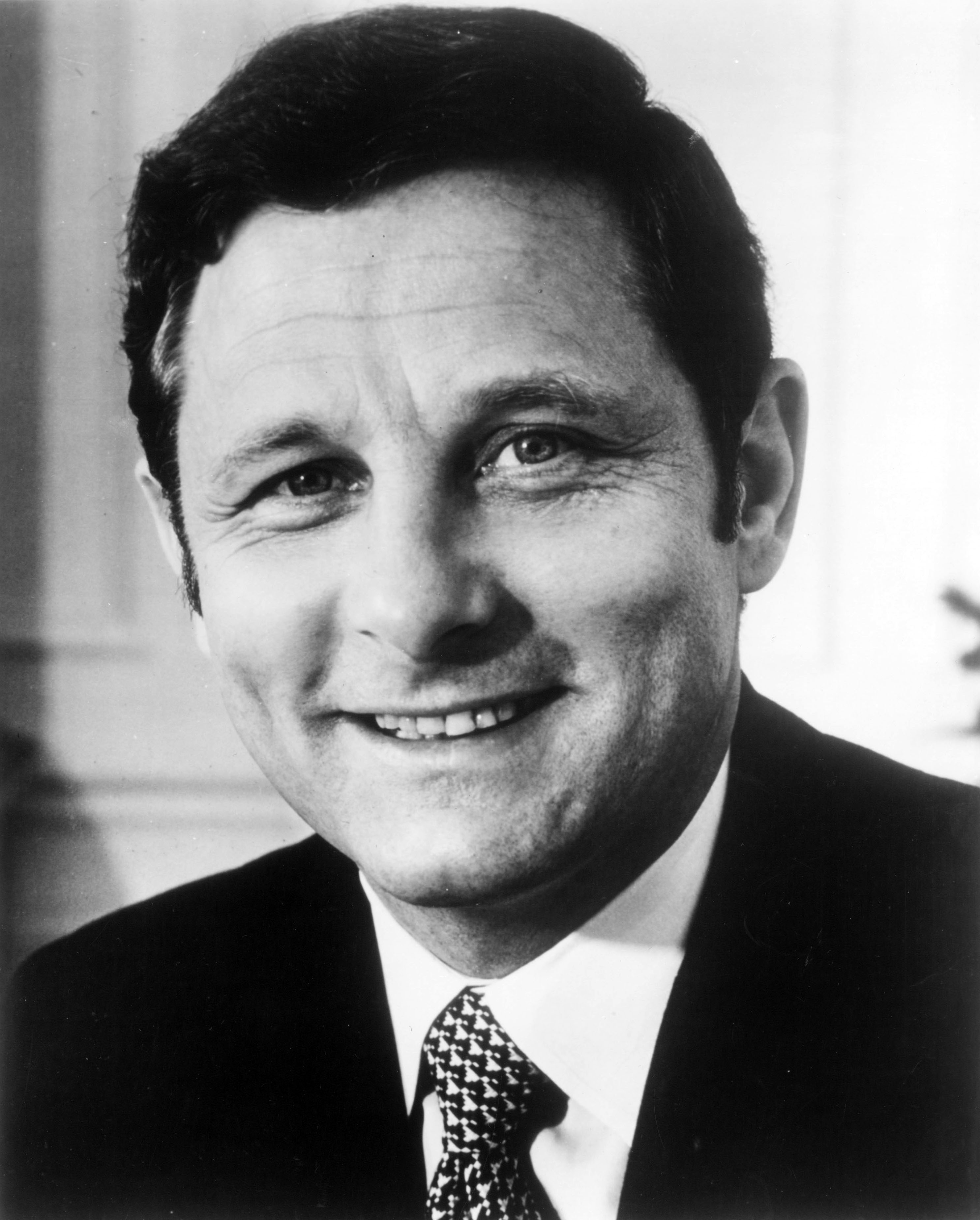
Birch Bayh (D-Ind.), the Senate sponsor of both the 1970 and 1979 efforts to scrap the Electoral College.

One thing I think Americans should be thankful for with this past election is that the popular and electoral vote went in the same direction. Although yes, I know technically that the electoral vote is what wins elections, there’s an additional sense of legitimacy if the popular vote goes the way of the electoral winner. Many people favor eliminating the Electoral College, but that requires a Constitutional change, and that is a difficult matter. This, by the way, is far from a new proposal.

Opposition to the Electoral College is older than you might think…in 1823, Senator Thomas Hart Benton of Missouri, later a founder of the Democratic Party, wrote, “Every reason which induced the convention to institute Electors has failed. They are no longer of any use, and may be dangerous to the liberties of the people” (O’Brien). Even a retired President James Madison, the father of the Constitution, had not supported maintaining the status quo of the Electoral College. He supported a district plan in which states would be divvied up into districts for presidential votes, and each district would choose its electors (O’Brien). President Andrew Jackson was the first to call for its outright abolition in favor of the popular vote. So just remember, when liberal Democrats push for the popular vote over the Electoral College, they are, in fact, acting as traditional Democrats. Some 20th century efforts to abolish or alter the Electoral College were pushed, as direct democracy grew in popularity.

In 1913, Senator Robert Owen (D-Okla.), a progressive and one of the fathers of the Federal Reserve, proposed substituting the electoral college with the popular vote, but this proposal failed on January 31st 32-36 (R 12-27, D 20-9). The Southern vote, perceived as particularly strong against changing the Electoral College, was 6-8 on this proposal. The conservative wing of the GOP overwhelmingly voted against.

In 1934, Senator George W. Norris (R-Neb.), one of the GOP’s most celebrated progressives, pushed for the popular vote of the president and vice president. He had been at the forefront of several movements towards direct democracy and was the father of the amendment to the Constitution that eliminated the “lame duck” session of Congress, and had the presidential term start on January 20th rather than March 4th. This proposal failed to achieve the necessary 2/3’s on a vote of 52-29 (D 40-9; R 11-20; FL 1-0) on May 22nd. The Southern vote was 15-5 for this proposal, the opposition making up 56% of Democratic opposition. Among the Republicans, there was a clear split with the party’s moderate to liberal wing voting for and the party’s conservative wing voting against. This was the high watermark of Southern support for scrapping the Electoral College.

1950: The Lodge-Gossett Amendment – Electoral College with No Electors

In 1950, Senator Henry Cabot Lodge Jr. (R-Mass.) and Representative Ed Gossett (D-Tex.) proposed an amendment to the Constitution that abolished electors and maintained the electoral numbering system, with electoral votes allocated proportionately to the vote. This is known as the fractional-proportional method, and everyone would have had motivation to vote in their states as the electoral vote of a state was no longer to be winner take all. Lodge, a moderate, thought this a good compromise between those who would want to abolish the electoral college and those who wanted to retain the power of states and wanted the GOP to make some headway in the South. His colleagues largely thought the same on the merits of the amendment, and it passed 64-27 (D 46-4; R 18-23) on February 1st. The Senate’s opposition, interestingly enough, consisted almost entirely of conservatives. Gossett, however, was a conservative Democrat and had some other motivations, wanting to limit the power of urban areas and of radicals and racial and ethnic minorities to push left-wing policies and civil rights bills. He expressed his views in 1949, “The Electoral College permits and invites irresponsible control and domination by small organized minority groups, within the large pivotal States. It aggravates and accentuates the building up and solidification within these States of religious, economic, and racial blocs. Small, definable, minority groups, organized religious or economic or racial lines, by voting together, can and do hold a balance of power within these pivotal States. As a result, the political strategists in both parties make special appeals to these various groups as such. These groups have become more and more politically conscious. They know their power. In many instances, they have no political alignments or philosophy as such, but are simply up for sale to the highest bidder. To encourage economic racial, and religious group consciousness and group action, is a dangerously undemocratic practice, aside from its other evil consequences” (National Popular Vote, 5-6). The timing of this amendment is interesting too, as in 1948, both major parties adopted pro-civil rights platforms, and some Southern Democrats broke away from the Democratic Party that year to back the explicitly segregationist State’s Rights Party, which ran South Carolina Governor Strom Thurmond. Given the South’s unity at the time against civil rights legislation, this would turn the South into an even more powerful voting bloc. Once Gossett’s motivations became clear, support for the amendment among Northern liberals collapsed. On July 17th, the Lodge- Gossett Amendment was easily defeated 134-210 (D 85-116; R 49-92; L 0-1; ALP 0-1). This reform proposal was not brought up again.

1956 – Electoral College Reform Debate

In 1956, reforming the Electoral College was brought up again. An effort to abolish the Electoral College and institute the popular vote fared badly in a Senate vote of 17-66 (D 16-25; R 1-41) on March 27th. After the failure of this proposal, liberal Senator Hubert Humphrey (D-Minn.) pushed a compromise reform that would award two electoral votes to the winner of each state and the rest would be proportionately represented (Goldman). This proposal was shelved on voice vote, and no proposed reform had 2/3’s support.

The Nixon Era: The Electoral College Comes Closest to Its Demise

In the 1968 election, although Richard Nixon won by 110 electoral votes he had won with less than 1% in the popular vote, and the third party candidacy of George Wallace was fully intended not to win, but rather to try to force the winner into making a deal with him. Much was also made of a faithless Nixon elector in North Carolina voting for Wallace instead. This set the stage for the consideration of the Bayh (D-Ind.)-Celler (D-N.Y.) Amendment, which if adopted would have scrapped the electoral college but not replaced it with an outright popular vote, rather a two-round system akin to how presidential elections work in France. There would be a first election, and if no duo won at least 40% of the popular vote, there would be a runoff election. The momentum for supporting this proposal was quite strong, with President Nixon as well as Speaker John W. McCormack (D-Mass.) and Minority Leader Gerald Ford (R-Mich.) in support. After a last-ditch effort by conservative Rep. David Dennis (R-Ind.) to institute a district plan was voted down 162-246 (D 62-166; R 100-80), the House passed this amendment on a vote of 339-70 (D 184-44; R 154-26) on September 18, 1969. Nearly all Democrats opposed were from the South, but interestingly two members of the Congressional Black Caucus, Charles Diggs of Michigan and Bill Clay of Missouri, also voted against. However, opposition grew when the measure reached the Senate, and there was a much less favorable climate in the Senate’s Judiciary Committee, as the chairman was James Eastland (D-Miss.) and his Republican counterpart was Nebraska’s Roman Hruska. Both men were strongly opposed to scrapping the Electoral College, and a bloc of Southern and some small state senators, notably Strom Thurmond (R-S.C.) and Carl Curtis (R-Neb.), filibustered. Two motions to end debate failed 54-36 (D 33-18; R 21-18) and 53-34 (D 34-15; R 19-19), and the proposal was scrapped after Majority Leader Mike Mansfield (D-Mont.) gave up in the midst of attempting a third, realizing he didn’t have the votes to proceed. Most of the Democratic opponents were from the South, and the Senate Republicans voting against were mostly a who’s who of its conservative wing.

1979: Jimmy Carter Supports Popular Vote

One of the presidents who supported abolishing the Electoral College was Jimmy Carter, who proposed simply a substitution of the popular vote. This proposal was debated on in the Senate as a Constitutional amendment, again sponsored by Senator Birch Bayh (D-Ind.), but there were some defections among Senate liberals for reasons that are similar to why liberal support collapsed for the Lodge-Gossett Amendment in 1950. These senators were convinced by arguments from black and Jewish groups that the Electoral College would cost them political influence, and the vote was 51-48 on July 10th, far short of the 2/3’s needed to adopt a Constitutional amendment (Weaver). Of the 22 Southern senators, only 6 supported, most of them being “New South” Democrats, a moderate to liberal sort that won with multi-racial coalitions. Another opponent of this proposal was none other than Joe Biden of Delaware.

Other proposals have been made since to abolish the Electoral College, but have not received votes, as attaining the 2/3’s majority is a highly difficult task. Instead, some other movements have been underway, including the National Popular Interstate Vote Compact to try to make the Electoral College irrelevant by granting all electoral votes to the popular vote winner, but this doesn’t go into effect until the number of states that agree to it amounts to 270 electoral votes.

What I found interesting is that although modern narratives surrounding the Electoral College that I’ve read recently seem to like to paint it as a part of historical racism that there were arguments for keeping it as a bulwark against racism. This impacted the 1950 debate on Lodge-Gossett and the 1979 effort to repeal the Electoral College. Furthermore, political journalist Theodore H. White held about scrapping the electoral college in 1970 that a direct election system would produce results that would go “brutally against our black population” and that it would “give the racists a chance” (CQ Press).

References

Electoral College Reform Victim of Senate Filibuster. CQ Press.

Retrieved from

http://library.cqpress.com/cqalmanac/cqal70-1291702

Goldman, R.M. (1958). Hubert Humphrey’s S.J. 152: A New Proposal for Electoral Reform. Midwest Journal of Political Science, 2(1).

Retrieved from

O’Brien, F.D. (2001). The Electoral College: How It Got That Way and Why We’re Stuck With It. American Heritage, 52(1).

Retrieved from

https://www.americanheritage.com/electoral-college-how-it-got-way-and-why-were-stuck-it

S.J. Res. 2. Passage. Govtrack.

Retrieved from

https://www.govtrack.us/congress/votes/81-1950/s242

S.J. Res. 2. Joint Resolution Proposing an Amend. To the Constitution Providing for the Election of a Pres. And Vice-Pres. On Motion to Suspend the Rules and Pass. Govtrack.

Retrieved from

https://www.govtrack.us/congress/votes/81-1950/h211

S.J. Res. 31. Electoral Reform. Substitute Proposal to Abolish Electoral College and Elect President and Vice-President by Direct Popular Vote. Govtrack.

Retrieved from

https://www.govtrack.us/congress/votes/84-1956/s132

The Fractional Proportional (Lodge-Gossett) Method of Awarding Electoral Votes. (2021, May 1). National Popular Vote.

Retrieved from

To Pass S.J. Res. 26, Providing for the Direct Popular Election of the President and Vice President of the United States. (Motion Failed; 2/3 Required). Govtrack.

Retrieved from

https://www.govtrack.us/congress/votes/96-1979/s161

To Pass S.J. Res. 29, Proposing an Amendment to the Constitution of the U.S. Relating to Popular Election for President and Vice President. Govtrack.

Retrieved from

https://www.govtrack.us/congress/votes/73-2/s198

To Recommit H.J. Res. 681, Proposing an Amendment to the Constitution Relating to the Election of the President and Vice-President, to the Committee of the Judiciary with Instructions to Report it Back Forthwith with an Amendment Incorporating the “District Plan”. Govtrack.

Retrieved from

https://www.govtrack.us/congress/votes/91-1969/h82

Weaver, W. (1979, July 11). Senate Rejects Proposal To End Electoral College. The New York Times.

Retrieved from

The 12th Amendment: A Controversial Constitutional Correction

The 1800 election marked some firsts in American history. For one thing, it was the first time a president lost reelection and the smooth transfer of power in this case was an important precedent in American as well as world history. However, there was a significant complication that could have derailed the public’s will in electing Thomas Jefferson.

Background

When the Constitution was adopted in 1788, the Founding Fathers were largely of the belief that political parties were to be avoided. President George Washington, who never identified with a party, certainly thought so. However, factionalism developed from the beginning with groups we retroactively call the Pro and Anti-Administration factions. The Pro faction of course sided with George Washington and was also supportive of Treasury Secretary Alexander Hamilton and Vice President John Adams, believing in the use of federal power to grow the nation through the funding of internal improvements to grow commerce and imposing tariffs to finance such developments. The Anti faction sided with Secretary of State Thomas Jefferson, who idealized an agrarian society of the people and disliked the Hamiltonian system of government of protective tariffs to fund internal improvements. However, because the Constitution had it that the winner would be president and the runner-up would be vice president, it created a situation in which the president would have a political foe in the vice presidency, as happened with John Adams and Thomas Jefferson. By the 1796 election, America’s first two parties had developed in the Federalist and Republican parties. For the purposes of avoiding confusion, however, historians and others call the latter the Democratic-Republican Party, as today’s Republican Party traces its lineage to the Whigs, which traced their lineage to the Federalists. Despite the wishes of many Founders, the seeds for political parties had been planted from the very beginning. Although both Adams and Jefferson had their picks for vice president, the tickets were not official and the results made it so that under the Constitution Adams was president and Jefferson was vice president, creating a rather awkward situation in the White House. Imagine this applied to recent politics in addition to the greater role of the vice president, and you can imagine how well this would go over. Electors cast two votes each, but there was no distinction as to president and vice president in these votes.

The 1800 Election

In the 1800 election, the Federalist and Democratic-Republican parties officially selected president and vice president. Jefferson’s running mate was New York’s Aaron Burr and Adams’s running mate was South Carolina’s Charles C. Pinckney. In that election, the tides decisively turned against John Adams, with the Administration being unpopular due to numerous factors, including their support of greater relations with Britain, their tariffs, and the Alien and Sedition Acts, now widely regarded as an unconstitutional overreaction to fears about the influence of revolutionary France. Thomas Jefferson won with 60.6% of the vote as opposed to Adams’ 39.4%.  The problem was that in the casting of electoral votes, the electors gave Jefferson and Burr 73 electoral votes, and because the electoral votes didn’t distinguish between president and vice president a Burr presidency was now possible! The Adams electors had been careful about this; his VP nominee Charles C. Pinckney received one less electoral vote than Adams, but this didn’t matter as the ticket hadn’t won. The conundrum had to be resolved by Congress, and the Federalists initially sought to make life difficult for Jefferson by voting for Burr and producing a stalemate, resulting in 35 ballots without a winner. Because state delegations were what mattered in the voting for president, this had the result of giving Delaware’s single representative, the staunchly Federalist James A. Bayard, the same power as the considerably more populous Democratic-Republican state of Virginia in determining the president. Burr, ever ambitious and far from the most ethical politician the US has ever had, was during this time accused of campaigning for himself being president as he did not rule himself out as a candidate for president. As a consequence, Burr would be completely frozen out of the Jefferson Administration’s inner circle. However, Alexander Hamilton realized that Jefferson was the preferable president. He didn’t like the idea of Burr being an instrument of the Federalists throughout his career. In 1804, Hamilton’s opinion on Burr reflected his views on him in 1801, asking, “Is he to be used by the Federalists, or is he a two-edged sword, that must not be drawn?” (Thomas Jefferson Monticello) He managed to convince some Federalists to switch their votes to Jefferson, and on the 36th ballot, Delaware’s Bayard cast his vote for Jefferson, thus producing the intended outcome of the people. An election being decided in the House of Representatives is, to say the least, not ideal as Americans would find out in 1824 (the election of the alleged “corrupt bargain”) and 1876, the only time in which a presidential candidate lost who got the majority, as opposed to the plurality, of the popular vote. Thus, Jefferson and his party proposed the 12th Amendment to the Constitution regarding the elections of the president and vice president. This amendment distinguished electoral votes for president and vice president, held whoever should have the greatest number of votes for vice president would be the vice president, and prohibited electors from a state for voting for more than one candidate from their state. The latter has had some relevance in decisions surrounding presidents; in 2000, Dick Cheney had to legally change his residence from Texas to Wyoming to still be Bush’s running mate, and this issue certainly factored in Trump declining to pick Senator Marco Rubio (R-Fla.) as his running mate this year. In a close election year, it is best not to risk loss because Florida’s electors can’t vote for the ticket if there are two Florida residents. The Federalist Party strongly opposed this proposal, as they saw it as a way to benefit Jefferson and his party and to further reduce their influence in politics. Senator Samuel White of Delaware argued that “we have not given it a fair experiment,” that “we should be cautious how we touch it”, and cautioned that the measure had potential to increase corruption, holding that the result would be to “more than double the inducement to those candidates, and their friends, to tamper with the Electors, to exercise intrigue, bribery, and corruption…” (Alder).

However, the Federalist Party was quite weak in representation and the Senate voted for the amendment on December 2, 1803, by a vote of 21-10, with all Federalists opposing and one Democratic-Republican joining them. On December 8, 1803, the House voted to ratify the amendment 84-42, or with 2/3’s of the vote. All Federalists and five Democratic-Republicans voted against, but the Jeffersonian majority was strong enough to ratify. Among the opponents was future President John Quincy Adams.

The 12th Amendment, it is true, did serve Jefferson and the Democratic-Republican Party, but it also adjusted to the reality of the existence of political parties, which with 20/20 hindsight just seems inevitable. That being said, Federalists were understandably self-interested in their opposition to the 12th Amendment, trying to stave off their long-term decline. The 1804 election turned out to be a cakewalk for the popular Jefferson, who had a new running mate in New York’s George Clinton and won in a massive landslide against South Carolina’s Charles C. Pinckney, who only won Connecticut and the staunchly Federalist outpost of Delaware. The Federalist Party would gradually die out, but it would ironically technically outlast the Democratic-Republican Party. The Federalist Party was finally dissolved around 1828 while the Democratic-Republican Party fell victim to its own success as the party’s tent had become far too big and it was split over the candidacy of the populistic General Andrew Jackson, dissolving around 1825. That partisan politics didn’t end with the “Era of Good Feelings” that characterized James Monroe’s administration should be demonstrative that the “end of history” will not come without the end of humanity itself.

References

Alder, C. (2016, March 3). A Far Superior Method – the Original Electoral College. In Search of the American Constitutional Paradigm.

Retrieved from

https://www.freedomformula.us/articles/a-far-superior-method/

Election of 1804. Thomas Jefferson Monticello.

Retrieved from

https://www.monticello.org/research-education/thomas-jefferson-encyclopedia/election-1804/

The Twelfth Amendment. National Constitution Center.

Retrieved from

https://constitutioncenter.org/the-constitution/amendments/amendment-xii/interpretations/171

To Adopt a Resolution, Reported by the Committee, Amending the Constitution. (P. 209-210). Govtrack.

Retrieved from

https://www.govtrack.us/congress/votes/8-1/s16

To Concur in the Senate Resolution to Submit for Approval to the Legislatures of the States, an Amendment to the Constitution Regulating the Election of the President and Vice President. (Speaker Voting in the Affirmative). Govtrack.

Retrieved from

https://www.govtrack.us/congress/votes/8-1/h24