Newt Gingrich, Part I: Early Career and Partisan Bomb-Throwing Backbencher

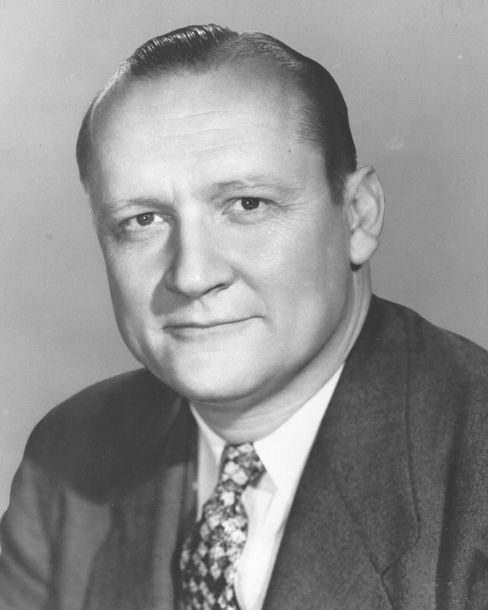
One of the most controversial figures of his day and one who from time to time can still say controversial things is Newton Leroy Gingrich (1943- ). Born Newton Leroy McPherson, his birth parents split before he was born, and his stepfather, Robert Gingrich, adopted him upon his marriage to his mother Kathleen in 1946. Robert was an army man, thus young Gingrich moved with his father to where he was stationed. He did not form many connections with his peers, as he often moved, rather concentrating his energies on personal interests, including history and animals. A visit to the site of the Battle of Verdun made a strong impression upon him about the consequences of failure of leadership. In 1965, he earned a Bachelor’s in history from Emory University in Atlanta, and would later earn an M.A. and PhD in European history. In his college days, Gingrich was involved with the Young Republicans, where he reportedly expressed a desire to “be an old-time political boss in 20 years” (Green).

During the Vietnam War, he received deferments for his status as a student and a father. Given Gingrich’s later hawkishness on the Cold War and his strong criticisms of Democrats for their dovishness, this would be used to call him a “chickenhawk”. However, it was likely a moot point against him. Gingrich’s stepfather, a veteran, said of him, “He is very nearsighted. You probably know that he can barely see across the street without his contacts. He has two of the flattest feet that there ever was”, thus he would have almost certainly not been eligible for military service on medical grounds (Thompson). Interestingly, Gingrich backed Nelson Rockefeller in the 1968 Republican primary, indicating a bit of a more moderate view on issues in his early years. After he had earned his PhD, Gingrich was a professor of history and geography at West Georgia College, although he would take leaves of absence for his political campaigns.

Haunting Congressman Flynt

In 1972, conservative Democrat John J. Flynt faced no opposition for reelection. Theoretically, the 1974 midterms should have also been baller for Flynt, but the entrance of Gingrich into the race held him down to 51.5% of the vote, and this election weighed Republicans down from the Watergate scandal. In that election, Gingrich ran on a conservative platform of cutting federal spending by at least $10 billion, revising the tax code, reducing federal bureaucracy, and against “special interest” groups (The Newnan Times Herald, 1974). He also distanced himself from Nixon and Watergate. Gingrich was a natural campaigner, and he was able to with ease walk into offices and introduce himself thusly, “Hi, I’m Newt Gingrich and with a name like that I need all the help I can get” (Jacobs). Working in Gingrich’s favor was that the district’s makeup was changing from rural to suburban, thus Flynt’s base of support in the district was deteriorating. Furthermore, the long march of Republicans to dominance in the South began in the suburbs. Flynt again had a tough race in 1976 with Gingrich trying again. He again emphasized his conservatism, with one of his ads touting that “He’s for a strong national defense, he’s opposed to gun control, and he’s an honest fiscal conservative. He’s said over and over that government is too big, too expensive, and too much in control of our daily lives” (The Newnan Times-Herald, 1976). Flynt campaigned against Gingrich as an outsider, with ads emphasizing that he was born in Pennsylvania and that he went to schools in Europe and college in New Orleans (Jacobs). Since both men were running as conservatives, Gingrich could not attack him on ideological grounds. However, he did go after him as a Washington insider, criticized the state of ethics in Congress which was relevant as Flynt was chairman of the House Ethics Committee, and went after his attendance record, stating that he missed 24% of House votes, not counting absences due to illness (Jacobs). However, Flynt was actually doing significant work as Ethics Committee chairman. This included the Ethics Committee investigating Representative Robert Sikes of Florida and refusing to cut a deal with Wayne Hays of Ohio (Lyons). Jimmy Carter easily won the state, and Flynt won with 51.7% of the vote. However, a 1978 midterm without the encumbrance of Watergate on Republicans nor the benefit of Carter at the top of the ticket spelled retirement for Flynt. With Flynt’s retirement, the way was cleared for Gingrich, and he won the seat with 54.4% of the vote against State Senator Virginia Shapard.

Congressman Gingrich

Gingrich from the beginning had a dream, and that was for a Republican majority. It was his idea for the Republicans to consult the Conservative Party of Britain on how they won the 1979 elections, and he said regarding his approach to politics, “For a great part of its minority life, the Republican Party has allowed itself to become coopted as an arm of government. Too often it has allowed itself to be cajoled into providing the necessary votes for the majority party to win…I’m personally getting tired of being told that we’re responsible when they (Democrats control the House, they control the Senate, they control the committees, and they control the rules. If we held those positions, then we should be responsible…If the majority party is content to run the House like a plantation, they can do so. But they can’t make me dress up and serve mint juleps with a smile” (Crown). Gingrich’s record started as conservative, with him siding with their positions in 1979 and 1980 92% of the time. He was notably outspoken against the Panama Canal Treaties and voted against implementation. A notable exception to his conservative record in this time, however, was his vote for the Department of Education in 1979. Gingrich also was keen on the South becoming Republican and in the process leaving behind some old legacies. Notably, he voted to extend the Voting Rights Act of 1965 in 1981 and the Martin Luther King Jr. holiday in 1983.

Gingrich was a strong supporter of President Reagan’s economic, social, and foreign policies. although he differed with him when he embraced partially rolling back the 1981 tax cuts. He in particular criticized Senator Bob Dole’s (R-Kan.) leading role, dubbing him the “tax collector of the welfare state” (Ponnuru). Back then, Georgia’s legislature was still quite Democratic, and they badly wanted to redistrict Gingrich out of a career. As The Gainesville Times (1981) reported, “The congressional reapportionment efforts will have four major goals. In descending order of priority they will be: (1) elimination of Republican Congressman Newt Gingrich, (2) insurance that a new Republican district isn’t created, (3) elimination of Democratic Congressman Larry McDonald [a John Bircher who was even more conservative than Gingrich], protection of the seats of the remaining incumbents who plan to seek reelection”. Although Republicans lost 26 seats in the 1982 midterms, Democrats did not achieve the ousters of either Gingrich or McDonald. In 1983, Gingrich formed the Conservative Opportunity Society, a group for young House Republicans. He also sought to attack the Democratic majority and became known as a rhetorical bomb-thrower, and realized a medium to do so. Only two months after Gingrich had been seated, C-SPAN began televising the proceedings of the House. I think I can write without fear of contradiction that people behave differently when they know they are on camera, and he knew how to use this to his advantage.

Gingrich vs. Speaker O’Neill

In 1984, Gingrich and his fellow younger Republicans started using a period of time called “Special Orders”, an end-of-the-day period in which few members were present, to denounce the Democrats. A most notable incident was when Gingrich used this time to speak before a mostly empty House in an end-of-the-day period known as “Special Orders”, his remarks being for the American public, accusing the Democrats of believing that “American does nothing right and communism…rushes into vacuums caused by ‘stupid’ Americans and its ‘rotten, corrupt’ allies” and called out numerous Democratic House members for their opposition to Reagan’s foreign policy (Reid). During the speech, he did something clever and sneaky. He briefly paused in his words, as if to challenge his opponents, who were not present, to respond (Stanley).

Speaker Tip O’Neill (D-Mass.), who learned of the speech two days later, was furious because none of the members named had been notified ahead of time by Gingrich that he would be making a speech that would name them in addition to his pause. In response, he ordered C-SPAN to pan the cameras around the House during “Special Orders”. Republicans had not been informed of the change ahead of time and strongly objected (O’Neill would apologize to Minority Leader Michel for a lack of notice), and Gingrich started speaking under a matter of “personal privilege” to denounce O’Neill and wouldn’t yield the floor when Democrats tried to get him to do so until O’Neill himself gruffly asked, “Will the gentleman yield?” (Reid) He proceeded to blow his stack. O’Neill shook his finger at Gingrich and boomed, “You deliberately stood in the well of this House and took on these members when you knew they would not be here” (Reid). This would have been fine under parliamentary rules. However, he continued, “You challenged their patriotism, and it is the lowest thing that I have ever seen in my 32 years in Congress!” (Stanley) The problem here was that O’Neill’s language was not parliamentary, and House Minority Whip Trent Lott (R-Miss.) demanded the words be taken down. The House parliamentarian indeed ruled him out of order for using “lowest” against Gingrich and the words were taken down. The normal penalty for this was that the member was not allowed to speak for the rest of the day, but Minority Leader Robert Michel (R-Ill.) came to his rescue by asking Lott to exempt O’Neill from the penalty, which was agreed to (Stanley). Although considered to be of the party’s conservative wing, Michel had been in the House since 1957 and thus had for a long time been used to being in the minority and acted accordingly. He had reservations about Gingrich’s bomb-thrower approach and was personally on good terms with O’Neill despite them having many political differences, including being his golfing partner. Older members of the House were not keen on this new development, with veteran Congressman Barber Conable (R-N.Y.) stating on the situation, “I think many people are upset with the loss of civility around here. They found confirmation in their strategy, that Tip was willing to mix with them. It gave them a purpose” (Harbrecht).

Gingrich’s influence would continue to rise from the 1984 election, and in particular there was one election in that cycle that helped motivate more Republicans to be combative, but that will be covered in Part II.

References

Crown, J. (1979, July 12). Gingrich Fantasy. The Atlanta Journal, 5.

Retrieved from

https://www.newspapers.com/image/972880788/

Gingrich, Newton Leroy. Voteview.

Retrieved from

https://voteview.com/person/14627/newton-leroy-gingrich

Green, C. (1974, July 22). 9 Georgia Congressmen Ready Defense. The Atlanta Journal, 12.

Retrieved from

https://www.newspapers.com/image/972649068/

Harbrecht, D. (1984, May 20). Rep. Newt Gingrich infuriates Democrats, inspires Republicans. The Houston Chronicle, 17.

https://www.newspapers.com/image/1203709361/

Jacobs, T. (1976, October 22). Gingrich Campaign Emphasizes Ethics. The Macon Telegraph, 2.

Retrieved from

https://www.newspapers.com/image/847272490/

Jenkins seems to be running hard. (1981, February 26). The Gainesville Times, 4.

Retrieved from

https://www.newspapers.com/image/1203346369/

Lyons, R.D. (1976, September 6). Ethics Committee Is Finally Gaining Respect in House. The New York Times.

Retrieved from

Newt Gingrich Will Work For You! (Political Advertisement). (1974, October 31). The Newnan Times-Herald, 7.

Retrieved from

https://www.newspapers.com/image/966899565/

Ponnuru, R. (2012, December 28). Republicans and Taxes. National Review.

Retrieved from

https://www.nationalreview.com/corner/republicans-and-taxes-ramesh-ponnuru/

Reid, T.R. (1984, May 16). Outburst. The Washington Post.

Retrieved from

https://www.washingtonpost.com/archive/politics/1984/05/16/outburst/4e338c71-cecb-4315-86df-3c6a969cf257/

Stanley, A. (1984, May 28). Tip Topped! Time Magazine.

Retrieved from

https://time.com/archive/6884173/tip-topped/

Thompson, M. (2011, December 27). General Newt. Time Magazine.

Retrieved from

When you compare the candidates for Congress, there’s really no comparison. (Political Advertisement). (1976, October 21). The Newnan Times-Herald, 5.

Retrieved from

https://www.newspapers.com/image/966847735/

The 1914 Election: The First Completely Popular Election

Speaker of the House Champ Clark (D-Mo.), who retained his majority, although considerably shrunken from what it had been at the start of the Wilson Administration.

The 1914 midterms were rather peculiar. They were one of the midterms in which the president’s party lost seats in the House but gained in the Senate. Furthermore, this was the first election in which senators were popularly elected, and as I have covered before this impacted the makeup of the Senate. The Progressive Party remained a factor in a number of crucial elections which arguably resulted in Democratic wins. This election saw a future president get elected to the Senate in Warren G. Harding in Ohio, as well as the election of the first and only Prohibitionist member of Congress as well as the election of the second Socialist member of Congress. This would also be the first election won by James Wolcott Wadsworth Jr. of New York, whose career was rather unusual in that he had his national start in the Senate, and then later served in the House. He would be a consistent voice for arch-conservatism on domestic issues and his advocacy for military preparedness but would notably differ with his party in his support for FDR’s foreign policy.

Republicans ran in the 1914 election on the platform of the economic policies of the Taft Administration producing prosperity seen at the time, and this saw big gains in their traditional stronghold of New England. In the Midwest, the Republican performance was a bit spottier. They did very well in Illinois and Iowa, but were only able to regain two seats from their complete wipe-out in the 1912 election in Indiana, gained a House seat in Kansas, lost a House and a Senate seat in South Dakota, and lost a Senate seat in Wisconsin. Democrats managed to keep a number of seats or make gains in the West, where Wilson was maintaining or gaining in popularity. An interesting example was in Utah, in which the state’s second district flipped from Republican to Democrat, and this would presage Wilson’s big win there in 1916 as well as Republican Senator George Sutherland’s loss and the loss of the first district. By stark contrast, the state had been one of only two to stick with William Howard Taft in 1912. It should be noted that a significant part of why Republicans made big gains in the House was because the 1912 split in the GOP had produced major gains in the House that year, Democrats having won seats they normally would not win. In Philadelphia, at the time a Republican stronghold in part thanks to its corrupt machine, Democrats had managed to snag two of the city’s Congressional districts, which came back under Republican control in this election. Republicans overall gained 62 seats in the House, a “shellacking” but not enough to win a majority, even though they did win the popular House vote. The Progressive Party loses a net of four seats; they were but a minor contender in national politics although as noted earlier, they ate away at Republican votes in some critical places. The Progressive Party’s influence would come to an end when Theodore Roosevelt decided to back Republican Charles Evans Hughes in the 1916 presidential election.

Republican Gains, House

In Colorado’s 2nd district, Republican Charles Timberlake defeated Democrat Harry Seldomridge for reelection.

In Connecticut, Republicans had a clean sweep, with Democrats Augustine Lonergan, Bryan F. Mahan, Thomas Reilly, Jeremiah Donovan, and William Kennedy losing reelection to Republicans P. Davis Oakey, Richard Freeman, John Tilson, Ebenezer Hill, and James Glynn respectively.

In Delaware, Republican Thomas W. Miller defeated Democratic incumbent Franklin W. Brockson.

In Illinois, Republicans gained a whopping net of 11 seats. Republican Ira Copley switched to Progressive for his reelection and won. The most notable victor was former Speaker Joe Cannon regaining his seat in the 18th district over Democrat Frank O’Hair. Progressives Charles Thomson and William Hinebaugh lose reelection to George Foss and Charles Fuller in the 10th and 12th districts respectively, while Democrats Louis FitzHenry, Charles Borchers, James Graham, William Baltz, H. Robert Fowler, Robert Hill, and Lawrence Stringer lose reelection to John Sterling, William B. McKinley, Loren Wheeler, William Rodenberg, Thomas Williams, Edward Denison, and Burnett Chiperfield respectively. Republican William Wilson would win an open seat in the 3rd district.

In Indiana, Republicans Merrill Moores and William Wood defeated Democratic incumbents Charles Korbly and John Peterson in the 7th and 10th districts respectively.

In Iowa, Republicans Harry Hull, Burton Sweet, and C. William Ramseyer win in the 2nd, 3rd, and 6th districts respectively. They all win open seats.

In Maryland, Republican Sydney Mudd wins an open seat in the 5th district.

In Massachusetts, Republican George Tinkham wins an open seat in the 11th district while Republicans William H. Carter and Joseph Walsh defeat incumbents John Mitchell and Thomas Thacher in the 13th and 16th districts respectively.

In Michigan, Republicans George Loud and W. Frank James defeat Progressive incumbents Roy Woodruff and William J. MacDonald in the 10th and 12th districts respectively.

In Minnesota, Republican Franklin Ellsworth wins an open seat in Minnesota’s 2nd district.

In Nebraska, Republican C. Frank Reavis defeats Democrat John Maguire for reelection in the 1st district.

In New Hampshire, Democrat Eugene E. Reed of the 1st district loses reelection to Republican Cyrus Sulloway and Democrat Raymond B. Stevens of the 2nd district runs for the Senate (he loses) and is succeeded by Republican Edward Wason.

In New Jersey, Republicans gain five seats. At the start of the 63rd Congress, William J. Browning of the 1st district was initially the only Republican, but Dow Drukker won a special election during the Congress. Democrats J. Thompson Baker, Allan B. Walsh, William Tuttle, and Edward Townsend lost reelection to Isaac Bacharach, Elijah Hutchinson, John Capstick, and Frederick Lehlbach respectively. Republican Richard Parker wins an open seat.

In New Mexico, Republican Benigno Hernandez defeats Democrat Harvey B. Fergusson for reelection. Hernandez is the first Hispanic American in Congress.

In New York, Republicans gain eleven seats. Democratic incumbents Lathrop Brown, James O’Brien, Jacob Cantor, Benjamin Taylor, George McClellan, Peter Ten Eyck, Charles Talcott, John Clancy, and Robert Gittins lose to Frederick Hicks, Oscar Swift, Isaac Siegel, James Husted, Charles Ward, Rollin Sanford, Homer Snyder, Walter Magee, and S. Wallace Dempsey respectively.

In North Carolina, Republican James J. Britt defeats Democrat James M. Gudger Jr. for reelection in the 10th district.

In Ohio, Republicans gain ten seats. Most notably, future Speaker Nicholas Longworth regains his seat from Democrat Stanley Bowdle in the 1st district. Democrats George White, William Francis, and Elsworth Bathrick lose reelection to William Mooney in the 15th district, Roscoe McCulloch of the 16th district, and John Cooper of the 19th district respectively. Republicans Joshua Russell, Nelson Matthews, Charles Kearns, Seward Williams, David Hollingsworth, and Henry Emerson win open seats.

In Pennsylvania, Republicans gain a net of eight seats, with Democrats Michael Donohoe, J. Washington Logue, Robert E. Lee, Franklin Dershem, Andrew Brodbeck, and Wooda Carr losing reelection to Peter Costello, George Darrow, Robert Heaton, Benjamin Focht, C. William Beales, and Robert F. Hopwood. Progressives Henry Temple and Willis Hulings lose reelection to Republicans William M. Brown and Samuel H. Miller.

In Rhode Island, Republican Walter Stiness defeats Democrat Peter Gerry for reelection in the 2nd district.

Democratic Gains, House

In Iowa, Democrat Thomas Steele defeats Republican George Scott for reelection in the 11th district.

In Kansas, Republican Victor Murdock steps down to run for the Senate as a Progressive and Democrat William Ayres wins an open seat in the 8th district.

In Minnesota, Democrat Carl Van Dyke defeats Republican Frederick Stevens for reelection.

In Nebraska, Democrat Ashton Shallenberger defeats Republican Silas Barton for reelection in the 5th district.

In Oklahoma, Democrat James Davenport wins an open seat in the 1st district from retiring Republican Bird McGuire.

In Pennsylvania, Democrat Michael Liebel defeats Republican Milton Shreve for reelection. It is a three-way race in which a Progressive candidate gets 23.5% of the vote.

In South Dakota, Democrat Harry Gandy wins the open seat in the 3rd district.

In Utah, Democrat James Mays wins the open seat in the 2nd district.

In West Virginia, Democrat Adam Littlepage defeats Republican Samuel B. Avis for reelection in the 3rd district.

In Washington, Democrat Clarence Dill wins in the 5th district.

Democratic Gains, Senate

In California, Democrat James Phelan wins the election to succeed retiring Republican George Perkins.

In South Dakota, Republican Coe Crawford loses renomination to Congressman Charles Burke, but Burke loses the election to Democrat Edwin Johnson.

In Wisconsin, Democrat Paul Husting narrowly wins the election to succeed retiring Republican Isaac Stephenson.

Progressive Gains:

In California’s 6th district, Republican Joseph Knowland retires and is succeeded by John A. Elston.

In Illinois’ 11th district, Ira C. Copley switches from Republican to Progressive and wins.

In Louisiana’s 3rd district, Progressive Whitmell P. Martin wins an open seat.

In Minnesota, Progressive Thomas Schall wins an open Republican seat in the 10th district.

Other Gains:

In California, Prohibitionist Charles Randall defeats Progressive Charles W. Bell for reelection in the 9th district.

In New York, Socialist Meyer London defeats Democrat Henry Goldfogle for reelection in the 14th district.

Renomination Losses:

In Alabama’s 6th district, Democrat Richmond P. Hobson lost renomination to William B. Oliver.

In Florida’s at-Large District, Claude L’Engle, who barely voted, lost to William J. Sears.

In Louisiana, Democrat James W. Elder lost renomination to Riley J. Wilson in the 5th district.

In Maryland, Democrat Frank Smith lost renomination to Richard A. Johnson in the 5th district, who loses to Republican Sydney Mudd.

In Missouri’s 12th district, Democrat Michael Gill loses renomination, and the seat is won by Republican Leonidas C. Dyer.

In New York, Democrats Frank Wilson, Jefferson Levy, and Henry George Jr. lose renomination to Joseph Flynn in the 3rd district, Michael Farley in the 14th district, and G. Murray Hulbert in the 21st district respectively, all who win the election. Democrats Herman Metz and Edwin Underhill lose renomination in the 10th and 37th districts respectively, and the victors lose the election to Republicans. Republican Samuel Wallin loses renomination to William Charles in the 30th district, who wins his election.

In Ohio, Democrat J. Henry Goeke lost renomination in the 4th district, and the victor lost the seat.

In Oklahoma, Democrat Claude Weaver loses to Joseph B. Thompson.

In Oregon, Republican Walter Lafferty of the 3rd district ran for reelection as an Independent and lost to Republican Clifton MacArthur.

In Pennsylvania, Democrat Robert Difenderfer loses renomination to Harry E. Grim in the 8th district, who loses the election. Democrat John Rothermel loses renomination to Arthur Dewalt, who wins the election in the 13th district.

In Washington, Progressive James W. Bryan loses renomination to Austin E. Griffith, who loses the election in the 1st district.

This election resulted in a Democratic House majority of 230-196 and 7 third party members, which would place Republicans in a good position in 1916, but they fell short in enough places so that a coalition of Democrats and third party members would retain a majority in the succeeding Congress. The Senate had a 56-39 Democratic majority, which was a bit of a tougher hurdle for Republicans to come back from.

References

1914 United States House of Representatives elections. Wikipedia.

Retrieved from

https://en.wikipedia.org/wiki/1914_United_States_House_of_Representatives_elections

1914 United States Senate elections. Wikipedia.

Retrieved from

https://en.wikipedia.org/wiki/1914_United_States_Senate_elections

Great Conservatives from American History #24: W. Murray Crane


For people who make it into positions of great power, having a mentor is vital. The man I am writing about today, Winthrop Murray Crane (1853-1920), was not only a politician of great significance in his own right, but he also mentored a president. Born to family in the paper mill business, the Crane Paper Company, Crane went to work for his father upon completing school at 17, and worked his way up through the company, serving in multiple roles so he could fully understand the business. In 1872, Crane had his first major success in obtaining a wrapping paper contract for the Winchester Repeating Arms Company and seven years later he followed up by securing an exclusive contract for the Crane Paper Company to provide paper for the currency of the U.S. government, a role it still has today. After Crane’s father’s death in 1887 he took the reins of the business and managed to significantly increase his family’s wealth through wise investments.

In 1892, Crane entered politics when he served as a delegate to the Republican National Convention, and would take part in subsequent conventions. He was notably not big on public speaking and disliked the process of campaigning. Indeed, Crane never made a speech in his years campaigning for office (can you guess who he mentored?). His reticence did not hurt him in Massachusetts, and in 1897, he was elected lieutenant governor, followed up by his election in 1899 as governor, serving from 1900 to 1903. As governor, Crane practiced fiscal conservatism, succeeded in getting an asylum constructed, and mediated a strike by the Teamster’s Union. His success in resolving that strike got him national recognition, including from President Theodore Roosevelt, who brought him on to be among the negotiators to successfully mediate the national Anthracite Coal Strike in 1902. Crane also advised Roosevelt to publicly state that he would not seek a third term when running for reelection (Bent). Although Roosevelt asked him to be Secretary of the Treasury, he declined.  Crane was described thusly by author Carolyn W. Johnson, “This Governor of Massachusetts, deep in public service, was by temperament a private man. In public reticent and unwilling to speak, he conversed constantly in closed meetings, in quiet conferences, and on the telephone….he never said more than he had to, and he said it once…His program was not one of sweeping changes, but one of small steps toward his goals: curtailed expenditures, reduced indebtedness, and increased legislative self-discipline…His administration was unspectacular and widely praised; he had not been expected, or elected to introduce grand reforms…He was the classic man-behind-the-scenes. Avoiding limelight and applause, he was a man who ‘knew,’ a collector of information, an acute observer who had many sources…With an easy private approach to individuals, he won their confidence; with sound perceptions, he gained their respect. His colleagues knew that he could keep a secret. He was honest, not extravagantly frank, and eminently sensible, with a deep knowledge of men and a wide grasp of affairs” (24, 29, 39). Crane chose not to run again for governor, but public office would again call to him.

In 1904, Senator George Frisbie Hoar, a longtime institution in Massachusetts and on Capitol Hill, died after several months of illness. Crane was appointed his successor by Governor John L. Bates, and the legislature elected him to a full term in 1907. In the Senate, he was known as a capable behind-the-scenes leader of the conservative wing of the GOP. This was attested to by his colleague, Chauncey Depew of New York, who wrote that he “never made a speech. I do not remember that he made a motion. Yet he was the most influential member of that body” (Abrams, 38). Crane also would often advise people not to act in certain situations. As he would tell people, “Do nothing” (Abrams, 39). Even though he was one of the Senate’s most conservative members in his day, he was known for his skills in persuasion and in bridging differences between the conservative and progressive wings of the party. Crane also could be direct in a way that his colleagues hesitated to be. For instance, after numerous Republicans had tried all sorts of indirect ways to divine how a fellow senator was going to vote on a crucial bill, Crane told his colleagues to “wait a minute”, strolled over to the senator and conversed with him briefly, then walked back and telling his fellow Republicans that “he’ll vote for the bill”, and when asked how he found out, he simply stated, “I asked him” (The Buffalo News). He was also inherently a high-tariff man, in line with traditional Republican economic philosophy, and voted for the Payne-Aldrich Tariff. However, Crane was also willing to vote for President Taft’s push for reciprocal trade relations with Canada, something that wouldn’t come to pass until the Reagan Administration. Crane was opposed to many reform proposals of his day, including publicizing campaign contributions, direct election of senators, and abolishing the electoral college. He could also engage in some behind-the-scenes maneuvering, possibly including Democratic Governor William L. Douglas not running for reelection. According to politician Charles Hamlin, Republicans had uncovered that Douglas had obtained by fraud an honorable discharge during the War of the Rebellion, and that Crane and Senator Lodge agreed to keep this a secret if he did not run again (Abrams, 120). Active at the Republican National Convention, Crane feared that William Howard Taft would be not be a sufficiently strong candidate, but he would fully back his reelection effort in 1912. By this point, Crane had declined to be a candidate for reelection and was succeeded by the also strongly conservative John W. Weeks. Crane’s DW-Nominate score stands at a 0.669, making him the second most conservative senator by that scale in all the time he was in office.

Mentoring a President

Crane took some interest in the career of a young state legislator who he saw as possessing great potential, this being none other than Calvin Coolidge. Although Coolidge was naturally a quiet person around strangers, Crane told him that this was the right path, advising that silence “avoids creating a situation where one would otherwise not exist” (Tacoma). Thus, Coolidge’s silence was both natural and political strategy. Coolidge noted about his mentor, “his influence was very great, but that it was of an intangible nature” (Abrams, 38). Both Crane and Coolidge were similar politically, as Coolidge was also a backer of high tariffs and both men were opposed to inflationary currency.

Crane’s Last Cause: The Versailles Treaty

Although Murray Crane had a long history of being a strong partisan, he nonetheless saw the establishment of the League of Nations and the US’s participation in it as vital. His position would be that of a mild reservationist, being for including some modest Republican reservations to the treaty before enacting it. This placed him at odds with his old colleague, Henry Cabot Lodge, who was for strong reservations to the treaty, and it is debatable whether Lodge would have really accepted a treaty in any form. Crane advocated for the adoption of a plank for the Republican Party to endorse the creation of the League of Nations with “proper reservations”, which was interpreted by journalist Mark Sullivan (1920) of the Des Moines Register to be as strong as Wilson’s as “proper” was a word that had a lot of room for interpretation (1). By this time, Crane’s health was fragile, and the hot summer of New England pushed him over the edge. On July 31, 1920, he collapsed in Northampton, Massachusetts prior to an event notifying Coolidge of his nomination for vice president, having been in the hot sun throughout the day. Although Crane recovered enough to be taken home, he found himself having several more collapses when he tried to work in subsequent days. As he himself said about the situation, “something gave out” (The Franklin Repository). The last two months of Crane’s life would be of increasing lethargy, and despite his family seeking the help of specialists he died on October 2nd of brain inflammation at his family home.

References

Abrams, R. (1964). Conservatism in a progressive era: Massachusetts politics 1900-1912. Cambridge, MA: Harvard University Press.

Bent, S. (1926, March 28). Murray Crane Was a Master of Politics. The New York Times.

Retrieved from

Crane, Whispering Giant of G.O.P., Dies. (1920, October 3). The Commercial Appeal, 1

Retrieved from

https://www.newspapers.com/image/768138336/

Crane, Winthrop Murray. Voteview.

Retrieved from

https://voteview.com/person/2147/winthrop-murray-crane

Ex-Sen. Crane Died Following Heart Attack. (1920, October 2). The Franklin Repository, 2.

Retrieved from

https://www.newspapers.com/image/853770856/

Johnson, C.W. (1967). Winthrop Murray Crane: a study in Republican leadership, 1892-1920. Northampton, MA: Smith College.

Memorial to Crane Unveiled at Dalton. (1925, October 3). The New York Times.

Murray Crane. (1920, October 4). The Buffalo News, 8.

Retrieved from

https://www.newspapers.com/image/846060620/

On Great Examples. (2013, April). The Importance of the Obvious.

Retrieved from

https://salientcal.com/2013/04/

Shlaes, A. (2013, May 12). Amity Shlaes: Irony of a Coolidge coin. Orange County Register.

Retrieved from

Sullivan, M. (1920, June 10). Sullivan Declares Crane’s League Plank As Strong As Wilson’s. The Des Moines Register.

Retrieved from

https://www.newspapers.com/image/129056493/

Tacoma, T. (2019, July 4). Calvin Coolidge’s Birthday Is The Perfect Time To Dispel Popular Myths About Him. The Federalist.

Retrieved from

https://thefederalist.com/2019/07/04/calvin-coolidges-birthday-perfect-time-dispel-popular-myths/

Winthrop Murray Crane Papers. Massachusetts History.

Retrieved from

https://www.masshist.org/collection-guides/view/fa0218

How Much Did the 17th Amendment Change the Senate?

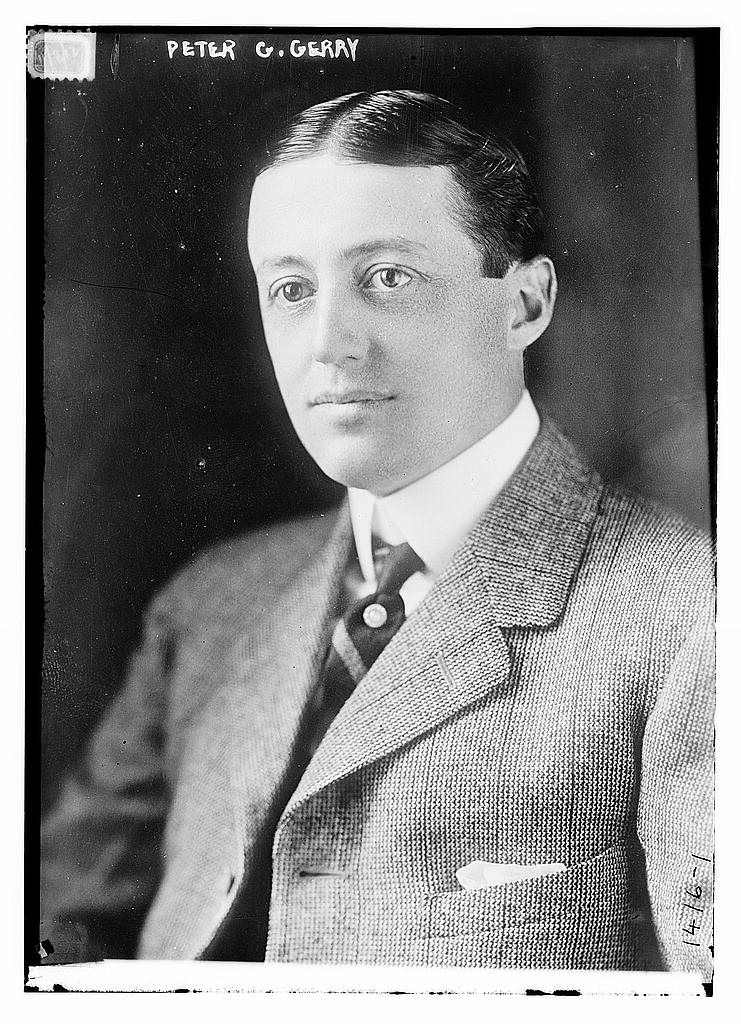
Peter G. Gerry was a clear beneficiary of the 17th Amendment. Had it not been enacted, Republican incumbent Henry Lippitt would have been a shoo-in for reelection in 1916 given the composition of the state legislature.

Every once in a blue moon we will hear a conservative call for the return of election of senators by state legislatures, although there will be no serious concerted movement towards this end, as it would require a constitutional change, and there is only one amendment that has ever been repealed in American history. After the Senate adopted the 17th Amendment, pushed strongly by progressives, it was ratified in 1913. Thus, the first Senate elections that would fall under the popular vote were in 1914. A question that came to my mind was did this have a significant ideological impact in the first elections?

In order to make this determination, I had to find out what party controlled the legislatures of these states, something that was a bit more difficult to accomplish than you might think and involved a mix of finding out who state House speakers were and who Senate presidents or pro tems were through Wikipedia or sources provided by state governments. Although it was by and large true that the voters of the states voted in the same party direction as their state legislatures would have, it is also true that the differences happened primarily in one direction: towards the Democrats. The only case I could find in which this arrangement benefited Republicans was the 1916 election in Maryland. A borderline case was the 1916 election in Delaware, which was won by Democrat Josiah O. Wolcott. The state House was Democratic, but the Senate was Republican at the time they would have been able to vote on a senator. Thus, whether the victor would have been a Democrat or Republican under the old rules is up to conjecture. However, I have my doubts that Republican incumbent Henry du Pont would have survived this process given that whoever got in would have likely been a compromise candidate, and it is unlikely that du Pont was someone that Democrats would have agreed to.

The 1914 Midterm: The Popular Vote Has Its Impact

Despite 1914 being a good midterm for Republicans in the House, the 17th Amendment resulted in Republicans losing rather than winning seats in that chamber. Democratic gains attributable to the 17th Amendment include the elections of James Phelan in California, Charles Thomas in Colorado, Francis Newlands in Nevada, George Chamberlain in Oregon, Edwin Johnson in South Dakota, and Paul Husting in Wisconsin. Had Senate elections remained with state legislatures, Republicans would have had a net gain of 3 rather than a net loss of 3. There is also a question surrounding the election in Illinois, as Republican Lawrence Sherman prevails, but the Illinois legislature is divided. Thus, whether Republicans would have won with the old system in this case is questionable. Also of issue in this is that the Progressive Party was running candidates and thus splitting elections for Republicans. Had the Progressive Party been taken out of the equation, it is hard to say what the results would have been.

The 1916 Midterms:

The 1916 midterms resulted in a net gain of 2 for Democrats because of the 17th Amendment. They achieved what they couldn’t in state legislatures with Andrieus Jones of New Mexico, Peter Gerry of Rhode Island, and John B. Kendrick of Wyoming, and only possibly Josiah O. Wolcott in Delaware given the divided legislature. Republicans made their gain with Maryland’s Joseph France.

The 1918 Midterms:

The impact of the 1918 midterms was +2 for Democrats in Massachusetts with David I. Walsh and Montana with Thomas J. Walsh and +1 in a special election in Idaho with John F. Nugent.

The 17th Amendment had an intention as well as its impact, that was at least in part to increase the power of progressives (in this case it was Wilsonian progressives). However, it did not turn out of office some of the conservatives proponents most wanted out, such as Republican leader Jacob Gallinger of New Hampshire and Pennsylvania’s Republican boss Boies Penrose in 1914. Indeed, although the latter had opposed the change, he found himself having an easier time with voters than his fellow politicians. After yet another win in 1920, he said to a reformer friend, “Give me the People, every time! Look at me! No legislature would ever have dared to elect me in the Senate, not even at Harrisburg. But the People, the dear People, elected me by a bigger majority than my opponent’s total vote of half a million. You and your ‘reformer’ friends thought direct election would turn men like me out of the Senate! Give me the People, every time!” (Kennedy) 

References

Kennedy, J.F. (1956, February 21). Remarks of Senator John F. Kennedy at the New York Herald Tribune Luncheon. New York, New York. John F. Kennedy Presidential Library and Museum.

Retrieved from

https://www.jfklibrary.org/archives/other-resources/john-f-kennedy-speeches/new-york-ny-herald-tribune-luncheon-19560221

The 1916 Election: A Close Shave

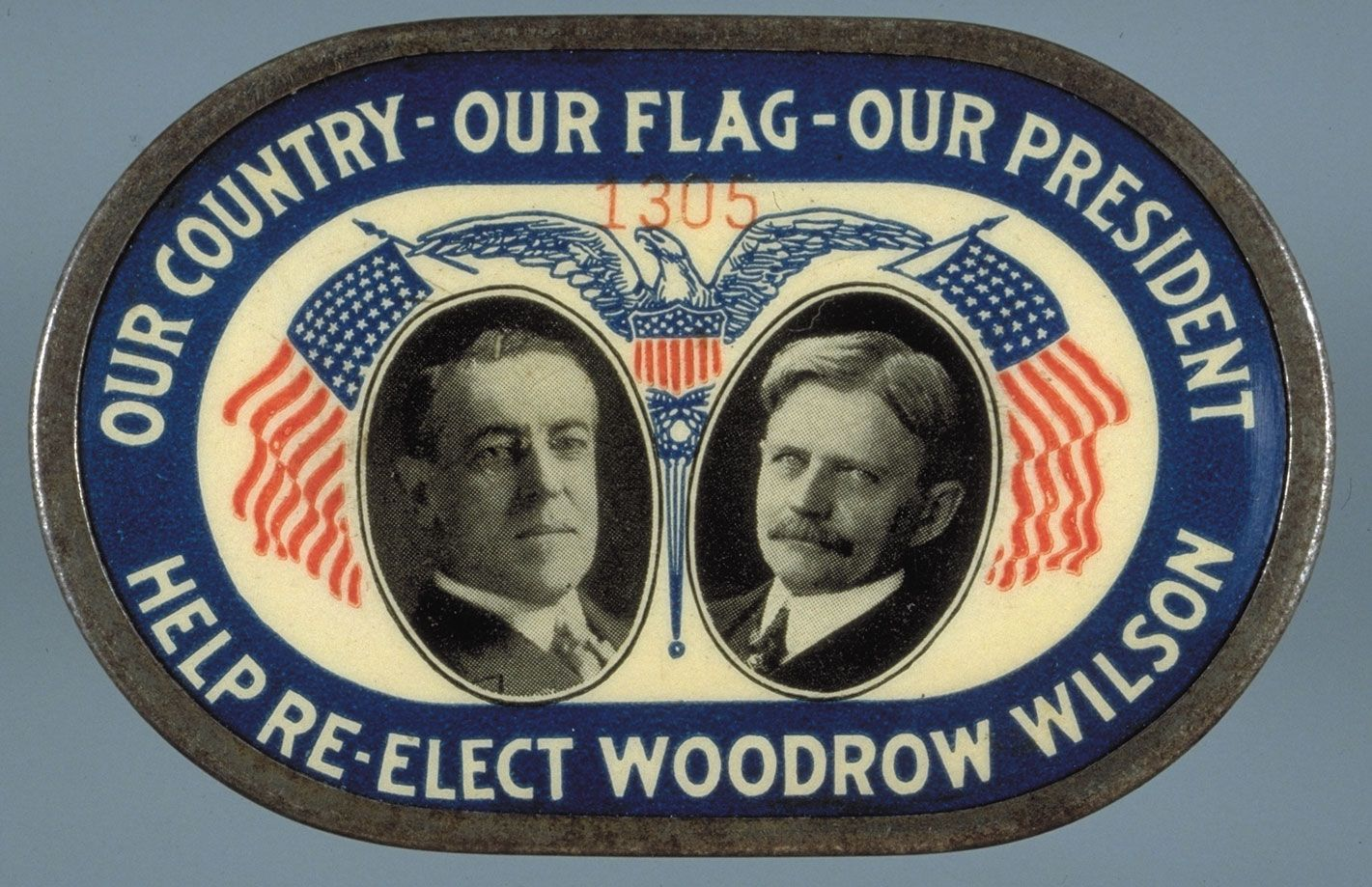
Although by 1916, Woodrow Wilson is a solid figure in the progressive era, particularly given his support of legislation aimed at the working man, such as the Adamson Act for maximum hours for railroad workers, this is still the era in which Republicans are dominating the presidency so he will have a tough fight. Although Republicans didn’t win majorities in the 1914 midterm, they did well nonetheless and established that they remained a force to be reckoned with. Wilson keeps his vice president, former Indiana Governor Thomas R. Marshall, while the Republicans select Justice Charles Evans Hughes, this being the one time that a party has nominated a justice of the Supreme Court and that a justice has resigned to run for president. Unlike Salmon P. Chase in the 1860s and 1870s, Hughes had not seen the Supreme Court as a steppingstone to the presidency. The candidate for vice president was again Indiana’s Charles W. Fairbanks, who had served as Theodore Roosevelt’s vice president and was known as a conservative stalwart. Although there were thoughts that the Progressive Party would run a candidate, Theodore Roosevelt was fully behind Hughes and refused to accept the party’s nomination for president, thus the Progressive Party was effectively hobbled, and although many Progressives went along with Roosevelt there were several prominent ones who went with Wilson. Wilson campaigned on having kept the United States out of war and for the measures he had gotten into law for working class Americans, while Hughes criticized Wilson’s intervention in Mexico, called for military preparedness, and voiced opposition to the Adamson Act.

Hughes campaigned considerably more to the conservative side of the GOP than the progressive side, and this approach may have been the difference between victory and loss in California. Hughes campaigned with party conservatives in California and thought he could pass on meeting with progressive Governor Hiram Johnson, who opted not to give an endorsement, and afterwards very narrowly lost the state. Indeed, Wilson’s performance west of the Mississippi was strong; of those states only Oregon and South Dakota voted for Hughes. This plus the Solid South won Wilson a second term. Hughes performed strongly in the Northeast with Wilson only pulling off New Hampshire and won 7 of the 11 Midwestern states.  Although by the popular vote, Wilson had won by three points, if Hughes had won California he would have won the electoral vote and it would thus become the fourth time in the nation’s history that the candidate who got the highest popular vote didn’t win the election (that would have to wait until Bush v. Gore!). This would also be the last election in which North Dakota and South Dakota voted differently (seriously guys they’re not the same!). This election did prove something important; Democrats could win an election on Wilson himself given the lack of the Republican split.

The Senate

Democrats lose a net of two Senate seats in this election. Republicans gain some seats but lose others, and this leaves Democrats with a still comfortable 54-42 majority.

Republican Gains

In Indiana, Majority Leader John W. Kern lost reelection to Republican Harry S. New, part of the Republican sweep of the state.

In Maine, Charles F. Johnson lost reelection to Republican Frederick Hale, the son of Eugene Hale, the man he had defeated in 1910. The state had reverted back to its traditionally Republican politics.

In Maryland, Republican Joseph I. France defeated Democratic Congressman David J. Lewis, the latter who would later play a key role in crafting Social Security.

In New Jersey, James E. Martine, a Democrat who had been a bit of a thorn in the side of President Wilson, lost reelection by 16 points to Republican Joseph Frelinghuysen. Indeed, New Jersey was a bit of a disappointment for Wilson.

In New York, Republican William M. Calder defeats Democrat William F. McCombs for the open Senate seat.

Democratic Gains

In Delaware, Republican Henry du Pont lost reelection to Democrat Josiah Wolcott despite Wilson losing the state.

In New Mexico, Republican Thomas B. Catron lost renomination to the younger Frank A. Hubbell, who lost the election to Democrat Andrieus A. Jones.

In Rhode Island, Republican Henry F. Lippitt lost reelection to Democrat Peter G. Gerry, the first time a Democrat has been elected to the Senate since before the Republican Party’s existence. It is also the first time that Rhode Island had a vote of the people for their senator. Gerry ran considerably ahead of Wilson, who lost the state.

In Utah, Republican George Sutherland lost reelection to Democrat William H. King by 17 points. Wilson ran two points ahead of King. President Warren G. Harding would place Sutherland on the Supreme Court. Wilson had won the state, in contrast to it being one of President Taft’s two victories in 1912.

In West Virginia, Democrat William Chilton lost reelection to Republican Congressman Howard Sutherland. Wilson had lost the state.

In Wyoming, Republican Senator Clarence Clark lost reelection to Democrat John B. Kendrick by 6 points. Wilson had won the state.

Lost Renominations

In Minnesota, Progressive Republican Moses Clapp lost renomination to the more establishment-friendly Frank B. Kellogg, who won the election.

In Tennessee, Democrat Luke Lea lost renomination to Congressman Kenneth McKellar. McKellar was the junior partner of the powerful Crump machine in Memphis, and he would have a long career, being involved in secretly securing funding for the atomic bomb project and staying in office until 1953. The man who would defeat him in his primary in 1952? Albert Gore Sr.

House

The House provided a rather interesting situation, as Republicans overall made gains and they actually won one more seat than the Democrats. However, there were more than two parties in the House. Socialist Meyer London of New York, Progressives John Elston of California, Whitmell Martin of Louisiana and Melville Kelly of Pennsylvania, and the Prohibitionist Charles Randall of California caucused with the Democrats, giving them the majority.

Democratic Gains

In California, Democrats gain one seat in the 1st district as Clarence F. Lea succeeds the retiring Independent William Kent.

In Connecticut’s 1st district, future Senator Augustine Lonergan unseats Republican incumbent P. Davis Oakey.

In Delaware, Democrat Albert Polk very narrowly edges out incumbent Thomas W. Miller. Miller would later become one of the corrupt officials in the Harding Administration.

In New Mexico, Republican Benigno Hernandez loses reelection to Democrat William B. Walton.

In New York, Democrat Daniel C. Oliver defeated Republican incumbent William S. Bennet in the 23rd’ district. In the 28th district, Democrat George Lunn succeeded retiring Republican William Charles in the 30th district. Lunn had previously been the Socialist mayor of Schenectady and had been persuaded to switch to run for Congress.

In North Carolina’s 10th district, Republican James J. Britt loses reelection to Democrat Zebulon Weaver. The election is challenged, and Britt does win the challenge, but only serves the last two days of the term as Weaver indisputably wins the 1918 election.

In Ohio, Republican representatives J. Edward Russell, Edwin Ricketts, Seward Williams, and William C. Mooney are defeated for reelection by Benjamin Welty, Horatio Claypool, Elsworth Bathrick, and George White in the 4th, 11th, 14th, and 15th districts respectively.

In Pennsylvania, retiring Republican C. William Beales is succeeded by Democrat Andrew Brodbeck in the 20th district while Republicans Robert Hopwood and Andrew Barchfeld are defeated for reelection by Democrats Bruce F. Sterling and Guy Campbell in the 21st and 32nd districts.

In Utah, Republican Joseph Howell of the 1st district retires and Democrat Milton Welling succeeds him.

Republican Gains

In California, Republican Henry Z. Osborne wins the election to succeed Progressive William P. Stephens in the 10th district.

In Illinois’ 7th, 14th, 16th, and one of the at-Large districts, Democrats Frank Buchanan, Clyde Tavenner, Claude Stone, and William E. Williams lose to Republicans Niels Juul, William Graham, Clifford Ireland, and William E. Mason respectively.

In Indiana’s 2nd, 5th, 6th, 8th, 9th, 11th, and 12th districts Democrats lose seats. In the 2nd, 5th, 6th, 11th, and 12th William Cullop, Ralph Moss, Finly Gray, George Rauch, and Cyrus Cline lose to Republicans Oscar Bland, future secretary to Calvin Coolidge Everett Sanders, Daniel W. Comstock, Milton Kraus, and Louis Fairfield. In the 8th and 9th incumbents John Adair and Martin Morrison retire and are succeeded by Republicans Albert Vestal and Fred Purnell.

In Iowa, the only Democratic incumbent, Thomas J. Steele of the 11th district, loses to Republican George Scott.

In Kansas, Democrat Joseph Taggart of the 2nd district loses reelection to Republican Edward C. Little.

In Maine, Democrat Daniel McGillicuddy of the 2nd district loses reelection to Republican Wallace White. White would sponsor the first major radio regulation legislation in 1926 and he would serve as Senate Majority Leader from 1947 to 1949.

In Maryland, Republican Frederick Zihlman succeeds Democrat David J. Lewis, who lost the Senate election.

In Michigan’s 2nd district, Republican Mark Bacon defeats Democrat Samuel Beakes. However, Beakes successfully contests the election and the House seats him in the middle of the session.

In one of Montana’s at-Large districts, Republican Jeanette Rankin succeeds Democrat Tom Stout. She is the first woman to ever be elected to Congress and she would gain a deserved reputation as anti-war.

In New Jersey’s 6th district, Republican John Ramsey succeeds retiring Democrat Archibald Hart.

In New York’s 14th, 18th, 24th, and 42nd districts, Democratic incumbents Woodson Oglesby, and Daniel Driscoll lose reelection to Fiorello La Guardia, George Francis, Benjamin Fairchild, and William F. Waldow. Interestingly, of these three districts, the first four were in New York City, a bit of a subversion of expectations I would say! La Guardia would become one of New York City’s most famous and many historians argue, the best of their mayors.

In Ohio’s 2nd district, Republican Victor Heintz succeeds retiring Democrat Alfred G. Allen.

In Oklahoma’s 1st district, Republican Thomas Chandler defeats Democrat James Davenport for reelection. Tulsa is in this district and it is a strong swing district; until the 1932 election it would repeatedly change parties.

In Pennsylvania’s 12th and 19th districts, Republicans Thomas Templeton and John Rose defeat Democrats John Casey and Warren Bailey respectively. In the 25th district, Republican Henry Clark succeeded retiring Democrat Michael Liebel.

In West Virginia, Republican Stuart F. Reed gained the open seat of the 3rd district.

In Wisconsin’s 2nd, 6th, and 9th districts, Republicans Edward Voigt, James H. Davidson, and David Classon would defeat Democratic incumbents Michael Burke, Michael Reilly, and Thomas Konop, making the state’s House delegation all-Republican.

Other Gains

In Massachusetts, 9th district Republican Ernest W. Roberts lost reelection to Independent Alvan T. Fuller, who would later be a controversial Massachusetts governor over his handling of the Sacco and Vanzetti case.

In Pennsylvania, Progressive Melville Kelly defeated Republican incumbent William Coleman in the 30th district.

Lost Renominations

In Florida’s 3rd’ district, Democrat Walter Kehoe prevails over Emmett Wilson.

In Georgia’s 12th district, Democrat William Larsen defeats Dudley M. Hughes.

In one of Idaho’s two at-Large seats, Republican Robert McCracken is defeated for renomination by Burton French.

In Michigan’s 10th district, Republican George Loud is defeated for renomination by Gilbert Currie.

In Minnesota’s 5th district, conservative incumbent George R. Smith loses renomination to Progressive Republican Ernest Lundeen.

In New York’s 39th district, Republican Henry Danforth loses renomination to Archie Sanders.

In Pennsylvania’s 22th district, Republican incumbent Abraham Keister would lose renomination to Edward Robbins. Robbins would be one of three members of Congress who would die from the influenza pandemic. Republican S. Taylor North would also lose renomination in the 27th district to Nathan Strong.

In South Carolina’s 3rd district, Democrat Wyatt Aiken lost renomination to Frederick Dominick.

In Texas, Oscar Callaway, John Stephens, William Smith, and James Davis of the 12th, 13th, 16th, and At-Large districts lost renomination to James Wilson, J. Marvin Jones, Thomas Blanton, and Daniel Garrett respectively. Jones would sponsor the Agricultural Adjustment Act during the Roosevelt Administration and would be a champion of overall New Deal farm policy. Blanton would, as mentioned in a previous post, be a controversial figure and was even considered for expulsion from Congress for putting foul language in the Congressional Record.

President Wilson and the next Congress would have to contend with World War I and all the difficulties that arose from it, including taking control of railroads, the Espionage and Sedition Acts, and the influenza pandemic.  

References

1916 United States House of Representatives elections. Wikipedia.

Retrieved from

https://en.wikipedia.org/wiki/1916_United_States_House_of_Representatives_elections

1916 United States presidential election. Wikipedia.

Retrieved from

https://en.wikipedia.org/wiki/1916_United_States_presidential_election

1916 United States Senate elections. Wikipedia.

Retrieved from

https://en.wikipedia.org/wiki/1916_United_States_Senate_elections

The 1936 Election – Democrats Dominate, Republicans Wrecked

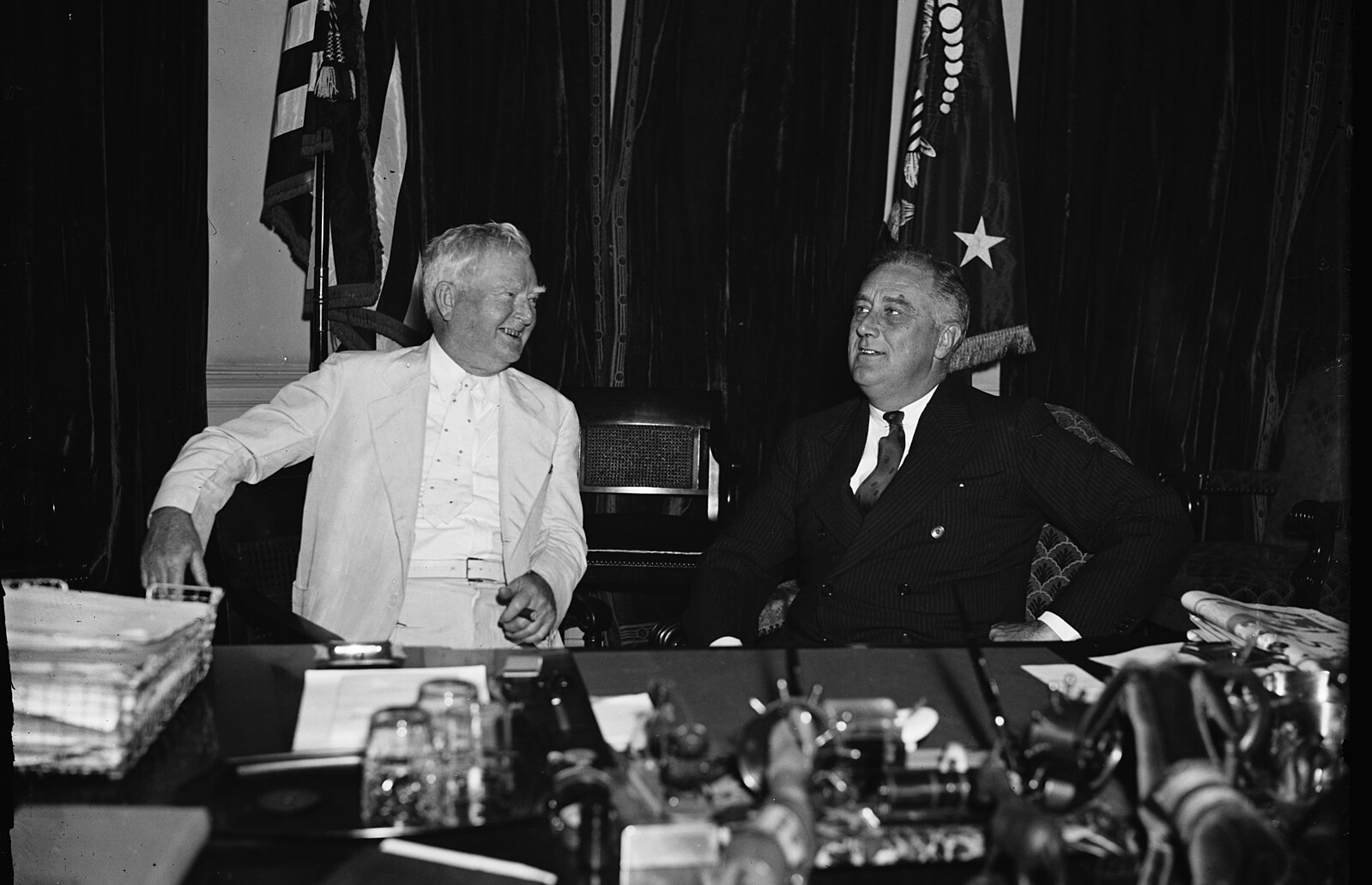
Vice President John Nance Garner and President Franklin Delano Roosevelt, the winners.

Every once in a while if things go badly for the GOP, some columnist will predict the end of the party. It turns out that Republicans are highly resilient, a lesson that should have been learned by the 1936 election, in which after they were at their lowest level of power since their foundation. The most obvious demolishing was FDR over Alf Landon. Landon, who ran on the slogan of “Life, Liberty, and Landon” and really had no issues to campaign on to effect save for critiquing government inefficiency and calling for less spending. FDR and his New Deal were so popular that he won over 60% of the vote and even defeated him in his home state of Kansas, winning every state except Maine and Vermont. Vermont at the time was the most Republican state in the nation and Maine had been strongly Republican save for a brief Democratic surge in the early 1910s. Many people had bad memories of the Hoover presidency and the Republicans were just not presenting an alternative that appealed to many at the time. As Virginia Senator Carter Glass quipped after the result, “It is well nigh impossible to beat a five billion dollar campaign fund”, referencing work relief spending (Hill). What’s more, money was short. What they could achieve was largely thanks to money provided from wealthy American Liberty League members. RNC chairman John D.M. Hamilton attested to this when after the election he said, “Without Liberty League money, we wouldn’t have had a national headquarters” (Pietrusza).

Democratic Gains:

In California, Republicans lost three seats. The 4th district’s (San Francisco) Florence Kahn was defeated by Progressive Franck Havenner, Sam Collins of the 19th district was defeated by Democrat Harry Sheppard, and the Democrats gained the open 20th district with Edouard Izac.

In Connecticut, down went both of the state’s House Republicans, William Higgins of the 2nd district to Democrat William Fitzgerald and Republican Schuyler Merritt of the 4th district to Democrat Alfred Phillips. However, the octogenarian Merritt had chosen not to campaign as he wasn’t that interested in reelection.

In Delaware, Republican Senator Daniel Hastings, definitely the most staunchly anti-New Deal of the senators, lost reelection to Democrat James Hughes. Republican freshman John G. Stewart also lost reelection to Democrat William F. Allen. Delaware’s sole seat would swing between the parties throughout the Roosevelt presidency.

In Michigan, Democrats picked up a seat, as Republican James Couzens, who had endorsed FDR for his reelection, had lost renomination in 1936 and then died. Democratic Congressman Prentiss Brown was elected. Republicans also incurred losses in the 6th and 13th districts, with Republicans William W. Blackney and Clarence G. McLeod losing reelection to Democrats Andrew Transue and George O’Brien. Blackney and McLeod would return in 1938.

In Minnesota, the Farmer-Labor Party’s Dewey Johnson picked up the open 5th district from the GOP, and Republican William Pittenger lost reelection in the 8th district to the Farmer-Labor Party’s John Bernard. Pittenger would return in 1938.

In New Hampshire, Democrat Alphonse Roy lost an election to the 1st district, which was open, to Republican Arthur B. Jenks, but this election was contested and the Democratic majority House voted to seat Roy towards the end of the 75th Congress. Jenks would win in 1938.

In New Jersey, Republican Senator William Barbour would lose reelection to Democrat William Smathers. However, Barbour would return in the 1938 election. House Republicans Isaac Bacharach of the 2nd district, Peter Cavicchia of the 11th district, and Frederick Lehlbach of the 12th district lost reelection to Democrats Elmer H. Wene, Edward O’Neill, and Frank Towey respectively.

In New York, Vito Marcantonio of the 20th district lost reelection to Democrat James Lanzetta. However, Marcantonio would make a comeback in 1938 as a member of the American Labor Party.

In Ohio, Republican representation in the House was reduced to two, as Republicans John Hollister of the 1st district, William Hess of the 2nd district, Leroy Marshall of the 7th district, John Cooper of the 19th district, and Chester Bolton of the 22nd district lost reelection to Democrats Joseph Dixon, Herbert Bigelow, Arthur Aleshire, Michael Kirwan, and Anthony Fleger respectively. Hess and Bolton would return in the 1938 election.

In Oregon, Portland’s Republican Congressman William Ekwall of the 3rd district would lose reelection to Democrat Nan Honeyman.

In Pennsylvania, a significant development occurred in Philadelphia: with the loss of all its Republican representatives, the city of brotherly love became represented entirely by Democrats! Republicans Harry Ransley of the 1st, William H. Wilson of the 2nd district, Clare G. Fenerty of the 3rd district, and George Darrow of the 7th district lost reelection to Democrats Leon Sacks, James McGranery, Michael Bradley, and Ira W. Drew respectively. Only Darrow would return in the 1938 election. Also losing in Pennsylvania were Charles Turpin of the 12th district and Isaac Doutrich of the 19th district to Democrats J. Harold Flannery and Guy J. Swope respectively.

In Rhode Island, Republican Senator Jesse Metcalf lost reelection to Democrat Theodore Green as did the 1st district’s Republican Charles Risk to Democrat Aime J. Forand. Risk would return in the 1938 election, but after 1940 no Republican would win a Senate seat from Rhode Island until 1976, and no Republican would get a House seat until 1980.

In Wyoming, Republican Senator Robert Carey lost reelection to Democrat Harry Schwartz. It was just as well, as he died only two months later.

Republican Gains

Not all was bad for Republicans in this election, although the wins they had far from made up for their big losses.

In Iowa, Republican Cassius C. Dowell, who had lost reelection in 1934, came back in winning the open 6th district.

In Kansas, Republican Edward H. Rees won the open 4th district.

In Maine, Republican James C. Oliver defeated Democrat Simon Hamlin for reelection in the 1st district, while Republican Clyde H. Smith won the open 2nd district. Yep, the Republicans did well in Maine!

In Massachusetts, Republicans scored their only Senate seat pickup: Republican Henry Cabot Lodge Jr. defeated Democrat James M. Curley. Roosevelt had come to despise Curley and his corrupt machine ways and refused to lift a finger for him. Republicans also picked up the open 2nd district with Charles R. Clason and Republican Robert Luce came back in the 9th district after his defeat by Democrat Richard Russell in 1934.  

In New York, Democrat Fred Sisson of the 33rd district lost reelection to Republican Fred Douglas.

In Ohio, Democrat William Fiesinger of the 13th district lost renomination, and Republican Dudley White won the seat.

 In Pennsylvania, Democrats Charles Dietrich of the 15th district and Denis J. Driscoll of the 20th district lost reelection to Republicans Albert Rutherford and Benjamin Jarrett respectively.

In South Dakota, Democrat Theodore Werner of the 2nd district was defeated for reelection by Republican Francis Case.

Renomination Losses

In Alabama’s 9th district, George Huddleston, who had served since 1915 and had become a critic of the New Deal, lost renomination to staunch New Deal liberal Luther Patrick. Since Alabama was a one-party state at the time, this was tantamount to election victory.

Multiple Democrats in Louisiana lost renomination, including Numa Montet in the 3rd district to Robert Mouton, Riley Wilson of the 5th district to Newt Mills, and Jared Y. Sanders Jr. in the 6th district to John K. Griffith.

In Michigan, Republican Verner Main of the 3rd district lost renomination to Paul Shafer, who won the seat.

In Missouri, Democrat James Claiborne of the 12th district, one of the least loyal Democrats, lost renomination to Charles Anderson, who won the seat.

In New York, Democrat Richard Tonry of the 8th district lost renomination to Donald O’Toole, who won the seat.

In Ohio, Democrat Warren Duffey of the 9th district lost renomination to John F. Hunter, who won the seat.

In Oklahoma, Democrat Percy Gassaway of the 4th district lost renomination to Lyle Boren, who won the seat.

In Pennsylvania, multiple Democrats lost renomination. Democrat William Richardson of the 14th district went down to Guy Moser, who won the seat. William Berlin of the 28th district also lost renomination to Robert G. Allen as did J. Twing Brooks of the 30th district to Peter De Muth. In Pennsylvania’s 32nd district, Theodore L. Moritz opted to run for reelection as a Progressive after losing renomination, but lost to Democratic nominee Herman P. Eberharter. In the prior two cases, the winners would turn out to be considerably more conservative than their predecessors.

In Texas, the voters of the 17th district finally had enough of Democrat Thomas Blanton being a lightning rod of controversy and dumped him for Clyde Garrett, who won the election.

In Virginia, Democrat Colgate Darden of the 2nd district, who had voted against Social Security, lost renomination to Norman Hamilton, but he would return in the 1938 election.

This election had significance not only as a public endorsement of the New Deal overall, but also as a signal to the Supreme Court that the laws they were striking down were part of what the public supported. After this election, Roosevelt would be able to replace retiring justices, changing the ideological landscape of the court in the direction of broad interpretation of the Commerce Clause. The New Deal programs would continue and the federal minimum wage under the Fair Labor Standards Act among other measures would be enacted.

References

1936 United States House of Representatives elections. Wikipedia.

Retrieved from

https://en.wikipedia.org/wiki/1936_United_States_House_of_Representatives_elections

1936 United States presidential election. Wikipedia.

Retrieved from

https://en.wikipedia.org/wiki/1936_United_States_presidential_election

1936 United States Senate elections. Wikipedia.

Retrieved from

https://en.wikipedia.org/wiki/1936_United_States_Senate_elections

Adler, B.S. (1951, February 25). Then and Now; Alf Landon, the G.O.P.’s hope (deferred) in 1936, is today a busy, contented man. The New York Times.

Retrieved from

Hill, R. (2013, January 27). Carter Glass of Virginia. The Knoxville Focus.

Retrieved from

http://knoxfocus.com/archives/carter-glass-of-virginia/

Pietrusza, D. (1978, January 1). New Deal Nemesis. Reason Magazine.

Retrieved from

https://reason.com/1978/01/01/new-deal-nemesis/

States Do Not Stay the Same, By Parties or Ideology!

It can be highly tempting for people to say that one state has “always been conservative” or “always been liberal” to explain away party switches. But the reality is that populations shift, political priorities shift, and one party’s policies can go so strongly against a certain state’s interests that their voters move to the other party, even if in the past they had supported much of what their old party stood for. This has been demonstrably true of some states even in modern day. I will present today five examples of states, not in the former Confederacy or New England, which have had considerable evolution in their status.

Henry Clay of Kentucky, whose state and him went from being supporters of Thomas Jefferson’s Democratic-Republicans to being staunchly with the Whig Party.

Delaware

Our last president was the first from America’s first state of Delaware. Since 1992, the state has voted Democratic and since 1996 it has done so by double digits save for 2004. Delaware also now has the distinction of having elected the first member of Congress to identify as trans. The state’s Democratic dominance would have been absolutely unthinkable during the time of the foundation of the Democratic Party itself.

Delaware had been one of the most loyal states to the old Federalist Party, only voting for the Democratic-Republicans in the 1820 election in which James Monroe had no substantive opposition. Delaware was also a reliable state for the Whig Party until 1852, when all but four states voted for Democrat Franklin Pierce. Normally, Delaware voters would be supportive of the economic philosophy that guided both the Federalists and the Whigs; an adherence to Alexander Hamilton’s American System. This being imposing tariffs both for protection of domestic industry and to fund internal improvements for the purpose of expanding national growth. The Whig’s successor party, the Republican Party, would embrace the same. However, Delaware was a tough state for Republicans because it was a slave state. Although slavery was not practiced by most families in the state by the start of the War of the Rebellion, many voters still defended the “peculiar institution” and the political of the power of the state lay with its defenders. During the war, its voters elected Unionist politicians to the House, but its senators were Democratic and defenders of slavery in Willard Saulsbury, James A. Bayard, and George Riddle. From 1865 to 1895 all of its governors were Democrats, and until the 1889 election all its senators Democrats. What changed in Delaware was that more blacks were becoming middle class, thus making the issue of race less salient. What’s more, a certain prominent family moved their operations to Delaware and bankrolled the state’s Republican Party in the du Ponts. Although in 1888, Delaware had voted for Democrat Grover Cleveland by nearly 12 points, an ominous signal of times ahead for the Democrats came in the next election, in which Cleveland won, but by only 1.5 points. This was an election in which incumbent Benjamin Harrison was unpopular and Cleveland scored unexpected wins in states that had consistent records of Republican voting in Illinois and Wisconsin, the former having voted Republican since 1860 and the latter having done so since its first presidential election in 1856. Delaware’s politicians, be they Democratic or Republican, had records of opposition to inflationary currency, and the economic depression as well as the Democrats shifting towards the left by picking William Jennings Bryan, a proponent of currency inflation through “free coinage of silver” (no limits on silver content in coinage), left Delaware cold. McKinley won the state by 10 points in 1896.

The 1896 election kicked off a period of Republican dominance. Until 1936, save for the 1912 three-way election, Delaware voted for the Republican candidate. Henry du Pont and his cousin Thomas were elected to the Senate during this period, and during FDR’s first term, its senators, Daniel Hastings and John Townsend, were the most consistent opponents of the New Deal in the Senate and voted against Social Security. However, FDR’s appeal even penetrated Delaware; Hastings would lose reelection in 1936 and Townsend in 1940. However, in 1948, Delaware would return to the Republican fold in voting for Thomas Dewey. The state would vary in its voting behavior through 1988, and it would go for the Democrat in the close 1960 and 1976 elections. Since 1993, Delaware has had only Democratic governors, and it has not elected a Republican to the Senate since 1994 nor to the House since 2008. A big part of the state’s shift towards the Democrats was that from 1990 to 2018, the black population of Delaware increased by 47% (Davis). Since 1964, black voter support for Republican presidential candidates has not surpassed 15%. Delaware does not look like it will turn away from the Democrats any time soon.

Iowa

Admitted to the Union in 1846, Iowa started existence as a Democratic state. In 1848, its voters preferred Michigander Lewis Cass to Whig Zachary Taylor. However, a significant minority of Iowa’s Democrats were staunchly anti-slavery and after the Kansas-Nebraska Act of 1854, these people bolted to the newly formed Republican Party. The GOP’s most prominent politician in the latter part of the 19th century and for a few years in the early 20th was Senator William B. Allison, who would be part of the Senate’s leadership during the McKinley and Roosevelt presidencies. Until 1912, Iowa would without fail vote for Republican presidential candidates and would not do so again until 1932. From 1859 until 1926, all of its senators were Republicans, and the 1926 case was because Republicans had split over their nominee, Smith W. Brookhart, who was on the party’s liberal wing. Iowa Democrats made significant headway during the 1930s, with the state even having two Democratic senators from 1937 to 1943. However, the state was moving against Roosevelt and its voters were strongly against American involvement in World War II, preferring the Republican candidate in 1940 and 1944. There was a bit of a surprise when Truman won the state in 1948, something that can be credited to his effective appeals to Midwestern farmers and painting the Republican 80th Congress as bad for their interests.

Iowa nonetheless continued its Republican voting behavior in Republican presidential elections, even though the state’s party saw significant gains in the 1970s, including both Senate seats. In 1988, Iowa delivered a bit of a surprise in its vote for Democrat Michael Dukakis. Indeed, from 1988 until Trump’s victory in the state in 2016, Iowa would be Democratic on a presidential level with the only exception being Bush’s squeaker of a win in 2004. Since 2016, however, support for Republicans has only been increasing. In 2024, Trump won the state by 13 points despite that Seltzer poll. This was the best performance a Republican candidate has had in Iowa since 1972, when Nixon won with 57%.

Kentucky

Kentucky has an even more varied history as a state than Delaware. After it was first admitted, it did, as did all the other states, vote to reelect George Washington in 1792. However, when it came to choosing between Adams and Jefferson, they chose Jefferson and kept doing so up until the foundation of the Whig Party. The Whig Party had as its central founder Kentucky’s Henry Clay, who at one time had been part of Jefferson’s Democratic-Republicans but had opposed the rise of General Andrew Jackson.

Kentucky’s issue with sticking with the successor party was the same as Delaware’s: it was a slave state. It remained in the union but its voters were staunch foes of the GOP. Kentucky did not vote Republican until 1896, and did so narrowly, a product of the economic depression and Democrat William Jennings Bryan’s inflationary currency stance. Although this looked like an opening and indeed Republicans had a few successes in electing governors, the state maintained its Democratic character up until 1956, its voters having only seen fit to vote Republican in 1924 and 1928. The 1956 election was quite successful for Dwight Eisenhower and Republicans, including in Kentucky. Not only did the state vote for him, they also voted in two Republicans to the Senate in John Sherman Cooper and Thruston B. Morton. However, their brand of Republicanism was much more moderate than what we see from Kentucky’s GOP today. Republicans followed up their 1956 win with Nixon’s 1960 win of the state. From 1956 onward, Kentucky did not vote for a Democratic candidate for president unless he was from the South. The last time the state voted for the Democrat was Bill Clinton in 1996. Nonetheless, the state party remained strong, and from 1975 to 1985 both of its senators were Democrats. However, this was broken with the election of Mitch McConnell in 1984, and Democrat Wendell Ford retired in 1999. To this day, Ford is the last Democratic senator from the state. This Republican bent is not going away any time soon either; Trump scored the highest margin of victory that any Republican has in 2024, even surpassing Nixon’s 1972 performance. However, Kentucky does still elect Democratic governors, but this puts it in a similar position to Vermont, which is highly Democratic but has happily elected Republican Governor Phil Scott.

New York

New York presents an interesting case as although recently it has voted solidly for the Democrats since 1988, it was at one time a big swing state. Indeed, New York’s vote was predictive of the winner of presidential elections until 1856, when their voters backed Republican John C. Fremont. However, this did not put them firmly in the Republican column. Indeed, Democrats had a strong presence in the state through the political organization of Tammany Hall in New York City. Republicans had a powerful machine as well in the late 1860s to early 1880s under Senator Roscoe Conkling. The electoral vote rich state became a prime target for the parties, and it resulted in Democrats picking people who were for hard currency for their presidential candidates even though their base nationwide was favorable to soft, or inflationary currency. When Democrats picked a New Yorker, they usually won the state. In 1868, they elected former New York Governor Horatio Seymour, and although the Republicans won the election, the Democrats won New York. In 1876, the same was true with their pick of Samuel J. Tilden. However, with the downfall of the Bourbon Democrats and the economic depression of the 1890s, New York voted for Republican William McKinley, beginning an era of Republicans being dominant in the state. These weren’t liberal guys either; at the start of the Harding Administration its senators were William Calder and James W. Wadsworth Jr., both staunchly conservative, with Wadsworth voting against the entirety of the New Deal in FDR’s first and second terms as a representative. However, the status of Republicans was starting to weaken with the gubernatorial elections of Al Smith and Franklin D. Roosevelt and in 1928 even though Republicans fared quite well in that election, Hoover only won the state by two points. New York would vote for Roosevelt all four times and although it would vote for Republican Thomas Dewey in 1948, this was a plurality caused by Henry Wallace’s Progressive Party getting 8.25% of the vote. New York voted for Eisenhower twice, but I would say that its Democratic era began with the election of 1960. I say this because Republicans have only won three presidential elections since then; the 49-state landslides of Nixon in 1972 and Reagan in 1984 as well as Reagan in 1980. It is true that Republicans were still able to elect some governors and managed to hold on to one of the Senate seats for 42 years, but this was because Republicans ran candidates that were far from doctrinaire conservatives. Jacob Javits, who served from 1957 to 1981, was a textbook example of a RINO, and his successor, Al D’Amato, would probably be a bit too moderate for the modern GOP’s tastes. Perhaps Republicans have some reason for optimism in the Empire State; Trump’s performance in 2024 was the best Republicans have had since 1988.

Oregon

You might have trouble believing this, but until Michael Dukakis’ win in 1988, Oregon had voted Republican for president 81% of the time. This included the close 1960 and 1976 elections and before Wilson’s 1912 win, they had only voted Democratic in the 1868 election. The state remained fairly robust for the GOP, even when faced with FDR. Although Roosevelt won the state four times, its senators were Republican for almost the entire time. Oregon’s Charles McNary was the leader of the Senate Republicans! Oregon also had Republican governors for all but six years from 1939 to 1987. However, Oregon Republicans understood that they had to make exceptions here and there on conservatism and McNary was a very moderate conservative. The Eisenhower Administration would challenge Republican rule in Oregon based on its belief in the private sector, rather than the public sector.

In 1954, the bottom began to fall out for the state GOP, and this was due to the Eisenhower Administration’s favoring private development over public development of power. It was in that year that Republicans lost the Congressional seat based in Portland and their senator lost reelection. This would be followed by two more Congressional Republicans losing reelection in 1956. The defeated senator, Guy Cordon, stands as the last conservative to represent Oregon in the Senate. Although for 27 years Oregon had two Republican senators, neither Mark Hatfield nor Bob Packwood could be considered conservatives. Gordon Smith, who represented Oregon from 1997 to 2009, was a moderate.

Although Oregon has had a strong Democratic streak since 1988, it is also true that Al Gore won by less than half a point in 2000, and Kerry won by less than five points in 2004. However, Oregon’s Democratic politics have strengthened since then, and since 2008 the Democratic candidate has won by double digits. Oregon does not look like it will be moving to the Republican column at any time in the foreseeable future.

References

Davis, T.J. (2018, December 30). Young people are changing black politics in Delaware. Delaware Online.

Retrieved from

https://www.delawareonline.com/story/opinion/contributors/2018/12/30/young-people-changing-black-politics-delaware/2123781002/


The Controversial Career of Owen Brewster

Among the states, I wouldn’t say that Maine was particularly known for making waves with the politicians its voters have sent to the Senate in the 20th century…that is, save for Ralph Owen Brewster (1888-1961). Brewster was, to put it bluntly, considered ugly, one of the ugliest men to have made it big in American politics and perhaps the ugliest since Benjamin Butler. Time Magazine (1935) would describe him as “toothy, slack-jawed” and journalist Jack Anderson in 1979 described him as “billiard-bald on top, cheerless-eyed, meaty-lipped, an appearance dark and gloomy” (Simkin). However, what he lacked in looks he made up for in hard work, diligence, and intelligence. Brewster’s success helped him get married to the daughter of one of Maine’s most prominent citizens. Although in his obituary Brewster would be most noted for his conservatism and opposition to FDR, in his earlier career he was more open to reform and change. He backed both Prohibition and women’s suffrage and initially even endorsed public ownership of water power generation in Maine. Brewster would after call for reform and would battle with holding company magnate Samuel Insull.

The 1924 Gubernatorial Election

In 1924, a rising force in American politics that had factions in both parties was the Ku Klux Klan. This was the second incarnation of the “invisible empire” and this one was the most popular. This Klan was in truth many things; it was of course racist, but it was also anti-Catholic, anti-Semitic, nativist, Prohibitionist, and Protestant group that engaged in numerous activities. These included multi-level marketing, summer camps, charity, political lobbying, and most notably in the South, exacting their brand of vigilante justice (usually night whippings) against those they regarded as violating their moral tenets. Unlike the first KKK which was seen only in the South, this Klan was nationwide, and even reached up to Maine, in which their primary prejudice was against French Canadian Catholics. Against what the Republican establishment of the state wanted, a 36-year-old Owen Brewster ran for governor with Klan support. Brewster played a bit of a game on this one; he would maintain a golden silence on the subject of the Klan unless it was to deny he was a member. Indeed, it has never been proven that Brewster was a member. He was supported by the Klan for two reasons: 1. He never condemned them when the press prompted him to do so, and 2. He supported cutting all government aid to parochial schools (which were primarily Catholic). The latter stance Brewster came to independent of the Klan, believing that this was too much government involvement in religion. He had introduced such a measure in the State Senate but it failed as its president, Frank Farrington, was opposed and convinced the Senate to vote it down (Syrett, 218). The GOP establishment of the state, represented most prominently by Governor Percival Baxter, Farrington, Senator Frederick Hale, and Representative Wallace White, were strongly against the Klan for its racial and religious bigotry. However, many white Protestant Americans at the time saw the Klan as a means for social advancement as well as a patriotic and Protestant organization. Although some state Klans had had ugly incidents of vigilantism (particularly in the South), Maine’s was not one of them. Brewster managed to win the nomination narrowly after Governor Baxter found that voter fraud had occurred in an Irish-American ward in Portland (The New York Times). At the time, winning the Republican nomination for a statewide office was tantamount to election in the strongly Republican Maine.

Brewster’s means of rising to power was something of a scarlet letter that could always be used against him. In 1925, he was the second governor to climb Mt. Katahdin (the first was his predecessor). In 1926, ever ambitious, Brewster attempted to win the special election to the Senate after the death of Bert Fernald but lost to the anti-Klan Arthur Gould. In 1928, he again attempted to win a Senate seat by trying to defeat the anti-Klan incumbent Frederick Hale in the primary, but Hale was retained with 63% of the vote. This marked the end of Klan influence in Maine, which had already been declining since the rape and murder conviction of Indiana Klan Grand Dragon D.C. Stephenson. Maine’s Klan leader, DeForest Perkins, resigned in the aftermath of the election. However, the Great Depression, although quite bad for Republican prospects, brought opportunity for Brewster.

Brewster and the Great Depression

In 1932, Brewster defeated Congressman Donald F. Snow for renomination, and this was for the best in truth as Snow would later be sent to the penitentiary for embezzlement. However, he narrowly lost the election to Democrat John Utterback. Brewster would try again in 1934, running on a platform of supporting the Townsend Plan for old age insurance, and this time he would win despite the midterm resulting in net Democratic gains. As a representative, despite his later reputation he would be far from the most conservative of Republicans, and he would support more popular measures such as Social Security and the Fair Labor Standards Act. A few of his diversions from conservatism could be seen as him looking out for his district. For instance, in 1935, he was one of five House Republicans to vote to add potatoes to the crops covered under the Agricultural Adjustment Act. One of the counties in his district, Aroostook, was one of the leading potato growers in the nation, and Brewster called them the “forgotten crop” especially since 36 million pounds of potatoes were in storage and their market value had declined from $1.37 a bushel in 1930 to $0.37 a bushel in 1935, which depressed the county (Hill). Brewster did sustain the party line on certain other subjects, such as housing policy. He also made his displeasure known about Roosevelt’s reciprocal trade policy, which most Republicans opposed, denouncing it as “Alice in Wonderland” economics (Standard-Speaker). In Brewster’s first term, he quickly stirred up controversy when in the aftermath of his conflict with the Roosevelt Administration the Passamaquoddy Tidal Power Project was canceled. He alleged that Maine representatives were pressured by brain truster Thomas Corcoran to support the “Death Sentence” clause of the Public Utilities Holding Company Act in exchange for the Roosevelt Administration’s support of the project; Brewster voted to strike the clause. This was a vote that surprised people given his efforts against holding company baron Samuel Insull as Maine’s governor. Brewster claimed his vote against was a protest against “unethical lobbying” (Hill). However, Corcoran had a witness. His side of the story, in which the “threat” was him telling Brewster that if the administration can’t count on him for the “death sentence” clause of the public utilities bill that they can’t count on him for the Passamaquoddy Tidal Power Project, was backed almost to the exact detail by witness Dr. Ernest Gruening, which made it most likely that Corcoran’s story was the accurate version of events (Time Magazine). Some constituents in Lubec were angry as they regarded Brewster as imperiling funds for the project and hung him in effigy with a sign reading, “our double-crossing Congressman” (Kansas City Journal). Nonetheless, he proved popular in his area of Maine and he was reelected in 1936. Joining him in Congress were Republicans James C. Oliver of the 1st district and Clyde Smith of the 2nd, both supporters of the Townsend Plan. Maine was one of the few places in which the 1936 election was good for Republicans.  

On to the Senate

In 1940, Senator Frederick Hale opted to retire, and this time Brewster won the nomination and succeeded him. Although generally known as a conservative, in truth, as previously noted, his career was a bit more complicated than that, as demonstrated by his support of the Townsend Plan and his interventionist record on foreign policy. Brewster largely supported FDR’s foreign policy before World War II, voting to end the arms embargo in 1939, voting for the peacetime draft in 1940, and Lend-Lease in 1941, but stopped short of supporting permitting merchant ships to enter belligerent ports. While an observer may look at his support from the KKK as evidence of bigotry, there are aspects of his record that defy this characterization; in 1950 he voted to end debate on the Fair Employment Practices bill and voted to kill a Southern effort to undermine army desegregation. Furthermore, Brewster backed increasing the number of refugees admitted to the United States, and this would include a fair number of Jews. During World War II, he was one of the senators selected by Senator Truman to serve on his committee to investigate wartime expenditures. The committee was non-partisan and won great acclaim for its successes in saving taxpayer money and uncovering corrupt practices, thus elevating Truman’s profile enough for him to be nominated vice president in 1944. In 1943, at the age of 55, Brewster decided that he would change the name he would be known by from “Ralph O. Brewster” to “Owen Brewster”. There were two possible reasons for this change; first, to honor his son who had died ten years earlier of the flu at the age of 15, and second, so that people would no longer think of “R.O.B.” when they thought of him. In 1946, Brewster sat on a joint House-Senate committee investigating the attack on Pearl Harbor. The committee concluded that the Roosevelt Administration had not failed to prepare and rather placed the blame on Admiral Husband E. Kimmel and General Walter Short. Brewster along with Michigan’s Homer Ferguson dissented, with the former writing that the late president “was responsible for the failure to enforce continuous, efficient, and appropriate co-operation” in Washington “in evaluating information and dispatching clear and positive orders to the Hawaiian commanders” (The Journal Herald, 1). Both Brewster and Ferguson believed that the inquiry was incomplete. In 1946, the Senate flipped from Democrat to Republican and Brewster was now chairing this committee.

Brewster vs. Howard Hughes

Owen Brewster has not fared well in the court of historical opinion; he was portrayed by Alan Alda in the Leonardo DiCaprio film The Aviator as a villain. As chairman of the committee, he was investigating Hughes and TWA for alleged misspending in government contracts. Hughes proved a tough opponent for Brewster and although journalist Drew Pearson, a staunch New Deal liberal, was not typically inclined to back businessmen like Hughes, he did back him against Brewster, who along with Wisconsin’s Joseph McCarthy and Tennessee’s hot-tempered Kenneth McKellar ranked among his favorite political targets in the Senate. The mood of the committee on Hughes was that he was going to be easy to deal with as he had not too long ago recovered from a major plane accident that nearly killed him (Watt, 40). However, Hughes effectively played against Brewster by making Brewster himself the issue by accusing him of using this probe to try to pressure him into merging his company with Pan Am, which would be convenient for his community airline bill. Thus, the narrative became that Brewster was corruptly carrying water for Pan Am CEO Juan Trippe rather than him conducting a good government investigation on whether a big businessman had schmoozed his way into securing government contracts during wartime only to waste taxpayer money. Brewster waived his senatorial immunity to testify, and it was a bold move and one to try to convey the message that he was being honest. In the course he did admit that the subject of a potential merger with Pan Am had come up but denied that it was being used as leverage against Hughes. However, if he was the villain in this situation and this was a bluff, it didn’t pay off as he came off worse in the court of public opinion. Both men had testified under oath and thus this was yet another incident of Brewster’s word against another’s. Furthermore, the subcommittee chairman who took Brewster’s place in continuing the Hughes matter, Senator Homer Ferguson of Michigan, was not in the best state to regulate the situation as he had poison ivy all over his feet (Watt, 41). There was also another possible motive to target Hughes…as a means of targeting the Roosevelts. The Republican 80th Congress was very keen on uncovering anything that possibly went wrong during the Roosevelt Administration and Hughes had a connection to Elliott Roosevelt, thus this was used to attack the old Roosevelt Administration (Watt, 42-43).

Campaign Financing Controversy

Republicans still thought of Brewster highly enough after the Hughes controversy to place him as  head of the Republican Senatorial Campaign Committee for the 1950 election. The results were good for the GOP, but there was a controversy regarding his neutrality in Republican primaries. Brewster was supposed to be neutral in primaries, and this meant that campaign money could not be used to fund anyone in the primaries. However, Brewster found a way to violate not the letter of the rule but the spirit of the rule by securing a $10,000 loan from the Liberty National bank in Washington and used shadowy middleman Henry Gruenwald to give $5000 each to candidates Richard Nixon of California and Milton Young of North Dakota (Quad-City Times). To his credit, it was Brewster who admitted this so this would not impact Gruenwald. Nixon did not have a contender in the primary who was actually a Republican as California at the time (and now) had an open primary, thus Democratic candidates Helen Gahagan Douglas and Manchester Boddy were also contenders. Young did have a Republican challenger in Thorstein H. Thoresen, formerly North Dakota’s lieutenant governor.

1952 Election

 In 1952, Hughes bankrolled Governor Frederick G. Payne’s primary challenge to Brewster. Payne and Brewster represented two different factions of the party. While Brewster was a strong supporter of Senator Joseph McCarthy’s anti-communist crusade and supported nominating Ohio’s conservative standard-bearer Robert Taft in 1952, Payne backed picking the more moderate and internationalist General Dwight Eisenhower. Like Eisenhower defeated Taft, Payne narrowly won the primary. The significance of Payne’s win is that this is the only time in Maine’s history that a Republican incumbent senator was defeated for renomination, further underscoring Brewster’s controversial reputation. Not only did the feud with Hughes harm him but also Drew Pearson’s charge of unseemly lobbying by Francoist Spain’s lobbyist Charles Patrick Clark to convince him as well as Rep. Eugene Keogh (D-N.Y.) to sponsor aid to Spain (Hill). Clark would beat up Pearson in retaliation. However, Brewster may have managed to deal a blow to Payne that would hang over his head as a wine bottler claimed that he paid $12,000 to a political influencer to give to Payne for his product to be placed on the shelves of government liquor stores (Hill). Brewster was alleged to be behind these accusations, but he denied it. Although as noted before, he was considered a staunch conservative, the metrics I use indicate that he had voted with the liberal Americans for Democratic Action from 1947 to 1952 20% of the time while his DW-Nominate score was a 0.271. This indicates overall moderate conservatism in his career with his later career being a bit more conservative. Brewster attempted to secure another position both in the Senate and in the White House, but neither effort was successful. In the former case this was particularly a stinging blow as it constituted a rebuke by his former colleagues. Brewster would spend the rest of his life in semi-retirement, and for the last three years of his life he went around advocating for Americans for Constitutional Action, a newly formed conservative organization that was established as a counterpart to the liberal Americans for Democratic Action. Brewster offered himself as a candidate for the Senate in 1958 should Payne have chosen not to run for reelection (Hill). However, Payne did opt to run for reelection, and he lost by over 20 points to Edmund Muskie for reasons that were described in my post last year about the Sherman Adams controversy.

A member of the Christian Science church, Brewster died suddenly while on a Christian Science retreat in Brookline, Massachusetts, on December 25, 1961. His death was unexpected, although he had been suffering from cancer.

My Opinion on Brewster

Owen Brewster was a figure who in many ways maintained a highly clean appearance. He neither smoked nor drank, no hint of scandal existed with his personal life, and he was strongly religious. However, he also had two incidents in which the issue became his word against someone else’s, and he came out on the wrong side of it, at least in the court of public opinion. Brewster also proved willing to use cunning and tricky methods to get things done, such as his underhanded using of the KKK to win public office and his usage of a shadowy middleman to funnel money to Senate candidates against the spirit of the rules of his position. He was also quite interested in taking advantage of causes that were rising in popularity, such as his surreptitious courting of the votes of KKK members, his public support for the fiscally infeasible Townsend Plan, and his support for Joseph McCarthy. Brewster’s conservatism also strikes me as perhaps a bit overly touted when his record gets examine. In all, he was a complicated figure whose personal morality sometimes contrasted with his political methods.

References

ADA Voting Records. Americans for Democratic Action.

Retrieved from

Brewster Declared Winner in Maine. (1924, August 8). The New York Times.

Retrieved from

Brewster, Ralph Owen. Voteview.

Retrieved from

https://voteview.com/person/1021/ralph-owen-brewster

Former U.S. Senator Dies. (1961, December 26). Standard-Speaker, 1.

Retrieved from

https://www.newspapers.com/image/61225510/

Hill, R. (2024). Owen Brewster of Maine. The Knoxville Focus.

Retrieved from

https://www.knoxfocus.com/archives/this-weeks-focus/owen-brewster-of-maine/

Owen Brewster Dies; Former U.S. Senator. (1961, December 26). The Journal Herald, 1.

Retrieved from

https://www.newspapers.com/image/394350317/

Sen. Brewster Tells Trick in Using ‘Conduit’. (1952, March 21). Quad-City Times, 2.

Retrieved from

https://www.newspapers.com/image/299380913/

Simkin, J. (1997). Owen Brewster. Spartacus Educational.

Retrieved from

https://spartacus-educational.com/JFKbrewsterO.htm

Syrett, J. (2001). Principle and Expediency: The Ku Klux Klan and Ralph Owen Brewster in 1924. Maine History, 39(4).

Retrieved from

The Congress: Boomerang and Blackjack. (1935, July 22). Time Magazine.

Retrieved from

https://time.com/archive/6754199/the-congress-boomerang-blackjack/

Unpardonable Sin. (1935, August 17). Kansas City Journal, 11.

Retrieved from

https://www.newspapers.com/image/1024050087/

Watt, R.Y. (1979). Oral History Interview. Washington, D.C. United States Senate Historical Office.

Retrieved from

The 1960 Presidential vs. Down Ticket Elections

I recently found a most interesting source on the 1960 election, and it is Congressional Quarterly’s breakdown of the election by district, which tells a fascinating story of the politics of the day. The politics of 1960 stand as a great contrast to contemporary politics. The parties were far more ideologically diverse, although Democrats still got more of the black vote than Republicans, Republicans could still get a significant minority, and both parties were trying to appeal to the white South. Republican Richard Nixon and Democrat John F. Kennedy compared records during the campaign to make their cases of who was the most experienced. Today, experience is often seen as a liability in Washington, as voters regularly clamor for outsiders. Only two candidates who were perceived as establishment rather than outsiders won presidential elections since 1976: George H.W. Bush in 1988 and Joe Biden in 2020, and neither of them served a second term. This was a remarkably close election, and victories could be seen for both parties in all regions of the nation. Kennedy’s top three states paint a varied picture in Rhode Island, Georgia, and Massachusetts. Richard Nixon won in some areas that are out of bounds for Republicans today, such as Portland, Oregon. Although San Francisco was Democratic, it was not as Democratic as it is today, and one of its two House seats was held by a Republican with Nixon coming close to winning that district.

Although one must acknowledge the complexities of politics in 1960 that we don’t see today, such as a substantial contingent of Southern Democrats voting more or less conservative, one sees a considerable difference between Nixon’s electoral performance and the Republicans down ticket. This was highly noticeable in the South, and there were numerous Southern districts that were overdue for a flip to the GOP. Some were predictive of future elections; Alabama’s 9th district (Birmingham), represented by George Huddleston Jr., was the only district Nixon won in the state, and in 1964 the district would flip to the GOP. Same goes for Arkansas’ 3rd district based in Fort Smith, in 1966 that district would flip to the GOP and do so for good. In Florida, Voters in half of its Congressional districts voted for Nixon, but the only House Republican elected was William Cramer of St. Petersburg. Although North Carolina voted for Kennedy, 7 of 12 of its House districts would have elected a Republican if the district vote was the same for president and Congressional candidates, while in reality only Charles Jonas of the 10th district was elected. In Tennessee, 5 of 9 of the districts voted for Nixon as did the state, yet only the standard two Republicans from the 1st and 2nd districts were elected to Congress that year. Republicans were gaining strength in suburban areas of the South, while Democrats retained their large advantage in rural areas. For instance, in Florida’s 3rd district, constituting the state’s western panhandle, Kennedy got the highest percentage of the vote of any of the districts. This area was the most culturally Deep South of any of Florida’s districts, and it would elect Democrats until 1994. This also happens to be the area that Matt Gaetz represented until last year. Among Southern states, Georgia was a great exception to the South being a battleground area, as Kennedy was spectacularly popular in the state, having an even better performance there than in his home state of Massachusetts and winning all districts, putting him narrowly over the top in the Southern vote. Indeed, the Southern vote came out 51-49 for Kennedy. This would make Georgia’s vote for Barry Goldwater in 1964 all the more jarring. However, something to note is that the black vote for Kennedy was considerably stronger than the Southern vote, which was informative for the Democratic Party as to where its future was, with him winning 68% of the demographic. A Democrat getting a figure as low as 68% in the black vote is now unheard of.

This map is also roughly predictive of where Kentucky and Oklahoma are now. In the former, Democrats only won two districts, the 1st based in Paducah which came the closest in the state to seceding during the War of the Rebellion, and the 7th, represented by liberal Carl Perkins. In the latter, only the 3rd district with Carl Albert, known as “Little Dixie”, voted for Kennedy. Yet, both states only sent one Republican to Congress from the House, although Kentucky strongly voted to reelect Republican Senator John Sherman Cooper, a popular maverick. On the state level, Missouri was strongly Democratic with both its senators and 9 out of 11 of its representatives being Democrats, but Nixon won 7 of 11 of its districts, only losing in the districts based around St. Louis and Kansas City.

In the West Coast, Nixon outperformed down ticket Republicans in California and in Oregon, winning all districts in the latter. However, Oregon’s status as a Republican state was going downhill, as President Eisenhower’s land use and private power policies were not popular among the state’s voters. Even though the state’s voters went for Eisenhower twice, Republicans in the state took a beating for it, and they since haven’t gone back to the level of power they had before the Eisenhower Administration. Washington, on the other hand, sent a curiously mixed delegation to Congress: 5 of its 7 representatives were Republican yet both of its senators were Democrats, and the state narrowly pulled the lever for Nixon. Republicans outperformed Nixon in the state, but this wouldn’t last, and by 1968, the state would be down to two House Republicans and Nixon would lose it.

Former House Speaker Joe Martin (R-Mass.), who hung on despite Kennedy winning his district on account of his status as an institution in his district.

Although Nixon outperformed Republican candidates in the Midwest and Border States and especially the South, Congressional Republicans outperformed Nixon in eight states: the aforementioned Washington, Connecticut, Massachusetts, Michigan, Minnesota, New Jersey, New York, and Pennsylvania. In Pennsylvania, prominent moderate Republican William Scranton would be elected from the Scranton-based 10th district while Nixon lost. Nixon way outperformed Republicans in the South, as voters were used to the idea of splitting their tickets. In Massachusetts, John F. Kennedy won in all of the Congressional districts and the state was his third best, but this did not translate into any defeats in the 6 House seats Republicans held nor did it result in the defeat of moderate Republican Senator Leverett Saltonstall, whose politics were pretty much perfectly calibrated for a Republican in the state; conservative enough to not tick off the GOP base but also liberal enough for him to have considerable crossover appeal. Another example of a successful Republican in the Bay State was former Speaker of the House Joe Martin, who had been in office since 1925 and who was holding on in a district that had been starting to vote Democratic as he was an institution, the many favors he had done for his constituents, and his increasingly moderate voting record. The performance of John F. Kennedy in 1960 in Massachusetts can be seen as predictive for the long-term of the state, which since 1997 has had an entirely Democratic delegation to Congress save for 2010-2013, when Republican Scott Brown served in the Senate. The only states in which Kennedy had a better performance were Georgia and Rhode Island, which reflects the highly dual nature of the Democratic Party at the time. Indeed, both candidates sought to appeal to black and Southern white votes. The House leadership team was Speaker Sam Rayburn of Texas and Majority Leader John W. McCormack of Massachusetts in what was known as the “Austin-Boston Connection”. Delaware was an interesting case, as although it gave Kennedy a victory, Republican Cale Boggs defeated Democratic Senator J. Allen Frear for reelection, but at this time Boggs was viewed as more liberal than Frear, who had often frustrated Democratic leadership with his conservative voting record. Delaware’s sole Congressman, liberal Democrat Harris McDowell, was reelected. Nixon also handily won Vermont, which at this time had the longest streak of voting for Republicans for president, but it should be noted that this would be broken in 1964 and neither its senators nor sole representative were of the conservative wing of the party.

The Strange Cases of Alabama and Mississippi

The South was competitive ground in the 1960 election, but there was a complication: the State’s Rights Party. They ran uncommitted slates of electors in Alabama, Louisiana, and Mississippi. Although not enough traction was gained for a difference to be made in Louisiana, they had impact in Alabama and Mississippi. Although they were far from the only Jim Crow states, they were the most disaffected by the civil rights movement and this impacted how the states were voting this year. Alabama had the single strangest way of voting of any state that year, as people who voted Democratic were clearly voting for a slate of electors, with some pledged for Kennedy and others not pledged, for president. The percentage of the vote tabulated in Alabama thus doesn’t technically go to Kennedy, rather Democratic electors. The Democratic electors won, and Alabama’s electoral vote was split 6 for Senator Harry F. Byrd of Virginia and 5 for Kennedy. A controversy remains to this day as to whether Nixon could be said to have won the popular vote in a plurality in Alabama because of this split.  

Mississippi was the only state that year to not cast electoral votes for either Nixon or Kennedy, with the state being won by “unpledged electors”, who cast their votes for Senator Harry F. Byrd of Virginia. Kennedy got the lowest percentage of the vote here of any state, and Mississippi would go even further in its rejection of the national Democrats in the 1964 election with 87% of its voters (at the time nearly all white) voting for Goldwater. Kennedy’s Catholicism in many areas of Mississippi was seen as suspect, and they were generally aware that he was a liberal, which didn’t play well there.

Alternative Scenario: Presidential and Down Ticket Votes Mirror Each Other

An interesting conclusion can be drawn if we present an alternate scenario in which the Republican Party down ticket is just as popular as Nixon: Kennedy would have faced a Republican House with Republicans getting 227 seats as opposed to the Democrats’ 207, although what happens in Alabama and Mississippi in this scenario is quite disputable. While the Senate would have stayed Democratic given the drubbing Republicans suffered in 1958, but they would have gained four seats instead of two. This would have made Kennedy’s presidency more difficult. The popularity of down ticket candidates for the Democratic Party can be attributed to there being many Democratic voters willing to split their tickets. Indeed, ticket splitting was far stronger in 1960 than it is today, although this is because we have what are called ideologically responsible parties with a lot less ideological wiggle room. Furthermore, back in 1960, Democrats had a 17 million voter registration advantage, far more than they have today. I have also included below a sheet that makes the data a bit easier to read than CQ’s source. Bold italics indicate Republican Congressional winners while D and R designations indicate the presidential winner of the district. Alabama is asterisked due to its unique way of counting Democratic votes, thus percentages reflect votes for Democratic electors rather than Kennedy.

1960 Election Results:

References

1960 Official Vote In Each State, All Congressional Districts. CQ Almanac 1961. Congressional Quarterly Press.

Retrieved from

https://library.cqpress.com/cqalmanac/document.php?id=cqal61-879-29204-1371757#=

1960 United States presidential election. Wikipedia.

Retrieved from

https://en.wikipedia.org/wiki/1960_United_States_presidential_election

The 1932 Election: The Triumph of Triumphs for the Democrats

The Republican Party was in terrible trouble in 1932. President Herbert Hoover was deeply unpopular and for multiple reasons; an economy in depression with over 20% unemployment and rising and a president who appeared to many voters as doing little, Hoover stubbornly clinging to Prohibition while public opinion was strongly souring on it, and the cherry on top was the disastrous dispersing of the bonus marchers. The news only seemed to be getting worse over the months. The 1930 midterms had already been bad for the GOP, with the House becoming Democratically controlled after the deaths of 14 representatives, including Speaker of the House Nicholas Longworth (R-Ohio).

On the presidential level, Democratic candidate Franklin D. Roosevelt soundly defeated Herbert Hoover, winning all but six states with 472 electoral votes and 57.4% of the popular vote, with Hoover only holding on in Connecticut, Delaware, Maine, New Hampshire, Pennsylvania, and Vermont. Only William Howard Taft’s loss in 1912 was worse for a Republican candidate. He would be on the outs in the political scene until after FDR’s death, and he was able to serve as an elder statesman.

The losses Republicans sustained in Congress were arguably more disastrous than the presidential election, with them losing a whopping 101 seats. This gave Democrats 313 seats in the House, outnumbering Republicans by nearly 200. In Colorado, Idaho, Indiana, Oklahoma, Missouri, Montana, Nebraska, Rhode Island, South Dakota, Utah, Virginia, Washington, and West Virginia Republicans suffered a complete wipeout, with all House seats going to the Democrats. Delaware’s and Nevada’s only House seats went Democratic too. Democrats had their largest gains in Illinois (seven seats), Iowa (five seats), Michigan (six seats), Ohio (seven seats), and Pennsylvania (net of seven seats). Further helping Democratic gains was the population growth in the cities, which were voting increasingly Democratic.  

Some of the most notable House freshmen in this election included Republican Everett Dirksen of Illinois, Democrat Guy Gillette of Iowa, Democrat John Dingell Sr. of Michigan, Democrat William M. Colmer of Mississippi, Republican Charles Tobey of New Hampshire, Republican William Lemke of North Dakota (Union Party candidate for president in 1936), Democrat Stephen Young of Ohio, Democrat Francis E. Walter of Pennsylvania, Democrat James P. Richards of South Carolina, Democrat Willis Robertson of Virginia, and Democrat Jennings Randolph of West Virginia.

In the Senate, Democrats won 12 seats from Republicans, a glorious result for the former and a catastrophic one for the latter. This would also be the last time Democrats ever won a Senate seat from Kansas. Notable victories for Democrats included former Secretary of the Treasury William G. McAdoo in California over incumbent Republican Samuel Shortridge, Democrat Elbert Thomas besting Republican Reed Smoot (as in, “Smoot-Hawley Tariff”) in Utah, Fred Brown narrowly dispatching stalwart conservative incumbent George Moses in New Hampshire, future Senate powerhouse Pat McCarran knocking out popular incumbent Tasker Oddie in Nevada, and Fred Van Nuys ending the career of Senate Majority Leader James Watson of Indiana. Democrat Joe Robinson of Arkansas, who had been the vice-presidential candidate in 1928, was now elevated to majority leader and would loyally shepherd the passage of major New Deal legislation in the Senate. Notable Senate freshmen included McAdoo of California and McCarran of Nevada. Democrat Hattie Caraway of Arkansas, first appointed by Arkansas’ governor after her husband’s death, was elected to a full term, the first time a woman was elected to the Senate. Of the Republicans who lost in the Senate in this election, only John Thomas of Idaho would return. With 59 senators and 313 representatives, the Democrats were more than well-positioned to enact newly elected President Roosevelt’s New Deal agenda. This was the single greatest election for the Democrats in their history, and the last one in which the House shifted by over 100 seats.

The 1932 election marked a sea change in the direction of politics in the United States. The legacy of FDR not only with numerous groundbreaking policies but also his navigation through two different major crises proved endearing, and he was highly successful at courting union workers and black voters in his direction while keeping Southern whites in the party. This would be known as the New Deal coalition, and it would hold for over three decades. Until 1994, Republicans would only win the House in two elections and the Senate in five elections and although the New Deal coalition was cracked in 1968, the Democratic brand remained solid even when their presidential candidates lost in landslides. Many people could just as easily vote for the Republican presidential candidate as they did their Democratic representative or senator.

References

1932 United States House of Representatives elections. Wikipedia.

Retrieved from

https://en.wikipedia.org/wiki/1932_United_States_House_of_Representatives_elections

1932 United States presidential election. Wikipedia.

Retrieved from

https://en.wikipedia.org/wiki/1932_United_States_presidential_election

1932 United States Senate elections. Wikipedia.

Retrieved from

https://en.wikipedia.org/wiki/1932_United_States_Senate_elections