The 1920 Election: A Massive Mandate

I’ve noticed these days that any win gets portrayed as some great mandate for leadership in a presidential election, both for the president and his party. However, there have been no elections that I would call a major mandate since Barack Obama’s win in 2008. Democrats expanded on their House majority and turned a slight Senate majority into one that could overcome a filibuster. Obama also won the states of Indiana and North Carolina, not ones that have landed in the Democratic column since. Since that election, wins have either been narrow or in the case of Obama in 2012, still having one of the House of Congress in the control of the opposing party. The 1920 election, however, was one for the ages.

Given the unpopularity of the defeated Versailles Treaty as well as a mini-depression that was occurring, it was nigh impossible for anyone to take up Woodrow Wilson’s mantle and win. Ohio’s Governor, James M. Cox, attempted it anyway. Ohio Senator Warren Harding’s call for “normalcy” resounded across the nation as the nation stood disillusioned with progressivism, tired of extensive involvement in foreign affairs, alarmed by race riots, strikes, and an anarchist bombing of Wall Street, and hurting from the depressed economy. Although old rumors that Harding had black ancestry made their way to the public, it didn’t seem to have much of an impact, and he won in a landslide, getting 404 to Cox’s 127 electoral votes. Only the states of the former Confederacy plus Kentucky backed Cox. The Solid South also had a breakaway in Tennessee, the first former Confederate state to vote for a Republican presidential candidate since Reconstruction.  Harding could fully claim a mandate, especially with the legislative results that accompanied his election.

House

The House results were catastrophic for Democrats in the North, with Republicans, already having a majority, gaining 63 seats. The following House delegations became or remained entirely Republican after the 1920 election:

Connecticut, Delaware, Idaho, Indiana, Iowa, Kansas, Maine, Michigan, Minnesota, Montana, Nebraska, Nevada, New Hampshire, New Mexico, North Dakota, Ohio, Oregon, Rhode Island, South Dakota, Utah, Vermont, Washington, West Virginia, Wisconsin, Wyoming

Pennsylvania was with one exception entirely Republican, and that exception, Guy Campbell, would vote like a Republican in the 67th Congress and subsequently switch parties.

Outside the South and Border States, Democrats were reduced to 19 representatives:

Carl Hayden, Ariz.

Clarence Lea, Calif.

John Raker, Calif.

Edward Taylor, Colo.

John Rainey, Ill.

Adolph Sabath, Ill.

Thomas Gallagher, Ill.

Peter Tague, Mass.

James Gallivan, Mass.

Charles O’Brien, N.J.

John Kindred, N.Y.

Thomas Cullen, N.Y.

Christopher Sullivan, N.Y.

Daniel Riordan, N.Y.

W. Bourke Cockran, N.Y.

John Carew, N.Y.

Anthony Griffin, N.Y.

Peter Ten Eyck, N.Y.

James Mead, N.Y.

Guy Campbell, Penn.

The Urban Areas

Republicans had massive success in urban areas, particularly shocking being in New York City, where they won a majority of the city’s districts in Congress. This feat has not been repeated since and was achievable because Tammany Hall largely sat on their hands in this election as well as some of the left-wing vote going to Socialist Party candidates arguably cost Democrats victories in New York’s 3rd, 7th, 8th, and 23rd districts. By contrast, today the only New York City district that Republicans often win is Staten Island. New York’s 12th district once again elected Socialist Meyer London, one of only two members of the Socialist Party to ever win a seat in Congress. In neighboring New Jersey, a Republican won a seat in the Northern portion of Jersey City, a feat that has only been repeated once since.

In Illinois, Republicans won all but three of Chicago’s House seats, although Chicago was considerably more Republican than it is now. Outside of Chicago, this election produced future House Speaker Henry T. Rainey’s only reelection loss.

In Ohio, Republicans won both seats in Cleveland, a feat they have yet to achieve again.

Ethnic Germans and Irish, usually rich sources for the Democratic vote in major cities, were hostile to the Versailles Treaty and to President Wilson. These groups had beefs with Britain, and yes, at that time anti-British politics were still something that could be capitalized on in the US. The result was many ethnic Germans and Irish either voted Republican or stayed home in 1920, and the Democratic machines that served these groups were not particularly willing to help the Cox/Roosevelt ticket. The degree of success Republicans had in the 1920 election in urban areas has been unheard of since.

The Border states were a disaster for Democrats too, with them only holding the staunchly Democratic 2nd and 11th districts in Missouri, the latter based in St. Louis. In Maryland, Democrats only won Maryland’s 1st and 4th districts, the latter based in Baltimore. In Oklahoma, Republicans won five of the eight House seats. The norm was for Republicans to only hold the 8th district while the 1st district, based in Tulsa, was highly competitive. The Socialist Party in Oklahoma arguably cost Democrats the 2nd, 4th, and 6th districts. Kentucky was the only state in which things were fairly normal for Democrats, with them holding 8 of 11 of the state’s House seats.  

The South remained mostly solid for Democrats, but Republicans won three seats in Tennessee that they didn’t usually win, putting Republicans on par with Democrats. The status quo of only two Republican representatives from East Tennessee would return with the 1922 election. They also won a single seat in Texas based in San Antonio, which they managed to win a few more times, as well as kept a seat in Virginia.

The Senate

The Senate Democrats took a bad lump, but the six-year terms of the Senate shielded them from worse. One retiring Democrat, Edwin Johnson of South Dakota, was succeeded by Republican Peter Norbeck, while 12 incumbents either lost reelection or renomination.

Arizona: Democrat Marcus A. Smith was defeated for reelection by Republican Ralph Cameron, making Cameron the first ever Republican elected to Congress from the young state, which at the time was usually strongly Democratic.

Arkansas – Democrat William F. Kirby lost renomination to Congressman Thaddeus Caraway, and in the South statewide the Democratic nomination contest was the real election.

California – Democrat James Phelan lost reelection to Republican Samuel Shortridge.

Colorado – Democrat Charles Thomas’s political independence resulted in him refusing to run for renomination with Democrat Tully Scot winning the primary, and then Thomas lost reelection as a member of the Nationalist Party.

Georgia – Democrat Hoke Smith lost renomination to fiery populist Thomas E. Watson.

Idaho – Democrat John F. Nugent lost reelection to Republican Frank Gooding.

Kentucky – Democrat J.C.W. Beckham lost reelection to Republican Richard P. Ernst.

Maryland – Democrat John W. Smith lost reelection to Republican Ovington Weller.

Nevada – Democrat Charles Henderson lost reelection to Republican Tasker Oddie.

North Dakota – Republican Asle Gronna lost renomination to Edwin F. Ladd, who won the election.

Oklahoma – Democrat Thomas P. Gore’s independence from the Wilson Administration cost him renomination to Congressman Scott Ferris, who lost the election to Republican Congressman John W. Harreld.

Oregon – Democrat George E. Chamberlain lost reelection to Republican Robert N. Stanfield.

The major gains of this election would result in many Republican policies being passed in the 1920s, but the extent of them would prove temporary as in 1922 Republicans would more than lose their 1920 House gains. Senate Republicans would lose seven seats. However, a Republican majority would persist in the House until the 1930 election and the Senate until the 1932 election, when the United States was in the Great Depression.
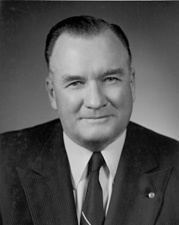
George W. Malone: The Silver State Nationalist

I have covered George Wilson Malone (R-Nev.) a little bit in the past as one of Joseph McCarthy’s closest allies in the Senate, but he is rather interesting to me because of his parochial and somewhat odd record in the Senate. Malone, although known by the effeminate nickname “Molly”, was actually rather masculine, having been an amateur boxer in his youth. An interesting personal detail, a bit of a bombshell you might say, arises about him upon research. He was married since 1921 to Katie Moslander, who was fifteen years his junior. They had a daughter in 1920, when she was 15 years old! The age of consent in Nevada was 18 years old at the time (today it is 16). Professionally, Malone was a civil and hydraulic engineer, and as the state water engineer of Nevada from 1927 to 1935 he was involved in the planning and construction of the Hoover Dam. During World War II, he was an engineering consultant for the U.S. Senate.

His first try for the Senate was in 1934, and a newspaper ad for him pledged that “A Vote for George W. Malone will be a Vote For The State of Nevada, First, Last and All of the Time” (Nevada State Journal). As his Senate career later would prove, this was a truthful ad, as he would be criticized for focusing too much on the interests of Nevada. Nevada voters would not go for his pitch this time around, as Republicans were deeply unpopular generally nationwide and Key Pittman was a giant in Nevada politics. Malone would get only 33.4% of the vote. He would try for the Senate again ten years later, this time against Democrat Pat McCarran on a staunchly pro-tariff platform, but McCarran was far too powerful, and Malone was not a better alternative for liberals displeased with McCarran, and thus he netted 41.6% of the vote.

1946 – The Year of the GOP…and Malone

For Malone, third time was the charm, and it greatly helped that 1946 was an excellent year for Republicans, who had not held a legislative majority in either chamber since the Hoover Administration. Also helping was that the Democratic primary was bitter, and enough Democrats who had voted for incumbent Edward P. Carville were unwilling to back Berkeley Bunker, and Malone won with 55.6% of the vote.

In the Senate, Malone was considered an Old Guard Republican, which included support for income tax reduction, high tariffs, and a resolute opposition to internationalism. While his colleague, McCarran, had been non-interventionist before World War II, he voted for aid to Greece and Turkey as well as the Marshall Plan, this was not so with George Malone. In his career, he never met a foreign aid measure he liked, and this contributed to his low influence in the majority internationalist Senate. He opposed the Marshall Plan on the grounds that the United States was harming its international goodwill by backing European “colonial” powers (Evening Star). Malone’s strong focus on tariffs and regional issues did not help him either in influence. His parochialism resulted in Time Magazine regarding him as one of the Senate’s eight worst members in 1950 alongside Kenneth McKellar (D-Tenn.), Pat McCarran (D-Nev.), Harry P. Cain (R-Wash.), William Jenner (R-Ind.), Glen Taylor (D-Idaho), William Langer (R-N.D.), and Elmer Thomas (D-Okla.). Time Magazine’s (1950) entry read, “His Senate office is a rat’s nest of statistics on the West’s mineral resources and little else; his chair on the Senate floor is often vacant. Fifty-nine-year-old “Molly” Malone once represented the Western mining and industrial interests in the Capitol lobby; as a Senator, he still does”. One must admit, however, that foreign aid is generally far from the priorities of landlocked Nevada voters. However, Malone was not a down-the-line conservative. Contrary to what his entry on One Nevada Encyclopedia states, he was one of three Republican senators to vote against overriding President Truman’s veto of the Taft-Hartley Act and he backed extending rent control in 1950, although for the latter issue he had voted to cut funds for rent control enforcement the previous year as well as for a “local option” amendment strongly opposed by the Truman Administration. Regarding organized labor, Malone voted for the Americans for Democratic Action position on both votes counted on union reform and against the Americans for Constitutional Action position on five of five votes they counted on the subject in 1958. His record on civil rights was not terribly favorable. Although Malone voted for the Civil Rights Act of 1957 (as did all Senate Republicans), he supported both the jury trial amendment and striking 14th Amendment enforcement by the attorney general from the 1957 act, which served to water it down.

In 1950, he succeeded in killing a bill that would have permitted the interstate shipment of slot machines with an 11-hour filibuster, and after he was finished, he said, “I could still go 10 rounds and if they bring this bill up again, I’ll talk against it again” (Evening Star).  That year, Malone weighed in on two civil rights issues: army desegregation and the Fair Employment Practices bill. For the former, Senator Richard Russell (D-Ga.) had managed to get an amendment in the draft bill that permitted “voluntary segregation” for drafted troops. Majority Leader Scott Lucas (D-Ill.) motioned to delete this amendment, which carried 42-29, and essentially serves as a vote to continue army desegregation. Malone voted with the majority. However, on voting to end debate on the Fair Employment Practices bill, a vote that was about breaking Southern obstruction on civil rights legislation, Malone was one of six Republican senators to vote against. Senators from the west most of the time voted against ending debate as a way of protecting themselves from what they regarded as domination from the east. Nevada senators had a state-specific motive for this, as there was always the potential threat of a federal crackdown on the casino industry. 

Malone was also notable as a figure who was a pain for most senators to hear speak, as his speeches tended to be dull, verbose, and lengthy. As columnist Holmes Alexander (1950) wrote while noting that Malone did make some good points in his speeches, “Agoraphobia – fear of open spaces – does not afflict George W. Malone, junior senator from Nevada. Whenever Senator Malone takes the Senate floor, its inhabitants run for the cloakrooms and leave him there talking to the vacant seats and a fistful of Midwest isolationists. He doesn’t seem to mind. At least he’s used to it. The Nevadan always talks too long – seldom less than three hours. And he usually talks on the same subject – the bipartisan foreign policy. He is against it”. Although I hesitate to use the word “isolationist” to describe opponents of internationalism, it does seem to fit in Malone’s case. In 1956, he proposed that the United States remove all its troops from abroad and deploy them for defense in North America (Evening Star).

The cause for which Malone was identified with the most regarded one of the oldest planks in the history of the Republican Party, and that was support for high tariffs. His fundamental belief on trade was that relying on goods produced by low wages in other nations would in the long run wreck American business and labor alike (Evening Star). Malone was perhaps the staunchest protectionist in the entire Senate, going as far as to be one of only two senators to vote against a compromise extension of the Reciprocal Trade Act in 1951 that included a “peril points” (setting a floor on tariff reduction) provision GOP senators had unanimously pushed for.

The 1952 Election and the Eisenhower Years

Malone’s election in 1946 could perhaps be seen as a fluke given that he was prone to extreme stances on certain issues that set him apart from political modernity, such as trade and foreign aid. However, the Democratic primary didn’t go the way Senator Pat McCarran wanted, with Democrats voting to nominate liberal Thomas Mechling, an opponent of his machine. Thus, McCarran surreptitiously lent campaign staff and resources to Malone, and he won reelection while several of his 1946 Republican freshmen lost. As a consequence, the Senate was Republican-controlled.

Malone’s stances, while opposed to most of what President Truman stood for, were not that much better aligned with the Eisenhower Administration. In 1953, he was one of 13 senators to vote against confirming Charles Bohlen as Ambassador to the USSR, a group comprised of Joseph McCarthy and his hard-core supporters. He would support McCarthy down the line, voting against his censure and in 1957 called for striking his censure from the record. In 1956, he had a notable outburst when he leapt over a table at a British diplomat in San Francisco in response to an insult during a dignified luncheon (The Evening Star). That year, Malone was noted by internationalist Paul Hoffman as one of the troublesome senators who should be read out of the GOP, with columnist George Sokolsky (1956) writing, “Senator George Malone is opposed because no one can control him. He goes his own way really not belonging wholly to one side or another. Independence of that sort is not welcomed and although George Malone spoke well of the Russians after his visit to their country, it has not won for him the support of those in our government who prefer Zhukov to Khruschev, which is none of our business”. He could sometimes go his own way through persuasion. Majority Leader Lyndon B. Johnson (D-Tex.) would occasionally court Malone for his vote on issues he wasn’t known to be a hardliner on. Some instances of him changing his mind included on the prevailing wage for the Interstate Highway Act in 1956, having initially voted against applying the prevailing wage but then voting for it. In 1958, Malone voted against an effort to kill the anti-preemption bill being considered (I have discussed this bill in an earlier post), but then voted to send the bill back to committee for the session. He also could be persuaded to vote for some social welfare measures, including being one of six Republicans to vote for Senator Walter George’s (D-Ga.) 1956 amendment starting disability payments under Social Security at age 50, which passed 47-45. In 1958, Malone was one of only three Republicans to vote for Senator John F. Kennedy’s (D-Mass.) amendment to expand coverage of unemployment compensation and weekly payments as well as mandating 39 weeks of unemployment benefits for states.

The 1958 election year was terrible for the GOP, and Malone faced a strong challenger in Las Vegas city attorney Howard W. Cannon and did not have the benefit of Pat McCarran being around. Although Eisenhower cabinet secretaries Fred Seaton and Ezra Taft Benson backed his reelection and Malone touted his seniority as well as his opposition to a federal tax on gambling, he lost reelection to Las Vegas’s city attorney Howard Cannon, getting only 42% of the vote, being one of 12 Republican senators defeated. His DW-Nominate score was a 0.312, and his Americans for Democratic Action scores were overall low with a cumulative of 14% when counting pairs and not counting absences against, with him thrice scoring zeroes. Malone’s Americans for Constitutional Action cumulative score was, including counting pairs, a 68% based on his record from 1955 to 1958. After his time in the Senate, he would achieve a dubious distinction; being the only former senator to ever work for Willis Carto. Like Malone, Carto was a protectionist, and he brought him on as a trade expert for Liberty Lobby’s Trade Policy Committee, where he lobbied for the adoption of a “scientific tariff”. Carto would later write glowingly of Malone in his book, Populism vs. Plutocracy: The Universal Struggle, in which he praised numerous figures from American history who opposed internationalism and/or banking interests, which also included Andrew Jackson, Robert La Follette, and Robert Taft.

Malone attempted a comeback in 1960, running for Nevada’s at-Large Congressional seat held by Walter Baring, but he was easily defeated. The following year, he was diagnosed with cancer, and died on May 19, 1961, after a week of hospitalization. Although not influential, Malone was far from unpopular, as 27 of his Senate colleagues attended his funeral. One thing that is clear to me is that the current Republican Party has a far greater home for Malone than the one in his day had.

References

Alexander, H. (1950, March 8). Unheard Talk. Fort Worth Star-Telegram.

Retrieved from

https://www.newspapers.com/image/638165950/

George Malone. Online Nevada Encyclopedia.

Retrieved from

http://www.onv-dev.duffion.com/articles/george-malone

George Malone Dies; Ex-Senator of Nevada. (1961, May 20). Evening Star (Washington, D.C.).

Retrieved from

https://www.newspapers.com/image/871152400/

Malone, George Wilson. Voteview.

Retrieved from

https://www.voteview.com/person/5944/george-wilson-malone

National Affairs: The Senate’s Most Expendable. (1950, March 20). Time Magazine.

Retrieved from

https://time.com/archive/6796166/national-affairs-the-senates-most-expendable/

Political Ad for George W. Malone. (1934, August 29). Nevada State Journal (Reno, NV).

Retrieved from

https://www.newspapers.com/image/78816810/

Sokolsky, G.E. (1956, December 28). GOP at Odds With Itself. Ledger-Dispatch and Star (Norfolk, VA).

Retrieved from

https://www.newspapers.com/image/952390129/

John Overton: Huey Long’s Defender and Hater of Daylight Savings Time

In the stead of larger-than-life characters, their key helpers get overlooked, and that is certainly the case with John Holmes Overton (1875-1948), whose time in politics was longer than that of his famous friend, Huey Long.

An attorney by profession, Overton attempted to get into office in 1918 when he ran for the Senate, but lost the primary to Edward Gay, who served only a short time before opting to call it quits. In the meantime, Overton befriended the considerably younger Huey Long of the Louisiana Public Service Commission, which if it was in any part political calculation, it was a highly intelligent one. Although Long’s first bid for governor failed in 1924, four years later he was elected. His methods of using (and abusing) his power resulted in his impeachment in 1929, and in the process, Overton served as his counsel. He defended him thusly, in language that perhaps we find familiar, “I’ve supported every governor that has been elected in Louisiana for twenty-five years, all on promises that they have made to the people. Not one of them has been able or, if able, willing to carry out what was expected of him. The present governor is throwing out of office the clique that all other governors promised to throw out. He is backed to the wall in his efforts to redeem his campaign pledge” (Long, 149). After a round robin statement was issued by a group of state senators that they wouldn’t impeach him under any circumstances, it was clear that Long would remain in office. In 1930, Overton was elected to the House for a single term, and his voting was at that time on the liberal side. As a loyal Long man, Long was sure to throw his weight in support of him in the 1932 Senate election, in which he defeated Edwin Broussard, who was of the Democratic Party’s conservative wing. It sure didn’t help Broussard that he hadn’t supported Long’s run for the Senate two years earlier. From 1933 to 1935, Overton served with Long in the Senate, and Overton mostly voted with Long, although unlike Long he voted for the Reciprocal Trade Act in 1934.

Overton’s political benefactor was assassinated in 1935, but his career survived; he was easily renominated in his own right in 1938. Incidentally, after his reelection, his record began increasingly shifting to the right. Like many Southerners during the Roosevelt Administration, Overton grew more conservative over time despite his initial support of New Deal laws. In 1939, Overton voted against the Neutrality Act Amendments, which repealed the arms embargo, thus permitting the US to trade arms with belligerent nations. However, he would support the Lend-Lease Act in 1941. By 1944, the rotund Overton was in declining health, and he initially announced that he would not run again. However, pleas to reconsider from many of his Senate colleagues as well as Governor James Noe announcing that he would run for the Senate convinced him to reconsider, and he won renomination (which was tantamount to reelection for a Democrat in Louisiana).

Overton vs. Daylight Savings Time

Of all the senators, no one was more opposed to Daylight Savings Time than John Overton. Daylight Savings Time was used inconsistently since World War I, but President Roosevelt reenacted it in 1942, which lasted until September 30, 1945 (national daylight savings time would come long-term with the Uniform Time Act of 1966). Overton in response threatened to place an ad in the lost and found section of the newspaper reading, “Lost — somewhere between sunrise and sunset, one golden hour, set with 60 diamond minutes. No reward is offered; it is lost forever” (Hill). Overton would not even in practice accept it during this time. His office’s schedule ran on what he referred to as “God’s time”, placing a sign on his office that read, “This Office Runs on God’s Time”, and this humorously made coordinating meetings with him a bit of a challenge for his fellow Louisianan Allen Ellender (Hill).

The 80th Congress and the End

In 1947, Overton attempted to have Senator Theodore Bilbo (D-Miss.) seated, which the Republican majority refused to do due to Bilbo’s publicly implying that intimidation and violence should be used to prevent blacks from voting. Although Huey Long was seen as favorable to the working man, Overton came to the conclusion that many Southerners and Republicans had…labor unions had become too powerful. To liberals, his vote for the Taft-Hartley Act was a repudiation of the working man. George S. Long, Huey Long’s brother, wrote to him that “you have quit the people who elected you to office” (Hill). In the 80th Congress, the liberal Americans for Democratic Action found that in 1947 he had voted their way 5 out of 9 times and the following year 5 out of 8 times. His overall DW-Nominate score was -0.053, which is just a hair higher than that of departing Senator Joe Manchin of West Virginia, and lower than that of Susan Collins. Per that scaling system, Overton is both to the right of all Democrats serving in Congress and to the left of all Republicans serving in Congress. Overton supported Truman’s foreign policy as well as his stance against GOP-pushed tax reductions in the 80th Congress, while opposing public housing and the nomination of David Lilienthal to head the Atomic Energy Commission. His poor health caught up with him in May 1948 when he developed an intestinal obstruction. Although he had emergency surgery, he died on the 14th.

References

Congressional Supplement. (1948). Americans for Democratic Action.

Retrieved from

Hill, R. (2016, May 1). Huey Long’s Lawyer: Senator John Overton of Louisiana. The Knoxville Focus.

Retrieved from

Long, H.P. (1933). Every man a king: the autobiography of Huey P. Long. New Orleans, LA: National Book Club, Inc.

Overton, John Holmes. Voteview.

Retrieved from

https://voteview.com/person/7126/john-holmes-overton

Report Card for 80th Congress. (1947). Americans for Democratic Action.

Retrieved from

S. Res 1. White Motion That the Oath of Office be Administered to Brewster. Taft Motion to Table Overton Motion to Substitute the Name of Bilbo. Govtrack.

Retrieved from

https://www.govtrack.us/congress/votes/80-1947/s2

RINOs from American History #21: John Chafee

For the last roughly 90 years Rhode Island has been a Democratic state. This was not always so, but immigration of Irish Catholics as well as the Democratic Party gaining the ability to win Senate seats in the state thanks to direct election of senators resulted in the state’s Democratic orientation, it being the first of the New England states to become Democratic in the long term since the founding of the Republican Party. One figure, however, who defied the modern trend was John Chafee (1922-1999), although he was a different sort of Republican than those of the age of Republican dominance.

Chafee’s political career began in the 1950s, and in 1956 he won a seat in the Rhode Island House of Representatives, later being elected minority leader. He also survived the 1960 election, in which Rhode Island was Kennedy’s best performing state and many Republicans lost reelection. His status as a leader and as a survivor made him a top candidate for the upcoming gubernatorial election. In 1962, Chafee ran and narrowly won in the closest gubernatorial race in the state’s history, winning by a mere .12%. Despite the 1964 election being yet another catastrophe for Republicans in Rhode Island (LBJ won 81% of the vote there), Chafee defied this trend and won reelection with 61% of the vote, carrying all counties. He did even better in 1966, with 63% of the vote. He was a productive governor, enacting public transportation and conservation legislation, and was a supporter of civil rights measures. However, Chafee’s record as governor was marked in some cases with inconsistency, particularly on the issues of public sector unions and pensions, such as supporting collective bargaining for teachers, but not government workers, and backing retaining a minimum age requirement for receiving pensions for government workers but removing it for teachers (Frias).

Despite Chafee having won reelection so strongly in 1964 and 1966, he narrowly lost reelection in 1968 over the issue of enacting a state income tax (he was for it after being against it) and that he stopped campaigning after his 14-year-old daughter tragically died from being kicked in the head by a horse. With this loss, however, came opportunities with the incoming Nixon Administration, and he was nominated and confirmed as Secretary of the Navy, his tenure being marked by his bold decision-making. In 1972, he resigned to run for the Senate.

Chafee’s run for the Senate was a significant undertaking and one in which he actually had a chance despite the state’s Democratic orientation. The 1972 election was initially looking bad for incumbent Claiborne Pell, and he was losing in early polls. However, the Senate overall turned out to be a disappointment for Republicans despite Nixon’s landslide win, and Chafee lost by 8 points. Although Chafee was down, this was the most significant challenge Pell ever faced, and he was not out! In 1976, he tried again for the open seat being vacated by John O. Pastore, and he won.  

Senator Chafee

John Chafee was a Rockefeller Republican. He was pro-choice, anti-death penalty, pro-affirmative action and busing, a supporter of strict gun control, a supporter of gay rights, opposed to school prayer, and supported the creation of the Department of Education. Chafee also was a leading advocate of environmental legislation throughout his time in office, and sponsored numerous laws on the subject, including establishing the superfund program. On foreign policy, Chafee was frequently liberal, backing foreign aid as well as the Panama Canal Treaties. Although not a rigid adherent to free market principles, he opposed the Chrysler bailout in 1979. His scores from Americans for Constitutional Action ranged from a mere 14% in 1982 to a 58% in 1984 (the last year ACA did ratings), and from the liberal Americans for Democratic Action ranged from 30% in 1995 to 90% (although this is based on not counting his favorable pair for an abortion measure) in 1988. Chafee’s DW-Nominate score is 0.084.

During the Reagan Administration, although Chafee as had almost all Republicans supported tax reduction, he opposed the portion indexing taxation to inflation and in 1984 sponsored an amendment delaying tax indexing’s implementation to 1988. On fiscal issues, Chafee could sometimes be conservative, and he supported some defense measures backed by conservatives, including backing President Reagan on his sale of Airborne Warning and Control systems to Saudi Arabia. Chafee’s independence from the national Republican Party was a winner in Rhode Island and certainly helped him narrowly win reelection in 1982. He would solidly win reelection in 1988 and 1994, the former being particularly notable as Democratic candidate Michael Dukakis won the state. Despite his frequent dissents from Republican orthodoxy, Chafee was elected chairman of the Senate Republican Conference in 1985, the third highest ranking position in party leadership, and served in this role until 1991. Although for the Supreme Court he backed William Rehnquist for chief justice and Clarence Thomas, he voted against Reagan’s nomination of Robert Bork in 1987. Some other notable votes Chafee cast included his vote for entering the Gulf War in 1991 and for NAFTA in 1993.

Chafee was, as might be expected, far from fully on board with the policies pushed with the Republican Revolution of 1994, and he had sponsored a compromise measure on healthcare which included an individual mandate. He also opposed the impeachment of President Clinton, voting against both counts. By this time, Chafee’s health was declining, and he announced on March 15, 1999, that he would not be a candidate for reelection. Before his term was up, he died on October 24th, mere weeks after being one of four Republicans to vote for the Comprehensive Nuclear Test Ban Treaty pushed by the Clinton Administration. His very last vote was for a resolution expressing the Senate’s support of Roe v. Wade. His son, Lincoln, was appointed to the Senate to succeed him, and he was elected to a full term in his own right in 2000 before losing reelection six years later to Democrat Sheldon Whitehouse. The Chafees remain the last Republicans to have been elected to the Senate from Rhode Island.

References

Chafee, John Hubbard. Voteview.

Retrieved from

https://voteview.com/person/14500/john-hubbard-chafee

Frias, S. (2012, December 28). The past haunts RI’s pension reform. Cranston Herald.

Retrieved from

https://cranstononline.com/stories/the-past-haunts-ris-pension-reform,77989

John Hubbard Chafee. Naval History and Heritage Command.

Retrieved from

https://www.history.navy.mil/research/library/research-guides/modern-biographical-files-ndl/modern-bios-c/chafee-john-hubbard.html

Senator John Chafee dies at age 77. (1999, October 26). Cape Cod Times.

Retrieved from

https://www.capecodtimes.com/story/news/1999/10/26/senator-john-chafee-dies-at/51023808007/