Given Friday’s Supreme Court ruling on tariffs and Trump’s condemnation of the decision and his move forward under different laws, it strikes me that the way the parties are regarding tariffs these days are laser-focused on what Donald Trump thinks. And neither of the directions the Democrats or the Republicans are going are ones that have been consistent with what the parities have been standing for for the past few decades. Below I am going to show you the splits on trade agreements, and you will see where the parties have been standing and to what degree:
House
North American Free Trade Agreement
Passed 234-200: D 102-156; R 132-43; 1 0-1, 11/17/93.
China Trade Normalization
Passed 237-197: R 164-57; D 73-139; I 0-1, 5/24/00.
Andean Trade Bill
Passed 215-212: R 190-27; D 25-184; I 0-1, 7/27/02.
Trade Facilitation and Trade Enforcement Act (Conference Report)
Adopted 75-20: R 47-3; D 28-17, 2/11/16.
As you can see, strong majorities of Republicans have consistently favored trade agreements and Democrats have opposed them, although their margins of opposition are a bit more variable. Interestingly, the Senate tends to be more favorable to trade agreements than the House. However, part of the Trump base are people who are deeply opposed to “globalism” and part of this means trade agreements. Whether we like it or not, Trump is the center of the US political universe for the time being, and the parties’ stances on this issue are increasingly motivated by where he stands and what he is doing on trade. Most Republicans are scared to death of being primaried by someone who promises 100% loyalty to Trump, while Democrats by and large want to make showings of opposition to Trump, especially since many of their base supporters are outraged with them based on a perception that Democrats don’t do enough against him. Since Democratic base voters are a dime a dozen in my part of Washington, I’ve noticed that they don’t seem to have a real idea of what would be sufficient against him aside from immediate removal from office, but they don’t have a legal means to do it within reach (they would have to win 2/3’s of the Senate or short enough of that for a few Republican rebels to vote for conviction).
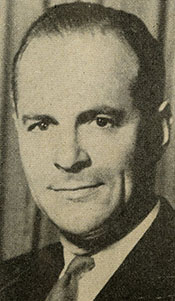
Some people of a conservative mindset may ask what happened to the Democratic Party. Interestingly, there are people whose records were considerably more moderate or even conservative before the politics of the 21st century. Some would say that a lot of Democrats back then would be Republicans now. However, this doesn’t account for politicians adapting to the directions of their parties. A prominent example of this is a recent politician in Clarence William “Bill” Nelson (1942- ).
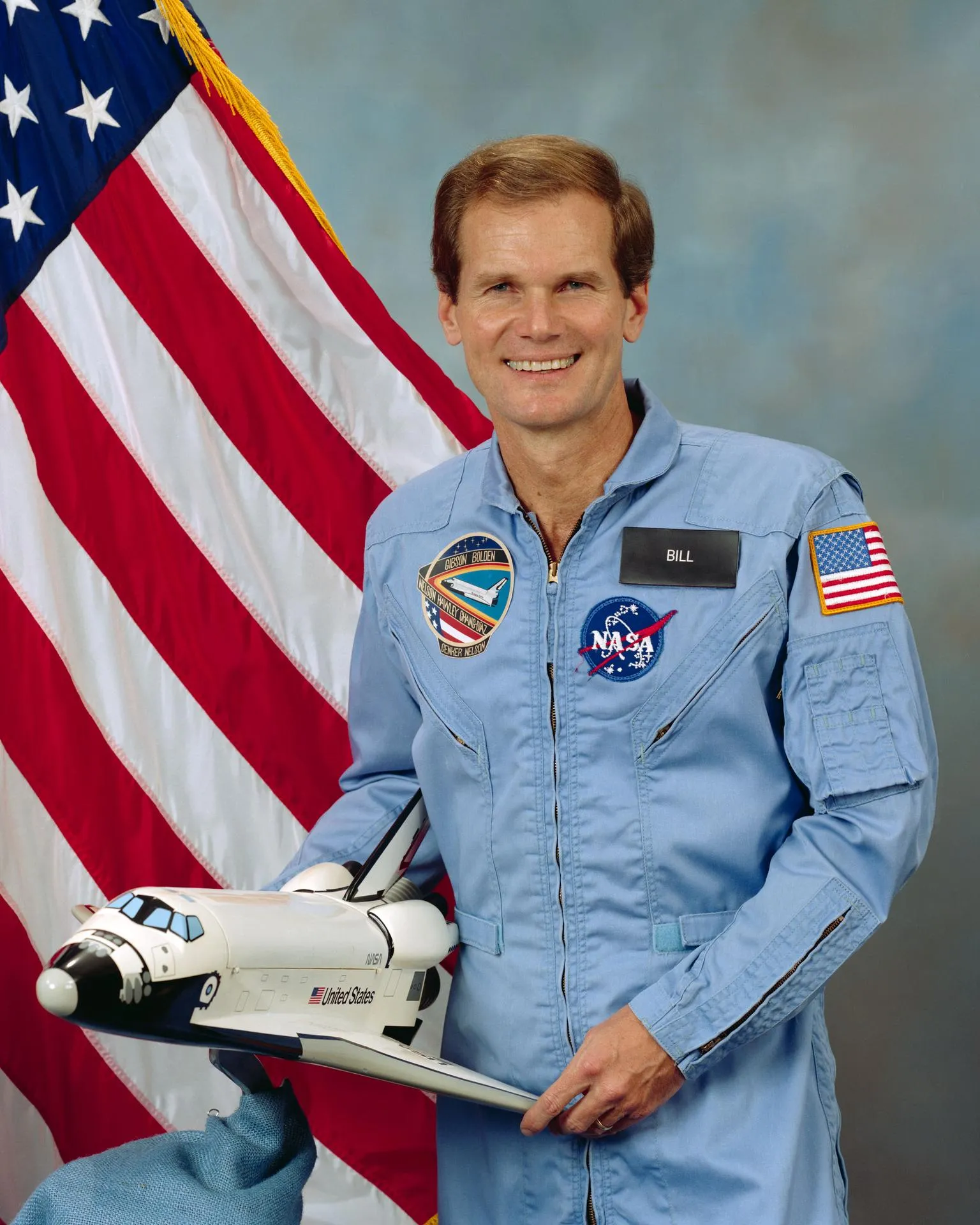
An attorney by profession, Bill Nelson got his start in politics by working as a legislative assistant to Governor Reuben Askew with his election to the state legislature in 1972. He won reelection in 1974 and 1976, and this time put him in a good position to run for Congress. In 1978, Republican Lou Frey announced that he would not run for another term. Nelson was an ideal candidate for his time and place; a man of 36 with a model American family running against a politician who although had avoided jail-time was tied to a campaign fundraising scandal in 64-year old Republican Edward Gurney. Although this Florida district had been electing Republicans since 1962, when it first elected Gurney, Democrats had a 60-40 party registration advantage (Peterson). Furthermore, Nelson was running as a conservative Democrat thus Gurney couldn’t pin the label of liberal on him. He won the election by 24 points and established a record that was moderate to moderately conservative. Nelson opposed government funding of abortion, supported the death penalty, and backed the Reagan tax cuts in 1981. However, he supported rolling them back considerably with his support of the proposed 1983 Tax Equity bill and was supportive of funding increases for domestic programs and opposed to limiting food stamps. In 1986, Nelson was the second member of Congress and the first representative to travel into space in Space Shuttle Columbia. After all, he represented Florida’s Space Coast where Cape Canaveral is located.
In 1990, he opted against running for another term for Congress to run for governor. However, Nelson had a formidable primary opponent in former Senator Lawton Chiles Jr., and miscalculated in his campaign against him when he made Chiles’ health an issue, particularly his use of Prozac to treat depression, which was made worse by his running mate suggesting that Chiles was suicidal, a suggestion Nelson disavowed (Orlando Sentinel). Running against Chiles on mental health didn’t stick to the man that Floridians had thrice elected to the Senate, and he easily prevailed.
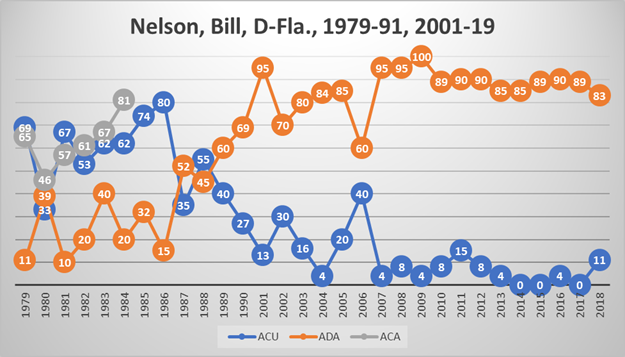
If his 1990 gubernatorial race was the end of his national career, I would be fine with the common view of him that he was a centrist or even a moderately conservative Democrat. From 1979 to 1984, he sided with the conservative Americans for Constitutional Action 63% of the time. However, Nelson’s career had quite a way to go and in 1994 the reelection of Governor Chiles also saw the election of Nelson as Treasurer, Insurance Commissioner, and Fire Marshal of Florida (yes, it is all one office). He won reelection in 1998, and his experience positioned him for a Senate run. In early 2000, Nelson resigned to run for the Senate, and just like the state’s presidential race, its Senate race was close and heated. His opponent was conservative Republican Congressman Bill McCollum, and both ran strongly negative campaigns against each other. Nelson repeatedly labeled his opponent as an extremist who would sacrifice the elderly, the poor, and the working class to coddle the rich while McCollum labeled him as “a liberal who would tax everything that moves, and some things that don’t” (Bragg). At the time, Nelson had the more solid case for the political center given his record in the House while McCollum had a pretty consistent conservative record. As political science professor Aubrey Jewitt noted, “he was known as a fairly moderate Democrat and right now that’s a good ideological place to be” (Bragg). Although Bush very narrowly officially won the state by 537 votes in one of the nation’s most controversial elections, Nelson edged out McCollum in the Senate election by 5 points.
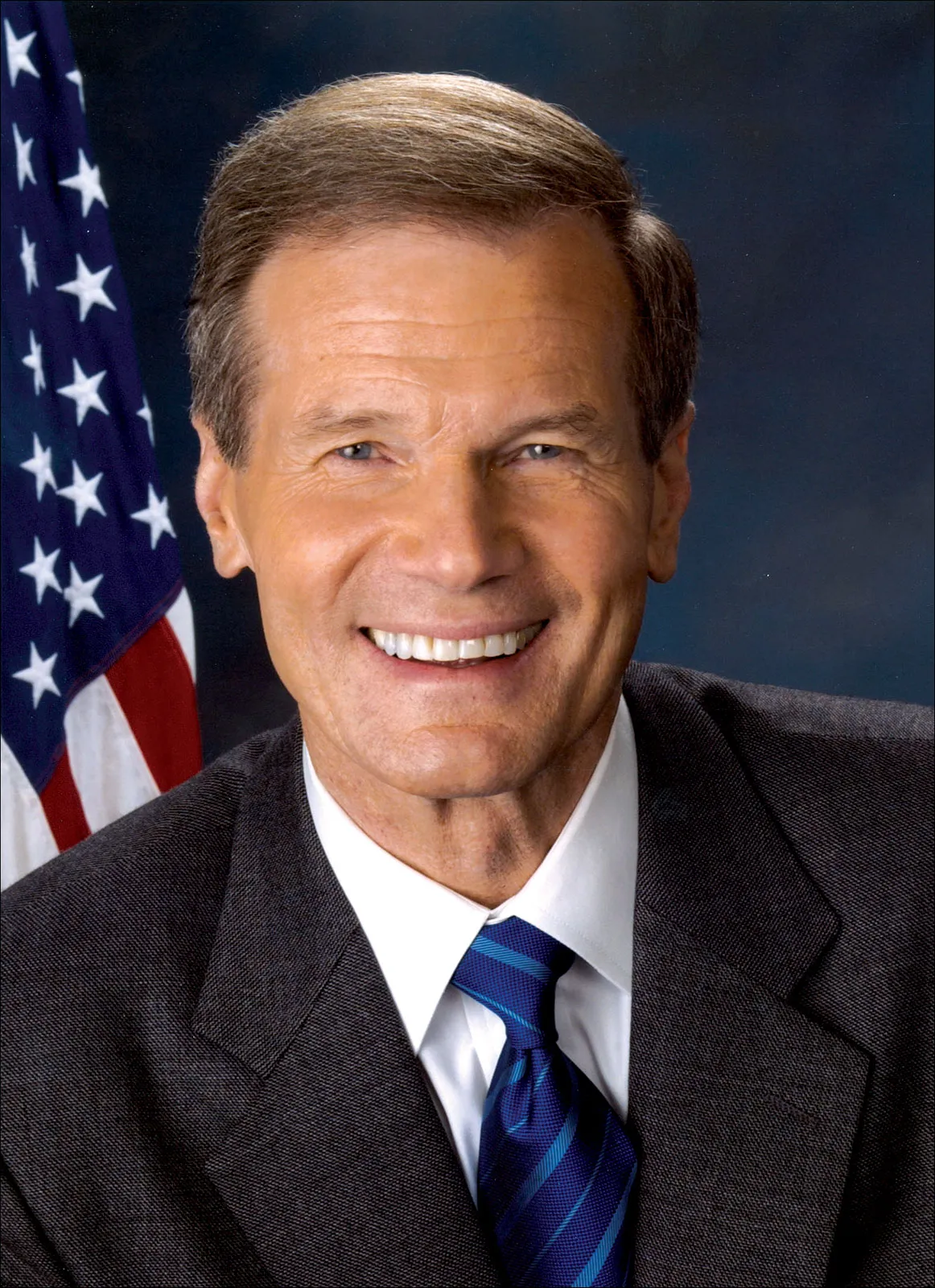
Senator Nelson
It should be noted that representing a district and representing a state can be a different ballgame and some politicians indeed have shifted left from when they represented a district as opposed to a state. Prominent examples include Senator Kirsten Gillibrand of New York who as a representative of an upstate district was pro-gun rights and now is pro-gun control and even more dramatically Charles Goodell of New York who went from moderately conservative establishment Republican to staunchly liberal anti-Vietnam War Republican in the Senate in what seems to have been an unsuccessful effort to make a Republican-Liberal Party coalition run for a full term in 1970. Indeed, the contrasts between Nelson as a representative and Nelson as a senator are considerable. Although in his first term in the Senate, you could make an argument that he seemed to represent was he was selling to Floridians, and contrary to what McCollum claimed he did vote for some tax reductions, notably ending the estate tax and extending the Bush tax cuts (although he had originally opposed them). However, in his first term he nonetheless sided with the American Conservative Union (ACU) 20% of the time and liberal Americans for Democratic Action (ADA) 79% of the time. As a representative, he had agreed with the ACU 55% of the time and ADA only 34% of the time. The 2006 election gave him a green light to be a party loyalist even more as he was reelected by 22 points not only due to a poor political climate for Republicans but also due also a weak candidate in Congresswoman Katherine Harris.
In his second term, Nelson was strongly with the liberal position and a loyalist to the agenda of the Obama Administration. He even stated his support for a “public option” for healthcare in 2009, an issue of contention among Senate Democrats (Dunkelberger). Indeed, Nelson sided with ACU 8% of the time in this term. Now wait…you might say, that’s just a conservative skew! However, he also sided with ADA positions 93% of the time! Thus, again, both conservatives and liberals agreed on where he stood on the American political spectrum. One area in which he was consistent over time on the conservative position was on favorability to free trade agreements. Furthermore, with Obama winning reelection not only nationally but also in Florida in 2012, Nelson pulled off an 11-point win. Once again, Republicans had run a weak candidate, this time in Congressman Connie Mack IV. A Florida Republican operative had said about Mack, “He’s a weak candidate. Let’s just be honest. He is a pale shadow of his father’s greatness as a politician” (Miller). Nelson’s third term represented more agreement with the Obama Administration as after all, Florida voters had opted to return him to office!
His siding with ACU and ADA differed a bit in his third term: 3% for the former and 87% for the latter. I should note that it is my opinion based on what I’ve seen of their ratings that ACU under Matt Schlapp has made their grading of politicians tougher and more oriented towards the politics of Rand Paul. However, Nelson’s loyalty to the Obama Administration was noted by journalist Ledyard King (2014) when he wrote that a new analysis showed that along with 16 other Senate Democrats he “voted in line with President Barack Obama’s positions 100 percent of the time last year”. In 2018, although Nelson in theory had the benefit of a good political environment given that this was looking to be a backlash election against Trump, he undoubtedly lacked the benefit of a weak candidate. Rick Scott was reasonably popular as Florida’s two-term governor, and better yet for the Republicans they were making inroads with Hispanic voters overall and not just increasing their support among Cuban-Americans (Ogles). Furthermore, Florida was increasingly moving to Republicans and Nelson’s loyalist record to President Obama as well as his opposition to nearly all Trump policies wasn’t playing so well in Florida now. This was highlighted with his announcement before Trump picked a Supreme Court nominee in 2018 that he expected to vote against the nominee based on protecting Roe v. Wade (Smith). The issue of abortion was yet another way in which Nelson had flipped; as a representative he had had an almost entirely anti-abortion record while as a senator, he had a record almost entirely supportive of abortion rights, only voting to prohibit taking minors across State lines without parental consent for abortions in 2006. This election was so close that it was decided by just over 10,000 votes, or 0.13% of the vote, with Scott prevailing. Nelson subsequently served as the administrator of NASA from 2021 to 2025.
In his overall Senate career, Nelson sided with ACU 10% of the time and ADA 86% of the time. Both ADA and ACU found Senator Nelson’s peak year of dissent from the liberal position as 2006, when he only sided with the liberal position on 60% of the votes they considered to be most important. Over his entire career, he sided with ACU 27% of the time and ADA 65% of the time, with his DW-Nominate score standing at -0.193. While his overall record does paint him as a moderately liberal Democrat, it makes more sense to see Representative Nelson as distinct from Senator Nelson, much like it made sense to see Representative Goodell of New York as distinct from Senator Goodell of New York.
The change of Bill Nelson overtime:
References
ADA Voting Records. Americans for Democratic Action.
Back in 1986, Ronald Reagan is on his second term as president, having won a 49-state landslide and only narrowly losing Minnesota, the home state of his opponent, Walter Mondale. Like Trump, Reagan had the benefit of a Republican Senate although unlike Trump he never had the benefit of a Republican House. The composition of the Senate during this time presents a fascinating contrast to today. For one thing, although by this point the South is on presidents in the Republican column, it has yet to move there in its Senate composition. Today, the South’s senators are Republican save for Georgia and Virginia. In the 99th Congress, Democrats held one seat in Alabama, both of Arkansas’ seats, one of Florida’s, one of Georgia’s, both of Louisiana’s, one of Mississippi’s, one of North Carolina’s, one of South Carolina’s, both of Tennessee’s, and one of Texas’s. That’s right, in 1984 Tennessee overwhelmingly elected Al Gore to the Senate. Republicans actually hold both of Virginia’s Senate seats as back then it was a conservative state. Virginia and West Virginia have switched places since then, as both of their senators are Democrats. Another bizarre feature of this time was that Democrats held both of Nebraska’s seats! For reference, Nebraska has not voted for a Democrat for president since 1964 and its senators were among the conservative wing of the Democratic Party. Some of the social stances they held would have gotten them a quick cancellation among the base.
New England was different too, as Republicans held a seat in Connecticut, one of Maine’s, both of New Hampshire’s, one of Rhode Island’s, and one of Vermont’s. The West Coast is downright bizarre; although Democrats have held all of the West Coast states’ Senate seats since 2009, in 1985-1986 they only have California’s Alan Cranston. However, the Republicans who hold these seats would, save for Pete Wilson and perhaps Slade Gorton, be although to the right of Democrats holding these seats today, far from tolerable for the modern Republican base. In truth, 48 Senate seats are different in party affiliation between this time and now. Kentucky at that time has freshman Senator Mitch McConnell, now in his last year of service, and the last Democrat to represent the state in the Senate in Wendell Ford. In Delaware, Joe Biden is there as a Democrat, but his colleague is Republican William Roth, who played a significant role in the crafting and passage of the Reagan tax cuts and is the Roth in the Roth IRA savings account. As hard as it may be to believe, both of Minnesota’s senators are Republican! One of them, Rudy Boschwitz, had a double-digit reelection in the same year Mondale won the state. How voters viewed the president and his party varied considerably and voters were far more willing to split their tickets than now. The states that remain the same partisan composition then as they are now are Alaska, Hawaii, Idaho, Illinois, Indiana, Kansas, Massachusetts, Michigan, New Jersey, North Carolina, South Dakota, Utah, Wisconsin, and Wyoming. However, a look at the agreement rates I have put up with the senators should indicate to you that the parties were far more ideologically diverse. For instance, many of the Southern senators would not pass muster in today’s Democratic Party. One of them, John C. Stennis of Mississippi, had first been elected to the Senate in 1947! Many of the New England Republicans would not be in today’s Republican Party; Lowell Weicker of Connecticut was a bane of Reagan Republicans and later identified as an Independent and supported Democratic candidates and even Gordon Humphrey of New Hampshire, the staunch Reagan conservative of the group, has been strongly anti-Trump in recent years. Neither John Chafee of Rhode Island or Robert Stafford of Vermont would be palatable to modern Republicans. I have below senators who served in both years of the 99th Congress and included are agreement rates from the liberal Americans for Democratic Action and the conservative American Conservative Union. These are a little bit different from their official ratings; I do not count absences either way unlike ADA, I count documented legislative pairs and opinions for, and I do not double-count votes unlike ACA. Each vote is weighted equally for position agreement.
In 1992, the Democrats won the White House for the first time since 1976, and with united government they sought to make numerous changes in the liberal direction, and one of the many issues Clinton was firmly liberal on was abortion. Since the late 1970s, a major movement of protests of abortion clinics formed, but with non-violent protests there came incidents that went beyond standard protesting, such as intimidation, criminal harassment, stalking of abortion providers, and violence. A particularly notable group perpetrating these incidents was the terrorist group Army of God, whose members have committed numerous crimes against abortion providers, including murder. The escalation of tactics as well as the March 10, 1993 murder of Dr. David Gunn by pro-life extremist Michael Griffin motivated the Democrats to push for the Freedom of Access to Clinic Entrances (FACE) Act.
While numerous of these activities were of course already illegal under state and local laws, the citations for trespass were not thought sufficient and in some jurisdictions local law enforcement was thought to be lax. Proponents also argued that the state and local authorities did not have sufficient resources to deal with the scope and scale of these incidents. The initial bill was passed in November 1993 and only covered abortion clinics, but in order to shore up additional support churches and other places of worship were added, thus creating two protected classes. In the House, the measure was sponsored by Reps. Chuck Schumer (D-N.Y.) and Constance Morella (R-Md.) while the Senate sponsor was Ted Kennedy (D-Mass.).
Rep. Louise Slaughter (D-N.Y.) justified this new law, stating, “State and local law enforcement lack the resources – and sometimes lack the will – to battle large-scale, long-term operations that include trespassing, vandalism, and assault (Congressional Record).
Rep. Jim Bunning (R-Ky.) opposed the bill, and stated in his opposition, “In the sixties, before passage of the Civil Rights Act, there were sit-ins, pray-ins and protests all around the country. Some were peaceful. Some were not. In some circles, the civil rights movement was not very popular, but Congress did not pass special laws to discourage civil rights protests because of their motivation or because of their viewpoint. He went on to say, “Yes, we should punish violence, threats of violence and intimidation. But this bill goes beyond that. It would punish people engaged in non-violent, free speech. It would create harsh new penalties for people who engage in non-violent civil disobedience” (Congressional Record).
Rep. Carolyn Maloney (D-N.Y.) in support stated, “Most people would be outraged if they were prevented from entering a supermarket – or a church or an office building or any other place – by someone who disagreed with what was going on inside. We need this Freedom of Access bill because throughout our country, there continue to be bombings, assaults, threats, and even murders by people trying to prevent people from working in or using medical facilities which offer reproductive health services. In the previous Congress, the House passed the Farm Animal and Research Facilities Protection Act, which prevents violent blockades of facilities for research animals. If we care that much about facilities for animals, we ought to care about facilities for women. The right to choose is meaningless without the access to choose.”
Rep. Lynn Schenk (D-Calif.), shall we say, poured on the Tabasco sauce in this debate when she alleged the motives of the opposition, “Their true agenda is to continue the reign of harassment, terror, and physical intimidation against women and their doctors” (Congressional Record). Would it surprise you to learn that she is a lawyer?
Rep. Chris Smith (R-N.J.), who continues to serve, had the most to say in opposition on the day of passage and in defense of abortion protestors, “The difference in what we are dealing with today are those acts of nonviolent civil disobedience, and I can tell you Mr. Speaker, if we applied the standard in this bill to those who have been involved in D.C. statehood, civil rights, women’s rights, animal rights, and a whole host of other very important causes, this particular legislation would never see the light of day on this floor. Mr. Speaker, just let me also make a very important point: that sidewalk counseling has saved tens of thousands of children throughout the last 20 years. Women, many of whom have had abortions frequently become sidewalk counselors and go to abortion clinics to speak out. These women, and I have pictures of women who have helped women through the difficult, distressful pregnancies they may be experiencing, they have helped women about to abort at that 11th hour (Congressional Record).
The bill passed the House on May 5, 1994 on a vote of 241-174 (D 201-43, R 40-131). The Senate followed up on a vote of 69-30 (D 52-3, R 17-27) a week later. Interestingly, among the Republican supporters was Mitch McConnell. The three Democratic dissenters were J. Bennett Johnston and John Breaux of Louisiana along with J. James Exon of Nebraska. None of these seats are held by Democrats today.
This law was controversial in passage as some non-violent tactics could result in jail time. For instance, in practice, one protest tactic that has resulted in jail time for offenders has been sit-ins. In particular, activist Herb Geraghty was imprisoned for doing so in Pennsylvania in 2020 and was sentenced in 2023. He was pardoned in 2025 by President Trump, and has advocated for the law’s repeal (Geraghty). It should also be noted that since passage of the law the number of violent incidents decreased surrounding abortion. I must note that it is interesting that the FACE Act is being used against Don Lemon yet the administration has made clear that it is only interested in using the FACE Act in egregious cases regarding clinics (Lucas). Selective prosecution does not seem to only been a feature of the present administration; the Biden Administration was also alleged to have used to the FACE Act selectively, in being willing to prosecute cases of attacks on abortion clinics at higher rates than attacks on pregnancy centers and churches (Kamman). That administrations, past and present, have used this law most selectively makes a case for repeal in this writer’s opinion. Earlier this year, Representative Chip Roy (R-Tex.) proposed to repeal the FACE Act.
References
A bill to amend the Public Health Service Act to permit individuals to have freedom of access to certain medical clinics and facilities, and for other purposes. Voteview.
On Saturday, Americans learned that Venezuelan dictator Nicolas Maduro had been taken from Caracas by U.S. forces and flown to Manhattan for trial. The most obvious comparison between the ouster of Maduro by the U.S. is the ouster of General Manuel Noriega of Panama. Although the cases of Maduro and Noriega on their faces do look the same, as in a Latin American dictator is engaged in drug trafficking and is wanted by the United States, there are some significant differences between the circumstances that resulted in Operation Just Cause.
Relations between the U.S. and Panama have had a complicated history, and part of this was the control of the U.S. over the Panama Canal, which they had constructed, and the area they owned called the Panama Canal Zone. Starting in the 1960s, agitation for Panamanian ownership of the Panama Canal began, and U.S. leaders began supporting turning over the Panama Canal to improve relations with Latin America. President Gerald Ford endorsed the idea while Jimmy Carter came around to it once he was president. With the signing of the Panama Canal treaties in 1978, the U.S. and Panama had certain treaty obligations, such as the U.S. reserving the right to militarily intervene if neutrality over the canal was violated. Carter had signed the treaty along with Panama’s leader, Omar Torrijos. However, Torrijos was killed in an air crash in 1981, and the power vacuum that followed was resolved by the rise to power of Manuel Noriega. Noriega was never officially the leader, rather he had puppet presidents.
The U.S. and Noriega: From Friends to Foes
Manuel Noriega had a long and complicated relationship with the United States, which began with his recruitment from the Panamanian military to study at the School of the Americas through the U.S. Department of Defense in the 1950s, which trained many anti-communist fighters in the Western Hemisphere. Noriega rose up through the Panamanian military and in 1968, he bet on the right horse when he backed the coup that deposed President Arnulfo Arias for Omar Torrijos. As a reward, Torrijos made him chief of military intelligence. In 1971, the CIA began paying him for intelligence (Graham). In 1981, however, Torrijos was killed in a mysterious plane crash and out of the power vacuum Noriega became the unofficial leader of Panama. He was never president, rather he had figureheads serve his interests as president. The U.S. was initially supportive of Noriega as an anti-communist leader in Panama, and indeed he provided military support for the Contras in Nicaragua. However, the CIA wasn’t his only outside source of income. In 1982, Noriega cut a deal with Pablo Escobar to allow his cocaine to move through Tocumen International Airport. In return, Noriega would get $1000 per kilo of cocaine that reached the U.S. Although the U.S. knew of this arrangement, they valued him for his providing weapons and funding of Contra rebels in Nicaragua. However, what they didn’t know until later is that the CIA wasn’t the only intelligence agency paying him. Despite his anti-communist stance, Noriega was also a double-agent, accepting money from Cuban intelligence in exchange for information on the U.S. He also became increasingly brutal as a ruler, including beheading political rival Hugo Spadafora in 1985. After the president he had rigged the 1984 election for, Nicolas Ardito Barletta, promised an investigation, Noriega forced his resignation. On February 4, 1988, Noriega was indicted in Miami for drug trafficking and money laundering. In May 1989, Noriega again stole the election, much like Nicolas Maduro had in Venezuela in 2024. Noriega afterwards amped up the hostility to the U.S., including stating that the U.S. and Panama were in a “state of war” and with his forces firing on U.S. marines, killing one, and abducting another marine and his wife, brutally beating him and threatening her with sexual assault. Given that Noriega was acting with such impunity there was certainly an existing risk for the neutrality of the Panama Canal.
On December 20, 1989, Operation Just Cause, or the invasion of Panama, was ordered by President Bush. A tremendous amount of American public support already existed for such an action, unlike the sudden operation and capture of Maduro, which came a bit out of left field for most, as prediction markets showed (the success of this however certainly serves to blunt a lot of criticism). The invasion of Panama proceeded quickly, and Noriega fled to the Vatican’s embassy for diplomatic sanctuary. The US forces proceeded to surround the embassy and blast disturbing chicken sounds and numerous songs including “Give it Up” by K.C., “Welcome to the Jungle” by Guns N’ Roses, “Never Gonna Give You Up” by Rick Astley, “Danger Zone” by Kenny Loggins, and “Panama” by Van Halen as a form of psychological warfare to get Noriega to come out (Myre). Noriega surrendered on January 3, 1990 and he was brought to the U.S. for trial.
Noriega was convicted by a Miami jury and sentenced to 40 years imprisonment for drug trafficking, racketeering, and money laundering. He served 17 years after which he was extradited to France where he was convicted of money laundering in 2010 and then extradited back to Panama where he was imprisoned for murder, corruption, and embezzlement, having previously been convicted in absentia. He died in a Panama City hospital of cancer on May 29, 2017. Some differences that exist between Maduro and Noriega is that although you could say that Venezuela is a national security issue for the U.S. given their relationships with China and Russia and that under Maduro it had become a narco state, there were more clear open hostilities with the U.S. with Panama and the Panama Canal lay in the balance.
References
Graham, D.A. (2017, May 30). The Death of Manuel Noriega – and U.S. Intervention in Latin America. The Atlantic.
The subject of the war powers of the president have again arisen with the Saturday U.S. raid on Caracas and the capturing of Venezuelan dictator Nicolas Maduro and his wife for trial. President Trump did not invoke the War Powers Resolution, although neither did President George H.W. Bush for his invasion of Panama in 1989-1990. The War Powers Resolution is definitely a subject of discussion, though, for this most notable event and today I am looking into the circumstances of the adoption of the War Powers Resolution.
Clement J. Zablocki (D-Wis.) and Nixon.
By 1973, the U.S. was in the process of withdrawing from Vietnam and many members of Congress were critical of how both Presidents Johnson and Nixon had used their war powers. For the latter, it was when Nixon ordered secret bombings of Cambodia without seeking Congressional consent. In the House, Clement J. Zablocki (D-Wis.), chairman of the House Foreign Affairs Committee, introduced the War Powers Resolution. The measure had bipartisan support as well as drafting, with Paul Findley (R-Ill.) being the resolution’s main author. The resolution requires the president to notify Congress within 48 hours of military action and bars forces from remaining for more than 60 days. The first body to vote on this resolution would be the House. On July 18, 1973, they voted for 244-170 (D 171-61, R 73-109). The central architect of the resolution in the Senate was Jacob Javits (R-N.Y.), one of the most liberal members of Nixon’s party who had repeatedly been in opposition to the Nixon Administration on Vietnam. He considered the measure as “a critical departure from the past” (CQ Almanac 1973). However, the measure attracted broad support, and a key senator to come out in favor was the chairman of the Senate Armed Services Committee and known conservative John C. Stennis (D-Miss.), who expressed that “It is of the utmost importance to the future of this nation that we not again slip gradually into a war that does not have the moral support and sanction of the American people” (CQ Almanac 1973). However, the measure did not have the support of another prominent figure from the South, a legal authority on the Constitution, Sam Ervin (D-N.C.). Ervin held that the measure was unconstitutional, stating, “Here is a power and a duty which the Constitution clearly imposes upon the President of the United States, to use the armed forces to protect this country against invasion. And here is a bill which says expressly that the President of the United States cannot perform his constitutional duty and cannot exercise his constitutional power to protect this country against invasion for more than 30 days without the affirmative consent of Congress” (CQ Almanac 1973). There was also a small cadre of liberals who opposed the War Powers Resolution as not being sufficiently strong. Thomas Eagleton (D-Mo.) objected to the absence of a provision disallowing the use of intelligence agencies or other actors to engage in hostilities against other nations (CQ Almanac 1973). On July 20th, the resolution was adopted 72-18 (D 50-4, R 22-14), but because it was different from the House version, the measure had to go into conference. October 10th, the equation did not change in the Senate with a vote of 75-20 (D 49-6, R 26-13, C 0-1), still a veto-proof margin. However, original passage in the House had not been veto-proof. This, however, would not remain so as President Nixon’s popularity was declining from the continuing sore on his presidency that was Watergate.
Majority Leader Tip O’Neill (D-Mass.) argued for the resolution, holding that “If the President can deal with the Arabs, and if he can deal with the Soviets, then he ought to be able and willing to deal with the U.S. Congress. That is all we ask of him” (CQ Almanac 1973). Democratic leadership was united in favor, and Republican leadership was mostly united against. The exception was Senate Minority Leader Hugh Scott (R-Penn.), thus the foremost opponent in the House was Minority Leader Gerald Ford (R-Mich.). Ford, less than a year away from being president, expressed his concerns, “We may be a long ways from being out of the woods. I am very, very concerned that the approval of this legislation over the President’s veto could affect the President’s capability to move forward from cease-fire and to achieve a permanent peace” (CQ Almanac 1973). The resolution passed on October 12th 238-122 (D 163-38, R 75-84). President Nixon, as no one doubted he would, vetoed the resolution. Further eroding Nixon’s popularity, however, between final passage and his veto of the resolution, the “Saturday Night Massacre” had occurred, in which Attorney General Elliot Richardson resigned after refusing Nixon’s order to fire special prosecutor Archibald Cox, and Deputy Attorney General William Ruckelshaus was fired after refusing to fire Cox. Solicitor General Robert Bork ultimately agreed to fire Cox.
The real battle to override the President’s veto occurred in the House, as supporters had more than enough on passage in the Senate to get the resolution through. To achieve an override, eleven opponents of the president had to be lobbied to switch their votes from “nay” to “yea”. Bella Abzug (D-N.Y.), one of the most left-wing members of Congress, had opposed, stating before the conference report that “I shall vote against this bill because it is patently unconstitutional and gives the President power he does not now have…I fear that it does exactly the opposite of what we set out to do: that is, to prevent the President, any president, from usurping the power of Congress to declare war” (CQ Almanac 1973). Speaker Carl Albert (D-Okla.) and the liberal group Americans for Democratic Action actively lobbied these legislators to switch. Their efforts were successful, as eight did so, including Abzug. The House vote of 284-135 (D 197-32, R 87-103) to override on November 7th was four votes above the threshold needed to override President Nixon’s veto.
In the Senate, with an override now inevitable, a few members switched their votes later that day: Republican Howard Baker of Tennessee and Democrats James Allen of Alabama, Harold Hughes of Iowa, and Gaylord Nelson of Wisconsin switched from “nay” to “yea” while Republicans Ted Stevens of Alaska and Henry Bellmon of Oklahoma switched from “yea” to “nay”. The vote was 75-18 (D 50-3, R 25-14, C 0-1). On a side note, the vote on the resolution as reported by Voteview has an error, as Senators Tunney (D-Calif.) and Tower (R-Tex.) have their votes swapped; Tower opposed the War Powers Resolution while Tunney supported. Overall, most of the resolution’s opponents were conservative, but there were some interesting conservative votes in favor on overriding the president’s veto, such as John Ashbrook (R-Ohio), who had run a quixotic primary campaign in 1972 to Nixon’s right, the legendary penny-pincher H.R. Gross (R-Iowa), and John Rousselot (R-Calif.), the only member of the John Birch Society in Congress at the time. In the Senate, conservative Republicans were a bit more unified against with Barry Goldwater (R-Ariz.) and Jesse Helms (R-N.C.) being among the dissenters, but you did have guys like James McClure (R-Idaho) and William Scott (R-Va.) as votes in favor. In another indication of how poorly the Nixon Administration was doing on popularity, among Southern Democrats, a key group that Nixon sought to court support, only Sam Ervin voted against overriding Nixon’s veto.
There have been critics of this resolution, both as being too strong and too weak. Law Professor Robert F. Turner argued in a Fall 2012 journal article that the War Powers Resolution was unwise, unconstitutional, and even resulted in a reduction of American security to the point that it directly contributed to the 9/11 attacks. However, Scott R. Anderson, a fellow of the Brookings Institution, holds that although the War Powers Resolution is imperfect, it was a good undertaking that had a positive result in constraining the executive in getting the US into prolonged wars.
References
Anderson, S.R. (2023, November 9). The Underappreciated Legacy of the War Powers Resolution. Lawfare.
To Agree to the Conference Report on H.J. Res. 542, to Govern the Use of the Armed Forces by the President During the Absence of a Declaration of War. Voteview.
To Override the President’s Veto of H.J. Res. 542, Concerning the War Powers of the Congress and the President Concerning the War Powers of the Congress and the President. Voteview.
To Override the President’s Veto of H.J. Res. 542, to Govern the Use of the Armed Forces by the President During the Absence of a Declaration of War. Voteview.
Turner, R.F. (2012, Fall). The War Powers Resolution at 40: Still an Unconstitutional, Unnecessary, and Unwise Fraud that Contributed Directly to the 9/11 Attacks. Case Western Reserve Journal School of Law, 45(1).
Tariffs have been figuring strongly in recent politics thanks to President Trump’s repeated changes in course throughout the year on the imposition or removal of tariffs and certain decisions surrounding them that have been questionable at best. Trump’s policies on tariffs, although more erratic than Republicans of past, given his positive mention of William McKinley does make me think of the McKinley Tariff of 1890, which was at the time a crowning partisan achievement of the GOP and one that helped bring about swift political consequences.
The 1888 election was very close, but a great success for the Republican Party. For the first time since the Grant Administration, they had achieved unified government, and under the highly capable Speaker Thomas Brackett Reed of Maine, they sought to make the most of it. At the forefront of the agenda was the bread and butter of economic Republicanism of the time…protective tariffs. Leading this charge was the popular Representative William McKinley (R-Ohio), known as the “Napoleon of Protection” for his strong advocacy. The Republican Party was at the time strongly unified behind increasing tariffs while the Democratic Party was just as if not more strongly unified against.
A key concept introduced by this legislation was the reciprocal tariff or empowering the executive to raise tariffs on commodities after their addition to the free list to disincentivize other nations from raising their tariffs on these goods. Furthermore, Harrison persuaded the Senate to adopt a provision permitting the president to sign agreements opening foreign markets (U.S. House). These provisions would be upheld unanimously by the Supreme Court as a constitutionally permissible delegation of power in the 1892 decision Field v. Clark.
The initial version of the McKinley Tariff passed 164-142 on May 21st on a highly partisan vote as only three representatives defected: Republicans Hamilton Coleman of Louisiana and Oscar Gifford of South Dakota and Democrat Charles Gibson of Maryland. In the Senate, the bill was managed by Nelson Aldrich (R-R.I.), perhaps the foremost representative of industry in the Senate. On tariffs, in which 138 votes on the subject were held that covered numerous commodities from salt to sponges, the Senate passed the bill 40-29 on September 10th a completely partisan vote. However, there were differences between the House and Senate versions and thus the measure went to conference to resolve them. On September 27th, the House voted on the conference report, which was passed 151-81, with only Republicans Harrison Kelley of Kansas and again Coleman of Louisiana breaking with party. In the Senate, however, there was some more dissent among Republicans, with Senators Preston Plumb of Kansas, Algernon Paddock of Nebraska, and Richard Pettigrew of South Dakota voting against. In its’ final form, this law raised tariffs on average from 38% to 49.5%. Certain commodities were heavily focused on for protective tariffs like manufactured goods such as tin plates to appeal to factories in the East, while wool was jacked up to appeal to the sheep farmers of the rural West. Other tariffs, however, were removed, such as those on sugar, molasses, coffee, tea, and hides, but the president was authorized to raise them should other nations choose to impose on these goods for the United States.
Puck cartoon mocking McKinley.
Although quite the achievement for the Republican Congress, it went into effect on October 6th, less than a month before the 1890 election, and prices promptly rose in response to the tariffs. The Democratic newspaper skewered the bill, and since the benefits of the tariffs (increase in domestic worker wages and jobs) had little time to take effect while the negative side took effect promptly, this resulted in a surge of disapproval of the Republicans. Eleven days after the tariff took effect, The Cleveland Plain Dealer (1890) wrote, “The consumers are finding out that they are compelled to pay the tax, and that fact will grow daily more apparent. A gentleman walked into a hardware store a few days ago and asked to see some pocketknives. A number were placed upon the show case and prices were given. “Are these McKinley prices?” he inquired. “No,” said the clerk, “but we will be compelled to raise prices. We have been busy and have not made any change in our prices yet, but we shall soon do so.” This is only one of many occurrences of which one hears on the streets, and to offset it all there is nothing but prattle about imaginary tin plate factories and other McKinley air castles”. Such unpopularity contributed a great deal to the utter slaughter the Republicans faced in the 1890 midterms including McKinley himself losing his seat, although his loss was in good part due to unfavorable redistricting. Democrats won the popular vote by 8 points in the House, which produced a gain of 86 seats for them and Republicans sustained a 93 seat loss; they also lost seats to the newly formed Populist Party. The Indianapolis Journal (1890), contrary to The Cleveland Plain Dealer, wrote in defense of the tariffs after the election, attributing much of the unpopularity to “falsehoods” propounded about the McKinley Tariff by the “importers’ press”, for instance attributing a price increase in fruits and vegetables to tariffs without mentioning that there were crop failures that produced shortages. Although Republicans continued to be for higher tariffs, they sought to proceed more carefully in the future than they had in 1890, and McKinley would have an astounding comeback, being elected Ohio’s governor in 1891, be reelected in 1893, and then be elected president in 1896. Although a high tariff man, he would embrace the idea of reciprocal tariff reductions, and the Dingley Tariff Act of 1897, although it enacted the highest tariffs on average in American history, would contain a provision permitting the president to reduce duties by up to 20%. McKinley even came around to the idea of reciprocal trade treaties shortly before his assassination.
References
Gould, L.L. William McKinley: Domestic Affairs. UVA Miller Center.
It can be highly tempting for people to say that one state has “always been conservative” or “always been liberal” to explain away party switches. But the reality is that populations shift, political priorities shift, and one party’s policies can go so strongly against a certain state’s interests that their voters move to the other party, even if in the past they had supported much of what their old party stood for. This has been demonstrably true of some states even in modern day. I will present today five examples of states, not in the former Confederacy or New England, which have had considerable evolution in their status.
Henry Clay of Kentucky, whose state and him went from being supporters of Thomas Jefferson’s Democratic-Republicans to being staunchly with the Whig Party.
Delaware
Our last president was the first from America’s first state of Delaware. Since 1992, the state has voted Democratic and since 1996 it has done so by double digits save for 2004. Delaware also now has the distinction of having elected the first member of Congress to identify as trans. The state’s Democratic dominance would have been absolutely unthinkable during the time of the foundation of the Democratic Party itself.
Delaware had been one of the most loyal states to the old Federalist Party, only voting for the Democratic-Republicans in the 1820 election in which James Monroe had no substantive opposition. Delaware was also a reliable state for the Whig Party until 1852, when all but four states voted for Democrat Franklin Pierce. Normally, Delaware voters would be supportive of the economic philosophy that guided both the Federalists and the Whigs; an adherence to Alexander Hamilton’s American System. This being imposing tariffs both for protection of domestic industry and to fund internal improvements for the purpose of expanding national growth. The Whig’s successor party, the Republican Party, would embrace the same. However, Delaware was a tough state for Republicans because it was a slave state. Although slavery was not practiced by most families in the state by the start of the War of the Rebellion, many voters still defended the “peculiar institution” and the political of the power of the state lay with its defenders. During the war, its voters elected Unionist politicians to the House, but its senators were Democratic and defenders of slavery in Willard Saulsbury, James A. Bayard, and George Riddle. From 1865 to 1895 all of its governors were Democrats, and until the 1889 election all its senators Democrats. What changed in Delaware was that more blacks were becoming middle class, thus making the issue of race less salient. What’s more, a certain prominent family moved their operations to Delaware and bankrolled the state’s Republican Party in the du Ponts. Although in 1888, Delaware had voted for Democrat Grover Cleveland by nearly 12 points, an ominous signal of times ahead for the Democrats came in the next election, in which Cleveland won, but by only 1.5 points. This was an election in which incumbent Benjamin Harrison was unpopular and Cleveland scored unexpected wins in states that had consistent records of Republican voting in Illinois and Wisconsin, the former having voted Republican since 1860 and the latter having done so since its first presidential election in 1856. Delaware’s politicians, be they Democratic or Republican, had records of opposition to inflationary currency, and the economic depression as well as the Democrats shifting towards the left by picking William Jennings Bryan, a proponent of currency inflation through “free coinage of silver” (no limits on silver content in coinage), left Delaware cold. McKinley won the state by 10 points in 1896.
The 1896 election kicked off a period of Republican dominance. Until 1936, save for the 1912 three-way election, Delaware voted for the Republican candidate. Henry du Pont and his cousin Thomas were elected to the Senate during this period, and during FDR’s first term, its senators, Daniel Hastings and John Townsend, were the most consistent opponents of the New Deal in the Senate and voted against Social Security. However, FDR’s appeal even penetrated Delaware; Hastings would lose reelection in 1936 and Townsend in 1940. However, in 1948, Delaware would return to the Republican fold in voting for Thomas Dewey. The state would vary in its voting behavior through 1988, and it would go for the Democrat in the close 1960 and 1976 elections. Since 1993, Delaware has had only Democratic governors, and it has not elected a Republican to the Senate since 1994 nor to the House since 2008. A big part of the state’s shift towards the Democrats was that from 1990 to 2018, the black population of Delaware increased by 47% (Davis). Since 1964, black voter support for Republican presidential candidates has not surpassed 15%. Delaware does not look like it will turn away from the Democrats any time soon.
Iowa
Admitted to the Union in 1846, Iowa started existence as a Democratic state. In 1848, its voters preferred Michigander Lewis Cass to Whig Zachary Taylor. However, a significant minority of Iowa’s Democrats were staunchly anti-slavery and after the Kansas-Nebraska Act of 1854, these people bolted to the newly formed Republican Party. The GOP’s most prominent politician in the latter part of the 19th century and for a few years in the early 20th was Senator William B. Allison, who would be part of the Senate’s leadership during the McKinley and Roosevelt presidencies. Until 1912, Iowa would without fail vote for Republican presidential candidates and would not do so again until 1932. From 1859 until 1926, all of its senators were Republicans, and the 1926 case was because Republicans had split over their nominee, Smith W. Brookhart, who was on the party’s liberal wing. Iowa Democrats made significant headway during the 1930s, with the state even having two Democratic senators from 1937 to 1943. However, the state was moving against Roosevelt and its voters were strongly against American involvement in World War II, preferring the Republican candidate in 1940 and 1944. There was a bit of a surprise when Truman won the state in 1948, something that can be credited to his effective appeals to Midwestern farmers and painting the Republican 80th Congress as bad for their interests.
Iowa nonetheless continued its Republican voting behavior in Republican presidential elections, even though the state’s party saw significant gains in the 1970s, including both Senate seats. In 1988, Iowa delivered a bit of a surprise in its vote for Democrat Michael Dukakis. Indeed, from 1988 until Trump’s victory in the state in 2016, Iowa would be Democratic on a presidential level with the only exception being Bush’s squeaker of a win in 2004. Since 2016, however, support for Republicans has only been increasing. In 2024, Trump won the state by 13 points despite that Seltzer poll. This was the best performance a Republican candidate has had in Iowa since 1972, when Nixon won with 57%.
Kentucky
Kentucky has an even more varied history as a state than Delaware. After it was first admitted, it did, as did all the other states, vote to reelect George Washington in 1792. However, when it came to choosing between Adams and Jefferson, they chose Jefferson and kept doing so up until the foundation of the Whig Party. The Whig Party had as its central founder Kentucky’s Henry Clay, who at one time had been part of Jefferson’s Democratic-Republicans but had opposed the rise of General Andrew Jackson.
Kentucky’s issue with sticking with the successor party was the same as Delaware’s: it was a slave state. It remained in the union but its voters were staunch foes of the GOP. Kentucky did not vote Republican until 1896, and did so narrowly, a product of the economic depression and Democrat William Jennings Bryan’s inflationary currency stance. Although this looked like an opening and indeed Republicans had a few successes in electing governors, the state maintained its Democratic character up until 1956, its voters having only seen fit to vote Republican in 1924 and 1928. The 1956 election was quite successful for Dwight Eisenhower and Republicans, including in Kentucky. Not only did the state vote for him, they also voted in two Republicans to the Senate in John Sherman Cooper and Thruston B. Morton. However, their brand of Republicanism was much more moderate than what we see from Kentucky’s GOP today. Republicans followed up their 1956 win with Nixon’s 1960 win of the state. From 1956 onward, Kentucky did not vote for a Democratic candidate for president unless he was from the South. The last time the state voted for the Democrat was Bill Clinton in 1996. Nonetheless, the state party remained strong, and from 1975 to 1985 both of its senators were Democrats. However, this was broken with the election of Mitch McConnell in 1984, and Democrat Wendell Ford retired in 1999. To this day, Ford is the last Democratic senator from the state. This Republican bent is not going away any time soon either; Trump scored the highest margin of victory that any Republican has in 2024, even surpassing Nixon’s 1972 performance. However, Kentucky does still elect Democratic governors, but this puts it in a similar position to Vermont, which is highly Democratic but has happily elected Republican Governor Phil Scott.
New York
New York presents an interesting case as although recently it has voted solidly for the Democrats since 1988, it was at one time a big swing state. Indeed, New York’s vote was predictive of the winner of presidential elections until 1856, when their voters backed Republican John C. Fremont. However, this did not put them firmly in the Republican column. Indeed, Democrats had a strong presence in the state through the political organization of Tammany Hall in New York City. Republicans had a powerful machine as well in the late 1860s to early 1880s under Senator Roscoe Conkling. The electoral vote rich state became a prime target for the parties, and it resulted in Democrats picking people who were for hard currency for their presidential candidates even though their base nationwide was favorable to soft, or inflationary currency. When Democrats picked a New Yorker, they usually won the state. In 1868, they elected former New York Governor Horatio Seymour, and although the Republicans won the election, the Democrats won New York. In 1876, the same was true with their pick of Samuel J. Tilden. However, with the downfall of the Bourbon Democrats and the economic depression of the 1890s, New York voted for Republican William McKinley, beginning an era of Republicans being dominant in the state. These weren’t liberal guys either; at the start of the Harding Administration its senators were William Calder and James W. Wadsworth Jr., both staunchly conservative, with Wadsworth voting against the entirety of the New Deal in FDR’s first and second terms as a representative. However, the status of Republicans was starting to weaken with the gubernatorial elections of Al Smith and Franklin D. Roosevelt and in 1928 even though Republicans fared quite well in that election, Hoover only won the state by two points. New York would vote for Roosevelt all four times and although it would vote for Republican Thomas Dewey in 1948, this was a plurality caused by Henry Wallace’s Progressive Party getting 8.25% of the vote. New York voted for Eisenhower twice, but I would say that its Democratic era began with the election of 1960. I say this because Republicans have only won three presidential elections since then; the 49-state landslides of Nixon in 1972 and Reagan in 1984 as well as Reagan in 1980. It is true that Republicans were still able to elect some governors and managed to hold on to one of the Senate seats for 42 years, but this was because Republicans ran candidates that were far from doctrinaire conservatives. Jacob Javits, who served from 1957 to 1981, was a textbook example of a RINO, and his successor, Al D’Amato, would probably be a bit too moderate for the modern GOP’s tastes. Perhaps Republicans have some reason for optimism in the Empire State; Trump’s performance in 2024 was the best Republicans have had since 1988.
Oregon
You might have trouble believing this, but until Michael Dukakis’ win in 1988, Oregon had voted Republican for president 81% of the time. This included the close 1960 and 1976 elections and before Wilson’s 1912 win, they had only voted Democratic in the 1868 election. The state remained fairly robust for the GOP, even when faced with FDR. Although Roosevelt won the state four times, its senators were Republican for almost the entire time. Oregon’s Charles McNary was the leader of the Senate Republicans! Oregon also had Republican governors for all but six years from 1939 to 1987. However, Oregon Republicans understood that they had to make exceptions here and there on conservatism and McNary was a very moderate conservative. The Eisenhower Administration would challenge Republican rule in Oregon based on its belief in the private sector, rather than the public sector.
In 1954, the bottom began to fall out for the state GOP, and this was due to the Eisenhower Administration’s favoring private development over public development of power. It was in that year that Republicans lost the Congressional seat based in Portland and their senator lost reelection. This would be followed by two more Congressional Republicans losing reelection in 1956. The defeated senator, Guy Cordon, stands as the last conservative to represent Oregon in the Senate. Although for 27 years Oregon had two Republican senators, neither Mark Hatfield nor Bob Packwood could be considered conservatives. Gordon Smith, who represented Oregon from 1997 to 2009, was a moderate.
Although Oregon has had a strong Democratic streak since 1988, it is also true that Al Gore won by less than half a point in 2000, and Kerry won by less than five points in 2004. However, Oregon’s Democratic politics have strengthened since then, and since 2008 the Democratic candidate has won by double digits. Oregon does not look like it will be moving to the Republican column at any time in the foreseeable future.
References
Davis, T.J. (2018, December 30). Young people are changing black politics in Delaware. Delaware Online.
It rather goes without saying that the two parties today are strongly ideologically polarized. The most conservative Democrat is more liberal than the most liberal Republican in Congress, and President Trump has zero thoughts of trying to get even a few Democratic politicians on his side. Indeed, all Senate Democrats and all but two House Democrats backed impeaching him in 2020, one who then switched to the GOP. However, the party systems have changed over the years, and in particular changed significantly after the election of President Roosevelt in 1932. He pursued what has been commonly called the pursuing of Jeffersonian ends by Hamiltonian means, an idea spelled out by progressive Herbert Croly in 1909. The Democratic Party as established stood for the policies and principles of Andrew Jackson that were inspired by the policies and principles of Thomas Jefferson. I will also be including the Whig platform here for contrast, but the Democrats are the central focus.
The following language was in all Democratic Party platforms from 1840 to 1856:
“1. Resolved, That the federal government is one of limited powers, derived solely from the constitution, and the grants of power shown therein, ought to be strictly construed by all the departments and agents of the government, and that it is inexpedient and dangerous to exercise doubtful constitutional powers.
2. Resolved, That the constitution does not confer upon the general government the power to commence and carry on, a general system of internal improvements.
3. Resolved, That the constitution does not confer authority upon the federal government, directly or indirectly, to assume the debts of the several states, contracted for local internal improvements, or other state purposes; nor would such assumption be just or expedient.
4. Resolved, That justice and sound policy forbid the federal government to foster one branch of industry to the detriment of another, or to cherish the interests of one portion to the injury of another portion of our common country—that every citizen and every section of the country, has a right to demand and insist upon an equality of rights and privileges, and to complete and ample protection of person and property from domestic violence, or foreign aggression.
5. Resolved, That it is the duty of every branch of the government, to enforce and practice the most rigid economy, in conducting our public affairs, and that no more revenue ought to be raised, than is required to defray the necessary expenses of the government.
6. Resolved, That congress has no power to charter a national bank; that we believe such an institution one of deadly hostility to the best interests of the country, dangerous to our republican institutions and the liberties of the people, and calculated to place the business of the country within the control of a concentrated money power, and above the laws and the will of the people.
7. Resolved, That congress has no power, under the constitution, to interfere with or control the domestic institutions of the several states, and that such states are the sole and proper judges of everything appertaining to their own affairs, not prohibited by the constitution; that all efforts by abolitionists or others, made to induce congress to interfere with questions of slavery, or to take incipient steps in relation thereto, are calculated to lead to the most alarming and dangerous consequences, and that all such efforts have an inevitable tendency to diminish the happiness of the people, and endanger the stability and permanency of the union, and ought not to be countenanced by any friend to our political institutions.
8. Resolved, That the separation of the moneys of the government from banking institutions, is indispensable for the safety of the funds of the government, and the rights of the people.
9. Resolved, That the liberal principles embodied by Jefferson in the Declaration of Independence, and sanctioned in the constitution, which makes ours the land of liberty, and the asylum of the oppressed of every nation, have ever been cardinal principles in the democratic faith; and every attempt to abridge the present privilege of becoming citizens, and the owners of soil among us, ought to be resisted with the same spirit which swept the alien and sedition laws from our statute-book.”
These principles were strongly consistent, as opposed to the Whig Party, which although they had principles (protective tariffs, funding internal improvements), they weren’t spelled out fully until their 1852 platform, and indeed specifics are not spelled out at all in their 1848 platform! The Whigs also sought to completely avoid the issue of slavery, a position which the events of the 1850s proved was untenable. The Democratic Party strikes me as the more programmatic party of the two, and indeed they were the dominant party from its creation until the 1860 election. They stood for concrete principles they placed in every platform, while the Whigs were the collection of opposition to the Democrats, and once its great standard-bearer and founder, Senator Henry Clay of Kentucky, died in 1852, they didn’t last much longer. The language of the Democratic Party indicates a strong belief in the role of states rather than the federal government, although the issues they care about from that perspective are ones that are seen as benefiting the privileged and powerful. The states, thus, were supposed to serve as a check against them per Democratic philosophy. Tariffs assisted the industrial private sector and often did so at the expense of the rural South, which would face retaliatory tariffs on their exported cotton and tobacco. Thus, the language in opposition to sectional legislation and policies benefiting one industry while harming another. The funding of internal improvements (bridges, roads, canals) were for the purpose of advancing commerce, something that Democrats of the time thought should be confined to states. President Andrew Jackson’ veto of the continuing of the Second Bank of the United States was seen as a heroic act by Democrats as a blow against the economically privileged, hence the language of a “concentrated money power”. The language on slavery was for the purpose not only of continued Southern support but also for preservation of the union. Now for the Whigs…
The 1844 Whig Platform
The first Whig platform was mostly non-specific on policy although they did spell out that they supported a protective tariff and spreading out the proceeds of sales of public lands to the states. Democrats did mention and oppose the latter in their 1844 platform.
The 1852 Whig Platform
I skipped to the 1852 platform because I already mentioned the barren 1848 platform. The 1852 platform actually comprehensively spells out what the Whigs believed, and sadly, when they issued the strongest statement of their beliefs they got creamed, only winning the states of Kentucky, Massachusetts, Tennessee, and Vermont. They did embrace the Compromise of 1850, Henry Clay’s last, as it was the hope that this would prevent disunion. The platform they did the best on was the 1848 platform, and this was because of the popularity of General Zachary Taylor, a hero of the Mexican-American War, a war the Whigs had opposed. This, in addition to President Pierce’s signing of the Kansas-Nebraska Act in 1854, was the death of the Whig Party, as opponents of slavery in both the Whig and Democratic parties became galvanized to form a new party…the Republican Party. And did this realignment ever bring together former opponents: Confederate President Jefferson Davis and Vice President Hannibal Hamlin were both Democrats before 1856, and President Abraham Lincoln and Confederate Vice President Alexander Stephens were both Whigs before 1850. These are the principles espoused by the Whigs:
“First: The Government of the United States is of a limited character, and it is confined to the exercise of powers expressly granted by the Constitution, and such as may be necessary and proper for carrying the granted powers into full execution, and that all powers not thus granted or necessarily implied are expressly reserved to the States respectively and to the people.
Second: The State Governments should be held secure in their reserved rights, and the General Government sustained on its constitutional powers, and that the Union should be revered and watched over as the palladium of our liberties.
Third: That while struggling freedom everywhere enlists the warmest sympathy of the Whig party, we still adhere to the doctrines of the Father of his Country, as announced in his Farewell Address, of keeping ourselves free from all entangling alliances with foreign countries, and of never quitting our own to stand upon foreign ground, that our mission as a republic is not to propagate our opinions, or impose on other countries our form of government by artifice or force; but to teach, by example, and show by our success, moderation and justice, the blessings of self-government, and the advantages of free institutions.
Fourth: That where the people make and control the Government, they should obey its constitution, laws and treaties, as they would retain their self-respect, and the respect which they claim and will enforce from foreign powers.
Fifth: Government should be conducted upon principles of the strictest economy, and revenue sufficient for the expenses of an economical administration of the Government in time of peace ought to be derived from a duty on imports, and not from direct taxes; and in laying such duties, sound policy requires a just discrimination and protection from fraud by specific duties when practicable, whereby suitable encouragement may be afforded to American industry, equally to all classes, and to all parts of the country.
Sixth: The Constitution vests in Congress the power to open and repair harbors, and remove obstructions from navigable rivers, and it is expedient that Congress shall exercise that power whenever such improvements are for the protection and facility of commerce with foreign nations, or among the States–such improvements being, in every instance, National and general in their character.
Seventh: The Federal and State Governments are parts of one system, alike necessary for the common prosperity, peace and security, and ought to be regarded alike with a cordial, habitual and immovable attachment. Respect for the authority of each and acquiescence in the just constitutional measures of each, are duties required by the plainest considerations of National, State, and individual welfare.
Eighth: That the series of acts of the Thirty-first Congress, commonly known as the Compromise or Adjustment (the act for the recovery of fugitive slaves from labor included,) are received and acquiesced in by the Whigs of the United States as a final settlement, in principle and in substance, of the subjects to which they relate; and, so far as these acts are concerned, we will maintain them, and insist upon their strict enforcement, until time and experience shall demonstrate the necessity of further legislation to guard against the evasion of the law, on one hand, and the abuse of their powers on the other–not impairing their present efficiency to carry out the requirements of the Constitution; and we deprecate all further agitation of the questions thus settled, as dangerous to our peace; and will discountenance all efforts to continue or renew such agitation, whenever, wherever, or however made; and we will maintain this settlement as essential to the nationality of the Whig party and of the Union.” (American Presidency Project).
Although the Whigs died off, many of their policies would be pushed by the Republican Party, which embraced the protective tariff and passed the National Bank Act in 1863, establishing a series of national banks with a unified currency, and contemporary Democrats have fully embraced Hamiltonian means to Jeffersonian ends and some state Democratic parties distance themselves from Jefferson and Jackson by renaming their dinners to “Kennedys-King” (after JFK, RFK, and MLK) dinners, figures who are far more relevant to the thinking of Democrats today than Jefferson and Jackson and whose legacies are unburdened by slavery.
References
1840 Democratic Party Platform. American Presidency Project.
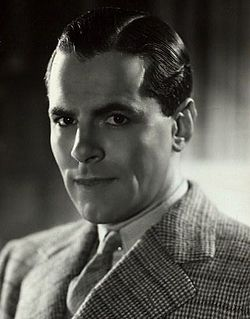
Perhaps the most famous people in the United States to have made the jump from actor to politician are Ronald Reagan and Arnold Schwarzenegger. Donald Trump is not primarily an actor, rather he was the host of The Apprentice and has had numerous film cameos and TV appearances. Rather, he is a celebrity businessman turned politician. All of them identify or identified as Republicans during their political careers. The first actor, however, to make the jump from actor to Republican politician was John Davis Lodge (1903-1985).
To be perfectly clear, Lodge’s family background set him up to be a politician. After all, he was descended from multiple families that produced politicians. The Lodge family, for instance, was one of the most prominent early families of Boston, and both his grandfather and older brother, Henry Cabot Lodge Sr. and Jr., were both prominent and influential politicians. Although Lodge studied law at Yale and became a lawyer, the call of Hollywood had him drop his lucrative legal practice. Naturally handsome, he would appear in numerous films from 1933 to 1940. Lodge later recalled his time in Hollywood, stating that he had known Ronald Reagan although never acted in the same film with him, explaining, “We were involved in different aspects of acting. I was leading man for Marlene Dietrich, and I acted with Katharine Hepburn in ‘Little Women,’ and I played Shirley Temple’s father in ‘The Little Colonel’” (Folkart). By the way, does this not look like a movie star to you?
During World War II, Lodge served as a lieutenant and lieutenant commander in the Navy, acting a liaison between the American and French forces. He served with distinction, being awarded the rank of Chevalier in the French Legion of Honor and the Croix de Guerre with Palm by Charles de Gaulle (National Governors Association). In 1946, a political opportunity opened up when Clare Boothe Luce of Connecticut’s 4th Congressional district decided not to run for reelection after the death of her daughter. This was an excellent year to be a Republican, and they won majorities in the House and Senate as well as had a complete sweep of the state’s House delegation.
Congressman Lodge
Lodge was without doubt a moderate Republican, as opposed to being among the conservative Old Guard. He sided with Americans for Democratic Action 40% of the time, and his DW-Nominate score was a 0.063, which indicates centrism. While in Congress, Lodge supported income tax reduction, the Taft-Hartley Act, aid to Greece and Turkey, the Marshall Plan, reducing the power of the Rules Committee to bottle up legislation, and public housing. Although the 1948 election was more difficult for Republicans, he won reelection by 12 points, easily the best performance among the state’s House Republicans. Lodge was also one of the strongest Republican internationalists, opposing foreign aid reductions and supporting Point IV aid to poor nations. Although he supported amendments weakening rent control, he supported extending it in 1950. That year, he opted not to run for reelection to run for governor against incumbent Chester Bowles, and campaigned against him as extremely left-wing (Krebs). Bowles in turn was dismissive of him, publicly regarding him as merely an actor. This was a political error as numerous retired actors lived in Connecticut (Folkart). The election was close, with Lodge winning by two points with a plurality of the vote. Had the votes for the Socialist candidate gone to Bowles, he would have won the election.
Governor Lodge
Lodge was the first governor for which the four-year term applied. Previously, Connecticut governors had served two-year terms. This gave him time to enact some measures, such as enhancing unemployment and worker’s compensation, increasing funds for education and the construction of public buildings, as well as the construction of the Lodge Turnpike (National Governors Association). However, the latter is often regarded as the reason behind his loss of reelection in 1954 to Abraham Ribicoff by just over 3,000 votes. After his loss, Republicans would have a tough time winning gubernatorial elections over the next forty years. Until 1994, the only time in which Republicans won the governorship was Congressman Thomas J. Meskill’s 1970 win.
Ambassador Lodge
Like his brother, Henry Cabot Lodge Jr., John was a friend of President Eisenhower, and he was tapped to the post of Ambassador to Spain. In this capacity, he played a role in the increasing normalization of relations between the US and Franco, serving until 1961. In 1964, Lodge attempted to revive his electoral career by running against Democratic Senator Thomas J. Dodd. Although he was far from being a Goldwater Republican, Dodd’s combination of domestic liberalism and anti-communism on foreign policy played well and Goldwater at the top of the ticket dragged down his campaign. Dodd won reelection by nearly 30 points, with Lodge only outperforming Goldwater by 3 points. Lodge did not run for political office again, but Republican presidents continued to find use for him. In 1969, President Nixon called him back into service as Ambassador to Argentina, a role he served in until 1973. Lodge’s last role would be as President Reagan’s Ambassador to Switzerland, serving from 1983 until his resignation in 1985. On October 29th, he delivered a speech at the Women’s National Republican Club in New York City but after he finished, he suffered a heart attack and was pronounced dead on arrival at St. Clare’s Hospital.
References
ADA Voting Records. Americans for Democratic Action.




 Mad Politics: The Bizarre, Fascinating, and Unknown of American Political History