The Voting Rights Act Debate

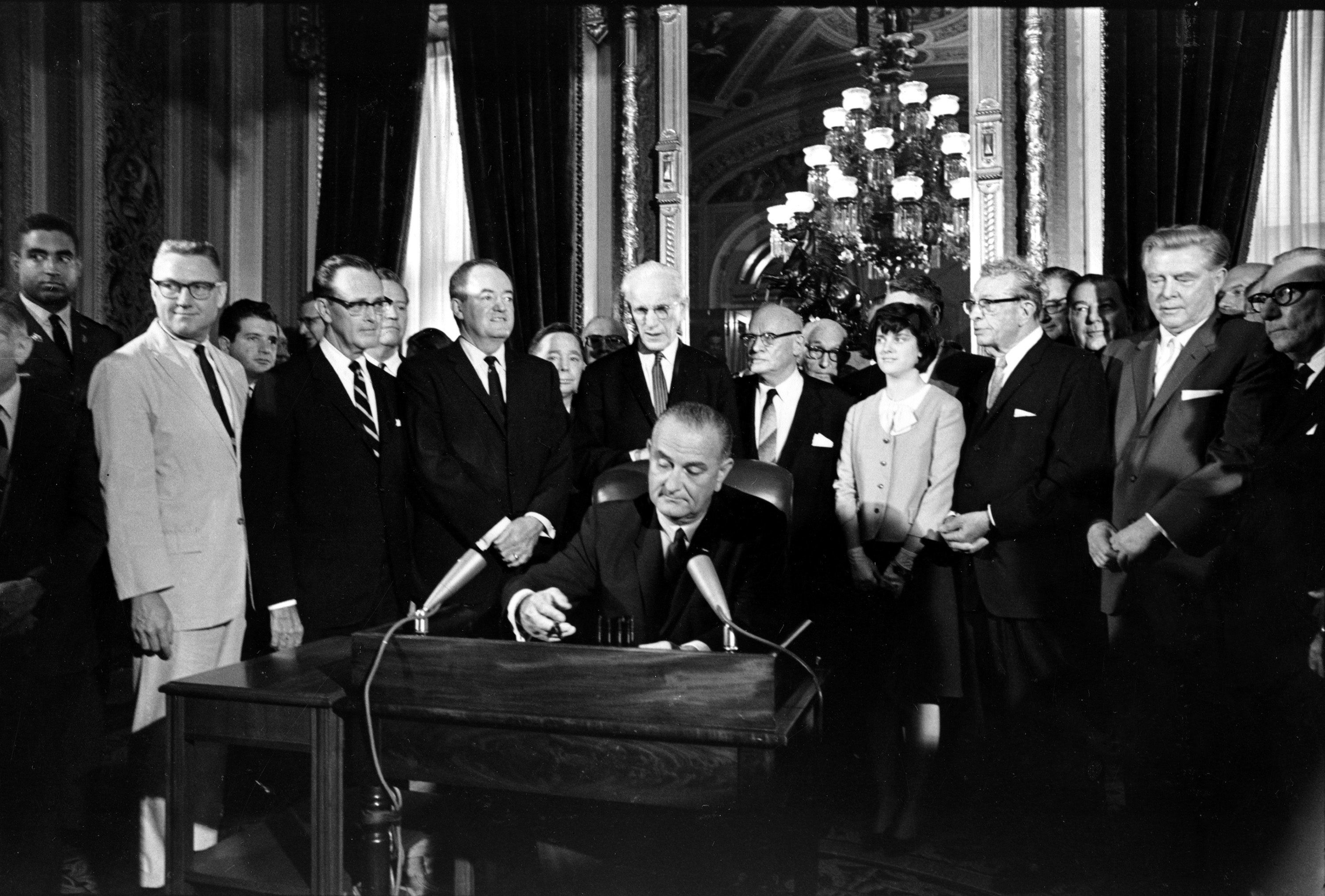
This month, the Voting Rights Act of 1965 turned 60; Lyndon B. Johnson signed the bill into law on August 6th. Thus, I am covering the subject of the process of its passage.

Selma

The violence seen on national TV in Selma, with non-violent protestors being beaten by police on the Edmund Pettus Bridge, shocked the nation and increased calls for action on voting rights. Further pushing public opinion was a racist mob beating Reverend James Reeb to death at Selma and the murder of Viola Liuzzo by members of the KKK. Although the previous year’s landmark Civil Rights Act of 1964 had a section for voting rights, it was not regarded as sufficiently strong during the 1964 election. Although it was clear that in the Great Society Congress action would be taken, the question was which course would be taken?

A Harsh Bill

After these events that got worldwide press coverage, President Johnson instructed his Attorney General Nicholas Katzenbach to craft “the goddamndest, toughest voting rights act that you can” to counter the situation in the South. The Johnson Administration’s measure, backed by House Judiciary Committee Chairman Emanuel Celler (D-N.Y.), contained the following provisions:

. A suspension of literacy tests for five years in areas where less than 50% of the eligible population was registered or voted in the 1964 election.

. Federal examiners to register and enforce the right to vote for all citizens unable to exercise the right.

. Nationwide prohibition on measures that are discriminatory in voting practices.

. Outright ban on the poll tax for voting in state and local elections.

. Language assistance for voters who were not proficient in English.

. A “preclearance” provision requiring covered states and localities to get their election changes approved by the US Attorney General. This was one of the most controversial provisions.

The Senate

The advocacy for a strong Voting Rights Act was led by Senator Phillip Hart (D-Mich.), the bill’s manager, and was aided in efforts to strengthen the bill by Hiram Fong (R-Haw.), Birch Bayh (D-Ind.), Ted Kennedy (D-Mass.), Edward Long (D-Mo.), Joseph Tydings (D-Md.), Jacob Javits (R-N.Y.), Quentin Burdick (D-N.D.), and Hugh Scott (R-Penn.). The opposition to the measure would normally be led by Richard Russell (D-Ga.), but he was under the weather so the bulk of the work against came from Allen Ellender (D-La.), with help from Sam Ervin (D-N.C.), James Eastland (D-Miss.), John Stennis (D-Miss.), Herman Talmadge (D-Ga.), Lister Hill (D-Ala.), and John Sparkman (D-Ala.). The Senate’s party leaders, Mike Mansfield (D-Mont.) and Everett Dirksen (R-Ill.), were instrumental in crafting a bill that could get widespread support.

Whither Poll Taxes?

One controversy surrounding the Voting Rights Act was how the law should address poll taxes. The original bill had a provision that outright banned state and local poll taxes, but the bill was changed in the Senate on this count. A key vote on the Voting Rights Act was regarding Senator Ted Kennedy’s (D-Mass.) amendment to retain the bill’s explicit ban on the poll tax for states and localities. This amendment was opposed by President Johnson, Majority Leader Mike Mansfield, and Minority Leader Everett Dirksen. Mansfield and Dirksen crafted a substitute that declared that poll taxes were contrary to the right to vote and directed the U.S. Attorney General to initiate lawsuits against poll taxes in states and localities, believing that courts would act against poll taxes. Kennedy’s amendment failed on May 11th, 45-49. Courts would act as Mansfield and Dirksen anticipated in striking down poll taxes.  The most unusual vote was from Louisiana’s Russell Long, who voted for this amendment but voted against the Voting Rights Act.

Support for the Voting Rights Act:

George McGovern (D-S.D.), future presidential contender, stated, “For more than one hundred years this basic right [voting] has been denied to large segments of the American citizenry, solely because of the color of their skin. The Voting Rights Act of 1965 will secure that right. It will be passed by an overwhelming margin, because there is broad agreement on the part of the American people that to deprive the American Negro of the right to vote is to deprive all of us of the essence of our heritage and democracy” (11750).

Jacob Javits (R-N.Y.), one of the Senate’s leading liberals, justified support of the Voting Rights Act given numerous instances of denials of the vote, stating, “The fundamental basis for the bill is the factual finding of Congress that there have been such widespread denials of the fundamental right to vote in so many broad areas of the Nation as to require the application of remedies in order to implement the 15th amendment” (11740).

Milward Simpson (R-Wyo.), while acknowledging the bill was a tough measure, he also said, “Time and time again legislation has been before the Congress which is proposed with the view toward bringing the right to vote to all citizens. I am ashamed, and all Americans should be ashamed, that this right has not been one of those cherished rights guaranteed to all citizens, regardless of race or color” (11746). Simpson’s support is a significant development as he had been one of six Republican senators to vote against the Civil Rights Act of 1964 the previous year.

Opposition to the Voting Rights Act:

James Eastland (D-Miss.), chairman of the Senate Judiciary Committee who had made his committee the “graveyard” for civil rights legislation, asserted that with the Voting Rights Act “we are entering an era of absolute government. The bill is a major step in that direction. It will destroy the system of government that we know now. We are destroying it under the whiplash of Martin Luther King and others of that ilk” and cited Article I, section 2 of the Constitution to justify opposition (11735).

John Sparkman (D-Ala.), who was the Democratic Party’s pick for vice president in 1952, opposed the bill on nine counts, including what he found to be unequal protection of the laws, a distortion of the proper relationship between federal, legislative, and judicial functions of government, and that the bill was sectional (11727-11728).

John Tower (R-Tex.) stated his sympathy with the aim of the bill and acknowledged that the federal government does have the authority to enforce the 15th Amendment, he objected to way it was to be achieved, holding, “Mr. President, the mathematical guilt formula to be so unjustly hung upon several States and counties, is arrived through the highly questionable assumption that literacy tests and lower voter participation always means discrimination. Other objective, basic assumptions that lack of participation in certain elections may be due to a strong one-party system, voter apathy toward one or more candidates, or even bad weather, are completely ignored” (11751).

Whither Literacy Tests?

The Voting Rights Act suspended literacy tests for five years in covered jurisdictions, and literacy tests would later be banned permanently. The core debate surrounded the question of whether literacy should be a consideration or if literacy tests should remain but with standards as to what constitutes literacy. Republicans, such as William McCulloch (R-Ohio), thought that a 6th grade education was sufficient proof of literacy. This standard would be placed into the Republican substitute of the bill. Another controversial proposal was by Rep. Jacob Gilbert (D-N.Y.), which permitted people to vote if they proved literate in a language other than English that was taught in their school. This amendment, primarily geared towards Puerto Ricans, was rejected 202-216. The bill passed 77-19 on May 26th, but the measure still had to get through the House.

Proposed Republican Substitute

House Republicans had an alternative voting rights plan, backed by Minority Leader Gerald Ford (R-Mich.) and William McCulloch (R-Ohio), ranking Republican on the Judiciary Committee. This substitute aimed to balance out the interests of state’s rights and civil rights, by making enforcement on a by county basis. It established a 6th grade education as proof of literacy (thus allowing literacy tests for individuals who had not graduated from 6th grade), retained the ban on poll taxes and would also cover Texas under the Voting Rights Act, which President Johnson, who continued to look out for the interests of his home state, didn’t want. Although not exactly a prince of a state on the subject of voting rights, it was known that the conditions of Texas were not like those of the Deep South. Rep. William McCulloch critiqued the Celler (D-N.Y.) version of the bill, and did so on conservative terms, calling the automatic trigger mechanism in the bill “pure fantasy – a presumption based on a presumption” and considered the committee bill an attack on the ability of the states to determine voter qualifications (Reichardt). This substitute had a key foe in liberal stalwart Frank Thompson (D-N.J.), who argued, “…I oppose the Ford-McCulloch substitute amendment because it does not reach down into the heart of the problems were are trying to eliminate. It is no fiction that “tests and devices,” a key phrase in voting and registration legislation, are being used to restrict the franchise. A serious defect of the Republican leadership substitute is in its requirement that Federal examiners administer tests to applicants with less than six grades of education. This requirement would serve to continue into the present and the future a double standard of testing – the very evil we are attempting to eliminate. Negroes would be tested by the examiners on the basis of the standard set forth in the substitute amendment – completion of six grades or passing of the State literacy test. At the same time, whites would be applying for registration to the State or local registrar, who would presumably do what he has always done – register whites on the basis of their white skin rather than on the basis of any educational achievement or passage of any test” (16228). Most fatal to this proposed substitute, however, was the embrace most Southern Democrats gave this substitute, even if they did not intend to support it on passage. This signaled to the liberal 89th Congress, already predisposed to support President Johnson on domestic policy, that the Republican substitute was weak. Rep. Harold Collier’s (R-Ill.) effort for the House to adopt the Republican substitute as well as Rep. Robert McClory’s (R-Ill.) amendment failed 171-248. Interestingly, a few opponents of the Voting Rights Act voted against this substitute, including some from Texas, as this version would have covered Texas. One Republican proposed amendment that did pass, however, was the Cramer (R-Fla.) anti-voter fraud proposal, which passed 253-165 with all Republicans in support.

House Supporters:

Ed Roybal (D-Calif.) cited recent violent events as justification for the Voting Rights Act and considered the measure a “clear, practical, effective, and legislatively responsible way to enable citizens to vote without the fear or threat of discrimination” (16280).

Majority Whip Hale Boggs (D-La.) stated, “I wish I could stand here as a man who loves my State, born and reared in the South, who has spent every year of his life in Louisiana since he was 5 years old, and say there has not been discrimination. But unfortunately it is not so” and went on to state, “I shall support this bill because I believe the fundamental right to vote must be part of this great experiment in human progress under freedom which is America” (U.S. House of Representatives). His announcement of support was a big deal given that he had previously opposed all civil rights measures save for the 24th Amendment.  

Jonathan Bingham (D-N.Y.) stated his support for the Celler (D-N.Y.) version, regarding the Ford-McCulloch substitute as much weaker (16273).

Paul Findley (R-Ill.) spoke in support of the bill, citing the Lincolnian heritage of the Republican Party as Lincoln’s Illinois hometown of Springfield being in his district, and praised Gerald Ford’s (R-Mich.) recent appointment of Frank Mitchell, the first black page of the House (16272).

Charles Goodell (R-N.Y.) stated his reserved support for the Celler (D-N.Y.) version of the Voting Rights Act and voiced his preference for the Ford-McCulloch substitute. He regarded the Celler version as “unnecessarily punitive” and critiqued only applying the Voting Rights Act to seven states, noting Texas being absent from coverage, but said he would vote for the Celler bill (16273).

William F. Ryan (D-N.Y.) wanted a measure that did more, and cited deprivations he witnessed as a civil rights activist of freedoms of speech, assembly, and press, but acknowledged that this measure was the furthest the federal government had gone so far (16265).

Frank Annunzio (D-Ill.) praised the bill and also cited the murders of civil rights activists Reverend James J. Reeb and Viola Liuzzo as being bad for the US’s image abroad (16272).

House Opponents:

John Dowdy (D-Tex.) condemned the suspension of certain state laws surrounding election policy and considered suspensions as characteristic of martial law or the tyrannical regimes of Hitler, Mussolini, and Stalin, but not America (16268).

Glenn Andrews (R-Ala.) asserted that the Voting Rights Act itself was a form of discrimination against seven states, Alabama being among them, and cited Article II, section 1, clause 2 that states have the right to set voter qualifications (Congressional Record, 16274).

James Broyhill (R-N.C.) stated his opposition to the Celler version of the Voting Rights Act, but said that if the Ford-McCulloch substitute would be adopted that he would vote for the bill on passage (16270).

W.J. Bryan Dorn (D-S.C.) condemned the embrace of the Voting Rights Act as Congress “being forced to bow and subvert itself to the will of the mob”  and that the legislation was “punitive”, “vindictive and sectional”, and “evil” (16268).

The House passed the Voting Rights Act of 1965 333-85 on July 9th.

There are a few things to note about the votes on the Voting Rights Act. First, opposition was almost entirely among Southern politicians. There were only seven legislators outside of the South that opposed the Voting Rights Act on both initial passage and the vote on the conference report: Senator Robert Byrd (D-W.V.), Republican Representatives H. Allen Smith of Glendale and James B. Utt of Tustin (Orange County), California, Republican George Hansen of Pocatello, Idaho, Republican H.R. Gross of Waterloo, Iowa, Democrat Paul C. Jones of Kennett, Missouri, and Republican Robert C. McEwen of Ogdensburg, New York. Also of note was the abstention of Democrat Adam Clayton Powell Jr. of Harlem, New York. Although in truth of disputable racial identity as he was of mixed racial origin (he had blue eyes) and thus could have passed for white, Powell identified himself as black, and a radical at that, and abstained as he thought the bill was not strong enough.  He held that this as well as the 1966 civil rights bill was a “phony carrot stick” for black middle class (CQ Press). There were also notable differences between the House and Senate versions of the Voting Rights Act of 1965, including the House version’s outright ban of state and local poll taxes. The final version hammered out by the conference committee kept the Senate language on state and local poll taxes, thus they would be challenged in court, adopted the Senate’s provision that waived requirements for English literacy to vote in certain cases, and adopted the stronger triggering formula in the House bill as opposed to the Senate bill which allowed certain escape clauses (Reichardt). The net impact of the conference committee’s bill does seem to have been to make the bill stronger. The only senator who switched on the Voting Rights Act’s conference report was Florida’s George Smathers, who went from voting against to voting for, while in the House there were a few new Republican votes against, such as Paul Fino (R-N.Y.) over the English literacy provision but there were also some new Republican votes for, such as all three of Tennessee’s Republican representatives. In the South, there were a few Democrats who flipped from opposition to support, such as A.S. Herlong (D-Fla.) and George Mahon (D-Tex.). Contrary to what GovTrack and Voteview will tell you, one of these switches was not Watkins Abbitt (D-Va.). Through an error they mix up Abbitt’s vote with that of E. Ross Adair (R-Ind.), who voted for both the House and conference version of the Voting Rights Act. The result was a highly effective law that increased black participation in politics in the South, although it would take a few election cycles for the full power of their votes to be realized.

References

Controversies Surround Rep. Adam Clayton Powell. CQ Almanac 1966. Congressional Quarterly Press.  

Retrieved from

https://library.cqpress.com/cqalmanac/document.php?id=cqal66-1301925#_=_

Majority Whip Hale Boggs’ Support of the Voting Rights Act of 1965. US House of Representatives.

Retrieved from

https://history.house.gov/HistoricalHighlight/Detail/36267

Reichardt, G. (1975). The Voting Rights Act of 1965 (C): Congress and the Voting Rights Act. Harvard University.

Retrieved from

The Senate Passes the Voting Rights Act. U.S. Senate.

Retrieved from

https://www.senate.gov/artandhistory/history/minute/Senate_Passes_Voting_Rights-Act.htm

Voting Rights Act of 1965. Congressional Record, 11715-11753.

Retrieved from

Voting Rights Act of 1965. Congressional Record, 16207-16286.

Worcester v. Georgia: The Ignored Supreme Court Decision

The idea of defiance of the Supreme Court is one that seems remote in the minds of many, although the court is certainly unpopular among liberals right now, an outright defiance of any one decision still seems remote. The closest that a president came to defying the Supreme Court as far as my memory goes was if the Supreme Court had ruled against FDR in the Gold Clause Cases in 1935. They ruled for the Administration 5-4, but Roosevelt had every intention to defy the court if they ruled otherwise, and the Supreme Court had ruled against numerous New Deal laws without FDR defying their verdicts. Andrew Jackson and the state of Georgia, however, did in 1832.

Samuel A. Worcester

One of President Jackson’s priorities, which really appealed to the South at the time, was moving the five civilized tribes out of their ancestral lands to make room for settlers to farm. Although popular in the South, the issue was highly controversial, and the Whig Party was opposed. The vote in the House was exceptionally close at 102 to 97. In the meantime, the tribes had a number of white sympathizers, which included missionaries. One of these missionaries was Samuel A. Worcester, who was helping the Cherokee, and Georgia’s state government didn’t appreciate their efforts. The state in response passed a law that prohibited whites from living in tribal land unless they got a special license from Georgia’s governor and swore an oath to the state. Worcester and his fellow missionaries were subsequently arrested, convicted, and imprisoned. He appealed his imprisonment to the Supreme Court, and in 1832 they ruled 5-1 in Worcester v. Georgia that Georgia had no authority to make laws regarding Cherokee land, and that treating tribal land as separate nations was consistent with the history of treaties by the United States with the tribes. Chief Justice Marshall wrote the opinion of the court, holding that “the nations had always been considered as distinct, independent political communities, retaining their original natural rights as the undisputed possessors of the soil” (31 U.S. 515) Marshall conceded that the Cherokee had surrendered some sovereignty with treaties, that this was not sufficient for enacting such a law.

John Marshall

That was all well and good, except who was going to enforce it? Georgia refused to comply, and President Jackson refused to enforce the ruling. Although Jackson is famously reputed to have said to Brigadier General John Coffee, “John Marshall has made his decision; now let him enforce it”, what he actually said was, “The decision of the supreme court has fell still born, and they find that it cannot coerce Georgia to yield to its mandate” (Garrison). Not as defiant, memorable, or smooth, right? After intense public pressure and criticism, the missionaries were pardoned the following year, and Indian removal would proceed in the coming years in what was infamously known as the Trail of Tears. That subject undoubtedly warrants a separate post.  Andrew Jackson would have greater appreciation of the Supreme Court, however, when it came to the Nullification Crisis, another subject that warrants a separate post in which South Carolina nullified two tariff laws as it found them unconstitutional, and Jackson proclaimed that South Carolina had no authority to determine constitutionality of federal legislation and that the Supreme Court had the ultimate authority on constitutionality (Rosen). The full stories of the Trail of Tears and nullification will be written about at a later date. Overall, it would be quite foreign and scandalous to us if a Supreme Court decision was actively defied and the White House would not enforce the ruling, indeed it would produce a Constitutional crisis. However, Worcester was not in vain and remains good law, thus it has served as a precedent for numerous Indian rights cases.

References

Garrison, T.A. (2004, April 27). Worcester v. Georgia. New Georgia Encyclopedia.

Retrieved from

https://www.georgiaencyclopedia.org/articles/government-politics/worcester-v-georgia-1832/

Rosen, J. (2006, December). The Supreme Court – The First Hundred Years. PBS 13.

Retrieved from

https://www.thirteen.org/wnet/supremecourt/antebellum/history2.html

Worcester v. Georgia. Encyclopedia Britannica.

Retrieved from

https://www.britannica.com/topic/Worcester-v-Georgia

Worcester v. Georgia, 31 U.S. 515 (1832). Justia.

Retrieved from

https://supreme.justia.com/cases/federal/us/31/515/

A Deeper Dive into the Bricker Amendment


I have written in the past about the defeat of the Bricker Amendment as an achievement of LBJ, but I felt this subject needed a bit of a deeper dive, so here it is. National sovereignty is a subject that has long greatly concerned American conservatives. This concern, in addition to extraordinarily bad relations between President Wilson and Senator Lodge (they refused to be in the same room together), resulted in the rejection of the Versailles Treaty. Another monumental event came quite close to happening on account of this concern, and this was the proposed Bricker Amendment to the Constitution. Over the history of the United States, the use of executive agreement has risen considerably overtime as opposed to treaties for convenience as the US has become a more prominent actor on the global stage (Lindsay). After World War II, there were several international developments that gave conservatives concern. The first was the Yalta Agreement, in which in addition to planning the postwar fate of Germany, Stalin succeeded in convincing the US and Britain that he would allow free and fair elections in Poland and contributed to the domination of the USSR of Eastern Europe.

Another was the UN Charter, of which the US is a signatory, which pledged members to promote “conditions of economic and social progress” and rights “without distinction as to race” (Time Magazine, 1954). This could be seen by conservatives nationally as international pushing for increasing government and by Southern conservatives as bringing an end to Jim Crow. The latter concern was bolstered by a Truman-appointed committee in 1947 suggesting that the UN Charter gave authority for civil rights laws previously lacking (Time Magazine, 1954).

Furthermore, the US endorsed but did not ratify until 1988 the Genocide Convention. One might think ratifying the Genocide Convention today to be a no-brainer, but there were substantial reasons why it was a cause for concern for the US at the time. One part of this was because of an expansive definition of genocide that included, “causing..mental harm” to members of “a national, ethnical, racial, or religious group” which Time Magazine opined “expressions of honest opinion might become crimes” (Time Magazine, 1954). This is an interesting early warning of “hate speech” laws that have been passed in numerous European nations and have attracted a disturbing level of support among American youth, who seem to have failed to account for who might be defining what “hate speech” is and the controversies that have occurred in European nations over such laws, such as the prosecution and conviction of politician Geert Wilders in the Netherlands for calling for less Moroccans in the nation. There was also the 1951 document authored by the communist Civil Rights Congress, “We Charge Genocide”, presented to the UN in Paris meetings in December that charged the US with genocide based on Jim Crow practices in the South as well as discrimination throughout the nation that had basis in this expansive definition, and claimed that US “endorsement” of racism and “monopoly capitalism” made this possible (Martin). Thus, the Genocide Convention could serve as at least an effective propaganda tool by the USSR, if not something worse for the US. There was also the UN Covenant of Human Rights.

The UN Covenant of Human Rights was a far-reaching document with Eleanor Roosevelt at the helm for two years in drafting. However, Time Magazine (1953) reported that there was a great deal of influence from Soviet delegates as well as from other dictatorships, which resulted in a dilution of “such natural rights as freedom of religion, speech, press and assembly by mixing them with highly dubious “rights”. Some of these “rights” would enlarge government powers instead of restricting them. According to the covenant, for example, the state is obliged to see such things as “healthy development of the child” and “environmental hygiene” and “the right of everyone” to a job, fair wages, adequate housing, education and a “continuous improvement of living conditions””. Desirable goals become state mandated, and result in both Big Brother and Big Sister taking hold.

The Treaty Power in General in a Postwar World

John Foster Dulles observed this potential danger in 1952 when he stated, “The treatymaking power is an extraordinary power liable to abuse. Treaties make international law, and they make domestic law…They are, indeed, more supreme than ordinary laws. [They] can override the Constitution…cut across the rights given to the people by their Constitutional Bill of Rights” (Time Magazine, 1953). However, only the next year he was tapped by President Eisenhower to be Secretary of State. By the time the Bricker Amendment came up for consideration, he came out against it, rationalizing given his previous statement that such abuses had not happened (Time Magazine, 1953). Thus, his argument as Secretary of State amounted to that the Bricker Amendment was seeking to solve a problem that wasn’t existing.

Time Magazine (1953) described the situation with treaties thusly, “In the 166 years since 1787, virtually the only limit put upon the treaty power by the Supreme Court is that a treaty may not “authorize what the Constitution forbids.” Even that limitation has been questioned. A circuit court of appeals declared: “It is doubtful if the courts have power to declare the plain terms of a treaty void and unenforceable”. Given that this was what the understanding was of the time, concern over the state of the treaty-making power of the Constitution is at least understandable. Worse yet, there wasn’t necessarily a dividing line as to what distinguishes a treaty from an executive agreement policy-wise. Senator Guy Gillette (D-Iowa) discovered this when he asked the State Department this question and received the following answer, “A treaty was something they had to send to the Senate to get approval by two-thirds votes. An executive agreement was something they did not have to send to the Senate” (Lindsay). There have been Supreme Court decisions that clarified this matter more since then. Speaking of the Supreme Court…

Further Concern: Troublesome Supreme Court Decisions

The American Bar Association considered the possibility of a treaty superseding the Constitution as “One of the greatest constitutional crises the country has ever faced” and urged the adoption of a Constitutional amendment to clarify the supremacy of the Constitution (Time Magazine, 1954). After all, in 1920 in Missouri v. Holland the Supreme Court upheld the Migratory Bird Treaty Act of 1918 (for It’s Always Sunny fans, yes, bird law nearly influenced the adoption of a Constitutional amendment.) in a decision that held that treaties superseded state laws, the same decision in which Justice Oliver Wendell Holmes Jr. articulated the notion of the “living Constitution”, a notion contemptible to judicial conservatives. This decision alarmed many conservatives, who came to believe that the president could amend the Constitution by making treaties with other nations, thereby encroaching on functions that were otherwise reserved to the states (Sutherland, 1951). Two more that caused alarm and added ambiguity to the situation were United States v. Belmont (1937) and United States v. Pink (1942). In the former, it was ruled that an executive agreement overrode New York State law and in the latter, it was ruled that treaties and executive agreements are interchangeable (Lindsay). If there is such ambiguity and executive agreements are to carry the same force on states as treaties, why bother submitting a treaty to the Senate just for it to potentially meet the fate of the Versailles Treaty?

Conservatives Act

On September 14, 1951, John W. Bricker (R-Ohio), one of the staunchest conservatives in the Senate, introduced what came to be known as the “Bricker Amendment” for the first time. This amendment proposed three limitations on executive power on foreign relations. These were, as Professor Cathal J. Nolan (1992) writes, “(1) the Executive was to be barred from entering into treaties which conflicted with the Constitution; (2) all treaties henceforth would require implementing legislation “which would be valid in the absence of a treaty” (a so-called ‘which clause’); and (3) executive agreements now would be overseen – and could be rejected – by Congress just as were treaties”. Not only was the American Bar Association in support as earlier mentioned, but so was the American Medical Association. Both groups were at the time considered conservative organizations. However, the Senate had a Democratic majority and had it come to a vote, the Bricker Amendment would have surely failed. The 1952 election, in addition to electing Dwight Eisenhower, also produced Republican majorities in Congress.

With a Republican president in the White House as well as a Republican Senate, the time seemed right for Senator Bricker, formerly the Republican vice-presidential candidate in 1944, to again propose his amendment. Unfortunately for Bricker, the chairman of the Senate Foreign Relations Committee at the time was Wisconsin’s Alexander Wiley, a former non-interventionist who had since become a staunch internationalist. Wiley decried the measure as “the most dangerous thing that has ever been brought before Congress” (Time Magazine, 1953).  Even worse for Bricker, President Eisenhower wanted the amendment defeated. He wrote to Majority Leader Knowland that he was “unalterably opposed” to the amendment as reported to the Senate Judiciary Committee and believed that it would “shackle the federal government so that it is no longer sovereign in foreign affairs” (CQ Almanac).

The “Which Clause”

Bricker’s amendment was weakened in committee to make it more palatable to the Eisenhower Administration, but he sought to restore its original strength by attempting to add Section 3. This, known as the “which clause”, read, “A treaty or other international agreement shall become effective as internal law in the United States only through legislation by the Congress unless in advising and consenting to a treaty by the Senate, by a vote of two-thirds of the Senators present and voting, shall provide that such treaty may become effective as internal law without legislation by the Congress” (CQ Almanac). If incorporated, this amendment had great potential to cause trouble for a president who wished to have executive agreements with other nations not rising to the level of treaty. This proposal was defeated 42-50, notably getting votes against by some who otherwise supported the Bricker Amendment, such as Majority Leader William Knowland (R-Calif.) and Walter George (D-Ga.). Senator George brought up a version that although was weaker than the original Bricker Amendment, was stronger than the committee version of the Bricker Amendment. The George Substitute was now the central proposal.

LBJ Engineers Amendment’s Demise

I have covered LBJ’s role in greater detail in the past, but Senate Minority Leader Lyndon B. Johnson (D-Tex.) was privately opposed to the Bricker Amendment. He had presidential ambitions and like Eisenhower he believed it would hamper the president’s ability to conduct foreign policy. However, Johnson could not simply vote against it. He had to pull off a tricky act as Texans were in strong support, therefore he had to appear to support the Bricker Amendment while getting it defeated. His vote on this amendment was “yea”, but he managed to get a vote adopting the George (D-Ga.) substitute defeated by one vote. With this one vote, the Bricker Amendment had met its Waterloo. Senator Bricker was embittered by this event and blamed Eisenhower for its defeat. In truth, both Eisenhower and Johnson were the necessary players for the Bricker Amendment’s fall. The cause for the Bricker Amendment was largely neutered through the Supreme Court’s decision in Reid v. Covert (1957), in which a plurality found that although executive agreements could be entered by the president, they couldn’t contradict the US Constitution. Had the Bricker Amendment been adopted, it would have been perhaps the most substantial alteration to the Constitution in the 20th century. The notion of the imperial presidency on foreign policy would be firmly out, and the balance of power would have gone more to the legislative branch, as some conservatives have argued was intended by the Founders, but as others could argue is inappropriate on foreign policy. Historian Walter LaFeber wrote that with the defeat of the Bricker Amendment that the Constitution was “saved from the most radical overhauling in its history” (Tananbaum). The most recent legal development involving the treaty power was the 6-3 Supreme Court decision Medellin v. Texas (2008), in which at-the-time Texas Solicitor General Ted Cruz successfully argued that a treaty is not binding as domestic law until an act of Congress has occurred to implement it, that rulings from the International Court of Justice are not binding on US courts, and cannot be enforced without authority from Congress or the Constitution (552 U.S. 491). If there is a heaven (which I happen to believe there is), then surely Bricker smiled from above at this decision.

Differing Perspectives

Interpretations for the motives behind the Bricker Amendment vary, and this is simply because there were multiple motives behind the amendment. As might be expected, a 2021 paper out of Columbia University on this emphasized the racial cause (Glusman). But frankly, certain segments of society are completely and utterly obsessed with racial identity. There were far more people with motives that differed from those of the white South. This was, for instance, not the motive of Bricker and his fellow Midwestern Republicans…he on multiple occasions had voted in the civil rights direction while in the Senate, including for the Civil Rights Act of 1957 and against weakening it by a jury trial amendment, as well as against Senator Richard Russell’s (D-Ga.) effort to undermine desegregation of the army in 1950. Rather, he was of the Old Guard Midwest Republicans who were skeptical to hostile to internationalism and constantly on guard for America’s national sovereignty. There is, however, a degree of truth in this narrative as the amendment had strong support from Southern legislators. Indeed, only three senators from former Confederate states in Lister Hill of Alabama, J. William Fulbright of Arkansas, and Estes Kefauver of Tennessee voted against the Bricker Amendment as amended by George, and they were among the most amenable to the politics of the national Democratic Party. Looking back, it is ultimately for the best that the US addressed civil rights without any sort of international force behind it, as such an approach would have only weakened, not strengthened, support for civil rights as the issue of national sovereignty could have been introduced as a reason to oppose in addition to the existing argument of state sovereignty to oppose. Another perspective, embraced by multiple scholars, was that the Yalta Agreement was the central cause of the proposal of the Bricker Amendment (Tananbaum).

References

Bricker, John William. Voteview.

Retrieved from

https://voteview.com/person/1024/john-william-bricker

Bricker Treaty Amendment Debate. (1954). CQ Almanac.

Retrieved from

https://library.cqpress.com/cqalmanac/document.php?id=cqal54-1358114

Glusman, G. (2021, December 2). The Long Afterlife of the Bricker Amendment: Jim Crow, Human Rights, and the Genocide Convention. Columbia Journal of Transnational Law.

Retrieved from

https://www.jtl.columbia.edu/bulletin-blog/the-long-afterlife-of-the-bricker-amendment-jim-crow-human-rights-and-the-genocide-convention

Holland v. Missouri (1920), 252 U.S. 416.

Lindsay, J.M. (2022, February 26). TWE Remembers: The Bricker Amendment. Council on Foreign Relations.

Retrieved from

https://www.cfr.org/blog/twe-remembers-bricker-amendment

Martin, C. (1997). Internationalizing ‘The American Dilemma’ – The Civil Rights Congress and the 1951 Genocide Petition to the United Nations. Journal of American Ethnic History, 16(4), 44-45.

Medellin v. Texas (2008), 552 U.S. 491.

National Affairs: The Bricker Amendment: A Cure Worse Than the Disease? (1953, July 13). Time Magazine.

Retrieved from

https://time.com/archive/6609013/national-affairs-the-bricker-amendment-a-cure-worse-than-the-disease/

Nolan, C.J. (1992). The Last Hurrah of Conservative Isolationism: Eisenhower, Congress, and the Bricker Amendment. Freedom and Security, 22(2), 337-349.

Retrieved from

https://www.jstor.org/stable/27550951

S.J.Res.1. Amend. To Committee Substitute Adding to Clause 2, Article IV, of the Constit. A Provision That No Treaty Shall by the Supreme Law of the Land Unless Made in Pursuance of the Constitution. Govtrack.

Retrieved from

https://www.govtrack.us/congress/votes/83-1954/s103

S.J.Res.1. Bricker Amend. Providing That a Treaty or Other International Agreement Shall Become Effective as Internal Law Only Through Act of Congress, But That Senate in Ratifying a Treaty May, by 2/3’s Vote, Make it so Effective Immediately. Govtrack.

Retrieved from

https://www.govtrack.us/congress/votes/83-1954/s105

S.J.Res.1. On Passage. (2/3’s Maj. Required – Failed). Govtrack.

Retrieved from

https://www.govtrack.us/congress/votes/83-1954/s109

Sutherland, A.E. (1952). Restricting the Treaty Power. Harvard Law Review, 65(8), 1305-1338.

Retrieved from

https://www.jstor.org/stable/1336653?origin=crossref

Tananbaum, D.A. (1985, January). The Bricker Amendment Controversy: Its Origins and Eisenhower’s Role. Diplomatic History, 9(1), 73-93.

Retrieved from

https://academic.oup.com/dh/article-abstract/9/1/73/366959

The Defeat of the Anti-Preemption Bill


The year is 1958, and Congress is not happy with the Supreme Court. In addition to Brown v. Board of Education (1954) other decisions that attracted criticism included Mallory v. United States (1957) in which it was ruled that any confessions brought out during an unlawfully long period of detention were inadmissible in court and Pennsylvania v. Nelson (1956), which overturned the conviction of a communist for sedition for his advocacy of overthrowing the US government by violent means by ruling that the 1940 Smith Act superseded Pennsylvania’s much older anti-sedition statute (350 U.S. 497). Interestingly, that law’s sponsor, Representative Howard W. Smith (D-Va.), was not only still in Congress, but he was also the powerful chairman of the House Rules Committee and objected, as he did not intend his measure to intrude on state anti-subversive laws.

Smith proceeded to introduce the “Anti-Preemption bill”, which would explicitly overturn Nelson and generally restrict Federal courts in the application of the preemption doctrine by only allowing them to block enforcement of state laws if Congress had explicitly intended to preempt and that there was direct and irreconcilable conflict in Federal and state laws (CQ Press). Furthermore, Federal anti-subversive laws would be clarified as not preempting state anti-subversive laws. Smith argued that Federal courts had been finding preemption in multiple cases where no evidence existed of intent to do so by Congress, with one other notable recent decision being Guss v. Utah Labor Relations Board (1957), which ruled that states could not get involved in labor disputes that the National Labor Relations Board (NLRB) refused to intervene (CQ Press, 353 U.S. 1). The House, in which the Conservative Coalition was strong, passed the bill 241-155 (D 101-109, R 140-46) on July 17th after an effort by Representative Kenneth Keating (R-N.Y.) to kill it failed. Critics contended that it would result in state intrusion in areas in which Federal laws were desirable and that since it would retroactively apply it would potentially result in a massive reevaluation of precedents in Federal-state relationships and burdening the courts with litigation (CQ Press). The opponents of the measure did have some strong allies in other places. Namely, President Dwight Eisenhower (who opposed as the bill would apply retroactively) as well as Senate Majority Leader Lyndon B. Johnson (D-Tex.).


The Anti-Preemption Bill Makes the Senate


Two key votes were held on the anti-preemption bill as it was debated in the Senate. The first was on Senator Thomas Hennings’s (D-Mo.) motion to table Senator John McClellan’s (D-Ark.) amendment substituting the House-passed anti-preemption bill for the much more moderate court bill, which failed 39-46 (D 25-19, R 14-27) on August 20th, and the second was a vote to kill the bill for the session. With the first vote, it looked like the Smith Anti-Preemption bill would pass the Senate. However, Majority Leader Lyndon B. Johnson (D-Tex.) had faced greater odds before, and he set to work to get the measure killed the next day. Journalist James J. Kilpatrick (1960) of the Richmond News Leader described how this went down, “He talked Florida’s Senator Smathers into pairing his vote for the bill with the vote of Oklahoma’s absent Senator Monroney against the bill. He persuaded Senator Young of North Dakota, Senator Frear of Delaware, and Senator Kerr of Oklahoma, all supporters of the bill, to take a walk down the corridors when the bell sounded for a roll call vote. He induced Senator Lausche of Ohio – against the Ohioan’s better judgment, as he ruefully confessed the next day – to switch his vote. And while the roll call actually was in progress, he saw to it that Republican Senator Bennett of Utah was high-pressured into voting against the bill in order to prevent a tie that might have embarrassed the Vice President”. Johnson had also managed to persuade Senator Malone (R-Nev.) to switch his vote, and while advocates gained reversals from Senators Kuchel (R-Calif.) and Gore (D-Tenn.), it was not enough. The Anti-Preemption bill was killed by Senator John Carroll’s (D-Colo.) motion to recommit 41-40 (D 27-17, R 14-23).

Although the House did pass another anti-preemption bill in the next Congress by a vote of 225-192 (D 111-162, R 114-30) on June 24, 1959, after a failed attempt by Representative John Lindsay (R-N.Y.) to kill the bill, the Senate, now much more liberal than before, did not take up the bill. Enthusiasm for this bill also died down after the Supreme Court ruled in Uphaus v. Wyman (1959) that the states had the right to investigate and penalize subversion directed against themselves, and that year the Guss decision had been overturned by Congress in passing the Landrum-Griffin Act, which explicitly permitted states to intervene in areas of Federal and state jurisdiction in which the NLRB refused to get involved (CQ Press).

References

Guss v. Utah Labor Relations Board, 353 U.S. 1 (1957)

HR 3. BAR COURTS FROM RULING THAT FEDERAL LAW NULLIFIES STATE LAW IN SAME FIELD UNLESS SPECIFIED BY CONGRESS. PASSED AS AMENDED.

HR 3. Bar Courts from Ruling That Federal Law Nullifies State Law in Same Field Unless Specified by Congress. Passed as Amended. Govtrack.

Retrieved from

https://www.govtrack.us/congress/votes/85-1958/h164

HR 3. Limitation of Court Application of Federal Preemption Doctrine. Govtrack.

Retrieved from

https://www.govtrack.us/congress/votes/86-1959/h47

Kilpatrick, J.J. (1960, October 14). LBJ: Counterfeit Confederate. Human Events.

Pennsylvania v. Nelson, 350 U.S. 497 (1956)

Preemption Doctrine. CQ Press.

Retrieved from

https://library.cqpress.com/cqalmanac//document.php?id=cqal59-1335860

S. 654. Permit States to Enact Laws Barring Subversive Activities. Hennings Motion to Table McClellan Amendment Providing That No Act of Congress Should Be Construed as Nullifying Unless Congress So Specifies. Govtrack.

Retrieved from

https://www.govtrack.us/congress/votes/85-1958/s293

S. 654. Permit States to Enact Laws Barring Subversive Activities. Motion to Recommit. Govtrack.

Retrieved from

https://www.govtrack.us/congress/votes/85-1958/s296

Dwight Eisenhower: An Ideological Profile of a President


President Eisenhower is often looked back with fondness by many as a figure of a more stable time in the United States (although there were social conflicts brimming and a lot of what was seen in the 1960s started developing in the 1950s), and indeed the representative of what President Joe Biden once called “your father’s Republican Party”. Given that Eisenhower is most certainly thought of as representative of “your father’s Republican Party”, what was he like ideologically? I already wrote in a previous post that he’s moderately conservative, but what are the details?

In his first term, Eisenhower took the side of states over the federal government in granting title for offshore natural resources (read: oil) and signed into law a bill making it so as he had promised in 1952. This issue was one of the reasons that Texas for the first time since 1928 had voted Republican. He was a convinced internationalist, and a major reason he ran for president was to stop the rise of Senator Robert Taft to the presidency, who would have been much more of a skeptic of foreign aid and the US role in the world). The relationship between Republicans and Eisenhower, although overall positive, had nuance and was complex. Although certainly far friendlier to business than his predecessor or his successor, Eisenhower was far from a turn back to his three Republican predecessors. Indeed, there was no great concerted effort to outright repeal portions of the New Deal (although there were efforts to scale back government in agriculture and to alter the Tennessee Valley Authority). He initially supported some public housing, but later turned against authorizing more. Although Eisenhower appointed some people who were not pleasing to the conservative wing of the GOP such as Charles Bohlen for Ambassador to the USSR and liberal Republican Paul Hoffman as a delegate to the UN General Assembly, he also picked some staunch conservatives in Secretary of the Treasury George Humphrey, Secretary of Commerce Sinclair Weeks, and especially Secretary of Agriculture Ezra Taft Benson. Examining Eisenhower’s official positions on votes counted by Americans for Constitutional Action for the Senate from 1955 to 1960 and for the House from 1957 to 1960 reveals that had he been a legislator, he would have scored an overall 69% by the group. ACA would endorse a legislator for reelection if their score was 65% or above, so the fiction of Eisenhower the legislator would have been endorsed for reelection (had the also fictional scenario existed in which he could and would have run), albeit not with enthusiasm by the group. Although much is made out of the 1956 Republican platform by contemporary liberals, indeed the platform was written by members of the party’s moderate to liberal wing, but Eisenhower was certainly less liberal than the platform made out the GOP to be. The Democratic Party overall was undoubtedly more liberal than Eisenhower, but Eisenhower was definitely to the left of the average Republican in his views by ACA standards. However, his DW-Nominate score was a 0.281 and places him a little to the right of the middle among Senate Republicans.

Eisenhower’s positions on votes counted by ACA were:

Supporting the elimination of a $20 tax credit, which if enacted would have had an estimated impact of removing 5 million taxpayers from the rolls (1955).

Opposed Senator Long’s (D-La.) amendment to cut foreign aid by $318 million (1955).

Supported Senator Capehart’s (R-Ind.) amendment to cut public housing to 35,000 units annually over two years (1955).

Supported the Senate Foreign Relations Committee’s amendment increasing foreign aid by $420 million (1955).

Supported Senator Anderson’s (D-N.M.) amendment to the farm bill for 90% of parity price supports (1956).

Supported Senator Aiken’s (R-Vt.) amendment to delete dual parity from the farm bill (1956).

Opposed the adoption of the farm bill for 90% of mandatory price supports for one year and for a soil bank program (1956).

Supported Senator Bridges’s (R-N.H.) amendment to reduce the increase in defense department spending from $960 to $500 million (1956).

Opposed Senator Bridges’s (R-N.H.) amendment to delete funding in future foreign aid bills for Yugoslavia (1956).

Opposed legislation authorizing the construction of the Hells Canyon Dam by the Federal Government as opposed to private development (1956, 1957).

Supported a foreign aid increase by an overall figure of $108.5 million over what was approved by the House (1956).

Supported legislation to authorize federal aid for economically depressed areas (1956).

Supported Senator Hruska’s (R-Neb.) motion to recommit the Rivers and Harbors bill with instructions reducing river and harbor projects by a minimum of $350 million and to consider deletion of new projects (1957).

Opposed Representative Fisher’s (D-Tex.) amendment to delete $50 million in grants for sewage plant construction (1957).

Opposed Minority Leader Knowland’s (R-Calif.) amendment to maintain the restriction on bartering commodities with communist nations (1957).

Opposed Representative Harrison’s (D-Va.) amendment, prohibiting the use of funds for a soil acreage reserve program on 1958 crops (1957).

Opposed Senator Morse’s (D-Ore.) amendment to increase public housing from 35,000 annually to 200,000 annually for fiscal years 1958 and 1959 (1957).

Supported Representative Boland’s (D-Mass.) motion to concur in the Senate amendment providing funds to enact the flood insurance program enacted in the previous year (1957).

Opposed Senator Ellender’s (D-La.) amendment to cut military assistance by $500 million (1957).

Supported Representative Arends’s (R-Ill.) amendment, deleting the requirement that the Secretary of Defense notify Congress of transfers of military public works projects to private industry and to subject these transfers to Congressional approval (1957).

Opposed the Anderson (D-N.M.)-Aiken (R-Vt.)-Case (R-S.D.) amendment to the Civil Rights Act of 1957, deleting Title III, which granted the attorney general the authority to institute civil action for preventative relief in 14th Amendment cases, even if all legal remedies hadn’t been exhausted (1957).

Opposed Representative Smith’s (R-Wis.) motion to recommit the Mutual Security Act with instructions to delete the creation of the Development Loan Fund (1957).

Opposed Senator Goldwater’s (R-Ariz.) motion to kill the bill allowing the Tennessee Valley Authority to issue and sell bonds for up to $750 million (1957).

Opposed Representative Taber’s (R-N.Y.) motion to recommit the 1958 Fiscal Supplemental Appropriation bill, reducing Tennessee Valley Authority funds (1957).

Supported Representative Judd’s (R-Minn.) motion to recommit the 1958 Mutual Security Fiscal 1958 Appropriations, restoring funds cut by Congress (1957).

Opposed the bill barring reducing price supports of agricultural commodities except tobacco (covered by separate legislation) below their 1957 level (1958).

Supported Representative McGregor’s (R-Ohio) motion to recommit the River and Harbor and Flood Control Acts of 1958, deleting four projects and reducing costs on fourteen others (1958).

Opposed Senator Jenner’s (R-Ind.) amendment to bar the sales of farm surpluses to any nation that has not pledged that it will not back communist governments in case the Cold War with them goes hot (1958).

Opposed Senator Fulbright’s (D-Ark.) amendment to limit interest rates on loans to states and localities to 3% instead of 3.5% (1958).

Supported Representative Herlong’s (D-Fla.) amendment to substitute the Eisenhower Administration’s proposals on unemployment compensation instead of the more generous committee bill backed by Democratic leadership (1958).

Opposed Senator Kennedy’s (D-Mass.) amendment to expand coverage of unemployment compensation and provide for a federally mandated standard of 39 weeks of unemployment benefits (1958).

Supported Minority Leader Knowland’s (R-Calif.) amendment, deleting allowing foreign aid to communist nations aside from the USSR, China, and North Korea (1958).

Opposed an open rule for debate on the second effort to pass legislation preventing reductions in agricultural price supports (1958).

Supported allowing States to assume jurisdiction in cases in which the National Labor Relations Board will not act (“no man’s land” disputes) (1958, 1959).

Opposed Senator Douglas’s (D-Ill.) amendment to provide for a reduction of personal income taxes by $50 a person along with other reductions in personal and excise taxes, which are unfunded and estimated to loss $6-6.3 billion in annual revenue (1958).

Opposed Senator McNamara’s (D-Mich.) amendment providing for a two-year school construction program at a cost of $2 billion (1958).

Supported three separate efforts to kill anti-preemption legislation by Senator Hennings (D-Mo.) and Representatives Keating (R-N.Y.) and Lindsay (R-N.Y.) respectively to provide that an act of Congress does not undo a state law unless explicitly stated in the legislation, designed to restore anti-subversive powers of states (1958, 1959).

Opposed Representative Hays’s (D-Ohio) motion to strike the enacting clause of a bill for mineral subsidies, thereby killing it for the session (1958).

Opposed Senator Ellender’s (D-La.) amendment reducing by $50 million funds for defense support (1958).

Supported Senator Capehart’s (R-Ind.) amendment reducing funds under the housing bill by $1.3 billion (1959).

Supported Representative Teague’s (R-Calif.) motion to delete a $300 million direct loan program from the Veterans Housing bill (1959).

Supported Senator Schoeppel’s (R-Kan.) amendment reducing from $165 million to $63 million in annual grants for airport construction over four years (1959).

Supported Representative Davis’s (D-Ga.) motion to reduce airport construction funding for fiscal years 1961 and 1962 by $32.3 million and for fiscal year 1963 by $32.4 million (1959).


Opposed the bill authorizing $389.5 million for Federal loans and grants to economically depressed areas (1959).

Supported Senator McClellan’s (D-Ark.) amendment prohibiting unions from coercing or inducing employers or employees to not do business with other entities (1959).

Supported Representative Scherer’s (R-Ohio) motion to add provisions to the Tennessee Valley Authority financing bill to increase control of executive agencies and Congress over the issuing of bonds (1959).

Opposed Senator Humphrey’s (D-Minn.) amendment to the wheat bill, enacting 85% of parity price supports on wheat for farmers who reduce acreage by 20% (1959).

Supported the amendment of Senator Williams (R-Del.) to reduce from $450 million to $375 million in funds for soil bank payments (1959).

Supported his nomination of Lewis Strauss as Secretary of Commerce (1959).

Supported Representative Kilburn’s (R-N.Y.) motion to recommit the Housing Act of 1959 to adopt the Herlong (D-Fla.) substitute, which authorizes no public housing and reduces funds for other housing programs by $1.3 billion (1959).

Opposed Majority Leader Johnson’s (D-Tex.) motion to raise parity in the wheat bill from 75% to 90% and incorporates a 25% acreage reduction (1959).

Supported Senator Dirksen’s (R-Ill.) motion to reduce funds for the Departments of Labor and of Health, Education, and Welfare by $365,061,000, in accordance with his budget (1959).

Opposed Senator Long’s (D-La.) amendment to increase funds for public assistance by $150 million (1959).

Supported Senator Williams’s (R-Del.) motion to recommit the Public Works Appropriations bill, reducing funds by $80,159,300, in keeping with his budget (1959).

Opposed the adoption of the wheat price support bill (1959).

Vetoed the Housing Act of 1959 (1959).

Opposed the proposed Federal Youth Conservation Corps to employ 150,000 young people, which would have cost between $375 and $400 million (1959).

Opposed concurring in the Senate amendments to the TVA Revenue Bond bill, thereby ending all efforts to place the TVA’s budget under the President’s control (1959).

Opposed Senator Anderson’s (D-N.M.) amendment capping interest rate at 4.25% for savings bonds, encouraging short-term borrowing for government funding (1959).

Supported the adoption of the Landrum (D-Ga.)-Griffin (R-Mich.) substitute labor bill, which curbed secondary boycotts as well as organizational and recognition picketing, and granting states authority to address “no man’s land” disputes (1959).

Opposed Representative Kearns’s (R-Penn.) motion to recommit and thus kill the Landrum-Griffin Act (1959).

Opposed the bill expanding Federal grants for sewage plant construction and permitting localities to request Federal grants, vetoing the bill in 1960 (1959, 1960).

Supported Representative Hiestand’s (R-Calif.) motion to recommit the Housing Act of 1959, spreading the $550 million urban renewal program over two years rather than one and deleting $50 million for college classroom construction loans (1959).

Vetoed a bill adding 67 public works projects not contained in his budget, which was sustained (1959)

Vetoed a second bill adding public works projects to an estimated over $800 million cost, but his veto was overridden (1959).

Passage of the bill eliminating prohibitions on foreign aid to Communist-dominated nations aside from the USSR, China, and North Korea (1959).

Supported Representative Simpson’s (R-Penn.) motion to recommit the bill permitting an increase in the interest rate of government bonds to permit the issuance of securities at over 4.25% should the President determine it in the national interest (1959).

Opposed Senator Ellender’s (D-La.) amendment to the 1959 Mutual Security Appropriations bill, reducing military assistance by $100 million (1959).

Opposed the $1.5 billion bill providing aid for school construction (1960).

Supported Representative Yates’s (D-Ill.) amendment to appropriate $50 million for urban renewal and slum-clearance grants (1960).

Supported Majority Leader Johnson’s (D-Tex.) motion to delete Title II of the Civil Rights Act of 1960, granting the Attorney General authority to seek injunctions in civil rights cases (1960).

Supported Senator Williams’s (R-Del.) amendment to reduce subsidized ship voyages from 2,400 to 2,225, saving an estimated $20 million (1960).

Opposed the Emergency Home Ownership bill, providing for an additional $1 billion to enable the Federal National Mortgage Association to buy Federally insured home mortgages on new homes worth $13,500 or less (1960).

Opposed the Area Redevelopment Act to provide Federal grants to economically depressed areas, vetoing the bill (1960).

Supported Senate approval of Executive N, an executive agreement for the compulsory settlement of disputes between nations (1960).

Supported the bill authorizing the United States to participate in the International Development Association and authorizing a subscription of $320,290,000 (1960).

Opposed Senator Clark’s (D-Penn.) amendment authorizing 37,000 more public housing units (1960).

Supported Representative Kitchin’s (D-N.C.) amendment substituting a bill that extends $1 an hour wage protection but no overtime protection to employees of interstate retail chains and raising the hourly minimum for previously covered workers to $1.15 instead of the stronger Democratic minimum wage bill (1960).

Opposed Senator Anderson’s (D-N.M.) Medicare amendment to the Social Security Act Amendments, providing for a system of medical benefits to all Social Security retirees 68 and older, financed by an increase in the Social Security tax (1960).

Supported Representative Ford’s (R-Mich.) amendment adding $65 million to the Mutual Security Program for defense support (1960).

Supported $190 million more for foreign aid (1960).

References

Eisenhower, Dwight David. Voteview.

Retrieved from

https://voteview.com/person/99901/dwight-david-eisenhower