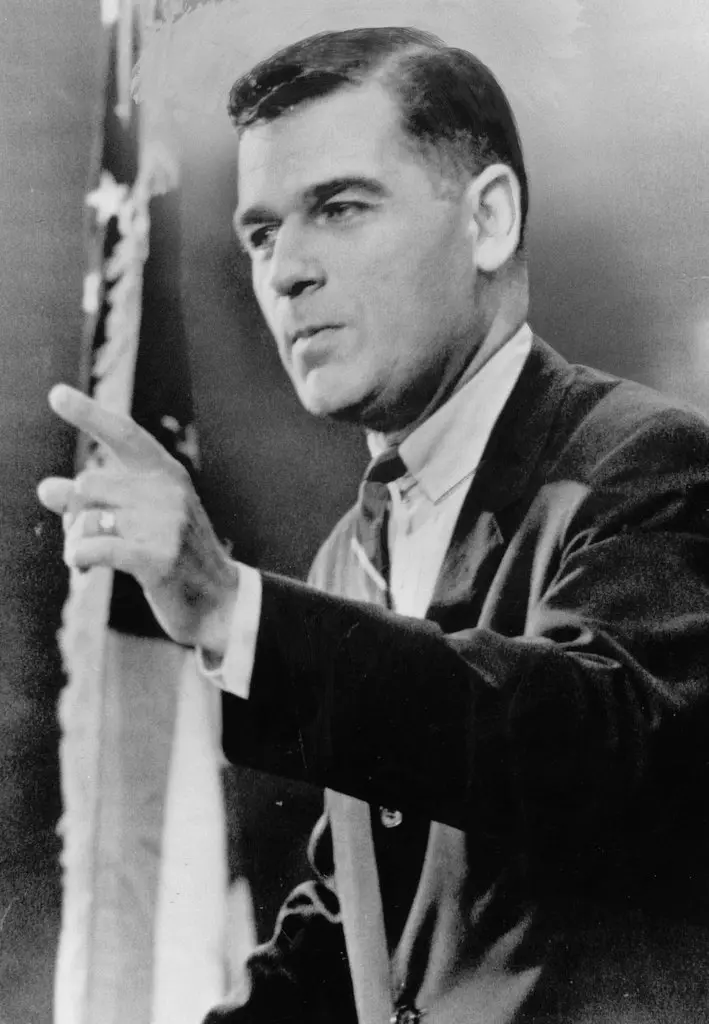
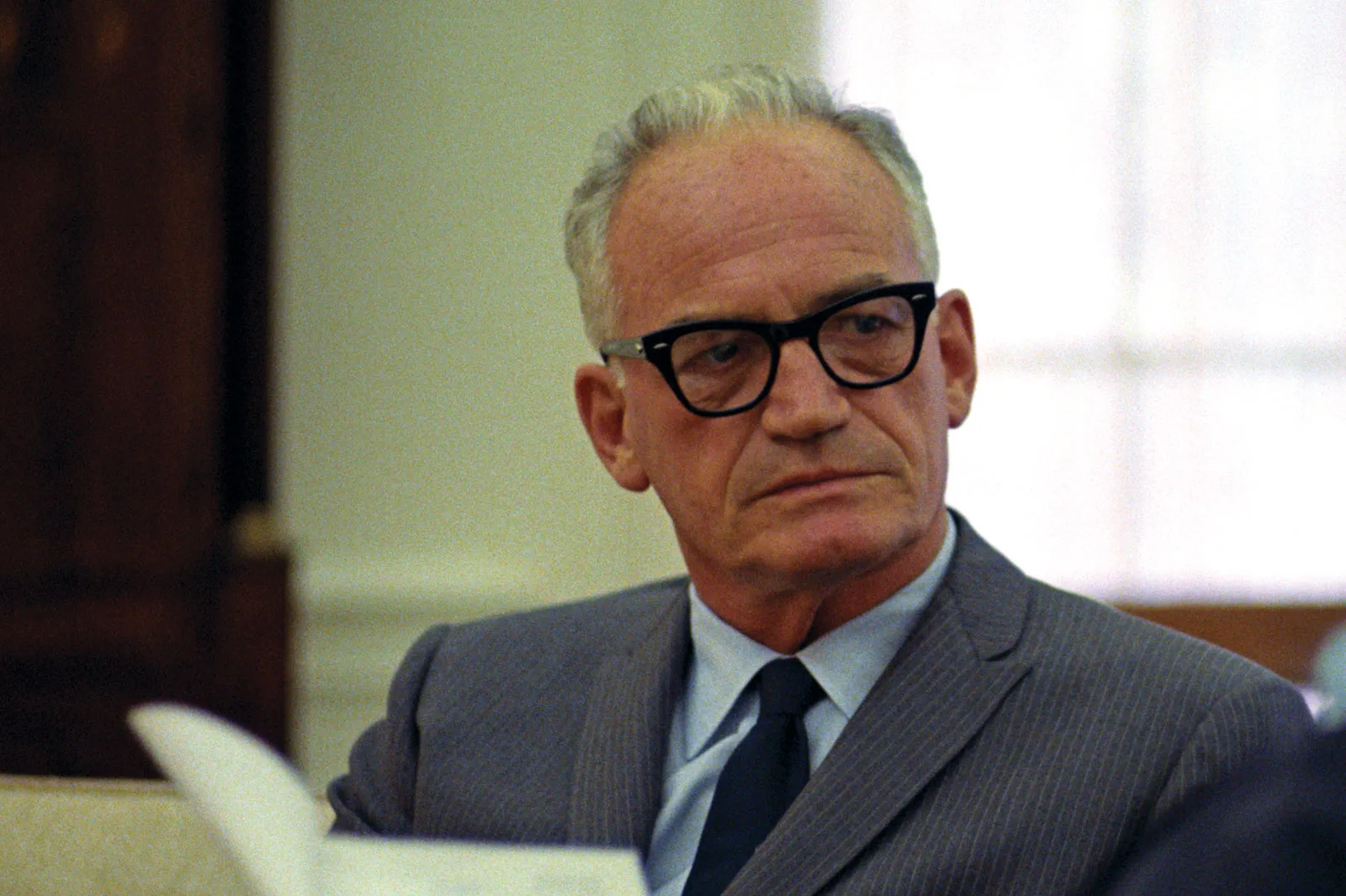
In 1970, the Vietnam War isn’t just still going on, US combat forces have expanded into Laos and Cambodia to stop Viet Cong incursions, and anti-Vietnam War protests are ever-present. Congress is pushing back on the Executive, and the Senate votes for the Cooper-Church Amendment, which if enacted would have removed US troops from Cambodia and Laos. In the midst of legislative battling over the Vietnam War, a curious duo comes together to replace the draft with an idea for an all-volunteer army starting in 1971, which was endorsed by President Nixon’s Commission on an All Volunteer Armed Force: Barry Goldwater of Arizona and Mark Hatfield of Oregon. These men represent very different wings of the Republican Party. Hatfield is of the liberal wing of the party and was even backed over the Democratic candidate in 1966 by Senator Wayne Morse over the issue of Vietnam. Hatfield sponsored with Senator George McGovern (D-S.D.) the “End the War” amendment and voted for Cooper-Church. Goldwater, on the other hand, was the face of conservatism in the Republican Party at the time and had opposed both the “End the War” Amendment and Cooper-Church. This proposal met with the opposition of President Nixon, who despite stating his support at different times for the concept of an all-volunteer army cited cost and poor timing (Rosenbaum). Senators had different arguments regarding this proposal. Senator Marlow Cook (R-Ky.), for instance, supported the idea of raising military pay and saw this measure as a way to boost the prospects of the poor and others argued that the draft would never be equitable and that it was “involuntary servitude” (Rosenbaum). This echoed a number of past arguments about the draft. The Senate vote on this proposal was 35-52 (D 15-34, R 20-18) on August 25, 1970, and it reveals some interesting divisions.
The vote can be seen here, with lifetime agreement scores with the conservative Americans for Constitutional Action for the senators. Republicans are in bold and italicized while Democrats are in plain font. A checkmark and an “x” mean paired for or expressed support or paired against or expressed opposition respectively:
Notably, all conservative Southern Democrats are against. Among legislators from the former Confederacy, only Republicans Edward Gurney of Florida and Howard Baker Jr. of Tennessee as well as Democrat Ralph Yarborough of Texas are in support. This vote also splits Cooper and Church, with John Sherman Cooper (R-Ky.) against and Frank Church (D-Idaho) for. Even the leadership of the parties is split: Majority Leader Mike Mansfield (D-Mont.) is for, while Majority Whip Ted Kennedy (D-Mass.) is against. Minority Leader Hugh Scott (R-Penn.) is for, while Minority Whip Robert Griffin (R-Mich.) is against.There is also a notable contingent of liberals against, including anti-war Democratic candidate Eugene McCarthy of Minnesota. The liberal critique of ending the draft, voiced most prominently by Senator Kennedy, is that the burden of the war ultimately fall upon the poor, as the wealthy youth were not regarded as likely to volunteer, and per the New York Times it likely tipped the balance against the measure (Rosenbaum). If it were not for the unity of Southern Democrats against, this vote would seem absolutely all over the place; 1972 presidential contender George McGovern (D-S.D.) votes for, 1984 contender Walter Mondale (D-Minn.) votes against, and 1996 presidential contender Bob Dole (R-Kan.) votes for. Furthermore, per DW-Nominate, the four most liberal senators are for this amendment while three of the four most conservative senators are for as well. President Nixon would eventually institute an all-volunteer army, but it would be on July 1, 1973, after the United States had agreed to make a gradual withdrawal from Vietnam.
References
Rosenbaum, D. (1970, August 26). Senate Bars Plan Designed to Bring Volunteer Army. The New York Times.
Retrieved from
To Amend H.R. 17123 So as to Provide for an All-Volunteer Military Service. Voteview.
Many who serve in Congress don’t make it their life’s profession, but one who did was Georgia’s Carl Vinson (1883-1981). On February 14, 1914, Georgia Senator Augustus Bacon suddenly and unexpectedly died, and appointed to succeed him was Congressman Thomas W. Hardwick. Enter 30-year old Carl Vinson, a judge of the Baldwin County court who had served two terms in the Georgia House of Representatives, who was elected to succeed him on November 3, 1914. As a young representative, Vinson was a strong supporter of President Woodrow Wilson. After all, Georgia was a strongly Democratic state and indeed until 1964 its people didn’t vote for a Republican for president. Although he initially opposed the Prohibition amendment, it was popular in Georgia and he ended up voting for it. He also opposed women’s suffrage, which was the norm in Georgia politics of the time. In 1918, Vinson had a tough contest for renomination, facing the old Populist leader Thomas E. Watson, but he narrowly prevailed. This would be the last serious challenge to his reelection. Vinson’s specialty would be building up the navy, and although he focused on American presence on the seas, he was not one for international travel. He hated flying, and only once flew out of the country to visit the Panama Canal in the 1920s (Honaker). Indeed, there were a number of ways he was simply different from other people. He smoked or chewed cheap cigars and never learned to drive (Cook). Vinson also preferred simple food over fine dining. On the navy, he was of the belief that “No person representing the American people should ever place the defense of this nation below any other priority” (The New York Times). And indeed, his focus became the creation of a powerful two-ocean navy. Vinson was strongly supportive of the First New Deal but would have more difficulties in supporting the Second New Deal, which included his vote against the Fair Labor Standards Act in 1938. Indeed, he would butt heads with the Roosevelt Administration over the increasing power of organized labor and in 1941 he sponsored a bill to counter strikes. His role in backing the navy had increased with his ascendancy to the chairmanship of the Committee on Naval Affairs in 1931, and would play a significant role in national defense, sponsoring three key measures. These were the Vinson-Trammell Act in 1934, increasing naval construction to the limits of the Washington Naval Treaty of 1922, the Second Vinson Act of 1938 further increasing construction after Japan pulled out of the 1922 agreement, and his sponsorship of the Two-Ocean Navy Act of 1940, which increased the size of the U.S. Navy by 70% (Hutcheson, 1541). All these measures served to create the modern U.S. Navy, and his impact on the strength of our forces in World War II was enormous. Admiral Chester E. Nimitz stated of his role, “I do not know where this country would have been after December 7, 1941, if it had not had the ships and the know-how to build more ships fast, for which one Vinson bill after another was responsible” (Cook). Known as the “swamp fox” for his supervisory role over the Pentagon from Congress, it was serious business when generals and admirals were called to testify before the House Armed Services Committee (Glass). He would serve as chairman until 1947, when the Republicans got into the majority, and in 1949 he would become chairman of the House Armed Services Committee, a post he would hold for the rest of his career with only a two year interruption when Republicans won Congress in the 1952 election. Although at one point he was supposedly being considered for Secretary of Defense by President Truman, Vinson was not interested, stating, “Shucks, I’d rather run the Pentagon from up here” (Glass).
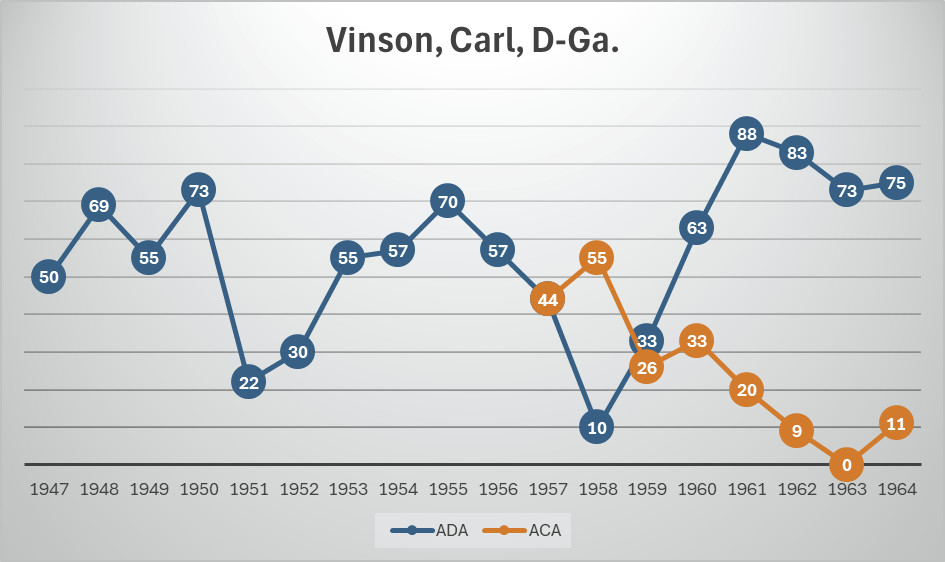
Although often considered part of the Conservative Coalition in Congress, Vinson was not nearly as conservative as you might think. He overall sided with the liberal Americans for Democratic Action 56% of the time from 1947 to 1964, and this is in part due to how he responded to the election of President Kennedy. Kennedy had his second best electoral performance in Georgia, and Vinson saw it as important to support a president who had such a mandate from the voters of his state. On January 31, 1961, he was one of only two Georgians to support enlarging the House Rules Committee, which helped key items of President Kennedy’s agenda reach the House floor, and was the only Georgian to oppose a conservative substitute to that year’s minimum wage bill. This contrasted with his support for Rep. Wingate Lucas’s (D-Tex.) conservative substitute for a minimum wage increase in 1949. Vinson also supported federal aid to education, and the Kennedy Administration’s housing bill. Indeed, he was Kennedy’s foremost champion in Georgia. Senator Sam Nunn, Vinson’s grandnephew, recounted that “One of the people he felt very close to was a young man by the name of John F. Kennedy…” (Shattuck). Vinson’s As I have covered before, the state of Georgia has On civil rights, Vinson had the politics of someone who would have been elected to Congress from the state in 1914.
The ideological Carl Vinson, the blue representing the liberal Americans for Democratic Action (ADA) agreement rates and the bottom representing the conservative Americans for Constitutional Action (ACA) agreement rates.
In 1964, Vinson announced he would not be running for reelection, stating, “My policy is to wear out, not rust out” (Glass). Indeed, there have been many stories of people who stayed in Washington far too long such as Strom Thurmond of South Carolina, James Murray of Montana, and John Sparkman of Alabama. Leaving Washington at age 81, he was the first person to have served 50 years in the House. From 1957 to 1964, Vinson had only sided with the conservative Americans for Constitutional Action 23% of the time and his DW-Nominate score was -0.212. In 1968, he was flown to Washington, D.C. for his 85th birthday and honored by President Johnson, who said of him, “Uncle Carl was my chairman, my tutor and my friend” (The New York Times).
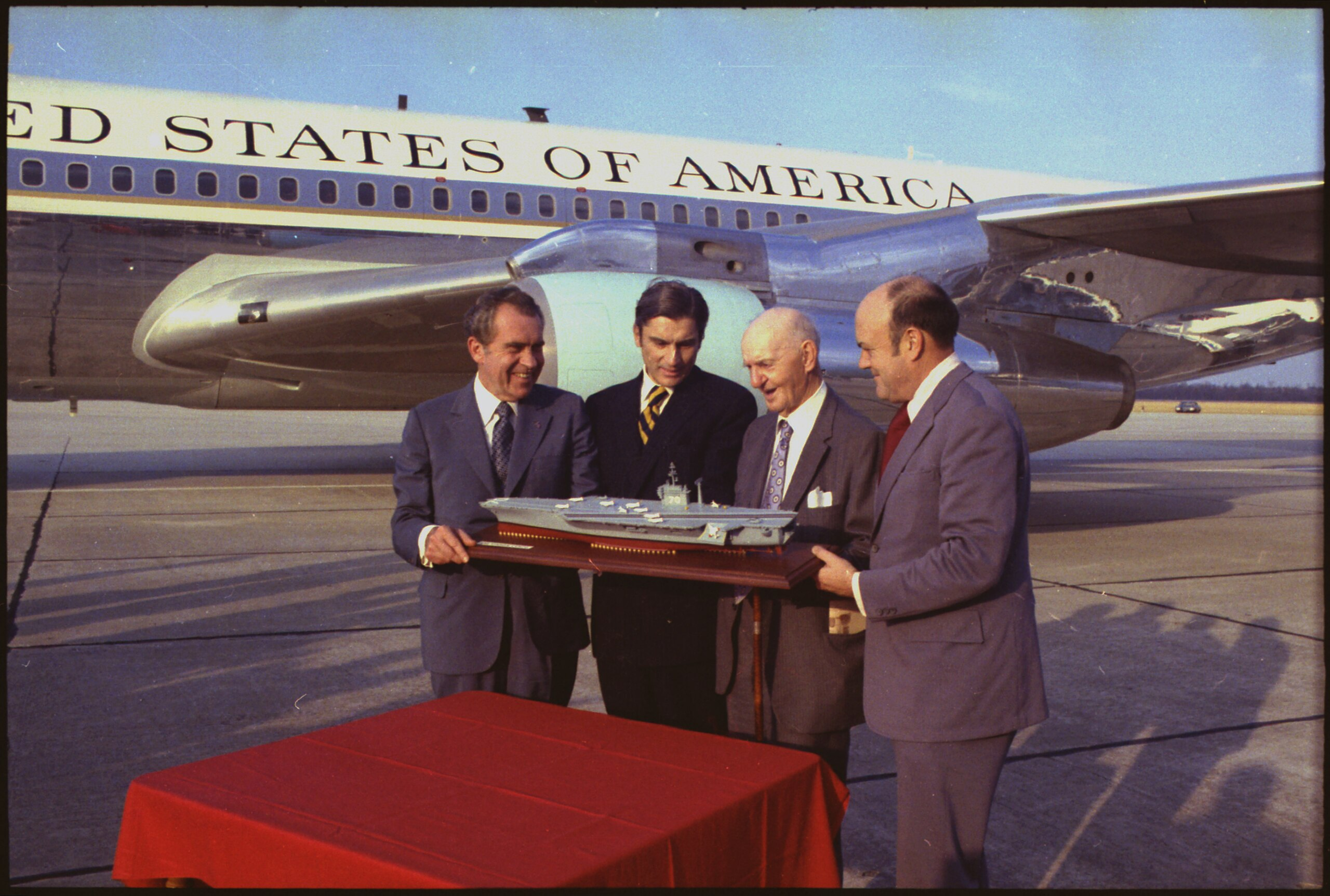
President Nixon, Secretary of the Navy John Warner, Vinson, and Secretary of Defense Melvin Laird with the model of to-be-constructed USS Carl Vinson.
On March 15, 1980, Vinson, who was still alive at 96, was granted an honor that no living person had before, the launching of a navy vessel named after him. The USS Carl Vinson is a Nimitz-class supercarrier that is still in use today, and in 2011 Osama bin Laden was buried at sea from the vessel. He said on the occasion that it was “a fine way to celebrate my youthful age of 96” (The New York Times). Sadly, his wife, Mary, had not lived or thrived nearly as long, having been an invalid for years before her death in 1949. Vinson himself joined her on June 1, 1981, at 97 from congestive heart failure. In Antarctica, the Vinson Massif is named after him.
References
ADA Voting Records. Americans for Democratic Action.
In 1916, Congress for the first time attempted to regulate child labor with the Keating-Owen Act. Sponsored by Representative Edward Keating (D-Colo.) and Senator Robert Owen (D-Okla.) and supported by President Wilson, this measure barred goods produced by the labor of youths under 14 from being sold in interstate commerce. The use of child labor had been growing overtime, and by 1900 1 in 6 children between the ages of 10 and 15 were employed (Encyclopedia.com). After the upholding of the Mann Act against “white slavery” (the interstate travel of prostitutes) by the Supreme Court, advocates of child labor regulation thought they stood a good chance of enacting a federal law. However, legal scholars differed as to whether the Constitution permitted such a measure.
Edward Keating, House sponsor of the Keating-Owen Act.
Some legislator views on the matter:
William Stiles Bennet (R-N.Y.) stated that “Most of us from New York City are going to vote for this child-labor bill because we think it is right. We have a similar law, somewhat more drastic, on the statute books of New York, and we are for this…” (Congressional Record, 2015). This highlighted the fact that many states already had child labor laws on their books, and thus the impact of this law would not be felt on New York. Indeed, it would not actually be felt on all but four states, as they had comparable or stricter laws on child labor.
James F. Byrnes (D-S.C.), who would later become a key supporter of FDR’s New Deal, stated on the matter, “…I am opposed to this bill, but in the only speech I ever made on the subject in my own State I advocated the enactment by the Legislature of South Carolina of a law prohibiting absolutely the employment of children under the age of 14 years. According to the majority report there are but four States in the Union in which this standard provision does not prevail, so that it is boiled down to a question here whether the Congress will force those four States now to progress gradually toward the adoption of that 14-year age limit” (Congressional Record, 2014).
Mahlon Garland (R-Penn.) acknowledged that opinions on the measure’s constitutionality were divided, and to this he said, “…if we are going to err, for God’s sake, let us err on the side of humanity. Let us pass this bill. And if some court declares it unconstitutional, let it do so, but let us not stand here in an attitude of fear as to what the court will do and refuse to do the thing that ought to be done” (Congressional Record, 2032).
Fred Blackmon (D-Ala.) explained his opposition in a traditional Jeffersonian sense, “While I have always been a staunch advocate of proper legislation to safeguard the interests of children who of necessity are compelled to labor in manufacturing plants, yet as a Democrat I am a firm believer in the broad principle of our Government that the States are amply capable of taking care of their own affairs, without the interference of the Federal Government” (Congressional Record, 2034).
Some interesting details in this vote:
A number of representatives who had futures as New Deal opponents were voting in favor, including:
Isaac Bacharach (R-N.J.), Fred Britten (R-Ill.), Simeon Fess (R-Ohio), John Cooper (R-Ohio), Porter Dale (R-Vt.), Carter Glass (D-Va.), Frederick Lehlbach (R-N.J.), James Parker (R-N.Y.), Louis McFadden (R-Penn.), Carl Mapes (R-Mich.), George Tinkham (R-Mass.), Allen Treadway (R-Mass.), and Bert Snell (R-N.Y.). Although George Huddleston (D-Ala.), one of the votes for, was considered a progressive in this time, he would oppose much of the New Deal. Also a “yea” vote was former Speaker of the House Joe Cannon (R-Ill.), who I have yet to find a credible historian call a liberal or progressive. Indeed, his conservatism was even voiced in this debate,
“There is much talk about social justice. Great heavens, I sometimes wonder what it means! I have sent for the dictionary and I have tried to find out what social justice is. Can any man define it? Is it to make all men equal? Is it to make all men and women equal? Is it to make all boys of equal capacity? Well, so far as I know, as a rule the man and the woman who talk most about social justice are the man and the woman who have never earned a dollar but are living on the production that they inherited. They talk about social justice. Then there is another class that talks about it. They are good people, and I am not abusing any of them, but if you will go to work and investigate you will find that two thirds of them never earned a dollar in their lives and that the other third are being subsisted by their contributions” (Congressional Record, 2023).
The most glaring detail of the House vote? With only one exception, all the nays came from the South. The exception was R. Wayne Parker (R-N.J.), a staunch reactionary who based on his record seems to have been an absolutist for states’ rights and was so by opposing Prohibition, women’s suffrage, and anti-lynching legislation. All Florida as well as North and South Carolinian representatives who voted were against.
In the Senate, although few of its members in this time would carry on to the New Deal era, James W. Wadsworth Jr. (R-N.Y.) paired for this bill. Wadsworth was an anti-New Deal absolutist, as he would vote against Social Security and the minimum wage, yet he supported this measure. So did future President Warren G. Harding (R-Ohio) and future conservative Supreme Court Justice George Sutherland (R-Utah).
Perhaps, you say, but wait? Doesn’t this vote prove that the right back then had its heartland in the South? Well, no. If we examine another vote in that session of Congress that is often also seen as a triumph for progressivism in the Adamson Act, which limited the hours of railroad workers, its House vote of passage was the nearly as commanding 239-56, except the situation with the opposition was the inverse…of the House opponents only two were from the South: Sam Sells (R-Tenn.) and Eugene Black (D-Tex.). Indeed, the only two representatives on record who voted against both the Keating-Owen Act and the Adamson Act were Parker and Black. This and the fact that child labor was far more prevalent in the South in addition to the status quo only changing in four Southern states makes it abundantly clear to me that the Keating-Owen Act is a regional rather than a left-right vote. But, does this make the Adamson Act a regional vote too? No, as the prevalence of railroads and their workers was all around the country, and Southerners generally were interested in curbing what they saw as excesses of Yankee capitalism. Furthermore, crossover support for the Adamson Act in the North was far more considerable than the Keating-Owen Act in the South. Additionally, the DW-Nominate scale on this vote clearly points to the most conservative legislators of American politics at the time voting for Keating-Owen while it simultaneously points to them voting against the Adamson Act. Other votes that put the South on the bad side of conservatism in the Wilson era included support for the excess profits tax, support for an anti-trust investigation into companies involved in food production (although there was some dissent among Southerners), opposition to increasing the size of the navy, opposing limiting the time for government control of the railroads in wartime, opposition to using a stopwatch for measuring efficiency in government workers, and opposition to the Esch-Cummins Act returning railroads to private ownership in peacetime under conditions that were on net favorable to them.
The Keating-Owen Act was challenged in the Supreme Court and overturned in 1918 in Hammer v. Dagenhart. Another effort to enact such a law also was struck down by the Supreme Court. Although the proposed Child Labor Amendment was never ratified, it was not considered needed after the enactment of the Fair Labor Standards Act in 1938 and its upholding in the Supreme Court. But what people don’t know (indeed I didn’t know this until I looked into it) that this law only changed the status quo on child labor in only four states! Indeed, such a rule could serve to help the other states against the four states in competition, thus there was every reason for support outside of the South to be so strong.
To Pass H.R. 17700 (39 Stat. 721, Sept. 3, 1916). A Bill to Establish an 8 Hour Day for Employees of Carriers Engaged in Interstate and Foreign Commerce. (P. 13608-1). Voteview.
To Pass H.R. 8234 (39 Stat. 675, Sept. 1, 1916), a Bill to Prevent Interstate Commerce in the Products of Child Labor and for Other Purposes (P. 2035-1). Voteview.
In the period before World War II, the Midwest was the heartland of non-interventionism and Chicago was regarded as the capital. One of the more notable and controversial figures from the state in this period was Stephen Albion Day (1882-1950).
Day was on track to have a career in politics from the time of his birth. His father was William Rufus Day, who would become prominent as acting Secretary of State and then briefly holding the role under President William McKinley. His most prominent position was as a Supreme Court justice, having been nominated by President Theodore Roosevelt. Through his father, he was able to get a position assisting Chief Justice Melville Fuller. From 1908 until his death, Day would practice law, and he considered himself a student of the Constitution. He was also a staunch foe of the Treaty of Versailles.
In the 1920s, Day sought a political career, but what held him back was that he was a foe of Prohibition, and had been a foe as early as 1922 when he organized the Anti-Prohibition League (The Belleville News-Democrat). He stated, “I was never for the eighteenth amendment. I felt that a mandate on private morality had no place in the constitution. It broke down respect for the basic law of the land” (The Dispatch). Thus, his repeated efforts to get elected to Congress as a Republican flopped.
In 1933, Day wired his congratulations to Adolf Hitler after his election as chancellor, a questionable move at best even in that time. It is possible that he did so out of his opposition to Germany’s treatment under the Treaty of Versailles and saw Hitler as a figure who rebelled against the nation’s harshly imposed reparations. Something else to bear in mind is that Mein Kampf was available in the United States at the time but only in a censored format that excised explicitly anti-Semitic and militaristic passages, as I covered in my 2022 article, “Who Censored Mein Kampf in America?”.
In 1936, Day ran for the Republican nomination for president, although he knew he had no chance of clinching it, stating afterwards that “it was a gesture to emphasize the necessity of upholding the constitution and preserving the integrity of the Supreme Court of the United States” (The Newark Advocate). He saw that the court was potentially under threat by the Roosevelt Administration, as it had struck down numerous New Deal laws, including the Agricultural Adjustment Act and the National Industrial Recovery Act. Day’s concerns were correctly placed, as Roosevelt attempted to get “court-packing legislation” enacted, but even the strongly Democratic Senate would not accede to it in the end.
On September 7th at the Lena, Illinois festival Day predicted that if elected for a third term, FDR would get the US into war in Europe two weeks after the election and accused him of being “greedy for power” for running for a third term, and that his request for $5 billion for national defense purposes was an effort to divert attention from domestic issues (Freeport Journal-Standard). Although Roosevelt won reelection as well as Illinois, a figure who won even bigger was Republican Dwight Green, who won the gubernatorial race in a landslide and he had coattails, from which Day among others benefited. He and fellow non-interventionist Republican William G. Stratton were elected at-Large.
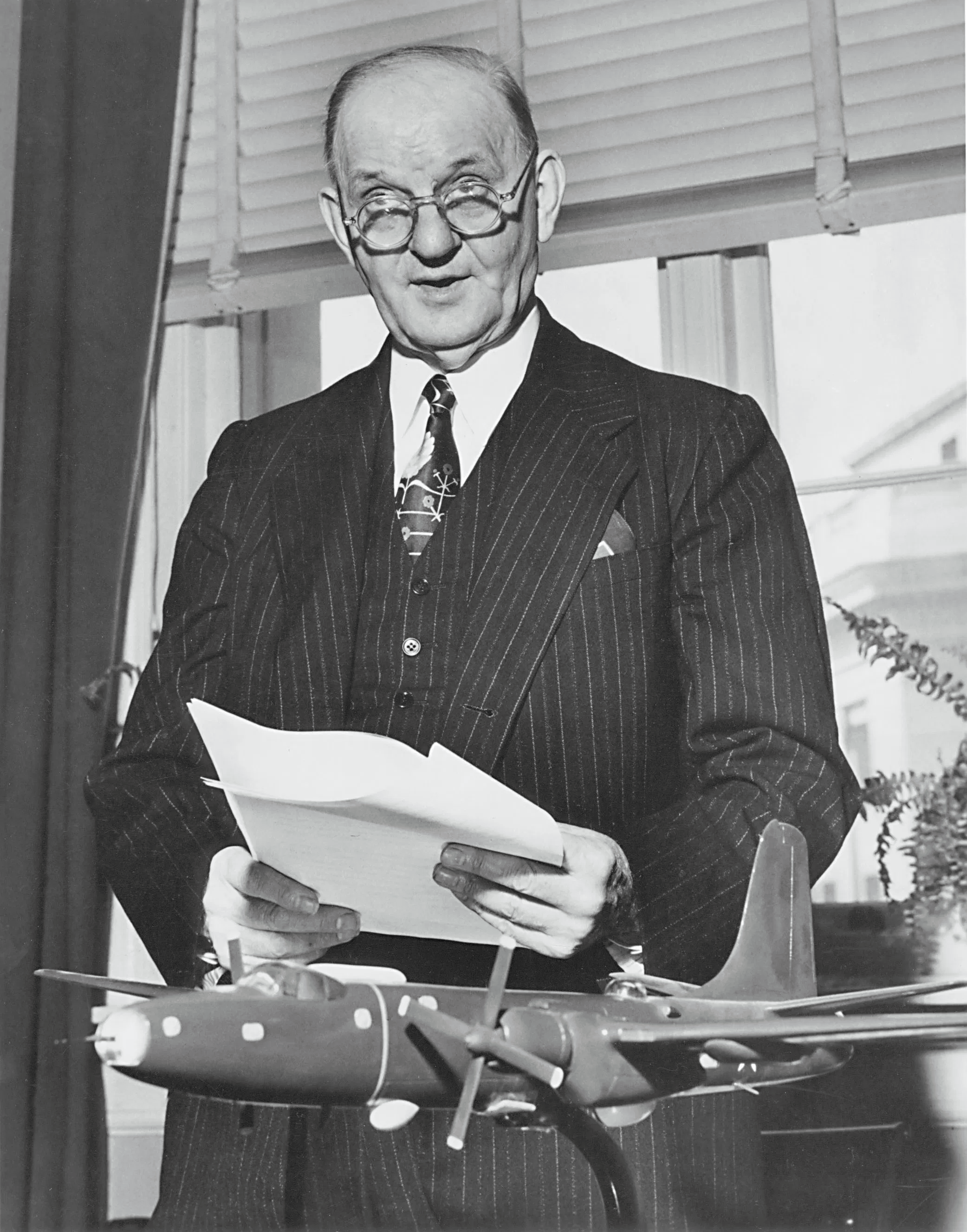
At the start of his time in Congress, Day pledged to support adequate defense of the United States and to oppose involvement in World War II (The Dispatch). Whether he was supportive of “adequate defense” is questionable given what his record would be, but to be sure, he was an unfailing opponent of the latter until Pearl Harbor. Day was also a foe of the New Deal, and it was hard to find a stronger opponent of FDR’s foreign policy. However, he also voted against the Vinson Anti-Strike Bill in 1941. Day was also a strong supporter of the Dies Committee out of his staunch anti-communism. The Daily Worker, the Communist Party’s newspaper, accused him of making a “Nazi speech” with anti-Semitic remarks to an audience of 2,000 on September 4, 1941 (Lapin). A non-communist source, Detroit Evening Times, had a different description of this speech. Rather than a “Nazi speech” with anti-Semitic remarks, they characterized it as an attack on Soviet Russia, President Roosevelt, and Lend-Lease Aid to the Soviets, with Day declaring, “Internationalism has become bonder and bolder. Like a serpent it has crawled into our midst. By the recent actions of our President we have been brought face to face with the most dangerous attack that has ever been made upon the welfare of the American people and their continued right to live under the blessings of our American Constitution. This serpent of international socialism is known as communism. It is the established political and economic philosophy of the Soviet Union – that same Soviet Union which has recently formed an active alliance with Britain. We shall be asked to extend that alliance to include the United States of America, at least to the extent of providing billions of dollars of the money of American taxpayers to make gifts to this same Soviet Union” (Detroit Evening Times). He and others in Congress were trying to push an amendment to eliminate aid to the USSR from Lend-Lease, but the effort overwhelmingly failed. In his pursuit of the non-interventionist cause, he got into some trouble due to his carelessness in his associations.
The Flanders Hall Connection
On August 4, 1941, reporters Drew Pearson and Robert S. Allen reported in their column The Washington Merry-Go-Round that Day had published a non-interventionist book titled “We Must Save Our Republic”. The problem? It was published through the small publisher Flanders Hall of Scotch Plains, New Jersey, an entity run by Sigfrid Hauck and financed by George Sylvester Viereck, a registered agent who received $1000 a month from Nazi Germany (Pearson and Allen). Unless Day had somehow forgotten what he was told in Pearson and Allen’s interview with him about the Nazi connections of the firm he had had about a month prior to the book’s publishing, he had done so with his eyes open (Pearson and Allen, September 1941).
They also reported that a speech that Day delivered on June 15th inspired the book, in which he called on Britain to repay its war debts. Interestingly, this speech was mimeographed and sent to newspapers from Columbia Press Service, which publicized for Viereck (Pearson and Allen). It is impossible to the escape the conclusion that Day at minimum exercised terrible judgment on this matter. The publishing rights to the book were, according to Sigfrid Hauck, sold to another firm three weeks after its publication and Flanders Hall shuttered in November 1941 (The Courier-News). Despite this unsavory connection, Day was reelected to his at-Large House seat in 1942.
During the 78th Congress, he supported banning the poll tax and although he introduced such a measure in 1943, he hadn’t done what was needed to get it considered as the Marcantonio bill was what proponents rallied behind (St. Paul Recorder). Day voted for the Marcantonio bill. He also warned against internationalism and most notably was one of 29 representatives to vote against the Fulbright Resolution in 1943, which expressed the House’s support for establishing an international peacekeeping body after the war, which would become the United Nations. On September 7th, Day condemned the push towards internationalism, stating, “internationalists are trying to edge us up to a commitment from which we cannot recede” (Freeport Journal-Standard, 1943). He supported overriding President Roosevelt’s vetoes of anti-subsidy legislation and tax relief and relentlessly opposed price controls, but also voted to sustain his veto of the Smith-Connally Act which provided a mechanism for stopping wartime strikes. Day’s overall record was in many ways staunchly to the right and extremely nationalist but was friendly to organized labor and he supported more benefits for workers in domestic war industries. His DW-Nominate score was a 0.443. 1944 was a good year for President Roosevelt in many ways; in addition to his reelection victory several outspoken foes lost reelection, and Day was one of them, losing to Democrat Emily Taft Douglas, wife of future Senator Paul Howard Douglas. Day continued his legal career, and died on January 5, 1950, after a two-month illness.
References
2,000 Hear Day Attack Russia and President. (1941, September 5). Detroit Evening Times, p. 3.


 Mad Politics: The Bizarre, Fascinating, and Unknown of American Political History