The Ideological Gerald Ford


In the last post, I covered the ideology of Jimmy Carter as president, and indeed as far as presidents go, he was quite liberal by DW-Nominate and solidly liberal by Americans for Constitutional Action. I thought I might as well cover his defeated 1976 opponent in Gerald Ford. Ford’s record on national issues goes far further back than Carter, having first been elected to the House in 1948. His record in the House is too expansive for me to cover fully key vote by key vote, but he was moderately conservative overall. ACA gave Ford a high score of 100% in 1959 (many Republican representatives aced by their standards that year) and a low score of 53% in 1969 (many Republican representatives did unusually poorly by their standards that year). His overall modified ACA score was a 78%. His DW-Nominate score stands at a 0.281.

Ford was mostly fiscally conservative on domestic matters, although he did in 1958 vote to establish a trial-run food stamp program (he voted against a similar proposal in 1959) and in 1960 voted for $50 million in urban renewal and slum clearance grants. Ford loyally supported President Eisenhower’s vetoes of public works bills and a sewage plant funding bill in 1960 and sided with the administration on agriculture issues. During the 1960s, Ford opposed Kennedy’s accelerated public works program, tax reduction (he regarded it as inflationary combined with domestic spending), the Economic Opportunity Act of 1964, and federal aid for school construction. He was even the only Michigander to vote against Medicare in 1965, perhaps as part of his being the new Republican House leader. Ford did, however, vote to increase the minimum wage in 1966 but only after backing Rep. John Anderson’s (R-Ill.) substitute to limit the measure’s impact on retail establishments based on gross sales. He routinely backed conservative substitutes to minimum wage increases, even if he voted for the final bills. Ford’s differences with conservatism in the 1960s largely surrounded foreign policy and civil rights issues. Speaking of civil rights…

Ford on Civil Rights

Gerald Ford was mostly supportive of civil rights measures. He voted for the Civil Rights Act of 1964 and the Voting Rights Act of 1965 (although he preferred the substitute he backed with Rep. William McCulloch (R-Ohio) that attempted to balance state and federal interests), and although he voted for Rep. Arch Moore’s (R-W.V.) motion to strike fair housing from the Civil Rights Act of 1966, he did vote for the bill itself and voted for the Civil Rights Act of 1968. Ford notably pushed a Nixon Administration backed substitute to the Voting Rights Act extension in 1969 that would have applied the temporary provisions of the act nationwide, but McCulloch didn’t back him on this one. He also backed Nixon on the adoption of the Philadelphia Plan, voting against Rep. George Mahon’s (D-Tex.) effort to kill it. As president, the issue of extending the Voting Rights Act of 1965 fell to him, and he simply signed a law extending the act for seven years. Ford, like Nixon, opposed busing as a means of desegregation. On other matters surrounding states vs. federal, Ford took conservative positions: on federal vs. state title over the Tidelands he voted in 1951, 1952, and 1953 for state title and voted in 1958 and 1959 for anti-preemption legislation to grant states greater leeway in anti-subversive legislation, all in response to Supreme Court decisions. Speaking of the Supreme Court…

Ford on the Supreme Court

Ford was a critic of the Warren Court, and in multiple ways he voted to counter to decisions of the court. He repeatedly voted for legislation against the Mallory rule of evidence that invalidates confessions extracted by criminal defendants if kept for an unreasonably long period in detention from arrest to court appearance whether there had been evidence of coercion or torture or not. In 1964, Ford voted for the Tuck (D-Va.) bill to strip state legislative apportionment from Supreme Court jurisdiction. In 1971, Ford voted for a school prayer amendment to the Constitution in response to Supreme Court decisions ruling state school prayer statutes unconstitutional. In 1970, he attempted to impeach Justice William O. Douglas, in what was at least in part a retaliatory move against Democrats for twice in a row tanking Nixon’s nominees to the court. Yet, Ford’s sole nomination to the Supreme Court, John Paul Stevens (who succeeded Douglas), would become known later in life as one of the most liberal justices.

Ford on Foreign Policy

Gerald Ford was heavily influenced in his politics by Senator Arthur Vandenberg. He reflected in a 2001 speech, “He holds a very special place in my life. Before Pearl Harbor, I emulated the isolationist outlook of my fellow Midwesterners – – Senator Vandenberg included at the time. A tour of duty in the South Pacific, aboard a combat aircraft carrier with nine battle stars, convinced me very strongly otherwise. After four years in the Navy, I came home to Grand Rapids a convert to the bipartisan foreign policy espoused by my fellow townsman, Arthur Vandenberg.

Inspired by Vandenberg’s example, I came to believe that only American leadership could shape a future where peace was possible and freedom was secure” (United States Senate).
As a protégé of Senator Arthur Vandenberg, he not only supported post-war aid to Europe but also, like his fellow townsman and hero, backed Point IV aid to poor nations. He backed every foreign aid vote counted by Americans for Constitutional Action during the Eisenhower Administration, and sponsored an amendment increasing foreign aid in 1960. Ford would, however, support some foreign aid cuts during the 1960s and repeatedly backed stronger anti-communist positions in foreign affairs, such as his support for blocking grain shipments to the USSR and Hungary in 1963. Ford’s retention of Henry Kissinger as Secretary of State was strongly disliked by anti-détente conservatives. Interestingly, however, his presidency was more conservative than his time in the House, as if his positions on ACA-counted votes are counted as votes, he scores an 84%. By DW-Nominate, he’s much higher, registering at a 0.506.

As President, Ford opposed the following:

. Agriculture Act Amendments (1975).
. A strip mining bill that would set federal standards for surface mining regulation, which he vetoed (1975).
. A House resolution disapproving of his plan to decontrol prices for domestic oil over a 39-month period (1975).
. A tax reduction bill reducing 1976 individual and business taxes without establishing a $395 billion fiscal 1977 federal spending ceiling, which he vetoed (1975).
. A bill authorizing $6.5 billion in financial assistance to railroads, which would simultaneously reduce regulation by the Interstate Commerce Commission (1975).
. A bill that would grant Congress the right to review any proposal to decontrol oil prices and require the president to place price ceilings on any oil not currently controlled (1975).
. Deleting funds for the B-1 Bomber (1975).
. Deferring funds for the Flight-Testing Maneuverable Reentry Vehicle until it can be established that the Soviets are flight testing their own system (1975).
. The Clark Amendment, limiting US involvement in Angola to gathering intelligence (1975).
. Only deregulating small oil producers while keeping big oil producers price-controlled (1976).
. Extending 65-week employment assistance until March 31, 1977 and special benefits for the uninsured to December 31, 1976 (1976).
. Permitting federal civilian and postal workers to participate as private citizens in political campaigns and protecting employees from improper political solicitation, a scaling back of the Hatch Act (1976).
. The Public Works Anti-Recession bill, making grants for public works programs for the explicit purpose of reducing employment, his veto being overridden (1976).
. The proposed Voter Registration Act, which would have created a voter registration commission in the Federal Elections Commission to register voters by mail (1976). Note on this one: Republicans opposing measures that are touted by their Democratic proponents as expanding voting access is nothing new.
. A bill increasing funding for the Departments of Labor and Health, Education and Welfare by $915,839,318 over his budget, with his veto being overridden (1976).
. A bill providing financial assistance for low-income people to insulate their homes and to push state and local adoption of energy conservation standards in new buildings (1976).
. A bill for no-fault auto insurance (1976).
. A bill establishing a government agency for grain inspection that would not be limited to federal export ports, thus moving into authority previously in the purview of states (1976). This is consistent with Ford’s consistent sense of federalism, his belief that liberal Democrats push measures on the federal level that improperly intrude in state prerogatives.
. A bill increasing Congressional control over U.S. arms sales (1976).
. A bill providing for federal child day care services under the Social Security Act, which he vetoed (1976).
. An amendment barring funds for the B-1 Bomber program before February 1, 1977 (1976).
. Another bill for public works for the purposes of increasing employment, in which Congress overrode his veto (1976).
He supported:
. The proposed South Vietnam Assistance Act, which if enacted would have spent $327 million for humanitarian and evacuation programs in South Vietnam and for the use of U.S. troops to assist evacuations. This measure got a lot of opposition out of fear that the US would be dragged into conflict in Vietnam again (1975).
. A bill providing for automatic cost-of-living increases in pay for members of Congress and top officials in the executive, legislative, and judicial branches (1975).
. Killing a proposal that disapproved of his proposed 5% pay increase for members of Congress, military personnel, and federal government officials, which would have instead resulted in a 8.66% pay increase proposed by the Advisory Committee on Federal Pay (1975).
. $2.25 billion in funds for the Inter-American Development Bank and funds of up to $25 million for the African Development Fund (1975).
. Partially lifting an arms embargo to Turkey (1975).
. Loaning up to $2.3 billion annually to New York City (1975). Ford however did not approve of any measure that would fully bail out the city, resulting in a famous headline from the New York Daily News: Ford to City: Drop Dead (New York Daily News). Although Ford never uttered such words, this was how his threat to veto any bailout was taken.
. The proposal by Rep. Charles Wiggins (R-Calif.) to investigate whether increasing fines is effective for anti-trust regulation instead of an anti-trust bill (1976).

Ford’s presidency was substantially limited on domestic policy due to the Democrats holding a supermajority, and sometimes he caved and reluctantly signed bills that he otherwise opposed (such as continuing federal price control on oil). Ford was essentially a fiscally conservative president, an internationalist, a supporter of increasing US military firepower, an opponent of federal encroachments into state functions, moderately socially conservative, and a compromiser.

References

Address by President Gerald R. Ford, May 23, 2001. U.S. Senate.

Retrieved from

https://www.senate.gov/artandhistory/history/common/generic/Leaders_Lecture_Series_Ford.htm

Ford, Gerald Rudolph Jr. Voteview.

Retrieved from

https://voteview.com/person/99905/gerald-rudolph-ford-jr

Ford, Gerald Rudolph Jr. Voteview.

Retrieved from

https://voteview.com/person/3268/gerald-rudolph-ford-jr

Ford to City: Drop Dead in 1975. (2018, April 9). New York Daily News.

Retrieved from

https://www.nydailynews.com/2015/10/29/ford-to-city-drop-dead-in-1975/
Jimmy Carter at 100: How He Was Ideologically Viewed During His Presidency


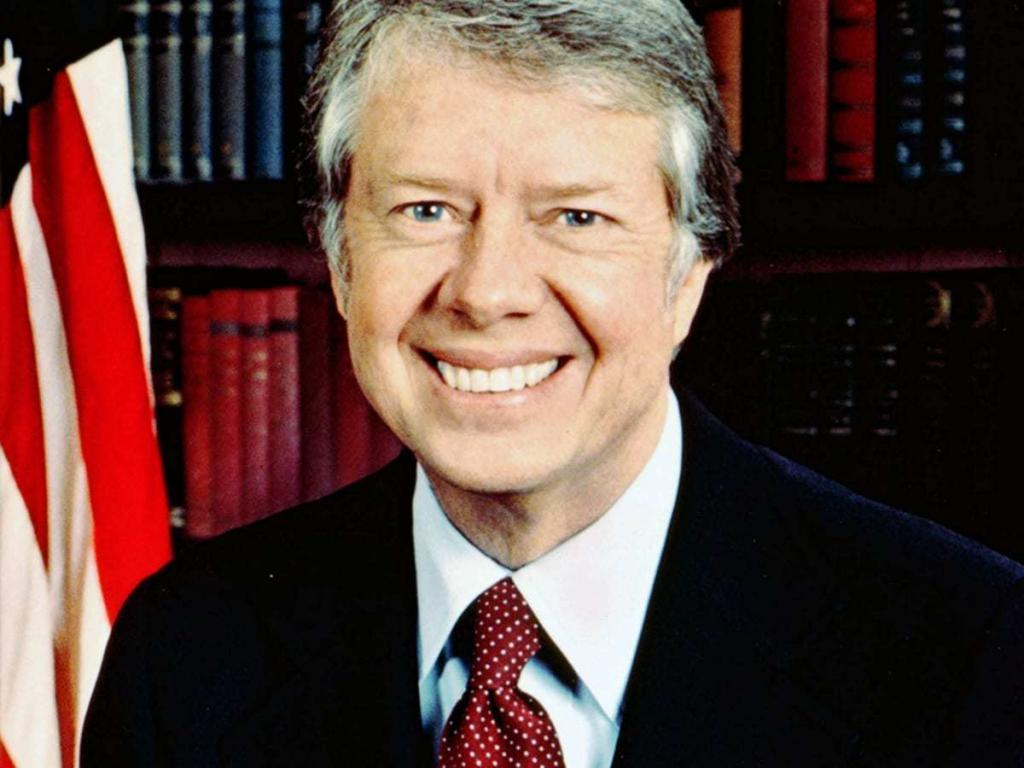
On October 1st, 1924, Jimmy Carter was born, and he still lives today. This makes him the first centenarian president in American history. An interesting minor coincidence is that on the day Carter turned 100 the debate between Walz and Vance was occurring. Like Carter’s running mate Mondale, Walz is from Minnesota. Maybe that’s a good portend for Democrats in this election? I don’t know. But what I do know is how Carter was seen ideologically during his presidency.

Unfortunately, I cannot at this time produce a proper Americans for Democratic Action rating for him, and this is because ADA’s 1979 page lacks descriptions of the first four Senate votes. I certainly can find out what those are, but not in time to post this before midnight PST. Liberals from what I’ve seen so far seem to regard him as a moderate liberal, and sometimes have counted as against the liberal position measures that most Republican conservatives went against. For instance, the 1978 administration-backed proposal to deregulate natural gas by 1985. This was unsatisfactory in its slowness for conservative Republicans, and deregulation itself of natural gas was unsatisfactory to liberals. Thus, Carter’s liberalism may be lessened in ways that conservatives wouldn’t agree with. I will also note later on in this post some votes on which ADA actually sided with Americans for Constitutional Action! DW-Nominate scores him a -0.504, which is pretty solidly liberal and places him to the left of many, many Democrats of his day (and today).

As for ACA…

If Jimmy Carter’s official positions on votes were to be counted as votes, he would score for his presidency a 13%. I can offer far more details here, because I have already compiled ACA votes for the Carter era. Areas in which Carter took a liberal position on issues were:

. $23.3 billion in federal programs for anti-recession purposes, which included public works financing (1977).

. Weakening the Hatch Act through the Federal Employees’ Political Rights Act, permitting greater allowances for participation in politics by Federal employees (1977).

. Opposing an effort by Congressman Beard (R-Tenn.) to prohibit VA funds to benefit individuals upgraded by his special discharge program that allowed certain individuals discharged as less than honorable to be upgraded (1977).

. Opposed a House and Senate effort to sunset price controls on natural gas, for new onshore in 1977 and new offshore in 1982 (1977).

. Supported House and Senate efforts to delete funds for five B-1 Bombers (1977).

. Opposed Congressman Erlenborn’s (R-Ill.) amendment for a more gradual increase in the federal minimum wage than the committee bill (1977).  

. Supported Majority Leader Byrd’s (D-W.V.) motion to table the Allen (D-Ala.) resolution expressing the opposition of the Senate to pardoning draft resisters and evaders (1977).

. Supported his nomination of Paul Warnke as chief negotiator of the Strategic Arms Limitation talks with the USSR. Warnke had previously called for reducing military spending by a third, and his nomination was a clear signal of continuing détente (1977).

. Opposed Senator Curtis’s (R-Neb.) amendment keeping the requirement that food stamp recipients pay for part of their cost (1977).

. Supported Majority Leader Byrd’s (D-W.V.) motion to end debate on the bill permitting public financing of Senate campaigns (1977).

. Supported an increase in the federal minimum wage (1977).

. Opposed Congressman Breaux’s (D-La.) substitute for outer continental shelf legislation that grants the states more money and limits government intervention in exploratory drilling (1978).

. Supported the proposed creation of the Office of Consumer Representation for consumer protection (1978).

. Supported deleting Senator Stennis’s (D-Miss.) motion to rescind funds for the production of two additional B-1 Bombers (1978).

. Supported the enactment of the Panama Canal Treaties, as well as supported tabling an effort to authorize the disposal of all US property before the treaties took effect (1978).

. Supported Appropriations Committee Chairman Mahon’s (D-Tex.) motion for the House to rescind funds for the production of three B-1 Bombers (1978).

. Opposed Congressman Young’s (R-Alaska) proposal to permit Alaska to choose lands to be conserved under the Alaska Lands bill and to remove five million acres from coverage (1978).

. Opposed Congressman Stratton’s (D-N.Y.) amendment to maintain troops at a minimum of 26,000 in South Korea (1978).

. Supported up to $1.65 billion in federal loan guarantees to New York City (a bailout, in other words) (1978).

. Supported Senate and House efforts to retain indirect U.S. Aid to Uganda, Cambodia, Laos, and Vietnam (1977, 1978).

. Opposed Congressman Hansen’s (R-Idaho) amendment prohibiting funds for Panama in the Foreign Aid Appropriations bill (1978).

. Supported an alternative version of the Consumer Cooperative Bank bill (1978).

. Opposed Senator Lugar’s (R-Ind.) proposed reduction in funding of food stamps by $250 million (1978).

. Opposed Congressman Kramer’s (R-Colo.) amendment reaffirming the position the US took in the 1955 mutual defense treaty regarding aggression against Taiwan (1979).

. Opposed an anti-busing amendment to the U.S. Constitution (1979).

. Supported the bill implementing the Panama Canal Treaties (1979).

. Supported the creation of the Department of Education (1979).

. Supported the Emergency Energy Conservation Act (1979).

. Opposed Congressman Courter’s (R-N.J.) amendment to prohibit funds for controlling the price of gasoline (1979).

. Supported $1.5 billion in federal loan guarantees to be matched by $2.1 billion from other sources to bail out the Chrysler Corporation (1979).

. Opposed Senator Percy’s (R-Ill.) amendment declaring that aggression against Taiwan by China would be considered a threat to U.S. security interests (1979).

. Opposed Senator Stennis’s (D-Miss.) effort to end sanctions against Zimbabwe-Rhodesia (1979).

. Opposed Senator Helms’s (R-N.C.) effort to retain a spending ceiling on food stamps for fiscal 1980-81 (1979).

. Supported Majority Leader Byrd’s (D-W.V.) tabling of Sen. Armstrong’s (R-Colo.) amendment for a higher military pay raise (1979).

. Supported the bill imposing a windfall profits tax (1979, 1980).

. Opposed Congressman Broyhill’s (R-N.C.) motion to provide for a legislative veto for Federal Trade Commission regulations (1980).

. Opposed Congressman Symms’s (R-Idaho) limited substitute for the Idaho Wilderness bill (1980).

. Supported Congressman Obey’s (D-Wis.) increasing in funds of domestic programs and oil tax credit reform to raise funds for the increase (1980).

. Opposed Congresswoman Holt’s (R-Md.) proposed transfer of funds from domestic programs for increases in defense spending (1980).

. Supported the International Development Bank bill (1980).

. Supported extending the debt ceiling at $879 billion through June 30, 1980 (1980).

. Supported Majority Leader Wright’s (D-Tex.) amendment providing $425 million in aid to Nicaragua (1980).

. Opposed Congressman Sensenbrenner’s (R-Wis.) motion to delete administrative (as opposed to judicial) enforcement of fair housing laws (1980).

. Supported Congressman Giaimo’s (D-Conn.) budget resolution (1980).

. Opposed Congressman Levitas’s (D-Ga.) amendment permitting a Congressional veto of trucking regulations (1980).

. Opposed Congressman Pritchard’s (R-Wash.) amendment reducing by $200 million funds for the Tennessee-Tombigbee Waterway (1980).

. Supported the Defense Production Act amendments, providing for funds for synthetic and alcohol fuels as well as the creation of a conservation bank (1980).

. Opposed Congressman Devine’s (R-Ohio) motion to kill the proposed Energy Mobilization Board (1980). Note: ADA supported this motion too!

. Opposed disapproving of his gasoline rationing plan (1980).

. Opposed Senator Schmitt’s (R-N.M.) amendment permitting a one-house veto of Federal Trade Commission regulations (1980).

Opposed Senator Dole’s (R-Kan.) motion to recommit the windfall profits tax bill for hearings (1980).

. Opposed Senator Hollings’s (D-S.C.) motion to table Senator Nelson’s (D-Wis.) proposed deletion of $2 billion from defense spending and $400 million in interest payments, transferring the funds to domestic priorities (1980).

. Opposed Senator Armstrong’s (R-Colo.) amendment to repeal the Credit Control Act of 1969 (1980).

. Supported Senator Hollings’s (D-S.C.) budget resolution (1980).

. Opposed Senator Stone’s (D-Fla.) motion to block funds for military aid to Nicaragua (1980).

Areas in which Carter took a conservative position included:

. Opposing the National Consumer Cooperative Bank bill, which would have provided $750 million for a bank and a self-help development fund to issue loans to consumer cooperatives and to assist inner-city residents to start consumer cooperatives respectively (1977).

. Opposed Congressman Weiss’ (D-N.Y.) amendment blocking funds for research and development of neutron bombs (1977).

. Opposed the emergency farm bill for wheat, corn, and cotton (1978).

. Opposed a resolution disapproving his sale of jet fighters to Middle Eastern nations (1978).

. Supported outlining U.S. policy on settling the dispute between Greece and Turkey over Cyprus as part of repealing the arms embargo on Turkey (1978).

. Supported implementation of the Selective Service (1980).

. Opposed Congressman Simon’s (D-Ill.) reduction by $500 million for the MX intercontinental missile system (1980).

. Opposed Senator Magnuson’s (D-Wash.) amendment to place the burden of proof on an applicant for a trucking certificate to demonstrate that their proposed service is consistent with present or future public needs (1980).

. Supported Senator Garn’s (R-Utah) amendment to delete middle-income housing subsidies, instead having the funds go to current housing programs (1980). Note: ADA supported Senator Garn’s amendment too!

. Opposed Senator Moynihan’s (D-N.Y.) amendment to allow students in private elementary and secondary schools to receive Basic Educational Opportunity Grants of up to $750 annually (1980). Note: ADA opposed Senator Moynihan’s amendment too!

Carter was overall a liberal man who most often dissented from liberalism on matters regarding military policy. His opposition to Senator Magnuson’s burden of proof amendment serves to highlight his support for deregulation that conservatives see as a positive of his presidency.

References

Carter, James Earl, Jr. Voteview.

Retrieved from

For the votes I described, check out my posts on the ACA-Index for the 95th and 96th Congresses.

The Strange Story of Merwin Coad

Iowa is a historically Republican state, and it looks like, at least for the time being, that it has gone back to its roots. It voted for Trump twice and its entire delegation to Congress is Republican. The one senator Democrats had representing Iowa between 1857 and 1933 was Daniel Steck, a figure who identified with the moderate wing of the Democratic Party and was senator thanks to Republican defections from the conservative side on the seating vote because they didn’t want RINO Smith W. Brookhart in the Senate. However, Democrats had some more regular presence starting in the 1930s. Indeed, from 1937 to 1943, both its senators were Democrats! The most successful of the Democrats in this time was Guy Gillette, an independent-minded figure. However, the state returned to form during FDR’s third term. This is where Merwin Coad (1924- ), who turned 100 today, comes in.

The 1956 election, although highly successful for Eisenhower, was not similarly successful for Republicans down-ticket and they on net lost two seats in the House. One of these unfortunates was Republican James Dolliver, who lost reelection to Coad by the slightest of margins, making him the first Democrat elected to the House from Iowa since 1940. Other Iowa Republicans came close to defeat, such as Henry O. Talle in the 2nd district, Karl Le Compte in the 4th district, and Paul Cunningham in the 5th district. All three seats would be won by Democrats in 1958, with Talle and Cunningham losing reelection. Coad was an appealing candidate, as he was pastor of the Central Christian Church, a boy scout leader, and a married father of four. Certainly, these are traditional markers of an upstanding citizen. He was also, contrary to many previous Democrats who sought to succeed in the state, a staunch liberal. Of 67 votes that Coad either voted or paired on that were included in Americans for Constitutional Action scores, he only sided with them four times: in 1957 he voted against funding a federal flood insurance program and against an Eisenhower-backed foreign aid increase, in 1959 he voted against recommitting the Labor-Management Reporting and Disclosure Act after it had been substituted with the Landrum-Griffin bill (he had voted against the Landrum-Griffin substitute), and in 1960 he voted against participation in and funding of the International Development Association. He did not once side with ACA during the Kennedy Administration, the agenda of which he was staunchly loyal. Coad’s DW-Nominate score was a -0.374. Appropriately for an Iowan in a rural district, he served on the House Agriculture Committee, and he advised Senator John F. Kennedy (D-Mass.) on agricultural issues. However, it was not his liberalism that caused him his troubles…it was his personal life.

The Early End of a Career

In 1961, the Des Moines Register’s Washington correspondent, Clark Mollenhoff, began to investigate Coad’s personal matters after he had quickly filed for divorce from his wife of 17 years in Double Springs, Alabama with no notice, and only two months later remarried to his chief of staff’s ex-wife, who also worked on his staff, and then raised her salary to the equivalent of $125,000 annually (Wildstein). HIs investigation found that Coad was having significant money problems. He was still speculating on the grain market as a member of the House Agriculture Committee (and not doing well), he gambled a lot and one night he lost the equivalent of $20,000 in a poker game in Washington D.C., and he bounced a $4000 check with the House Sergeant At-Arms (Wildstein). All this was rather far from the picture voters had of Pastor Coad when they first elected him in 1956. He did not opt to run for another term after these exposures. When asked whether he’d go back to being a pastor, Coad responded, “I don’t know. There are many things I have to think about” (Time Magazine). One must wonder, did the call of public service ultimately serve to lead Pastor Coad to sin?  

Coad, out of electoral politics at 38, managed to secure a position in the Kennedy Administration, but once Senator Bourke Hickenlooper (R-Iowa) learned of this, he phoned the head of the Agency for international Development’s head to complain, citing his “background and history and utter lack of qualifications for the job” and the next day Coad was forced to resign.

Coad got into the real estate business, but ran into trouble again when a widow accused him of defrauding her. The judge, John J. Sirica, agreed with the widow in his ruling against his efforts to foreclose on her and he he stated, “This is just a racket…that’s all this is…just a racket. This thing smacks of fraud” (Wildstein). Coad subsequently became a pusher for no money down real estate purchasing techniques and spoke at numerous seminars, where questions were raised about his ethics. He has since retired to Florida.

References

Coad, Merwin. Voteview.

Retrieved from

Nation: Something to Think About. (1961, June 30). Time Magazine.

Retrieved from

https://time.com/archive/6830416/nation-something-to-think-about/

Shotwell, W. (1956, November 8). Pastor Coad Tells of Race For Congress. Des Moines Register, p. 9.

Retrieved from

https://www.newspapers.com/article/the-des-moines-register-rev-merwin-coad/34939893/?locale=en-CA

Wildstein, D. (2024, September 28). Grifter ex-congressman who served while Eisenhower was president is 100; has ties to New Jersey. New Jersey Globe.

Retrieved from

Charles Goodell: The Politics of Dramatic Change


In 1959, longtime Congressman Daniel A. Reed, who had been a staunch opponent of just about everything FDR stood for, including Social Security, died after 40 years in office. This upstate New York district was sure to elect in his place a Republican, and it did in attorney Charles Ellsworth Goodell (1926-1987), who had previously served as a liaison assistant for Congress to the Department of Justice. However, Goodell would prove a much more flexible politician than Reed ever was.

Support for Eisenhower and Beyond

Goodell’s political views seemed to represent well those of his constituency based in upstate New York, being conservative on domestic issues and an internationalist on foreign policy. During the Eisenhower Administration, he backed his vetoes on spending bills, opposed food stamps, opposed federal aid to economically depressed areas, and opposed federal aid for school construction. He also supported the federal anti-preemption bill, contrary to President Eisenhower’s position, which would strengthen the ability of states to crack down on subversion, which had been weakened by a Supreme Court ruling. Goodell was no squish during this time. He did, however, support foreign aid, contrary to his predecessor, Reed, who true to his non-interventionist past consistently opposed Mutual Security bills.

Goodell vs. JFK

During the Kennedy Administration, Goodell opposed expanding the House Rules Committee, federal aid to school construction, strong minimum wage legislation, and accelerated public works projects. He was, however, supportive of educational television.

Crafting a Compromise on Equal Pay

One of Goodell’s legacies came in the form of none other than the Equal Pay Act. The Kennedy Administration initially came up with a sweeping equal pay law for women with a whole new bureaucratic structure to be created. Major business interests as well as many conservatives were opposed to Kennedy’s proposal. Paul Findley (R-Ill.), at this point in the arch-conservative phase of his career, held that the bill would “do more harm than good” and that it would “cut back on female employment” (CQ Almanac). Goodell, however, managed to craft substitute legislation that instead of making it a separate law simply added equal pay to the Fair Labor Standards Act, thus not requiring a new bureaucracy and it being administered through a federal agency that American business had over twenty years of experience with (CQ Almanac). That became the law we know of today that got consensus support. He was also a supporter of civil rights legislation overall, voting for the Civil Rights Act of 1964, the Voting Rights Act of 1965, and fair housing. Even his one vote against a significant civil rights measure, the 24th Amendment, was on the grounds that he thought a legislative poll tax was constitutionally permissible and should be adopted in that form.

Goodell vs. LBJ

Goodell’s record during the Johnson Administration was moderately conservative. In 1964, he voted against the Economic Opportunity Act, federal funds for mass transit, and against food stamp legislation. The following year he voted against the Elementary and Secondary Education Act and the creation of the Department of Housing and Urban Development. However, Goodell did support final passage of the Social Security Amendments, which included Medicare, as well as the Appalachian Regional Development Act. Despite usually opposing the prevailing Democratic rule in the 1960s, Goodell was a constructive legislator.

Crafting Substitutes to the Great Society and Ascending to the Senate

In 1964, Republicans took it on the chin with the candidate at the top of the ticket, Barry Goldwater, harming many down ticket. After the 1964 election loss, Goodell was among the young members of Congress who led the successful push to oust Minority Leader Charles Halleck (R-Ind.) for Gerald Ford (R-Mich.), and he had been instrumental in getting Ford the post of chairman of the Republican Conference two years before over its incumbent, Charles B. Hoeven of Iowa (Barnes). While an opponent of Great Society legislation, he not merely opposed but also sought alternatives. One such effort was the “Opportunity Crusade” proposal of the House GOP leadership as a substitute for the “War on Poverty”. Goodell was an effective critic of the Office of Economic Opportunity. He referred to the OEO as “the fuddle factory” and pledged that the “Opportunity Crusade” would “eliminate the waste and scandal and abuses” (McLay, 6). However, it wasn’t all smooth sailing on ideas. As Donald Rumsfeld humorously reflected, “We would put forth what were called Constructive Republican Alternative Proposals. If you think of the acronym, it was a problem” (Curtis). Nonetheless, Goodell was one of the standout legislators among the Republicans for his efforts, and was held in high esteem by Minority Leader Ford. Richard Reeves of The New York Times characterized him as “kind of the Paul Ryan of his time” (Curtis). Death once again benefited Goodell’s political career after Sirhan Sirhan assassinated Robert F. Kennedy. Governor Nelson Rockefeller appointed Goodell to the Senate, and he resigned the House on September 9th to serve. His time in the Senate would prove much different from his time in the House.

Goodell vs. Nixon

The Goodell of the Senate was not the Goodell of the House. For one thing, House Goodell represented an upstate New York constituency, while Senate Goodell represented the entire state, thus significantly different political considerations existed. What’s more, he is keen on staying in the Senate, and one way to go about doing this is to win primaries in multiple parties. In New York at the time, there were four parties whose primaries mattered: Democratic, Republican, Liberal, and Conservative. Goodell hoped to win not just the Republican nomination but the Liberal nomination as well. The Liberal Party, a uniquely New York party, had been founded in 1945 as an independent alternative for liberal-minded voters who were turned off by the machine politics of the Democrats. While often the Liberal Party would nominate Democrats, they could sometimes nominate Republicans too. Republican Senator Jacob Javits, for instance, was repeatedly nominated by the Liberal Party, and the Liberal Party’s nomination of New York City Mayor John Lindsay for another term in 1968 saved his political career for four years.

The change in Goodell was soon noticed in Washington, as it was one of the most pronounced that the place had ever seen. He had gone from opposing much of the Great Society to voting to uphold and expand it. Some domestic liberal votes he cast included for national unemployment compensation standards, increased funds for food stamps, increased funds for higher education, and urban renewal. On crime, he opposed “no knock” warrants for drug offenses. Conservative James Buckley, brother of National Review founder and editor-in-chief William F. Buckley Jr. quipped, “It was the most stunning conversion since Saint Paul took the road to Damascus” (Curtis). For the Congressional basketball game, Congressman Mo Udall (D-Ariz.), noted for his sense of humor, came up with a new term for a play. It was called the Goodell Shift, in which when all players were on the right side of the court, someone would yell, “Senate!” and a player would move left (Curtis). Goodell’s liberalism also crossed Nixon something fierce.

Not only did Goodell vote against both Clement Haynsworth and G. Harrold Carswell for the Supreme Court, he also opposed Nixon on Vietnam. Goodell’s stance on Vietnam at least appeared to be genuine. In 1968, he wrote to Congressman Al Quie (R-Minn.) that “We should not be engaged in a land war 10,000 miles away” (Curtis). Goodell voted for both the Cooper-Church Amendment prohibiting funds for American troops in Cambodia in 1970, and the McGovern-Hatfield Amendment the same year, providing for a six-month timetable for withdrawal of American troops from Vietnam. He also did some things off of the Congressional Record that aligned him with the left, such as marching with Coretta Scott King in a Vietnam War protest, publicizing the Pentagon Papers, and hosting Jane Fonda at his office (Curtis). His anti-Vietnam War position even got him endorsed by none other than Noam Chomsky. Nixon, who was once on good terms with Goodell and had previously assessed him as “our egghead in Congress – a creative intellectual in the best sense of the word”, was now dead set against him remaining in the Senate (Barnes). Goodell’s campaign slogan in 1970 was “too good to lose!” While looked upon negatively by Nixon and his administration, he was regarded favorably by the Ripon Society, a liberal Republican group, for being “blunt and outspoken against the war, and against mediocre Supreme Court Justices, and against useless toys for the military like the ABM…” (Ripon Forum, 13). The Nixon Administration decided upon a response to Goodell to secure him a permanent vacation from the Senate.

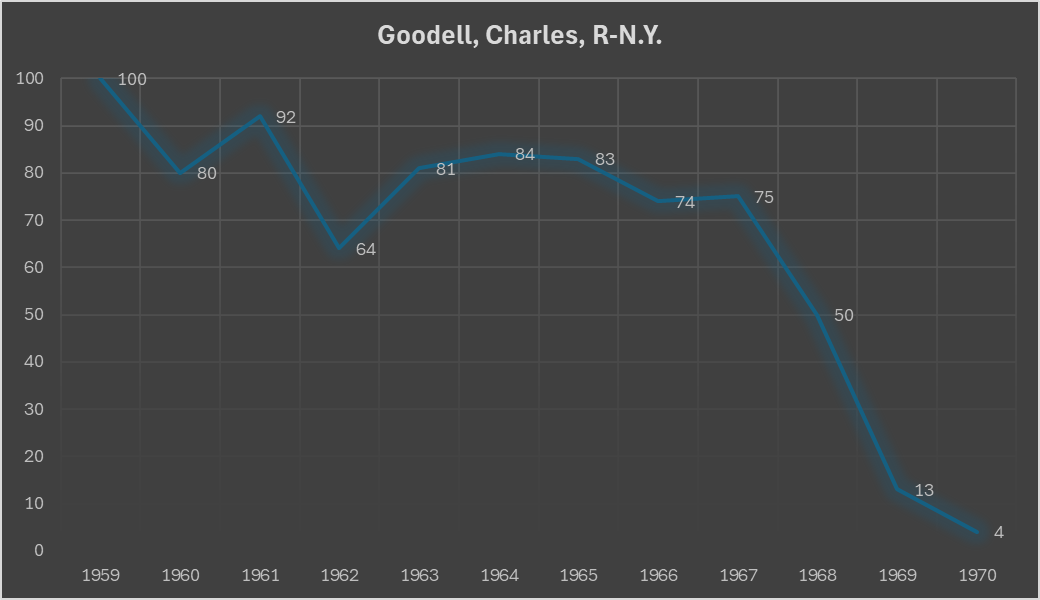
Nixon’s tool to defeat Goodell was his attack dog, Vice President Spiro Agnew. He was to publicly condemn Goodell on multiple occasions, and this would elevate his profile among liberals, thus resulting in a split in the liberal vote between him and Congressman Richard Ottinger. Agnew condemned what he called his “radiclib ideology” (Barnes). However, this would not be the most notable attack. The real kicker, and one that was considered deeply shocking in its day, was when he said, “If you look at the statements Mr. Goodell made during his time in the House and compare them with some of the statements I have been referring to, you will find that he is truly the Christine Jorgensen of the Republican Party” (Curtis). For context, Jorgensen was a famous transsexual of the time. Although Goodell’s strategy to win the Republican and Liberal nominations worked, and as a bonus he secured the endorsement of The New York Times, Nixon’s strategy was working too. Ottinger sought the liberal vote as well and came out against Goodell’s House record, stating that “As a member of the House of Representatives he was one of its most reactionary members. He just voted against everything constructive” (Curtis). Ultimately, the liberal vote split, with the Conservative Party’s candidate, James Buckley, who got the unofficial support of the Nixon Administration, winning the election. This was quite a turnaround for a man who only two years before had only netted 17% of the vote in running for the Senate. Embarrassingly for a man who ran on the slogan of “Too good to lose”, he came in third, as polling had predicted over a week earlier (The Observer). By the criterion set by the conservative interest group Americans for Constitutional Action (ACA), while in the House he had either paired or voted with them on 139 out of 179 votes, but in the Senate, it was only 3 out of 39 votes. Overall, he sided with ACA positions 65% of the time. Goodell’s DW-Nominate score stands at a 0.253, which accounts for both his House and Senate service and indicates moderate conservatism. Just as an illustration of the dramatic change, here is a line graph of his adjusted ACA scores throughout his whole legislative career:

Although Goodell would never again run for public office, he still had a friend in Gerald Ford. Once Ford became president after Nixon’s resignation, Goodell became one of his close advisers. Goodell commented happily on this development, “For me, it’s a new day, a new world. The sun has come out again” (Tolchen). Goodell’s influence may have had a hand in motivating Ford to select Nelson Rockefeller as his vice president. However, he denied directly recommending him, stating, “I said good things about Nelson Rockefeller, but I didn’t recommend anybody personally” (Tolchen). Ford would appoint him chairman of the Presidential Clemency Board, which reviewed and decided on clemency applications by Vietnam War draft dodgers and deserters. In his post-Senate career, he specialized in representing foreign business interests trying to expand into the United States. On January 16, 1987, Goodell suffered a massive heart attack and died at George Washington University Hospital five days later, aged 60. His son, Roger Goodell, is the current commissioner of the NFL.  

References

Barnes, B. (1987, January 22). Charles E. Goodell, Ex-Senator from New York, Dies at 60. The Washington Post.

Retrieved from

Curtis, B. (2013, February 4). Mr. Goodell Goes to Washington. Grantland.

Retrieved from

https://grantland.com/features/roger-goodell-father-senator-charles-goodell/

Equal Pay Act for Women Enacted. CQ Almanac 1963.

Retrieved from

https://library.cqpress.com/cqalmanac/document.php?id=cqal63-1315824

Goodell, Charles Ellsworth. Voteview.

Retrieved from

https://voteview.com/person/3670/charles-ellsworth-goodell

Goodell holds firm on Senate bid; battles against Agnew and polls. (1970, October 26). The Observer (Notre Dame and St. Mary’s College newspaper).

Retrieved from

McLay, M. (2019). A high-wire crusade: Republicans and the War on Poverty, 1966. Journal of Policy History, 31(3), pp. 382-405.

Retrieved from

New York: Charles Goodell, outcast and underdog, fights Agnew and the Conservatives. (1970, November). Ripon Forum, 6(11).

Retrieved from

https://riponsociety.org/wp-content/uploads/2023/12/1970-11_Vol-VI_No-11.pdf

Tolchen, M. (1974, September 12). Goodell, Once a Forgotten Man, Is Now a Close Adviser to Ford. The New York Times.

Retrieved from

RINOs from American History #19: Usher Burdick


North Dakota has had a tremendously interesting history as a state, given how although Republican-dominated, the progressive wing of the party, the Non-Partisan League was riding high during the Great Depression. In 1934, Republican Usher Burdick defeated for renomination the already progressive James Sinclair. Burdick had lost a previous effort to get the Republican nomination in 1932 as he openly endorsed FDR.

Congressman Burdick

Burdick was staunchly supportive of most of the New Deal, and was to Roosevelt’s left on agriculture, being an agrarian radical. He arguably was to his left as well on old age insurance, as he was one of the representatives to vote against Social Security on the grounds that it wasn’t sufficient. He preferred the “Townsend Plan”, which was proved to be economically unfeasible. Burdick’s DW-Nominate score was a -0.048, which is very low for a Republican. As a Midwestern Republican, he was of course to FDR’s right on foreign policy, being a staunch non-interventionist. During World War II, he was one of the foremost supporters of price control in the GOP and opposed the House Committee on Un-American Activities as well as the Smith-Connally Labor Disputes Act. Burdick sought the Republican nomination for the Senate, and then after losing that he tried to run for reelection as an Independent, but was defeated in the At-Large election for both of North Dakota’s House seats, with William Lemke and Charles Robertson making the top two. Burdick was down, but not out, and in 1948 Robertson was defeated for renomination, with Burdick again being in the top two. Burdick most notably was one of only two House Republicans to oppose the McCarran Internal Security Act in 1950 (the other was fellow RINO Jacob Javits of New York), which provided for, among other provisions, communist registration with the Attorney General. Burdick’s postwar record reflected a preference for domestic liberalism and against foreign aid, and he would time and again vote against Mutual Security legislation. Burdick consistently backed public over private ownership of power generation, supported price and rent controls during wartime, opposed any legislation curbing the power of organized labor, and opposed transferring the title of the tidelands from the Federal government to State governments. However, his record on domestic issues wasn’t entirely liberal, and in 1955 he supported revoking the Federal Power Commission’s authority to regulate natural gas and he frequently voted against public housing.

Retirement, Securing His Son’s Future

Burdick’s greatest legacy, however, lay in his son, Quentin. In 1958, Burdick, by this time approaching eighty, agreed to not run for reelection if the Democrats selected his son, Quentin, to succeed him (H.W. Wilson Company). The Non-Partisan League had shifted its affiliation from Republican to Democratic as did Quentin. The younger Burdick won the election, and he would be elected to the Senate in 1960 after the death of William Langer. Usher Burdick would die less than two weeks after his son was elected to the Senate, and Quentin would serve in the Senate until his death in 1992.

References

Burdick, Usher Lloyd. Voteview.

Retrieved from

https://voteview.com/person/1254/usher-lloyd-burdick

Current biography yearbook. 27. (1964). New York, NY: H.W. Wilson Company.

Sen. Quentin Burdick, N.D. Democrat. (1992, September 9). The Los Angeles Times.

Retrieved from

https://www.latimes.com/archives/la-xpm-1992-09-09-mn-155-story.html

The 1976 Election: A Mixed Verdict, Lasts, and Changing Winds


The American public was rather disheartened with “politics as usual” (1976 seems to be the norm these days in this sense) particularly after Watergate and the deeply unsatisfying outcome of the Vietnam War. In 1976, they were looking for a change. While Gerald Ford was a pleasant contrast to the Nixon crowd, his pardon of him was a constant shadow over his presidency and his campaign.  The Democrats too were looking for a change, not only from the Republicans but just politics as usual, and they found their man in Georgia’s Jimmy Carter, who had been one of the state’s first politicians you might call “post racial”. These two battled head-to-head and although Carter had a massive lead early on, Ford managed to make the race close despite his debate stumble on Iron Curtain nations as well as SNL’s lampooning of his alleged clumsiness. Carter had stumbled with his Playboy interview, in which he admitted to lusting after other women in his heart.

A Race of Regions: West vs. South

This election had Carter winning all former Confederate states save for Virginia, which is the opposite of the 2016 election. Ford dominates in the West, winning all of its states save Hawaii, and makes a strong showing in New England, winning four of its six states. The Midwest is a mixed bag, with Carter winning Minnesota, Ohio, and Wisconsin, while Ford wins Illinois, Indiana, Iowa, and his home state of Michigan. Carter crucially won the electorally rich states of Pennsylvania and New York as well. West and South would in four years unite in electing Ronald Reagan.

This campaign focusing on change was certainly a last in many respects, most notably the last gasp of the “Solid South”. While it is true that the composition of the Carter voters in the South was a bit different than it had been for Democrats in many elections past (he got most of the black vote), there were still enough whites motivated by tradition to vote for Carter, and helping in this was the support of numerous Southern politicians, including George Wallace. This would, incidentally, be the last time Wallace made a run for president, running in the Democratic primary, by this time having dropped his segregationist platform. Another notable feature about this race was that in most states the margins were single digits. Carter barely squeaked by in Ohio while Ford won by the narrowest of margins in Oregon. Yet another matter of note is that in this election, both men and women favored Carter 50-48. Today, there is a gap between men and women and the parties they support, with more men going Republican and more women going Democratic. This election also saw Ford winning more states but Carter winning more electorally heavy states at 23 to Ford’s 27.

The Senate

The Senate is a mixed bag, as Republicans and Democrats alike lose reelection in different places. The Senate bids farewell to both Majority Leader Mike Mansfield of Montana and Minority Leader Hugh Scott of Pennsylvania, both who are succeeded by members of their own parties. The 1976 election marked the end of some things we haven’t seen again in the Senate. With the retirement of Hiram Fong, one of Hawaii’s first two senators, the state has never again had a Republican senator. In Maryland, the loss of J. Glenn Beall Jr. to Democratic Congressman Paul Sarbanes marked the end of the last time Republicans held both Senate seats from the state. Although Larry Hogan is the most promising candidate Republicans have had in years for the Senate, he probably will not win since many of the state’s voters don’t want the Senate to go Republican. The loss of New York’s James Buckley marked the end of a time in which Democrats did not hold either of the state’s seats in the Senate. Buckley was also arguably the last conservative to ever represent New York in the Senate (Al D’Amato is debatable). The 1976 election also sent packing Democrats Frank Moss of Utah and Gale McGee of Wyoming, and to this day they are the last Democrats to represent these states in the Senate, succeeded by Orrin Hatch and Malcolm Wallop respectively, both who would be strong Reaganites. The latter ran some of my favorite political ads, which can be found in References.

In Indiana, Democrat Vance Hartke loses reelection by double digits to Richard Lugar, Indianapolis’s popular mayor. However, a famous Republican name loses in Ohio…Robert Taft Jr., a moderate, is replaced by liberal Democrat Howard Metzenbaum. There were also some victories that would not be expected at all today. In California, Republican S.I. Hayakawa defeats Democrat John V. Tunney for reelection, the last time a Republican defeated a Democratic Senate incumbent in the state. In New Mexico, astronaut Harrison Schmitt defeated Democrat Joseph Montoya, who managed to get negative publicity over his poor performance on the Watergate Committee (also the last time a Republican defeats a Democratic incumbent in the Senate), and in Rhode Island Republican John Chafee, who had in 1972 given Democratic Senator Claiborne Pell the only tough election of his career, was elected to succeed the retiring John Pastore. In Tennessee, the victory of Democrat Jim Sasser over Republican Bill Brock would be the last time a Republican incumbent senator lost reelection in the state. Just in case you thought Democrats were roundly getting thrashed in the West, Democrat Dennis DeConcini succeeds Republican Paul Fannin to the Senate in Arizona.

The House

In the House, we for the last time saw an election in which Democrats won a supermajority…they gained one seat, as the 1974 midterms had already been excellent for them. Of course, something to bear in mind about 1976 is that the Democratic Party had a conservative wing, and it was still fairly sizeable. Thus, a 2/3’s majority isn’t to be read as 2/3’s liberal. However, the Republicans too had their moderate to liberal wing. What’s more, in the House, this was the last time the Democrats won Wyoming’s House seat. This election is also the first and only time that Ron Paul ever loses a House election, being narrowly defeated by Democrat Bob Gammage after having won a special election. Paul would defeat him in a rematch in 1978. This election also marks the first elections to Congress of two vice presidents. In Indiana, Republican Dan Quayle defeats Democrat J. Edward Roush for reelection, and in Tennessee, Al Gore at 28 succeeds Democrat Joe Evins to office with a whopping 94% of the vote. One figure who still serves in office was first elected in 1976, this being Ed Markey of Massachusetts, who serves alongside Elizabeth Warren in the Senate. Other notable first-timers include Democrat Leon Panetta, who would serve as President Obama’s CIA director and Secretary of Defense, and Republican “B-1 Bob” Dornan, noted for his staunch conservatism, frequently inflammatory rhetoric, and advocacy for the B-1 Bomber.

The 1976 election is demonstrative on the presidential level of how much politics can change…we don’t expect for instance a Republican to win California, Oregon, and Washington any time soon in a presidential election. Likewise, we don’t expect a Democrat to be winning Alabama and Mississippi at any time in the foreseeable future.

P.S.: By Saturday, I will archive all 2021 posts.

References

1976 United States House of Representatives elections. Wikipedia.

Retrieved from

https://en.wikipedia.org/wiki/1976_United_States_House_of_Representatives_elections

1976 United States presidential election. Wikipedia.

Retrieved from

https://en.wikipedia.org/wiki/1976_United_States_presidential_election

1976 United States Senate elections. Wikipedia.

Retrieved from

https://en.wikipedia.org/wiki/1976_United_States_Senate_elections

Malcolm Wallop for U.S. Senate Wyoming 1976 TV Ad. YouTube.

Retrieved from

https://www.youtube.com/watch?v=-BXm8vEpT7U

The Changes in Focus by Liberals and Conservatives on Taxes

Gerald Ford, a fiscal conservative, stood repeatedly against income tax reductions that did not come with budget reductions.

The policies on income taxes have changed a bit over the decades, notably with the conservatives in terms of how they approach the subject when it comes to deficits. Namely, they care less about deficits in relation to tax reduction than they used to. The history surrounding this also largely counters liberals who cite the tax system of the 1950s positively. There were calls for reform from both liberals and conservatives of the time, but in different directions.

Liberals – Curbing Tax Deductions, Focusing on the Working Class

Liberals of the 1950s realized that the tax code had numerous loopholes that made the effective rate considerably lower than the 91% statutory rate. On September 28th, 1951, Senator Hubert Humphrey (D-Minn.) proposed an amendment to eliminate income splitting, which resulted in lower tax rates for families with over $10,000 in income if the husband and wife reported their income separately. This proposal was rejected 15-62, and counted by Americans for Democratic Action as a positive. Liberals also were interested in pushing certain tax reductions to primarily help the working class that were deficit-financed. For 1955, both ACA and ADA counted for their ratings the March 15th the vote defeating a tax credit of $20 per person regardless of income. ACA supported eliminating the $20 tax credit, citing that it would have eliminated 5 million people from the taxpayer rolls and resulted in a $2.3 billion annual loss in revenue, regarding the vote as “FOR Sound Money & AGAINST Inflation” (Americans for Constitutional Action, 1960, 40). Americans for Democratic Action, on the other hand, favored the tax credit. Another instance of liberals supporting tax reduction and conservatives opposing was when on June 18, 1958, Senator Paul Howard Douglas (D-Ill.) offered an amendment to reduce personal income taxes by $50 as well as repealing or reducing excise taxes and reducing taxes on small businesses. ACA regarded the vote in the category of “FOR Sound Money & AGAINST Inflation” in their opposition to the measure, which they opposed for reducing annual revenue by an estimated $6 to $6.3 billion annually while there was a deficit (Americans for Constitutional Action, 1960, 38). This was rejected 23-65, with most Republicans voting against this proposal and a majority of Democrats doing so as well. ADA had counted the vote favorably in their scorecard. This is not to say that conservatives didn’t like the idea of income tax reduction, indeed they had pushed an income tax reduction over President Truman’s veto in 1948. They wanted income tax reductions to be paid for by budget reductions.

One famous tax reduction effort started during the Kennedy Administration. On September 25, 1963, the House passed a tax reduction bill 271-155, and this was counted as a plus by Americans for Democratic Action and a negative by Americans for Constitutional Action. This vote fell on liberal vs. conservative lines and it was based on the question of inflation. Liberals supported deficit financing for tax reduction while conservatives were against its potential inflationary impact.

In the following year, ACA included two votes surrounding tax reduction. The first was Senator John McClellan’s (D-Ark.) amendment placing a limitation on tax reduction and the tax reduction bill itself. McClellan’s amendment was directly in opposition to the Keynesian nature of the Kennedy tax cut, which was meant to be deficit-financed. ACA itself explained its opposition to the tax reduction bill thusly, “ACA firmly believes that a “tax cut” is necessary for it will act as a stimulus to our national economy by presenting the opportunity for greater investment by the private sector of our society. However, tax reductions during periods of budgetary deficits can only lead to additional inflationary pressures. A realistic tax reduction program should be coupled with efforts to decrease Federal expenditures with the objectives of securing balanced budgets” (Americans for Constitutional Action, 1964, 12). The bill itself, which reduced the top income tax rate from 91% to 70% and corporate rates from 52% to 47%, passed the Senate 77-21 on February 7th. Supporting this measure were staunch liberals such as Ted Kennedy (D-Mass.), Hubert Humphrey (D-Minn.), and George McGovern (D-S.D.), and opposing were conservatives such as Barry Goldwater (R-Ariz.), John J. Williams (R-Del.), and John Tower (R-Tex.). The economist who advised Kennedy to push for a tax reduction was Keynesian Walter Heller, who despite Reagan and Republicans adopting tax reductions in the 1980s, he didn’t embrace Reagan and Republicans, backing Walter Mondale in 1984 (Kansas State University). This post hasn’t even yet mentioned the largest tax loophole in the system, the oil depletion allowance, which allowed for the first 27.5% of revenue to be tax free, and this was an allowance that liberals repeatedly sought to reduce. Although generally the debate on this one went in a liberal-conservative direction, with liberals supporting reduction of the depletion allowance and conservatives supporting retaining the depletion allowance. Although Americans for Democratic Action repeatedly counted this as an issue, the conservative Americans for Constitutional Action never counted this as an issue. There were simply questions for them that were seen as more ideologically relevant for them, and they weren’t overly inclined to render favorable judgment on a question that outright favored one sector of the economy, albeit a highly important one for the economy and national defense in oil.

In 1975, conservatives again opposed tax reduction proposed by Democrats, which if enacted would have reduced individual and business taxes by $15.5 billion without the $395 billion ceiling for 1977 federal spending requested by President Ford. President Ford vetoed the tax reduction, writing in his veto message to Congress, “I have clearly stated ever since last October 6 that I would veto any tax cut if you failed to cut future Federal spending at the same time. You have refused at this time to put any limit on spending for the fiscal year and instead sent me a temporary 6-month extension of the present temporary 1975 tax levels due to expire on New Year’s eve” (The American Presidency Project). Ford had voted against the 1963 tax reduction as a member of Congress, and interestingly among the votes in support of his position was Jack Kemp (R-N.Y.), who would later spearhead the GOP’s approach of placing tax reduction over budget reduction in the party’s priorities. Although President Ronald Reagan is most commonly associated with the “voodoo economics” as George H.W. Bush put it, he wasn’t actually a believer in the concept of lower taxes meaning more revenue. This is demonstrated in his embrace of the 1982 Tax Equity and Fiscal Responsibility Act, which although it raised no income tax rates that were in effect at the time, it did cancel certain future reductions and hit particularly hard were business tax reductions. Conservatives had universally embraced the 1981 tax reduction despite deficits as a way to help out the flagging economy, and it certainly was something needed when you consider the interest rate cuts the Federal Reserve did to curb inflation. Liberals became more interested in the budgetary impact of tax reductions for cutting into funds for domestic programs.

Although I support lower income taxes, in the future I want these tax reductions to be paid for, which can be done by budget cuts as well as tax loophole and deduction closings. I frankly think it is time to get back to old-fashioned conservatism on finances, and the recent inflation has proven the problem of not doing so. Too many people in our politics are willing to go with deficit financing, and it is costing us in the long run. The question is, are we willing to continue to accept this cost?

References

ACA Index. (1960). Americans for Constitutional Action.

ACA-Index Second Session 88th Congress. (1964). Americans for Constitutional Action.

ADA World – Congressional Supplement. (1951, October). Americans for Democratic Action.

ADA World – Congressional Supplement. (1955, September). Americans for Democratic Action.

Retrieved from

ADA World – Congressional Supplement. (1958, September). Americans for Democratic Action.

Retrieved from

ADA World – Voting Record Supplement. (1964, January). Americans for Democratic Action.

Retrieved from

Dr. Walter H. Heller – Regents Professor of Economics at University of Minnesota. Kansas State University.

Retrieved from

https://www.k-state.edu/landon/speakers/walter-heller/#:~:text=Upon%20taking%20office%20he%20said,and%20%2411%20billion%20in%201965.

H.R. 8363. Passage. Govtrack.

Retrieved from

https://www.govtrack.us/congress/votes/88-1964/s264

Veto of a Tax Reduction Bill. The American Presidency Project.

Retrieved from

https://www.presidency.ucsb.edu/documents/veto-tax-reduction-bill

Where Did the South Stand Politically in the Civil Rights Era?

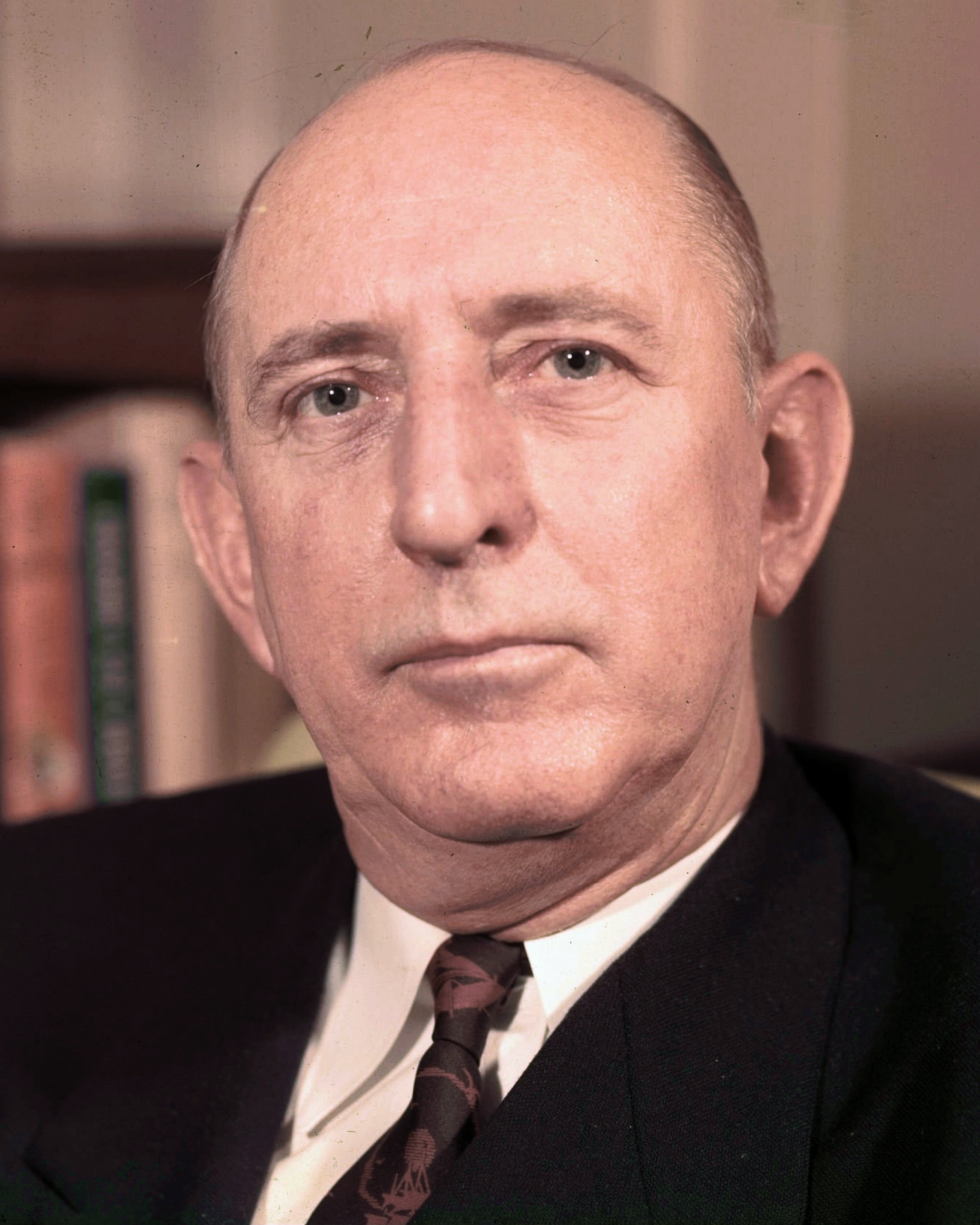
Richard Russell, the leader of the Southern Democratic faction of the Senate.

Southern Democrats occupy something of a debated space in their politics in the liberal/conservative range of things. Conservative Republicans don’t like the idea of them being connected to them and will argue that most didn’t switch to the GOP. There are some reasons for that that stand outside of ideology, such as figuring that they would do better sticking to their regional brand of Democratic politics, as many in the South still were in the habits of their fathers, grandfathers, and great-grandfathers in voting Democratic. This being said, the Southern Democrats as a group although were not the staunchest conservative group in the Senate (that would be the conservative wing of the Republican Party of the day), many were conservative enough to have an informal “Conservative Coalition” with Republicans to oppose many liberal policies. There were issue areas in which this coalition weakened…on the Southern Democratic side it was on agriculture and public power, and on the Republican side it was on civil rights and particularly during the Eisenhower Administration on foreign aid, to which Southern Democrats had become increasingly antagonistic.

Based on lifetime modified ACA scores (thus based on records from 1955-1984), this is how the Senate Southerners, who served during the Civil Rights Era (1954-1968) did on conservatism. I will be ranking them from least to most conservative:

Estes Kefauver (D-Tenn.) – 5%

Lowest score: 0% (1955, 1956, 1962, 1963)
Highest score: 11% (1957)

Kefauver in short: Kefauver, who I have written about before, was a liberal populist who was more amenable to civil rights than many Southern senators, indeed Tennessee had become a bit of a softer state on the subject, while it used to be that it was only Republicans in East Tennessee who would vote for civil rights. Kefauver’s biggest moments in the sun were his publicized investigations of the mafia and his vice-presidential run in 1956. He would play no role in the civil rights debates of the 1960s as he died before the Civil Rights Act of 1964 was debated.

Ross Bass, (D-Tenn.) – 7%

Lowest score(s): 0% (1961, 1962, 1963, 1964, 1966)
Highest score: 33% (1957)

Bass in short: Bass’s record here includes his time in the House and his time in the Senate during the Great Society Congress. He was in terms of his ideology a true successor of Estes Kefauver. However, Bass lost the 1966 Democratic primary to Frank Clement, who proceeded to lose to Republican Howard Baker Jr.

Ralph Yarborough (D-Tex.) – 8%

Lowest score: 0% (1962, 1967, 1970)
Highest score: 17% (1968)

Yarborough in short: Ralph Yarborough was Texas’ best-known champion of liberalism, backing strongly Democratic national programs. He even voted for the Civil Rights Act of 1964, the only senator from a former Confederate state to do so, and that year defeated his Republican challenger by the name of George H.W. Bush. The times in which Yarborough voted conservative per ACA included some foreign aid votes, and he did vote with LBJ on civil rights in 1957 and 1960. Yarborough’s liberalism became tiresome for Texans, and he lost renomination to moderate Lloyd Bentsen in 1970.

W. Kerr Scott (D-N.C.) – 10%

Lowest score: 0% (1958)
Highest score: 20% (1955)

Scott in short: W. Kerr Scott was a progressive Democrat on most matters save for the civil rights issue, certainly a New Dealer in spirit and deed. He died in office in 1958, resulting in his replacement with a much more conservative man who also went by his middle name: B. Everett Jordan.

Lyndon B. Johnson (D-Tex.) – 10%

Lowest score: 0% (1955)
Highest score: 22% (1957)

Johnson in short: As Senate Majority leader, Lyndon B. Johnson was a national figure, and was an especially talented leader, pulling off narrow victories, and he with great frequency backed liberal positions despite liberals mistrusting him and considering him something of a conservative. His presidency would put this mistrust (at least on domestic issues) to rest for liberals.

Walter George (D-Ga.) – 18%

Lowest score: 8% (1956)
Highest score: 40% (1955)

George in short: This period catches the very last years in Walter George’s long career, as he had served in the Senate since 1922. his low score here reflects a bit of a softening in his final years more towards where he stood at the beginning of his career. In the middle of his career, George had gained praise as a principled dissenter of much of what FDR stood for.

Albert Gore Sr. (D-Tenn.) – 21%

Lowest score: 0% (1962)
Highest score: 75% (1955)

Gore in short: The father of the much more known Al Gore, Gore Sr. was known as one of the most liberal of the Southerners in the Senate. This didn’t only manifest itself in support for much of the national Democratic agenda but also on his votes on some social issues, and one that was particularly politically damaging was his vote against Everett Dirksen’s school prayer amendment in 1966. Gore’s positions on the Vietnam War also didn’t do him favors in Tennessee, and he lost reelection to Republican William Brock in 1970.

Herbert S. Walters (D-Tenn.) – 24%

Lowest score: 7% (1963)
Highest score: 40% (1964)

Walters in short: Walters was an interim replacement after the death of Estes Kefauver. There really isn’t that much to say about him. However, ACA and ADA do strongly disagree on Walters’ ideology, so that’s of note.

J. William Fulbright (D-Ark.) – 25%

Lowest score: 4% (1963)
Highest score: 54% (1968)

Fulbright in short: The name Fulbright lives on the Fulbright Scholarship, and he was one of the strongest internationalists in the South. Undoubtedly one of the more liberal Southern Democrats, he could nonetheless, based on the ACA vote selection, stood for the conservative position 25% of the time. He both sponsored the Gulf of Tonkin Resolution and then turned against the Vietnam War as chairman of the Senate Foreign Relations Committee. Fulbright’s record on race (although he could at least vote to confirm Thurgood Marshall to the Supreme Court), his Faustian bargain for power if you will, ended up contributing to his renomination loss in 1974.

Olin Johnston (D-S.C.) – 30%

Lowest score: 19% (1963)
Highest score: 50% (1960)

Johnston in short: Olin Johnston had during the 1930s been a strong supporter of FDR, being the state’s New Deal governor. His bid against Senator “Cotton Ed” Smith fell short in 1938, but the second time was a charm as he won a rematch in 1944. Senator Johnston’s record consisted of a lot of domestic liberalism (he supported the Economic Opportunity Act of 1964 and Medicare) but he frequently voted against foreign aid. Indeed, Johnston had been one of the few Southern Democrats to vote against the Marshall Plan in 1948.

J. Lister Hill (D-Ala.) – 31%

Lowest score: 7% (1959)
Highest score: 54% (1967)

Hill in short: Lister Hill, who I wrote about quite recently, had had a longstanding reputation as a New Dealer and a Fair Dealer who specialized in public health. However, his state was moving quite to his right, and it was to the extent that he thought it best to retire in 1968.

John J. Sparkman, D-Ala. – 35%

Lowest score(s): 0% (1956, 1959)
Highest score(s): 75% (1970, 1972)

Sparkman in short: John Sparkman was much of the same New Deal class as Lister Hill, and was the last segregationist to be on a Democratic Party presidential ticket, being the candidate for vice president in 1952. Sparkman certainly moved to the right after 1962, although far from staunch conservative. By 1978, he had clearly stayed in office too long and bowed out of reelection.

George Smathers, D-Fla. – 38%

Lowest score: 18% (1962)
Highest score: 73% (1968)

Smathers in short: George Smathers was certainly a turn right from his predecessor, Claude Pepper. However, among the Southern Democrats of his time, he was certainly one of the more liberal. Although Smathers signed the Southern Manifesto, he proved more flexible than many others, voting for the Civil Rights Act of 1957 and the Constitutional amendment banning the poll tax. He even privately hoped the Civil Rights Act of 1964 would pass even though voting for it was politically impossible for him. Smathers was also a close friend of JFK and was one of two options to replace Lyndon Johnson had Kennedy lived to the 1964 election. Smathers chose not to run for reelection in 1968.

Russell Long (D-La.) – 42%

Lowest score: 10% (1966)
Highest score: 73% (1970)

Long in short: Long’s record seems to zig-zag a bit, with him strongly supporting President Johnson’s Great Society during the Great Society Congress, but he moves to the right towards the Nixon presidency. On civil rights, he seemed to have a fairly easy time adjusting to the changing South, and his name and influence far from hurt him. He also was one of the Democratic senators to support President Reagan’s tax reductions. Long would opt not to run for reelection in 1986.

Thomas Wofford (D-S.C.) – 44%

Wofford in short: Perhaps the least notable senator in this entire list, as he served in the interim after Strom Thurmond briefly resigned from the Senate, only to win again.

Fritz Hollings (D-S.C.) – 46%

Lowest score: 28% (1976)
Highest score: 71% (1967)

Hollings in short: Hollings was the last of these senators to leave office, retiring in 2004. Although Hollings started out as a bit of a conservative, he found his place as a moderate and stuck to that for a long time. He was also known for his outspoken and occasionally offensive remarks. Hollings was also known as the “Senator from Disney” for his advocacy for the company.

William B. Spong Jr. (D-Va.) – 49%

Lowest score: 38% (1971)
Highest score: 63% (1969)

Spong in short: Spong was a straight-up moderate, and he had been recruited by President Johnson in 1966 to run in the Democratic primary against A. Willis Robertson. Robertson had two things going against him: the Voting Rights Act of 1965, which had expanded the electorate, and his age. Spong defeated him, but only served a term until he was defeated in 1972 by Republican Congressman William Scott. Spong contributed a rather funny name when senators were trying to come up with ridiculous names for bills, that being the hypothetical legislation sponsored with Senators Hiram Fong (R-Haw.) and Russell Long (D-La.) protecting the copyrights of songwriters from Hong Kong, which would be titled the “Long-Fong-Spong-Hong-Kong-Song Bill”.

Price Daniel (D-Tex.) – 53%

Lowest score: 50% (1956)
Highest score: 60% (1955)

Daniel in short: Daniel made much more of an impact as governor after his Senate term. He seemed to be about where many Texans were politically at the time of his service in the Senate.

Allen Ellender (D-La.) – 57%

Lowest score: 31% (1956)
Highest score: 83% (1964)

Ellender in short: I wrote a lot about Allen Ellender recently, which you can read. He was kind of a hodgepodge of views liberal and conservative, although his later career trended more conservative than liberal. Also notably supported FDR’s court-packing plan in 1937. Ellender died in office in 1972.

B. Everett Jordan (D-N.C.) – 61%

Lowest score: 38% (1963)
Highest score: 80% (1969)

Jordan in short: Succeeding the late W. Kerr Scott, Jordan was miles more conservative than him, voting frequently with Sam Ervin. However, Jordan did show some independence from what was expected of Southern Democrats, such as his opposition to the Vietnam War later in his career. He lost renomination to Congressman Nick Galifianakis, who would proceed to lose the election to Republican Jesse Helms.

Herman Talmadge (D-Ga.) – 62%

Lowest score: 22% (1979)
Highest score: 83% (1970)

Talmadge in short: Herman Talmadge was elected to succeed Walter George in 1956, and was known as a hardliner on segregation. Although his reputation was quite right-wing, he was more variable than his reputation let on, such as voting for the Economic Opportunity Act in 1964 and Medicare in 1965. His finest hour in Washington was when he served on the Watergate Committee, which raised the profiles of most who served on it. However, his censure for ethics violations damaged his prospects and although efforts were made to rally black support for Talmadge in 1980, selling him was difficult and many blacks had negative connotations with the Talmadge name. He lost reelection to Republican Mack Mattingly.

Spessard Holland (D-Fla.) – 66%

Lowest score: 40% (1958)
Highest score: 94% (1961)

Holland in short: Holland was uniformly opposed to civil rights with the sole exception of his Constitutional amendment to ban the poll tax in 1962. He was one of the more oppositional senators to domestic liberalism, including voting against the Economic Opportunity Act of 1964 and against Medicare, unlike his fellow Floridian Smathers. Holland retired in 1970.

Sam Ervin (D-N.C.) – 69%

Lowest score: 31% (1956)
Highest score: 91% (1972)

Ervin in short: The trope originator for the “country lawyer”, Ervin by far had his greatest claim to fame as chairman of the Senate Watergate Committee, making him a hero among many Americans. Although perhaps the Senate’s most skilled legal opponent of civil rights legislation, he got points from liberals for his opposition to Everett Dirksen’s school prayer amendment as well as to “no knock” warrants for drug cases. However, such occasional liberal positions could serve to obscure his more conservative record in later years. Ervin retired from the Senate in 1974.

John C. Stennis (D-Miss.) – 69%

Lowest score: 37% (1983)
Highest score: 95% (1974)

Stennis in short: Stennis was a figure who was quite a bit more respected for his more legalistic approach than James Eastland’s on the subject of civil rights. He also was the author of the Senate’s first ethics code. Stennis was among the more conservative Southerners, but his record got a bit more moderate starting around the Carter Administration. Stennis managed to avoid a lot of trouble for his civil rights stances, something his colleague Eastland couldn’t end up living down. Stennis retired from the Senate in 1988, by which time he was 87 years old.

Donald Russell (D-S.C.) – 70%

Lowest score: 68% (1965)
Highest score: 71% (1966)

Russell in short: Donald Russell served during most of the Great Society Congress, and he wasn’t particularly notable as he filled in the vacancy caused by the death of Olin Johnston. He lost renomination to Fritz Hollings in 1966.

John McClellan (D-Ark.) – 72%

Lowest score: 38% (1956)
Highest score: 100% (1955)

McClellan in short: McClellan specialized in legislation combatting crime and racketeering and also famously chaired the McClellan Committee that investigated union corruption. He supported many measures (although not all proposals) limiting the power of organized labor. McClellan died in 1977, only a week after he publicly announced he would retire due to age and health.

James Eastland, D-Miss. – 73%

Lowest score: 43% (1957)
Highest score: 89% (1974)

Eastland in short: Among Southern senators, James Eastland was regarded as among the most racist of the group. Although not the worst major Mississippi politician on race during the Civil Rights Era (Governor Ross Barnett was worse), he became a face of Jim Crow. Eastland was certainly one of the more conservative of the Southern Democrats and was more willing to back proposals restricting organized labor than many were in the 1958 and 1959 debates on union reform. Once the political power of blacks in Mississippi’s Democratic Party was sufficiently developed, he opted not to seek another term in 1978.

Richard Russell, D-Ga. – 74%

Lowest score: 38% (1956)
Highest score(s): 100% (1955, 1960)

Russell in short: Richard Russell was the leader of the Southern bloc, and he was greatly admired by his Senate colleagues all-around. For instance, Republican Milton Young of North Dakota got in some hot water with his party in 1952 when he announced that if Russell won the Democratic nomination that he would support him for president. Russell was the lead tactician against civil rights legislation in the Senate. Although his earlier career reflected support for much of the New Deal, a lot of such politics had faded away by this period in history, with him opposing domestic liberal legislation frequently and opposing foreign aid. However, Russell did vote for the final version of Medicare in 1965. Russell’s heavy-smoking habit caused his 1971 death in office from emphysema.

Harry F. Byrd Jr., D, I-Va. – 86%

Lowest score: 69% (1980)
Highest score(s): 100% (1974, 1978)

Byrd Jr. in short: The son of Harry F. Byrd Sr. and his successor in the Senate, Byrd ultimately found given his strong conservatism and that Democrats would want him to pledge to support whoever the Democratic nominee for president would be in 1972, he instead ran for reelection as an Independent. Despite officially being an Independent, Byrd would continue to caucus with the Democrats until he opted to retire in 1982. He would be very much his father’s son, and this included being among the eight Senate “nay” votes to the Voting Rights Act extension in 1982, if perhaps a little more flexible.

William Blakley, D-Tex. – 86%

Blakley in short: William Blakley served briefly as an interim senator in 1957 after Price Daniel’s departure, and then again served in 1961 after Lyndon B. Johnson’s departure for the vice presidency. Blakley sought to finish LBJ’s term in 1961, but many liberal Democrats couldn’t stomach the solidly conservative Blakley and defected to Republican John Tower, who won.

A. Willis Robertson, D-Va. – 88%

Lowest score: 69% (1956)
Highest score(s): 100% (1955, 1957, 1961, 1962)

Robertson in short: Virginia’s delegation to Congress was among the most conservative, and possibly the most conservative of the whole South, and Willis Robertson was part of why. He was more fiscally conservative than most Southern Democrats, although even he doesn’t outmatch one of Virginia’s other senators. Robertson was also the father of televangelist Pat Robertson.

J. Strom Thurmond, D, R-S.C. – 91%

Lowest score: 25% (1956)
Highest score(s): 100% (1960, 1961, 1962, 1974, 1976)

Thurmond in short: In addition to being the candidate for president in 1948 on the State’s Rights Party (Dixiecrat) ticket, he also had the longest solo filibuster on a bill in history, when he spoke for 24 hours and 18 minutes against the Civil Rights Act of 1957. He also serves as a symbol for many: you might say he was the symbolic start of the long march of the South to the Republican Party when he switched in 1964. Thurmond was also known for his longevity, both in life and in office, serving until 2003, when he was 100.

Harry F. Byrd Sr., D-Va. – 93%

Lowest score: 81% (1958)
Highest score(s): 100% (1955, 1957, 1959, 1960, 1962)

Byrd in short: Harry F. Byrd, who had been Virginia’s governor in the 1920s and served in the Senate since 1933, had been one of the earliest Democrats to turn against FDR’s New Deal. His record on fiscal conservatism was pretty hard to beat and had a strong aversion to debt. Byrd also disagreed with Democrats on foreign aid and had even voted against both Greek-Turkish aid in 1947 and the Marshall Plan in 1948, a rarity for a Democrat. Byrd would maintain his power in Virginia through his machine as well as through his “golden silence”: he would not endorse a candidate for president. He also has some infamy for his push for “massive resistance” to desegregation, which lasted until 1959 but the effects of which lasted longer. Byrd would be strongly opposed to the New Frontier and Great Society. A brain tumor would force his retirement in 1965 and cause his death the next year. Per positions based on votes the ACA found to measure conservatism, Byrd is the foremost conservative among the Senate Democrats.

As you can see from this post, the range of Democrats varied a bit in the South, and although most would not be successes in today’s Democratic Party, many would perhaps be too moderate or liberal for today’s Republican Party.

Americans for Constitutional Action on the Senate in Eisenhower’s Second Term


I was finally able to determine the Senate criterion for Americans for Constitutional Action scores from 1955 to 1959. The book of the first release of that group’s scores is massive…the library I found it in had it in the oversized book section. The ratings of the Senate from 1955 to 1959 consist of 77 votes, and are broken down as follows:

1955 – 5 votes

1956 – 13 votes

1957 – 9 votes

1958 – 20 votes

1959 – 30 votes

I also have determined the Senate ACA-Index for 1960, which consists of 13 votes.

The Standout: John J. Williams of Delaware

The outstanding individual in the Senate by ACA standards for Eisenhower’s second term was Republican John J. Williams of Delaware. Although Arizona’s Barry Goldwater technically has a higher score by 1960, he pairs contrary to ACA’s position on three occasions – once in 1957 on cutting military aid, again in 1958 on Senator Douglas’s (D-Ill.) tax reduction amendment, and once again in 1959 on cutting military aid. Williams only does wrong twice by ACA standards in the Eisenhower era: voting against cutting military aid in 1957 and voting to approve a compulsory settlement international agreement in 1960.

Democratic Hero of Conservatism: Harry Byrd of Virginia

Of all the Democrats, Virginia’s Harry Byrd scores the highest. He had turned against the New Deal by 1935 and was a consistent vote and voice for fiscal conservatism. Many Republicans were big fans of Byrd for his conservatism, and Byrd’s record justifies it, at least among conservative Republicans.

The Big Zeroes: Hart and McNamara

Senators Phil Hart (D-Mich.) and Pat McNamara (D-Mich.) vote zero times with ACA’s position during Eisenhower’s second term. A major political force in the state in this time was Walter Reuther of United Auto Workers, who effectively advocated for unions to lobby for liberalism overall rather than just pro-union policies. His efforts also helped turn Michigan away from its historic Republicanism. McNamara only voted for the ACA position twice in his entire career!

“Tail Gunner Joe” Doesn’t Make the Cut

I have read the take that Senator Joseph McCarthy was not a hardline right-winger, rather a moderate Republican, and this perspective is bolstered by how he voted on the votes counted by ACA on his last years in office. However, something to bear in mind is that for 1956, four votes involve agriculture, and McCarthy takes the liberal position each time. His positions against ACA actually outnumber his ones for!

LBJ and JFK: Decidedly Liberal

Future presidents LBJ and JFK both vote a liberal line per ACA. This is despite liberals regarding LBJ as something of a conservative. The number of government programs, foreign aid, etc. that LBJ votes for, however, qualifies him as a liberal, even if there is the occasional time he frustrates liberal objectives as majority leader. John F. Kennedy’s voting in the 84th Congress qualifies him as only a moderate liberal, but his voting after that Congress gives him his celebrated liberal reputation. He only sides with the ACA on two votes after 1956: reducing appropriations for rivers and harbors projects in 1957, and voting against drydock subsidies in 1959.

Eisenhower: Moderately Conservative

President Eisenhower’s “score”, as he doesn’t cast votes rather has positions on votes, is a 72%, as he stands for the conservative position on 41 of 57 Senate roll calls in which he is recorded as having a position. The biggest complaints for conservatives on him are his stances in favor of foreign aid and his occasional support of a liberal domestic measure. His strong points are on fiscal conservatism on domestic issues; his vetoes are quite cost-conscious.

Mistakes

I found out that I, to my regret, made two mistakes in my counting of the House for Eisenhower’s second term in a previous post. In 1958, I included the Anti-Preemption bill, when the vote ACA actually counted was Rep. Kenneth Keating’s (R-N.Y.) motion to recommit. In 1959, also with the Anti-Preemption bill, ACA counted Rep. John Lindsay’s (R-N.Y.) motion to recommit instead of passage, which I thought was the vote counted. I will correct these errors soon.

The ACA-Index Basis for 84th to 86th Congresses:

I have tabulated scores on individual years:

Allen J. Ellender: The Blunt Bayou Stater


In 1928, a young and aggressive reformer won the Louisiana governorship in Huey Long. Although state legislator Allen Joseph Ellender (1890-1972) originally opposed Long’s rise, campaigning against him in 1924 and 1928, he got wise as he saw which way the wind was blowing both in Baton Rouge and among his constituents, and became a key ally (Bencel, 42-43). However, this wasn’t an easy relationship initially. In one instance, they had a nasty argument over the phone over Ellender voting against $150,000 to renovate the governor’s mansion, with Long swearing at him and Ellender threatening to slap Long if he did so in person (Bencel, 41). However, Long and Ellender would prove to have an effective working relationship, and they did have some things politically in common, including opposition to the traditional leadership of Louisiana. Ellender drafted the “Round Robin” statement that enough senators signed in 1929, which guaranteed the Senate wouldn’t vote for conviction in an impeachment trial (Alford). With Long’s support, Ellender was elected speaker of the Louisiana House in 1932.

Rise to the Senate

Ellender’s elevation to the Senate was attributable to two deaths. First, Huey Long succumbing to his assassination on September 10, 1935, and Governor Oscar K. Allen’s death on January 28, 1936. The path was clear for Ellender to run for the Senate. He had previously been denied nomination for governor because he had refused to back ethically questionable oil leases. Ellender as a senator was quite different from Huey Long towards Roosevelt, now that he was free of Long’s command. Long, although he supported some key aspects of the New Deal, often crossed swords with Roosevelt, both to his left and right. He reflected on Long, “Huey Long was personally ambitious and I saw in his feud with a president a means of advancing his own presidential ambitions. I always thought that Huey was subordinating the best interest of the state to his own ambitions” (Bencel, 74).

Staunch Ally of FDR

When Ellender first entered the Senate, he was one of the most loyal supporters of President Roosevelt, and this included being one of only twenty senators to vote to keep his “court packing plan” alive. His support of the court-packing plan can be explained by him wanting to win favor with the Roosevelt Administration (Bencel, 77). Ellender also supported the Wage and Hour bill in 1937, which numerous Southerners thought went too far on fair labor standards. Ellender also proved loyal on foreign policy matters, including backing the repeal of the arms embargo in 1939 and Lend-Lease in 1941. On civil rights, Ellender was predictably a strong foe, and fought against anti-lynching legislation. His stance on race is explained by his biographer thusly, “Ellender’s racism was essentially traditional, neither vindictive nor mean. A product of his times, he, like most white southerners, opposed granting more rights and privileges to blacks, whom he considered inferior. Like many segregationists, he professed to like blacks personally. He softened his stance somewhat by saying his real opposition was to intrusion by the federal government into the affairs of the state” (Bencel, 79). Despite his at times peppery and prejudiced takes, he was popular among his colleagues across the board, and his honesty, courtly manners, as well as his Cajun shrimp gumbo were certainly a part of it. He, like many other Southerners, would gradually grow more conservative, and this would increase during the Truman Administration.

Post-War Years

In 1946, Ellender led the defense for Senator Theodore Bilbo (D-Miss.) when the incoming Republicans sought to deny him seating for advocating the use of violence to stop blacks from voting, and managed to get Bilbo off on accusations of depriving qualified black voters the vote. One senator, however, Ellender did not defend was Wisconsin’s Republican demagogue Joseph McCarthy, holding “The fact that a man belonged to an organization that later turned semi-Red is no reason to charge him with being a Communist” (Bencel, 171).

Although Ellender backed the Marshall Plan and Greek-Turkish aid during the 80th Congress, he would become disillusioned with foreign aid starting in 1951, when he toured Europe for a fifth time. He found what he considered to be waste and extravagance, and only backed continued aid to Austria and West Germany (Bencel, 188). From then on, he voted against Mutual Security legislation. Following a 28-nation tour in 1957, Ellender condemned economic aid as having been an “abysmal failure” in all instances (Fried). That year, he voted against the establishment of the Development Loan Fund.

In other ways, Ellender was a flexible legislator, and indeed his support was key to the enactment of the 1949 Taft-Ellender-Wagner bill, providing for public housing. Taft represented the Republicans, Ellender the Southern Democrats, and Wagner the Northern Democrats. Ellender, as chairman of the Senate Agricultural Committee, was staunchly for retaining high price supports during the Eisenhower Administration, contrary to the push towards lower and flexible price supports by Eisenhower and Republicans, seeking more of a free market approach. On civil rights, Ellender found that the position of the South had weakened in the ability to stop such legislation since Brown v. Board of Education (1954) and recalled in 1971 that this ability was dealt a fatal blow with the admission of Alaska and Hawaii, which he had opposed (Cates).

Controversial Views on Developing Nations

Ellender was outspoken in his views on foreign policy, and he could be undiplomatically so when it came to developing nations. In 1956, he referred to South Koreans as no better than “bloodsuckers”, commented that a public market in Mogadishu, Somalia was “untidy”, called markets in Addis Ababa “filth”, and implied that the Nepalese were lazy (Time Magazine). In 1962, while visiting Morocco, he expressed his doubts that black Africans could self-govern. He proceeded to make numerous racist comments while touring Africa, including “Egypt hasn’t achieved anything great since the Pharaohs began practicing desegregation with their slaves”, “Ethiopia would have nothing if it weren’t for the Italians”, and “The average African is incapable of leadership except through the assistance of Europeans” (Time Magazine). The nations and their people that were targets of his undiplomatic remarks were not pleased. Ellender was barred from entering Uganda, Taganyika, and Ethiopia. However, one point Ellender would make, which he repeated in a 1971 interview that proved prescient was on the problems surrounding the concept of nationhood among Africans given the many differences among tribes (Cates). This continues to be a difficulty in the governance of African nations to this day.

Ellender and the 1960s Democratic Administrations

Senator Ellender tended to vote against budget cuts to existing programs, but would usually vote against new programs. On foreign policy, while proving an opponent of foreign aid as well as the Arms Control and Disarmament Agency, he did vote for the Partial Nuclear Test Ban Treaty in 1963. Ellender also opposed Republican efforts to block the sale of grain to the USSR and Hungary.

In 1964, Ellender participated in the filibuster of the Civil Rights Act, voted against tax reduction, voted against the Economic Opportunity Act, and voted against Senator Albert Gore’s (D-Tenn.) Medicare amendment. The following year, Ellender voted against the Appalachian Regional Development bill and the Voting Rights Act of 1965. He also opposed Medicare, but supported the Elementary and Secondary Education Act, the Housing and Urban Development Act, and rent subsidies. Ellender also supported both of Senator Dirksen’s proposed Constitutional amendments, on legislative reapportionment and school prayer. Despite his vote for the latter, Ellender was not a religious man. Although he professed a belief in God, he didn’t hold rigidly to Christian doctrines, did not attend church, and was turned off by extravagance in church ceremonies, especially in poor areas (Bencel, 150). Were Ellender alive today, he’d certainly feel a sense of revulsion towards megachurches. In contrast to his vote for the Wage and Hour bill in 1937, he voted against increasing the minimum wage in 1966. On civil rights, he regarded Brown vs. Board of Education as a tragedy and lamented that many blacks seemed to hate the South (Cates).

Later in his life, Ellender became receptive to warming relations with the USSR. As George McGovern recalled while the two were at the Senate gym getting a massage, Ellender told him, “George, when I die I want you to take up my mission of convincing the Senate and the country that the Russians are not ogres out to destroy us and that we should seek better relations with the Soviet Union” (Fried). He was largely supportive of President Nixon and although he had become vocally critical of the Vietnam War, he felt bound to support the president in a war situation, and this included him voting against the Cooper-Church (no more funds for operations in Cambodia) and McGovern-Hatfield (timetable for withdrawal from Vietnam) amendments in 1970. In 1971, Ellender became chairman of the powerful Senate Appropriations Committee. Despite being 81 years old in 1972, Ellender wanted to run for renomination, and he was making a go at it. Despite his mind and spirit being into having another term in the Senate, his heart was not, and he died on July 27th at Bethesda Naval Hospital of a heart attack. Ellender is a complex figure whose perspective, although overall turned more towards conservatism than liberalism in his last two decades in office, was a man who on numerous questions was not rigid, and in some categories such as housing was quite supportive of the liberal position. Ellender’s DW-Nominate score was a -0.089, which is rather high for a Democrat. His Americans for Democratic Action scores in by the 1950s and 1960s were showing a consistent conservatism, while his Americans for Constitutional Action scores showed him to be more of a moderate who leans conservative.

References

Alford, J. (2009, November 1). Ellender maintains stature in U.S. Senate history. Houma Today.

Retrieved from

Ellender maintains stature in U.S. Senate history (houmatoday.com)

Americans Abroad: Travel Is So Narrowing. (1962, December 14). Time Magazine.

Retrieved from

https://time.com/archive/6810575/americans-abroad-travel-is-so-narrowing/

Bencel, T.A. (1995). Senator Allen Ellender of Louisiana: a biography. Baton Rouge, LA: Louisiana State University Press.

Cates, H. (1971, April 30). Allen Ellender [Interview], Richard B. Russell Jr. Oral History Project.

Retrieved from

Allen Ellender, Richard B. Russell Jr. Oral History Project – University of Georgia Kaltura (uga.edu)

Ellender, Allen Joseph. Voteview.

Retrieved from

Voteview | Sen. ELLENDER, Allen Joseph (Democrat, LA): Sen. ELLENDER is more liberal than 50% of the 92nd Senate, and more conservative than 88% of Democrats

Fried, J.P. (1972, July 28). Allen J. Ellender Dies. The New York Times.

Retrieved from

ALLEN J.ELLENDER OF LOUISIANA DIES – The New York Times (nytimes.com)