The layman thinks of Reagan as a candidate who had two terms as president and had his background as an actor who was in a film with a chimpanzee. People with deeper knowledge know that he had two terms as California’s governor and put forth a major challenge to Gerald Ford’s 1976 run for president. And people with yet even deeper knowledge know that 1976 wasn’t Reagan’s first go at the Oval Office.
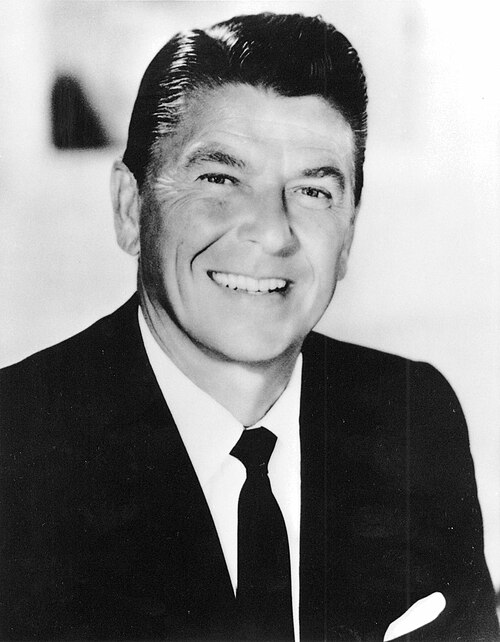
Ronald Reagan was a bit of a latecomer to electoral politics. Although he had been attentive to politics since his youth, by the 1960s Reagan had only recently fully come along to conservatism. I already covered the period in which he was a liberal, and his change was not a matter of an on/off switch, it was gradual. Indeed, he had made his debut on the national stage as a political figure at the 1964 Republican National Convention, where he delivered a powerful speech titled “A Time for Choosing”. This speech convinced wealthy California businessmen Holmes Tuttle and Henry Salvatori to press Reagan to run for governor in 1966, which he agreed to. This would be his first election victory, at the age of 55. By contrast, Lyndon B. Johnson had first won a Congressional election at 29, John F. Kennedy at 29, Richard Nixon had won at 33, and Gerald Ford at 35. Reagan’s victory and his time as governor was inspiring for conservatives nationwide. Something interesting to note about Reagan as well is that he had a hidden mentor during the 1960s. This was none other than a retired Dwight Eisenhower, who had watched Reagan’s speech on TV and saw tremendous potential in him (Kopelson). He would mentor him from 1965 to 1968, giving him pointers on public speaking and how to run for public office. As early as June 1967, merely six months into his first political office, he left the door open for a presidential run in 1968, stating, “If the Republican Party comes beating at my door I won’t say ‘Get lost, fellows’” (Moore, 58). Back in 1968, presidential nominations didn’t work the way they do today. It was entirely possible for someone to win no primaries and come out ahead at the national convention. Both the Democratic and Republican parties have since made sure that the result is not in doubt by the time of convention.
Although Reagan was not technically running early in the game, he still got votes in early Republican primaries as a “favorite son” of California and won that primary, Nixon, who was running a full campaign, dominated. Indeed, throughout much of 1968 he denied that he was a candidate (Moore, 61). Another figure who had entered the race late, although not as late as Reagan officially would (August 5th), was Governor Nelson Rockefeller of New York, the ultimate symbol of liberal Republicanism at the time. Interestingly, despite their ideological differences, Governor Reagan and Governor Rockefeller were friends and they had a shared concern about Nixon’s temperament being a hindrance to him serving as president and to the Republican Party (Shirley, 12-13). Thus, they agreed to coordinate a strategy to try to deny Nixon, possibly pulling off what the Blaine and Sherman factions did to prevent President Grant’s return in 1880. Rockefeller’s best chance was to pull delegates away from the Northeast while Reagan’s best chance was to pull delegates away from the South. Reagan campaigned against the Great Society, the 1968 gun control law, and the Johnson Administration’s failure to win the Vietnam War (Moore, 63). His campaigning pushed Nixon’s rhetoric to the right to secure the Republican nomination, and although he easily had the biggest lead on delegates, Reagan actually had the plurality of primary votes while coming third in delegate count.
As Reagan biographer Craig Shirley (2005) concluded about his first bid,”The California Governor’s 1968 attempt to win the Republican nomination was ill-conceived, ill-timed, and too little, too late” (13). Indeed, his entry came when prominent conservatives including Barry Goldwater had already endorsed Nixon. However, there is an alternative positive view of his run. Glen Moore (1992) of Columbus State University writes, “…there were more positive than negative results from Reagan’s first presidential campaign. He gained valuable experience that helped him strongly challenge President Gerald [R]. Ford for the GOP nomination in 1976” (65)
References
1968 Republican Party presidential primaries. Wikipedia.
Retrieved from
https://en.wikipedia.org/wiki/1968_Republican_Party_presidential_primaries
Kopelson, G. (2016, April 30). ‘The Speech’: When Reagan Electrified America, and Transformed It. National Review.
Retrieved from
Moore, G. (1992). Ronald W. Reagan’s Campaign for the Republican Party’s 1968 Presidential Nomination. Columbus State University.
Retrieved from
Shirley, C. (2005). Reagan’s revolution: the untold story of the campaign that started it all. Nashville, TN: Nelson Current.
 Mad Politics: The Bizarre, Fascinating, and Unknown of American Political History