Come November 2, 1948, Republicans were highly confident that they would have a new president in Thomas E. Dewey. Dewey was the governor of New York and a young, genial if a bit of a tame candidate. He had also earned great acclaim as the mob-busting district attorney of Manhattan. Dewey had been aggressive on the 1944 campaign trail, and his advisors believed he needed to play it safe this time. However, one person who did not think so was House Speaker Joe Martin’s (R-Mass.) mother, who according to Martin (1960) while Dewey was campaigning in North Attleboro, “admonished him with more wisdom than any of us realized at the time ‘Don’t take it so easy'” (19). President Harry S. Truman was not taking it easy…at all.
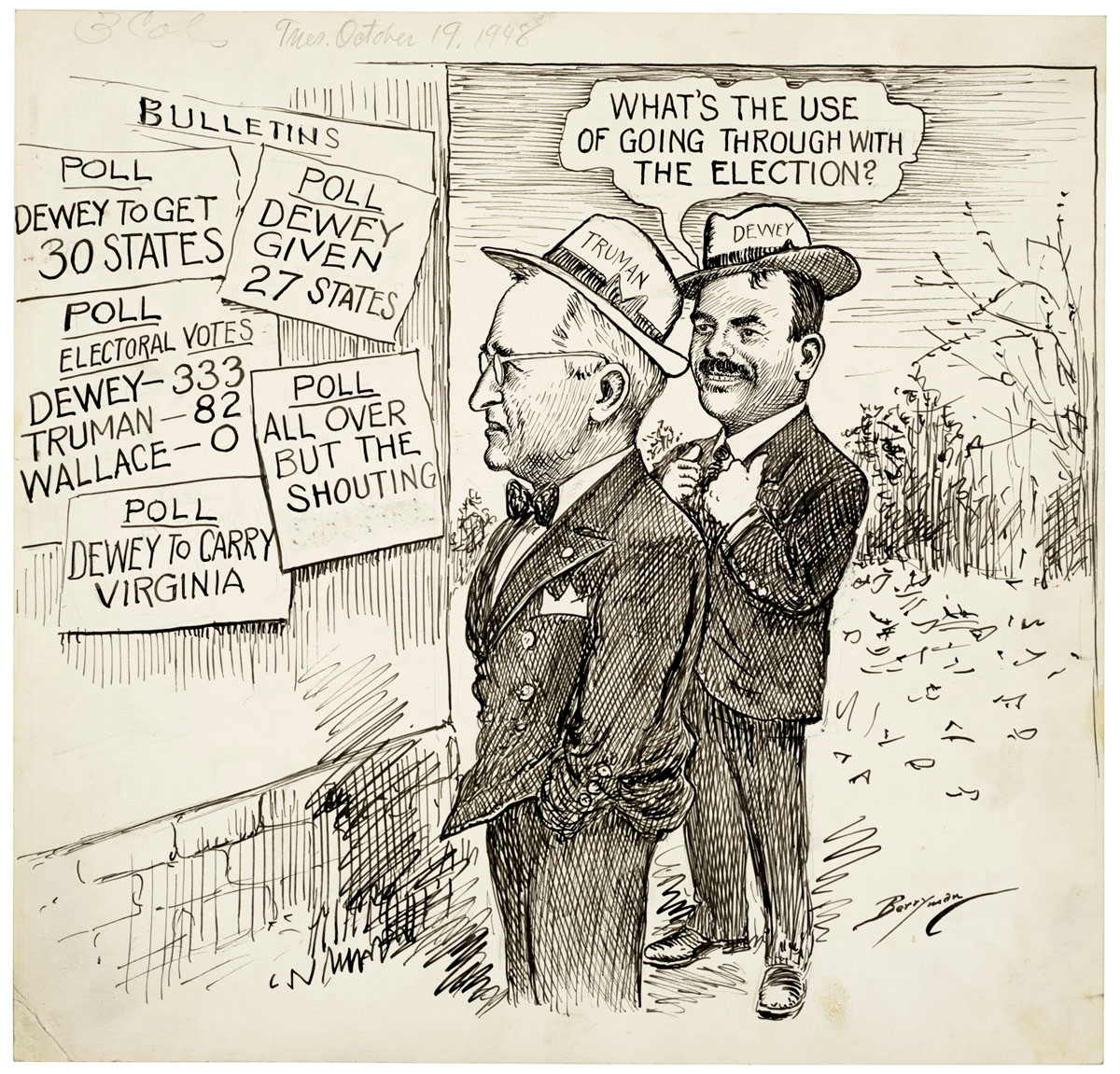
The common perception of Truman’s chances.
President Truman faced not one, not two, but three challengers in 1948. Generally, having more than one significant challenger as a president is bad news for the president’s party. This proved most notably true in 1892, 1912, 1968, and 1992. Along with Dewey, Truman faced two breakaways from within his own party. The first was former Vice President Henry A. Wallace, who was nominated to run for president for the newly constituted Progressive Party, not to be confused with Theodore Roosevelt’s Progressive Party or Wisconsin’s Progressive Party. Wallace ran on a staunchly left-wing platform and refused to criticize communists, and although this Progressive Party did not start as a communist venture, the party machinery became controlled by secret communists and went as far as to oppose the Berlin Airlift (Radosh). Wallace would later regret his run and realize the error of his positions on communism. On Truman’s right was the State’s Rights Party (or “Dixiecrat” party) and its nominee, South Carolina Governor Strom Thurmond. Before his run, Thurmond was seen as a bit of a racial moderate by Southern standards. However, with this campaign he became the national spokesman for Jim Crow. President Truman had ordered the desegregation of the army and embraced a civil rights platform, which seriously tested Southern support for him.
Truman worked hard to get reelected. He went around the nation blasting the “do nothing” Republican 80th Congress (they simply weren’t doing what he wanted on domestic issues and doing things he didn’t want). Dewey opted to stay above the fray and not defend the 80th Congress. Truman also campaigned heavily on the farm vote, placing blame on the Republican Congress for a grain storage shortage and highlighting Republican cuts to agricultural programs.
Although all newspaper polls predicted a Dewey win, including papers preemptively publishing that he won, as seen in the below picture, Truman managed to completely defy expectations. Instead of divisions harming him, they actually helped distinguish him from radicals and from segregationists, which helped him consolidate votes from moderate voters, farmers, and blacks. Truman swept much of the Midwest, the West, and although he lost four Southern states to Thurmond, it was not enough to hamper him. In New York, the Progressive Party’s presence did split the left and Dewey won the state, but that was the most damage they did to Truman.
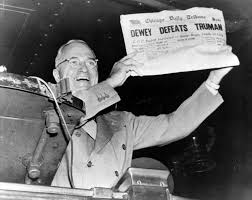
The results were apparent down ticket too, as Republicans not only lost the House, but their loss was a whopping 75 seats! In the Senate, Republicans lost 9 seats.
In California, Democrats gained three seats, but this was offset by two with Republican Hubert Scudder succeeding retiring Democrat Clarence F. Lea and Republican Thomas Werdel succeeding retiring Democrat Alfred Elliott. The sweetest loss for Truman was most certainly Fresno’s Bud Gearhart, who he had specifically campaigned against as a conservative obstructionist, “You have got a terrible Congressman here. He has done everything he possibly could do to cut the throats of the farmer and the laboring man” (Time Magazine).
In Colorado, two Democrats defeated Republican incumbents. Republican Robert Rockwell was defeated by Democrat Wayne Aspinall, who would serve in Congress until 1973, while Democrat John Marsalis’s defeat of J. Edgar Chenoweth would not stick and he would return in the 1950 election.
In Connecticut, two House Republicans lost reelection, but this was not too shabby; Republicans had been out all of their seats before and would get fully wiped out in the 1958 midterms. A notable Congressional freshman was future senator Abe Ribicoff.
In Delaware, Republican Senator C. Douglass Buck lost reelection to Democrat J. Allen Frear.
In Idaho, Democrat Compton White would return for one more term. He had served from 1933 until his 1946 defeat by Abe Goff. Republican Senator Henry Dworshak would lose reelection to Democrat Bert Miller, but he would return after Miller died the next year.
In Illinois, Republicans lost six seats, most prominently in Chicago. This was before Richard Daley made Democrats the undisputed dominant party of the city. Republican Senator Curly Brooks would lose reelection to Democrat Paul Howard Douglas in an upset.
In Indiana, Republicans lost five seats, which is a bit hard to imagine today.
In Iowa, Senator George Wilson was defeated for reelection by Democrat Guy Gillette, who had previously served in the Senate. An added shocker to Truman’s win in that staunchly Republican state.
In Kentucky, Republican W. Howes Meade lost reelection to Democrat Carl Perkins. Perkins would serve until his death in 1984 and became most noted for his work on education. Republican Senator John Sherman Cooper would also lose reelection, to Democrat Virgil Chapman.
In Massachusetts, Republican Charles Clason lost to Democrat Foster Furcolo, who would later serve as the state’s governor.
In Michigan, Republicans lost two House seats in Detroit. Yeah, it was a different time back then. A notable freshman was future President Gerald Ford of Grand Rapids.
In Minnesota, the Democrats proved that the merger of the Democratic Party and the Farmer-Labor Party was an excellent idea. They had gone from only representing the Iron Range to Hubert Humphrey defeating Republican incumbent Joseph Ball for the Senate by 20 points and gaining three House seats. Second only in sweetness to Humphrey’s victory in Minnesota for Truman was most certainly the defeat of House Ways and Means Committee Chairman Harold Knutson, who had been in office since 1917, was a bitter foe of internationalism, and was at loggerheads with the Truman Administration on tax reduction.
In Missouri, Truman was certainly jumping for joy at Democrats gaining eight House seats. Republican House incumbents were almost entirely wiped out, with only Springfield’s Dewey Short surviving the wave.
In Nebraska, Warren Buffett’s father, Howard, was defeated for reelection in Omaha. Buffett would return in the 1950 election for one more term.
In New Jersey, Democrats gained three seats, including that of retiring Republican Fred Hartley of Newark, who had sponsored the Taft-Hartley Act, which passed over President Truman’s veto. His successor, Peter Rodino, would serve until 1989 and chair the House Watergate Committee. That seat has not been represented by a Republican since.
In Nevada, Democrat Walter Baring won the seat.
In New York, Democrats gained nine seats, but one of those was from American Labor Party Congressman Leo Isacson. Five of the Republican losses were in New York City.
In Ohio, Republicans lost eight House seats, including that of At-Large Representative George Bender, who would be among the returning representatives in the 1950 election.
In Oklahoma, Democrats had a clean sweep of the state, with Republican George Schwabe of Tulsa losing to Dixie Gilmer (Schwabe would come back for one more term in the 1950 election) and they would gain the Enid-based seat as well as a Senate seat.
In Pennsylvania, Republicans lost eleven seats, including four in Philadelphia. Yes, Philadelphia used to be a strongly Republican city, but this election was the beginning of the end; Republicans would never hold all of Philadelphia’s seats again.
In Utah, Republican William A. Dawson lost reelection to Democrat Reva Beck Bosone. He would return in the 1952 election.
In Washington, Democrats gained one seat.
In West Virginia, Democrats gained all four of the House seats Republicans held and Democrat Matthew Neely made a return to the Senate by defeating Republican Chapman Revercomb for reelection.
In Wisconsin, Democrats gained two seats based in Milwaukee.
In Wyoming, Democrat Lester Hunt defeated Republican Senator Edward Robertson for reelection. It was a different time!
References
Face of the Victor. (1948, November 15). Time Magazine.
Retrieved from
Martin, J.W. & Donovan, R.J. (1960). My first fifty years in politics. New York, NY: McGraw-Hill.
Radosh, R. (2013, July/August). Oh, Henry. Commentary Magazine.
Retrieved from




 Mad Politics: The Bizarre, Fascinating, and Unknown of American Political History