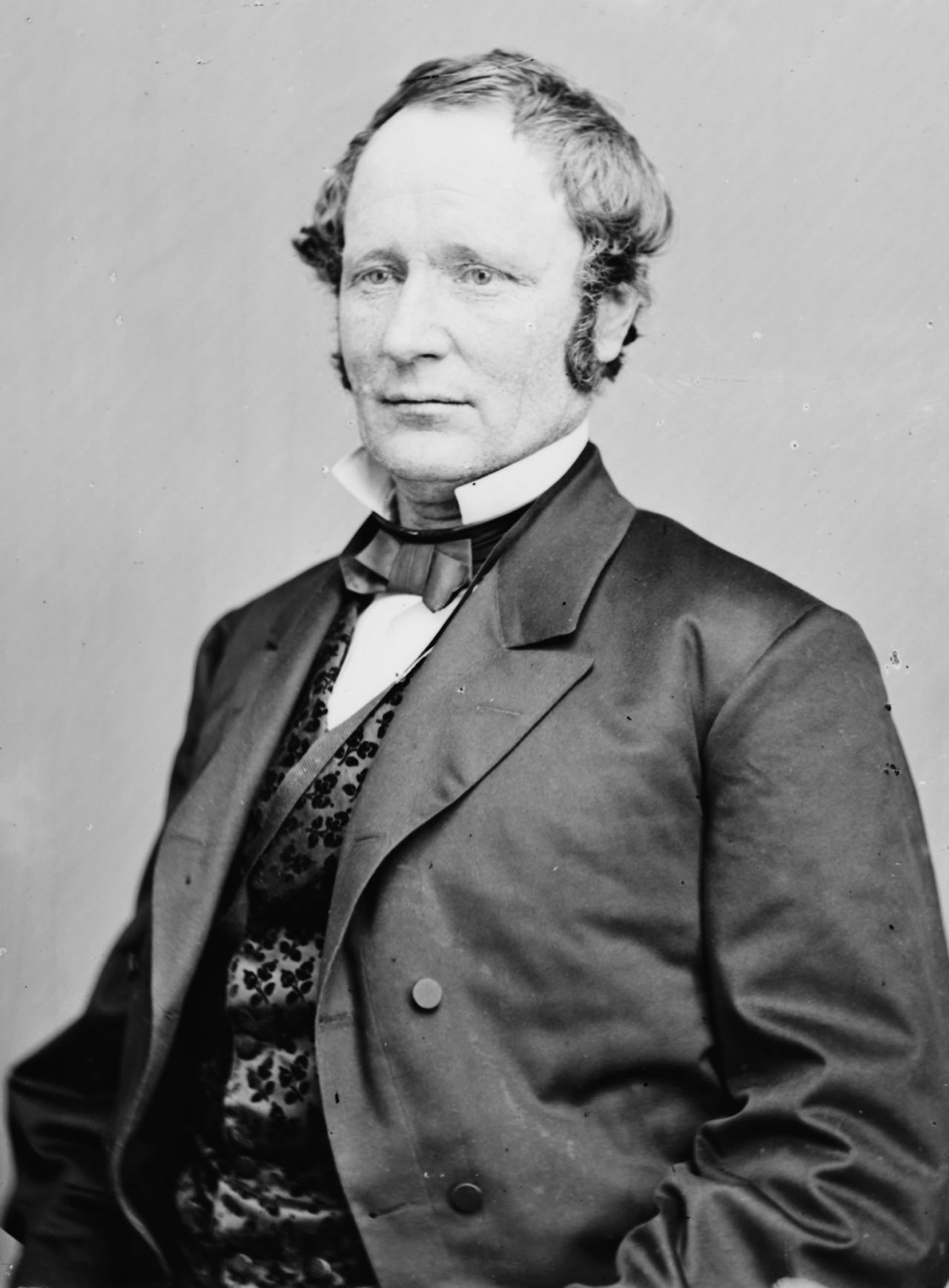
Thomas A. Hendricks, 1860s
Vice Presidents are an easily forgotten group, especially when they don’t last long. Indiana’s Thomas Andrews Hendricks (1819-1885) only lasted eight months as vice president, but this obscures his lengthy political career in a state that in his time was politically tumultuous.
Hendricks was born for politics, as he was raised in a family that staunchly adhered to Jacksonian principles and he was politically connected as his uncle, William Hendricks, had served as Indiana’s governor. However, his uncle was anti-Jacksonian as opposed to the views of his immediate family. Hendricks married Eliza Morgan in 1845 and they had one child, Morgan, but he tragically died at the age of three.
In 1848, he had his first political success when he was elected to the Indiana State House, but he wasn’t there long, as in 1850 he won election to the U.S. House in a district that was normally aligned with the Whigs. Hendricks aligned himself with the foremost young Midwestern politician of his day in Senator Stephen Douglas of Illinois. Like Douglas, Hendricks believed in popular sovereignty as the answer to the issue of slavery; the people of the states get to decide whether they are slave or free states. In 1854, consistent with this belief, he voted for the Kansas-Nebraska Act, which repealed the Compromise of 1820 and permitted residents of the Kansas and Nebraska territories to decide whether they were to be free or slave states. This resulted in pro and anti-slavery settlers moving into Kansas to influence the state’s vote, and the result were numerous incidents of violence and massacres from 1854 to 1859 that became known nationally as “Bleeding Kansas” and was a preview of the War of the Rebellion. Hendricks was also opposed to repealing the Fugitive Slave law unless slavery were abolished. Despite his political skills, the 1854 midterms were bad for the Democrats and he lost his seat.
Hendricks was subsequently picked by President Pierce to serve as the U.S. Commissioner of the General Land Office. However, like Senator Stephen Douglas, he had differences with President Buchanan. For one, Hendricks was an advocate of a homestead law to encourage settlement of the west, which Buchanan opposed. He also objected to Buchanan’s catering to the interests of slavery, and resigned in 1859.
In 1860, he ran for governor, but narrowly lost to Republican Henry Lane. However, an opportunity would arise for Hendricks given the actions of Senator Jesse Bright. Bright, the de facto leader of the Democratic Party in Indiana, was discovered to have engaged in correspondence with Confederate President Jefferson Davis. In February 1862, the Senate expelled him for treason and the following year, the Indiana legislature elected Hendricks to the Senate. He was a unionist or “War Democrat”, opposing the Copperhead faction of the Democrats and voting for funds for the war, serving as the leader of the small Democratic opposition. However, Hendricks opposed emancipation as a war aim as well as draft legislation. He would not differ from his party in opposition to Reconstruction, having not only opposed the 14th and 15th Amendments but also the 13th Amendment. Hendricks accepted that slavery was no more but believed that the Southern states should be represented as he was of the view that they had never actually left the union. He held that it would be “unpropitious” to change the Constitution at that time (Gray). Had Hendricks gotten his way, the 13th Amendment would have faced a harder vote and the 14th and 15th Amendments would have likely been sunk. Indeed, enacting the amendments before the Southern states were readmitted would be an argument some Southern politicians would use against the legitimacy of the 14th and 15th Amendments in the future. Hendricks also expressed his beliefs that blacks were morally and intellectually inferior and unfit for citizenship and on numerous occasions he said, “This is the white man’s Government, made by the white man, for the white man” (Gray). Although President Lincoln and Senator Hendricks had many disagreements, Lincoln praised him for always having been respectful to his administration. In 1868, Hendricks again tried for governor, but narrowly lost to incumbent Conrad Baker. That year he was also considered for the Democratic nomination for president but that went to Horatio Seymour, who had twice been New York’s governor. By 1869, Republicans had regained control of the Indiana legislature, and Hendricks was out. His DW-Nominate score was a -0.436. Hendricks would subsequently focus his politics on supporting inflationary currency and federal aid to rural areas.
Thomas A. Hendricks was not only for easy money, but was also an easy candidate, regularly being available. Indeed, some Democrats thought him too available for the presidency. This, plus a reasonable belief that him at the top of the ticket with his soft currency stance would lose the Democrats New York, he was twice relegated to vice president. However, electors in Kentucky, Maryland, Tennessee, and Texas did cast their votes for him in 1872 after the Liberal Republican/Democratic candidate, Horace Greeley, died only weeks after the election. So technically, he did win four states and six electoral votes from Kentucky despite not officially being a candidate.

Hendricks in 1875.
In 1876, Hendricks got the nomination for vice president. The ticket of Tilden/Hendricks didn’t just win the popular vote, it also won the majority of the vote. Yet, Tilden/Hendricks lost to the Republican Hayes/Wheeler ticket by one electoral vote. The election was the most controversial in the nation’s history (yes, even more than the 2000 election) and there were widespread allegations of voter fraud, intimidation, and violence from both parties. This was the only election that was decided by a special created commission, the Electoral Commission, which produced the controversial result. Tilden and Hendricks opted not to contest this result in the name of keeping the nation from entering yet another War of the Rebellion. Nonetheless, Democrats were bitter after this election and were calling President Hayes “Rutherfraud B. Hayes” and “his fraudulency”. Hendricks declined to participate in the 1880 election on health grounds, but when 1884 rolled around, he was again available for the vice president nomination. Although some Democrats wanted to run Samuel J. Tilden again to redeem the 1876 election, he was 70 and in poor health, so he declined. Hendricks as vice president, however, was a replay of 1876 and Democrats were for that. What’s more, Hendricks provided a good balance as he was far more amenable to political machines than reformer Grover Cleveland and he was for using the government to help agriculture and inflationary currency as opposed to Cleveland, who did not want to intervene with agriculture and was a gold standard guy. Furthermore, both Cleveland and Hendricks were from states that were must-wins for Democrats, and indeed in 1884 they won both New York and Indiana as well as the election.
Vice President Hendricks
While vice president, Hendricks had a friendly relationship with Cleveland and said of him that he was “courteous and affable”, traits that Hendricks himself possessed. However, he issued strong objections to him initially refusing to dole out patronage out of his sense of good government. Eventually political reality forced Cleveland to engage in patronage to reward his party’s supporters. On September 8, 1885, Hendricks delivered a controversial speech in which he called for Ireland’s independence, which although was to the consternation of the British, a lot of Irish Americans appreciated the speech. On November 24, 1885, Hendricks reported feeling ill and he went to bed early. He never woke up as his heart had given out. Hendricks’ death was a shock to the public as he had appeared to be fine. The truth, however, was that his health had been declining over the past five years. Hendricks had suffered a stroke in 1880 which resulted in his right foot becoming lame, thus making it hard for him to stand. The truth of his health had been known only to his family and doctors. His funeral in Indianapolis was attended by hundreds of people, including President Cleveland. Hendricks’ death inspired a change to the law on succession for the presidency, as the next in line was the Senate president pro tempore, who at the time was a Republican as Republicans had a majority, and both Democrats and Republicans of the time recognized that it would not be suitable for whoever succeeded a dead president to be a member of a party that the public hadn’t voted for and removed Congressional leaders from succession, thus the Secretary of State became third in line for the presidency. This arrangement would hold until 1947, when Congressional leaders were put back on the succession order.
References
Caffrey, C. (2023). Thomas Andrews Hendricks. EBSCO.
Retrieved from
https://www.ebsco.com/research-starters/biography/thomas-andrews-hendricks
Gray, R.D. (2017, August 21). Thomas A. Hendricks: “The Constitution as it is, the Union as it was”. Untold Indiana.
Retrieved from
https://blog.history.in.gov/tag/racist/
Hendricks, Thomas Andrews. Voteview.
Retrieved from
https://voteview.com/person/4319/thomas-andrews-hendricks
Thomas A. Hendricks. UVA Miller Center.
Retrieved from
https://millercenter.org/president/cleveland/essays/hendricks-1885-vicepresident
 Mad Politics: The Bizarre, Fascinating, and Unknown of American Political History