States Do Not Stay the Same, By Parties or Ideology!

It can be highly tempting for people to say that one state has “always been conservative” or “always been liberal” to explain away party switches. But the reality is that populations shift, political priorities shift, and one party’s policies can go so strongly against a certain state’s interests that their voters move to the other party, even if in the past they had supported much of what their old party stood for. This has been demonstrably true of some states even in modern day. I will present today five examples of states, not in the former Confederacy or New England, which have had considerable evolution in their status.

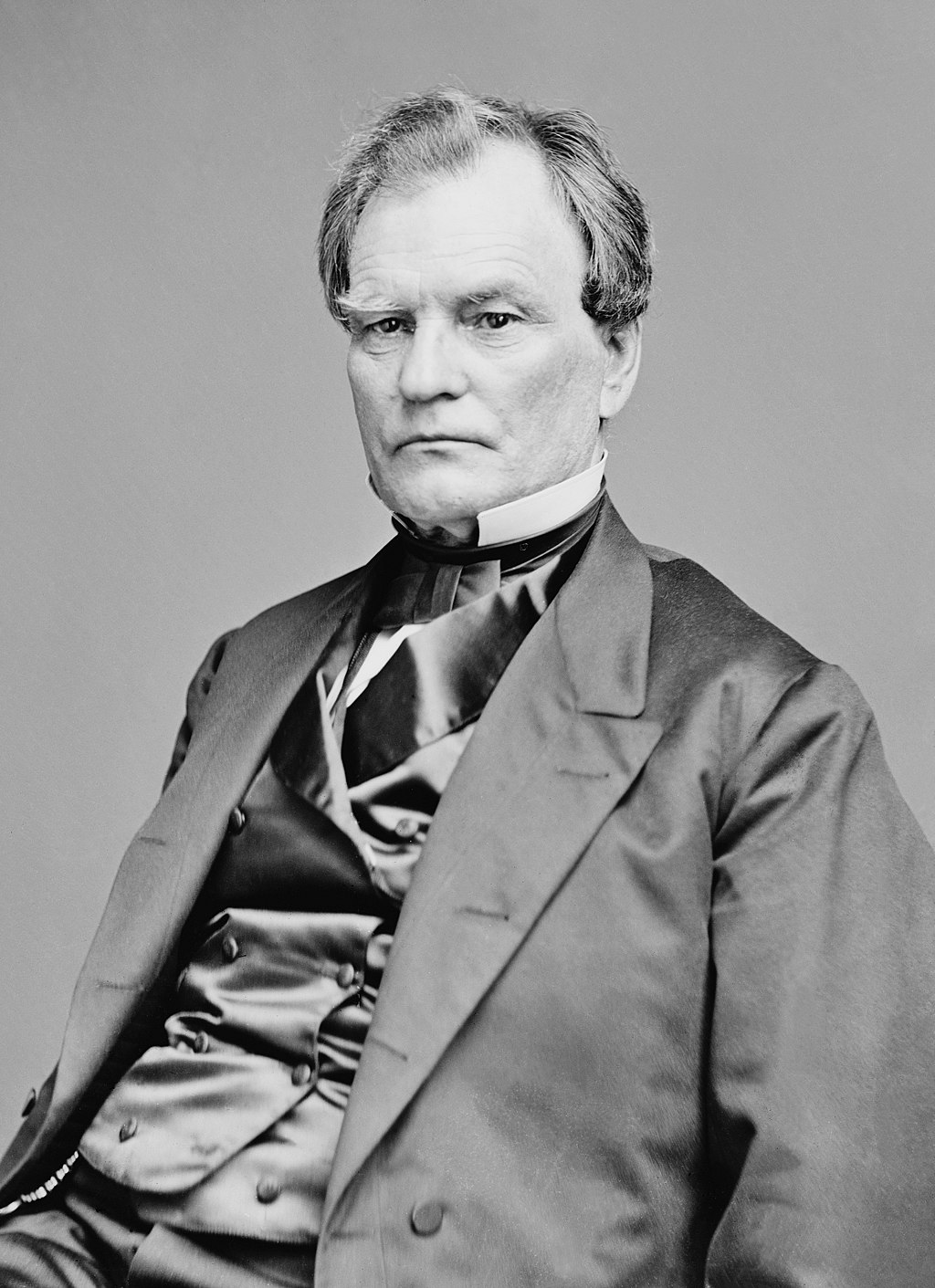
Henry Clay of Kentucky, whose state and him went from being supporters of Thomas Jefferson’s Democratic-Republicans to being staunchly with the Whig Party.

Delaware

Our last president was the first from America’s first state of Delaware. Since 1992, the state has voted Democratic and since 1996 it has done so by double digits save for 2004. Delaware also now has the distinction of having elected the first member of Congress to identify as trans. The state’s Democratic dominance would have been absolutely unthinkable during the time of the foundation of the Democratic Party itself.

Delaware had been one of the most loyal states to the old Federalist Party, only voting for the Democratic-Republicans in the 1820 election in which James Monroe had no substantive opposition. Delaware was also a reliable state for the Whig Party until 1852, when all but four states voted for Democrat Franklin Pierce. Normally, Delaware voters would be supportive of the economic philosophy that guided both the Federalists and the Whigs; an adherence to Alexander Hamilton’s American System. This being imposing tariffs both for protection of domestic industry and to fund internal improvements for the purpose of expanding national growth. The Whig’s successor party, the Republican Party, would embrace the same. However, Delaware was a tough state for Republicans because it was a slave state. Although slavery was not practiced by most families in the state by the start of the War of the Rebellion, many voters still defended the “peculiar institution” and the political of the power of the state lay with its defenders. During the war, its voters elected Unionist politicians to the House, but its senators were Democratic and defenders of slavery in Willard Saulsbury, James A. Bayard, and George Riddle. From 1865 to 1895 all of its governors were Democrats, and until the 1889 election all its senators Democrats. What changed in Delaware was that more blacks were becoming middle class, thus making the issue of race less salient. What’s more, a certain prominent family moved their operations to Delaware and bankrolled the state’s Republican Party in the du Ponts. Although in 1888, Delaware had voted for Democrat Grover Cleveland by nearly 12 points, an ominous signal of times ahead for the Democrats came in the next election, in which Cleveland won, but by only 1.5 points. This was an election in which incumbent Benjamin Harrison was unpopular and Cleveland scored unexpected wins in states that had consistent records of Republican voting in Illinois and Wisconsin, the former having voted Republican since 1860 and the latter having done so since its first presidential election in 1856. Delaware’s politicians, be they Democratic or Republican, had records of opposition to inflationary currency, and the economic depression as well as the Democrats shifting towards the left by picking William Jennings Bryan, a proponent of currency inflation through “free coinage of silver” (no limits on silver content in coinage), left Delaware cold. McKinley won the state by 10 points in 1896.

The 1896 election kicked off a period of Republican dominance. Until 1936, save for the 1912 three-way election, Delaware voted for the Republican candidate. Henry du Pont and his cousin Thomas were elected to the Senate during this period, and during FDR’s first term, its senators, Daniel Hastings and John Townsend, were the most consistent opponents of the New Deal in the Senate and voted against Social Security. However, FDR’s appeal even penetrated Delaware; Hastings would lose reelection in 1936 and Townsend in 1940. However, in 1948, Delaware would return to the Republican fold in voting for Thomas Dewey. The state would vary in its voting behavior through 1988, and it would go for the Democrat in the close 1960 and 1976 elections. Since 1993, Delaware has had only Democratic governors, and it has not elected a Republican to the Senate since 1994 nor to the House since 2008. A big part of the state’s shift towards the Democrats was that from 1990 to 2018, the black population of Delaware increased by 47% (Davis). Since 1964, black voter support for Republican presidential candidates has not surpassed 15%. Delaware does not look like it will turn away from the Democrats any time soon.

Iowa

Admitted to the Union in 1846, Iowa started existence as a Democratic state. In 1848, its voters preferred Michigander Lewis Cass to Whig Zachary Taylor. However, a significant minority of Iowa’s Democrats were staunchly anti-slavery and after the Kansas-Nebraska Act of 1854, these people bolted to the newly formed Republican Party. The GOP’s most prominent politician in the latter part of the 19th century and for a few years in the early 20th was Senator William B. Allison, who would be part of the Senate’s leadership during the McKinley and Roosevelt presidencies. Until 1912, Iowa would without fail vote for Republican presidential candidates and would not do so again until 1932. From 1859 until 1926, all of its senators were Republicans, and the 1926 case was because Republicans had split over their nominee, Smith W. Brookhart, who was on the party’s liberal wing. Iowa Democrats made significant headway during the 1930s, with the state even having two Democratic senators from 1937 to 1943. However, the state was moving against Roosevelt and its voters were strongly against American involvement in World War II, preferring the Republican candidate in 1940 and 1944. There was a bit of a surprise when Truman won the state in 1948, something that can be credited to his effective appeals to Midwestern farmers and painting the Republican 80th Congress as bad for their interests.

Iowa nonetheless continued its Republican voting behavior in Republican presidential elections, even though the state’s party saw significant gains in the 1970s, including both Senate seats. In 1988, Iowa delivered a bit of a surprise in its vote for Democrat Michael Dukakis. Indeed, from 1988 until Trump’s victory in the state in 2016, Iowa would be Democratic on a presidential level with the only exception being Bush’s squeaker of a win in 2004. Since 2016, however, support for Republicans has only been increasing. In 2024, Trump won the state by 13 points despite that Seltzer poll. This was the best performance a Republican candidate has had in Iowa since 1972, when Nixon won with 57%.

Kentucky

Kentucky has an even more varied history as a state than Delaware. After it was first admitted, it did, as did all the other states, vote to reelect George Washington in 1792. However, when it came to choosing between Adams and Jefferson, they chose Jefferson and kept doing so up until the foundation of the Whig Party. The Whig Party had as its central founder Kentucky’s Henry Clay, who at one time had been part of Jefferson’s Democratic-Republicans but had opposed the rise of General Andrew Jackson.

Kentucky’s issue with sticking with the successor party was the same as Delaware’s: it was a slave state. It remained in the union but its voters were staunch foes of the GOP. Kentucky did not vote Republican until 1896, and did so narrowly, a product of the economic depression and Democrat William Jennings Bryan’s inflationary currency stance. Although this looked like an opening and indeed Republicans had a few successes in electing governors, the state maintained its Democratic character up until 1956, its voters having only seen fit to vote Republican in 1924 and 1928. The 1956 election was quite successful for Dwight Eisenhower and Republicans, including in Kentucky. Not only did the state vote for him, they also voted in two Republicans to the Senate in John Sherman Cooper and Thruston B. Morton. However, their brand of Republicanism was much more moderate than what we see from Kentucky’s GOP today. Republicans followed up their 1956 win with Nixon’s 1960 win of the state. From 1956 onward, Kentucky did not vote for a Democratic candidate for president unless he was from the South. The last time the state voted for the Democrat was Bill Clinton in 1996. Nonetheless, the state party remained strong, and from 1975 to 1985 both of its senators were Democrats. However, this was broken with the election of Mitch McConnell in 1984, and Democrat Wendell Ford retired in 1999. To this day, Ford is the last Democratic senator from the state. This Republican bent is not going away any time soon either; Trump scored the highest margin of victory that any Republican has in 2024, even surpassing Nixon’s 1972 performance. However, Kentucky does still elect Democratic governors, but this puts it in a similar position to Vermont, which is highly Democratic but has happily elected Republican Governor Phil Scott.

New York

New York presents an interesting case as although recently it has voted solidly for the Democrats since 1988, it was at one time a big swing state. Indeed, New York’s vote was predictive of the winner of presidential elections until 1856, when their voters backed Republican John C. Fremont. However, this did not put them firmly in the Republican column. Indeed, Democrats had a strong presence in the state through the political organization of Tammany Hall in New York City. Republicans had a powerful machine as well in the late 1860s to early 1880s under Senator Roscoe Conkling. The electoral vote rich state became a prime target for the parties, and it resulted in Democrats picking people who were for hard currency for their presidential candidates even though their base nationwide was favorable to soft, or inflationary currency. When Democrats picked a New Yorker, they usually won the state. In 1868, they elected former New York Governor Horatio Seymour, and although the Republicans won the election, the Democrats won New York. In 1876, the same was true with their pick of Samuel J. Tilden. However, with the downfall of the Bourbon Democrats and the economic depression of the 1890s, New York voted for Republican William McKinley, beginning an era of Republicans being dominant in the state. These weren’t liberal guys either; at the start of the Harding Administration its senators were William Calder and James W. Wadsworth Jr., both staunchly conservative, with Wadsworth voting against the entirety of the New Deal in FDR’s first and second terms as a representative. However, the status of Republicans was starting to weaken with the gubernatorial elections of Al Smith and Franklin D. Roosevelt and in 1928 even though Republicans fared quite well in that election, Hoover only won the state by two points. New York would vote for Roosevelt all four times and although it would vote for Republican Thomas Dewey in 1948, this was a plurality caused by Henry Wallace’s Progressive Party getting 8.25% of the vote. New York voted for Eisenhower twice, but I would say that its Democratic era began with the election of 1960. I say this because Republicans have only won three presidential elections since then; the 49-state landslides of Nixon in 1972 and Reagan in 1984 as well as Reagan in 1980. It is true that Republicans were still able to elect some governors and managed to hold on to one of the Senate seats for 42 years, but this was because Republicans ran candidates that were far from doctrinaire conservatives. Jacob Javits, who served from 1957 to 1981, was a textbook example of a RINO, and his successor, Al D’Amato, would probably be a bit too moderate for the modern GOP’s tastes. Perhaps Republicans have some reason for optimism in the Empire State; Trump’s performance in 2024 was the best Republicans have had since 1988.

Oregon

You might have trouble believing this, but until Michael Dukakis’ win in 1988, Oregon had voted Republican for president 81% of the time. This included the close 1960 and 1976 elections and before Wilson’s 1912 win, they had only voted Democratic in the 1868 election. The state remained fairly robust for the GOP, even when faced with FDR. Although Roosevelt won the state four times, its senators were Republican for almost the entire time. Oregon’s Charles McNary was the leader of the Senate Republicans! Oregon also had Republican governors for all but six years from 1939 to 1987. However, Oregon Republicans understood that they had to make exceptions here and there on conservatism and McNary was a very moderate conservative. The Eisenhower Administration would challenge Republican rule in Oregon based on its belief in the private sector, rather than the public sector.

In 1954, the bottom began to fall out for the state GOP, and this was due to the Eisenhower Administration’s favoring private development over public development of power. It was in that year that Republicans lost the Congressional seat based in Portland and their senator lost reelection. This would be followed by two more Congressional Republicans losing reelection in 1956. The defeated senator, Guy Cordon, stands as the last conservative to represent Oregon in the Senate. Although for 27 years Oregon had two Republican senators, neither Mark Hatfield nor Bob Packwood could be considered conservatives. Gordon Smith, who represented Oregon from 1997 to 2009, was a moderate.

Although Oregon has had a strong Democratic streak since 1988, it is also true that Al Gore won by less than half a point in 2000, and Kerry won by less than five points in 2004. However, Oregon’s Democratic politics have strengthened since then, and since 2008 the Democratic candidate has won by double digits. Oregon does not look like it will be moving to the Republican column at any time in the foreseeable future.

References

Davis, T.J. (2018, December 30). Young people are changing black politics in Delaware. Delaware Online.

Retrieved from

https://www.delawareonline.com/story/opinion/contributors/2018/12/30/young-people-changing-black-politics-delaware/2123781002/


Henry Carey: Lincoln’s Economist

For a long time there has been a debate about what side of an issue the late Abraham Lincoln would be on; in the 1930s numerous New Deal politicians expressed their belief that Lincoln would be on their side with some Republicans asserting that Lincoln would have done things differently than FDR. While we can never be totally what Lincoln’s social views would be in different times given that his changed over the course of his life, including on civil rights, there is a bit more certainty on economic issues, and on this question, there are two Henrys who can help us answer this question, both who greatly influenced Lincoln. The first is Henry Clay, the much-admired founder and three-time candidate of the Whig Party for president. The second is a considerably less known figure but one who shines light on Lincoln’s economic views in Henry Carey (1793-1879), a major advocate of the “American School” of economics who is largely forgotten today but was quite prominent in his day.

The American School of Economics

Carey did not start off as an economist, rather as a businessman in the publishing industry, but the Panic of 1837 inspired him, at the age of 44, to study economics. He was something of a gadfly in the world of economics in his day, as British economists were overwhelmingly on the side of pure lassiez-faire, and this is where Carey was initially. However, he was persuaded by economic crises in the 1830s and 1840s that this approach fell short. Carey would start arguing in 1848 that free trade served to benefit the British empire (indeed its most prominent advocates were from Britain) and that the United States should at that stage as a nation be developing its home markets and achieving economic independence (Cowan). Thus, he would argue for tariffs to help develop the nation and build up American industry so they could compete fairly with Great Britain, a more powerful nation than the US in his time. Carey would also argue that tariffs were a mutually beneficial policy as they helped both the profits of industry and the wages of labor (Cowan). He was also a critic of economists David Ricardo and Thomas Malthus, and wrote against their views in this three volume Principles of Social Science (1858-1860). On Malthus, he wrote that he “teaches that a monopoly of the land is in accordance with a law of nature. Admiring morality, he promotes profligacy by encouraging celibacy. … Desirous to uplift the people, he tells the landowner and the laborer that the loss of the one is the gain of the other. His book is the true manual of the demagogue, seeking power by means of agrarianism, war and plunder” (Levermore, 562-66). In the late 1850s, Carey blamed tariff reductions passed and signed into law by President Franklin Pierce for the Panic of 1857, and some historians have shared his judgment. Carey was also an opponent of unions as an instrument of collective bargaining, regarding the tariff as the proper mechanism for wage growth. However, Carey was supporting tariffs for the US based on its present conditions. He hoped for a future in which the nations of the world could trade without tariffs, writing, “Of the advantage of perfect free trade there can be no doubt. What is good between the states ought to be good the world over. But free trade can be successfully administered only after an apprenticeship of protection. Strictly speaking, taxation should all be direct. Tariff for revenue should not exist. Interference with trade is excusable only on ground of self-protection. A disturbing force of prodigious power pre- vents the loom and spindle from taking and keeping their proper places by the plow and harrow. When the protective regime has counteracted the elements of foreign opposition, obstacles to free trade will disappear and the tariff will pass out of existence. Wars will cease; for no chief magistrate will dare to recommend an increase of direct taxation” (Levermore, 570).

Carey was the lead editor on articles regarding political economy for Horace Greeley’s New-York Tribune from 1849 to 1857. At that time, another economist contributed from abroad who wrote under a pen name, this other economist being none other than Karl Marx. Marx considered Carey, a staunch opponent of socialism, to be the only notable American economist and also his ideological rival, considering himself to be engaging in “hidden warfare” against him through his work for the Tribune (Marx & Engels, 78-79). Indeed, Marx even thought that Carey’s philosophy was the central impediment to a communist revolution in the United States.

Carey was a supporter of Abraham Lincoln and upon his election to the presidency, he served as an economic advisor to both him and Secretary of the Treasury Salmon P. Chase. He helped draft Republican tariff bills, including the Morrill Tariff of 1861 and was influential in getting the National Bank Act of 1863 adopted. Carey was a consistent supporter of greenbacks, supporting both the Legal Tender Act of 1862 (which along with distribution of greenbacks unbacked by gold or silver and achieved the Whig goal of a unified national currency) and postwar currency inflation. The former got the support of the Republican establishment as an emergency measure for the war, but the latter was opposed as the Republican establishment was fundamentally conservative on issues of economics and finance. Whether Lincoln would have heeded Carey had he lived I think is an open question. On one hand, he was influenced by Carey in numerous facets of policy, but on the other hand, shortly before his death he had tapped Hugh McCulloch as Secretary of the Treasury, who pursued a policy of contraction of greenbacks. Would Lincoln have sought to rein in his own Secretary of the Treasury or heeded his advice?

Influence Today?

Although Henry Carey is a figure who is generally seen as a modern conservative’s go-to economist, Professor Adam Rowe, writing for Compact Magazine, argues that Henry Carey is an explaining figure for Trump’s tariffs. If Carey has any influence, this is a full circle back to the earliest days of the Republican Party.

References

Cowan, D.A. (2022, September 8). Henry C. Carey’s Practical Economics. The American Conservative.

Retrieved from

Henry Charles Carey. New World Encyclopedia.

Retrieved from

https://www.newworldencyclopedia.org/entry/Henry_Charles_Carey#google_vignette

Levermore, C.H. (1890). Henry C. Carey and his Social System. Political Science Quarterly, 5(4), 553-582.

Marx, K. & Engels, F. (1975). “Notes”. In Ryazanskyaya, S.W. (ed.). Selected Correspondence. Translated by Lasker, I. (3rd edt.). Moscow, USSR: Progress Publishers.

Retrieved from

Rowe, A. (2025, March 4). The Thinker Who Explains Trump’s Tariffs. Compact Magazine.

Retrieved from

https://www.compactmag.com/article/the-thinker-who-explains-trumps-tariffs/

What Did the Old Democratic Party Stand For?

It rather goes without saying that the two parties today are strongly ideologically polarized. The most conservative Democrat is more liberal than the most liberal Republican in Congress, and President Trump has zero thoughts of trying to get even a few Democratic politicians on his side. Indeed, all Senate Democrats and all but two House Democrats backed impeaching him in 2020, one who then switched to the GOP. However, the party systems have changed over the years, and in particular changed significantly after the election of President Roosevelt in 1932. He pursued what has been commonly called the pursuing of Jeffersonian ends by Hamiltonian means, an idea spelled out by progressive Herbert Croly in 1909. The Democratic Party as established stood for the policies and principles of Andrew Jackson that were inspired by the policies and principles of Thomas Jefferson. I will also be including the Whig platform here for contrast, but the Democrats are the central focus.

The following language was in all Democratic Party platforms from 1840 to 1856:

“1. Resolved, That the federal government is one of limited powers, derived solely from the constitution, and the grants of power shown therein, ought to be strictly construed by all the departments and agents of the government, and that it is inexpedient and dangerous to exercise doubtful constitutional powers.

2. Resolved, That the constitution does not confer upon the general government the power to commence and carry on, a general system of internal improvements.

3. Resolved, That the constitution does not confer authority upon the federal government, directly or indirectly, to assume the debts of the several states, contracted for local internal improvements, or other state purposes; nor would such assumption be just or expedient.

4. Resolved, That justice and sound policy forbid the federal government to foster one branch of industry to the detriment of another, or to cherish the interests of one portion to the injury of another portion of our common country—that every citizen and every section of the country, has a right to demand and insist upon an equality of rights and privileges, and to complete and ample protection of person and property from domestic violence, or foreign aggression.

5. Resolved, That it is the duty of every branch of the government, to enforce and practice the most rigid economy, in conducting our public affairs, and that no more revenue ought to be raised, than is required to defray the necessary expenses of the government.

6. Resolved, That congress has no power to charter a national bank; that we believe such an institution one of deadly hostility to the best interests of the country, dangerous to our republican institutions and the liberties of the people, and calculated to place the business of the country within the control of a concentrated money power, and above the laws and the will of the people.

7. Resolved, That congress has no power, under the constitution, to interfere with or control the domestic institutions of the several states, and that such states are the sole and proper judges of everything appertaining to their own affairs, not prohibited by the constitution; that all efforts by abolitionists or others, made to induce congress to interfere with questions of slavery, or to take incipient steps in relation thereto, are calculated to lead to the most alarming and dangerous consequences, and that all such efforts have an inevitable tendency to diminish the happiness of the people, and endanger the stability and permanency of the union, and ought not to be countenanced by any friend to our political institutions.

8. Resolved, That the separation of the moneys of the government from banking institutions, is indispensable for the safety of the funds of the government, and the rights of the people.

9. Resolved, That the liberal principles embodied by Jefferson in the Declaration of Independence, and sanctioned in the constitution, which makes ours the land of liberty, and the asylum of the oppressed of every nation, have ever been cardinal principles in the democratic faith; and every attempt to abridge the present privilege of becoming citizens, and the owners of soil among us, ought to be resisted with the same spirit which swept the alien and sedition laws from our statute-book.”

These principles were strongly consistent, as opposed to the Whig Party, which although they had principles (protective tariffs, funding internal improvements), they weren’t spelled out fully until their 1852 platform, and indeed specifics are not spelled out at all in their 1848 platform! The Whigs also sought to completely avoid the issue of slavery, a position which the events of the 1850s proved was untenable. The Democratic Party strikes me as the more programmatic party of the two, and indeed they were the dominant party from its creation until the 1860 election. They stood for concrete principles they placed in every platform, while the Whigs were the collection of opposition to the Democrats, and once its great standard-bearer and founder, Senator Henry Clay of Kentucky, died in 1852, they didn’t last much longer. The language of the Democratic Party indicates a strong belief in the role of states rather than the federal government, although the issues they care about from that perspective are ones that are seen as benefiting the privileged and powerful. The states, thus, were supposed to serve as a check against them per Democratic philosophy. Tariffs assisted the industrial private sector and often did so at the expense of the rural South, which would face retaliatory tariffs on their exported cotton and tobacco. Thus, the language in opposition to sectional legislation and policies benefiting one industry while harming another. The funding of internal improvements (bridges, roads, canals) were for the purpose of advancing commerce, something that Democrats of the time thought should be confined to states. President Andrew Jackson’ veto of the continuing of the Second Bank of the United States was seen as a heroic act by Democrats as a blow against the economically privileged, hence the language of a “concentrated money power”. The language on slavery was for the purpose not only of continued Southern support but also for preservation of the union. Now for the Whigs…

The 1844 Whig Platform

The first Whig platform was mostly non-specific on policy although they did spell out that they supported a protective tariff and spreading out the proceeds of sales of public lands to the states. Democrats did mention and oppose the latter in their 1844 platform.

The 1852 Whig Platform

I skipped to the 1852 platform because I already mentioned the barren 1848 platform. The 1852 platform actually comprehensively spells out what the Whigs believed, and sadly, when they issued the strongest statement of their beliefs they got creamed, only winning the states of Kentucky, Massachusetts, Tennessee, and Vermont. They did embrace the Compromise of 1850, Henry Clay’s last, as it was the hope that this would prevent disunion. The platform they did the best on was the 1848 platform, and this was because of the popularity of General Zachary Taylor, a hero of the Mexican-American War, a war the Whigs had opposed. This, in addition to President Pierce’s signing of the Kansas-Nebraska Act in 1854, was the death of the Whig Party, as opponents of slavery in both the Whig and Democratic parties became galvanized to form a new party…the Republican Party. And did this realignment ever bring together former opponents: Confederate President Jefferson Davis and Vice President Hannibal Hamlin were both Democrats before 1856, and President Abraham Lincoln and Confederate Vice President Alexander Stephens were both Whigs before 1850. These are the principles espoused by the Whigs:

“First: The Government of the United States is of a limited character, and it is confined to the exercise of powers expressly granted by the Constitution, and such as may be necessary and proper for carrying the granted powers into full execution, and that all powers not thus granted or necessarily implied are expressly reserved to the States respectively and to the people.

Second: The State Governments should be held secure in their reserved rights, and the General Government sustained on its constitutional powers, and that the Union should be revered and watched over as the palladium of our liberties.

Third: That while struggling freedom everywhere enlists the warmest sympathy of the Whig party, we still adhere to the doctrines of the Father of his Country, as announced in his Farewell Address, of keeping ourselves free from all entangling alliances with foreign countries, and of never quitting our own to stand upon foreign ground, that our mission as a republic is not to propagate our opinions, or impose on other countries our form of government by artifice or force; but to teach, by example, and show by our success, moderation and justice, the blessings of self-government, and the advantages of free institutions.

Fourth: That where the people make and control the Government, they should obey its constitution, laws and treaties, as they would retain their self-respect, and the respect which they claim and will enforce from foreign powers.

Fifth: Government should be conducted upon principles of the strictest economy, and revenue sufficient for the expenses of an economical administration of the Government in time of peace ought to be derived from a duty on imports, and not from direct taxes;  and in laying such duties, sound policy requires a just discrimination and protection from fraud by specific duties when practicable, whereby suitable encouragement may be afforded to American industry, equally to all classes, and to all parts of the country.

Sixth: The Constitution vests in Congress the power to open and repair harbors, and remove obstructions from navigable rivers, and it is expedient that Congress shall exercise that power whenever such improvements are for the protection and facility of commerce with foreign nations, or among the States–such improvements being, in every instance, National and general in their character.

Seventh: The Federal and State Governments are parts of one system, alike necessary for the common prosperity, peace and security, and ought to be regarded alike with a cordial, habitual and immovable attachment. Respect for the authority of each and acquiescence in the just constitutional measures of each, are duties required by the plainest considerations of National, State, and individual welfare.

Eighth: That the series of acts of the Thirty-first Congress, commonly known as the Compromise or Adjustment (the act for the recovery of fugitive slaves from labor included,) are received and acquiesced in by the Whigs of the United States as a final settlement, in principle and in substance, of the subjects to which they relate; and, so far as these acts are concerned, we will maintain them, and insist upon their strict enforcement, until time and experience shall demonstrate the necessity of further legislation to guard against the evasion of the law, on one hand, and the abuse of their powers on the other–not impairing their present efficiency to carry out the requirements of the Constitution; and we deprecate all further agitation of the questions thus settled, as dangerous to our peace; and will discountenance all efforts to continue or renew such agitation, whenever, wherever, or however made; and we will maintain this settlement as essential to the nationality of the Whig party and of the Union.” (American Presidency Project).

Although the Whigs died off, many of their policies would be pushed by the Republican Party, which embraced the protective tariff and passed the National Bank Act in 1863, establishing a series of national banks with a unified currency, and contemporary Democrats have fully embraced Hamiltonian means to Jeffersonian ends and some state Democratic parties distance themselves from Jefferson and Jackson by renaming their dinners to “Kennedys-King” (after JFK, RFK, and MLK) dinners, figures who are far more relevant to the thinking of Democrats today than Jefferson and Jackson and whose legacies are unburdened by slavery.

References

1840 Democratic Party Platform. American Presidency Project.

Retrieved from

https://www.presidency.ucsb.edu/documents/1840-democratic-party-platform

1844 Democratic Party Platform. American Presidency Project.

Retrieved from

https://www.presidency.ucsb.edu/documents/1844-democratic-party-platform

1848 Democratic Party Platform. American Presidency Project.

Retrieved from

https://www.presidency.ucsb.edu/documents/1848-democratic-party-platform

1852 Democratic Party Platform. American Presidency Project.

Retrieved from

https://www.presidency.ucsb.edu/documents/1852-democratic-party-platform

1856 Democratic Party Platform. American Presidency Project.

Retrieved from

https://www.presidency.ucsb.edu/documents/1856-democratic-party-platform

Whig Party Platform of 1844. American Presidency Project.

Retrieved from

https://www.presidency.ucsb.edu/documents/whig-party-platform-1844

Whig Party Platform of 1848. American Presidency Project.

Retrieved from

https://www.presidency.ucsb.edu/documents/whig-party-platform-1848

Whig Party Platform of 1852. American Presidency Project.

Retrieved from

https://www.presidency.ucsb.edu/documents/whig-party-platform-1852

Benjamin Wade: The Controversial Radical Republican

One of the most controversial figures of the old Republican Party of Lincoln, if not the most controversial, was Ohio Senator Benjamin “Bluff” Franklin Wade (1800-1878), famous for his reputation as a Radical Republican. This was due to his image as a punitive figure for Reconstruction, his uncompromising attitudes on the rights of freedmen, and a perception that he was but a tool of Northern capitalists.

An attorney by profession, Wade’s career in politics began in 1831 when he formed a legal partnership with Joshua Giddings, a fierce opponent of slavery. From there he was elected prosecutor of Ashtabula County in 1836 and in 1837, he won election to the Ohio State Senate. Although a member of the Whig Party, a party known for its staunch support of business, Wade was a bit too independent of the interests of business for the liking of the Whigs and it cost him a third term. He was out of office, but not for good, as in 1847 he was elected presiding judge of Ohio’s 3rd judicial district, serving until 1851, when he was elected to the Senate as a Whig. Although he had long been fiercely anti-slavery, he had a sense of strategy in how he voted for president, which was displayed when he voted for Whig Zachary Taylor in 1848 rather than Martin Van Buren of the anti-slavery Free Soil Party. Wade figured that a vote for Taylor, a slaveowner on a party platform that said nothing of slavery, would be preferable to Van Buren because the Free Soil Party had no chance of victory, and he correctly figured that Taylor would not bow to pro-slavery interests. Wade strongly opposed the Compromise of 1850 for its provisions benefiting slavery and in 1854, he voted against the Kansas-Nebraska Act.

In the 1850s with the party system changing given the demise of the Whig Party and the temporary rise of the American (“Know Nothing”) Party, Wade could have capitalized on the issue of nativism to help his 1857 reelection, but being a man of outspoken convictions he rather condemned nativism, and his condemnation was such that he almost got into a brawl with American Party Senator John M. Clayton of Delaware, one of the leading promoters of nativism (Trefousse, 65). Indeed, he was strongly opinionated and often crossed swords rhetorically with his colleagues. Historian Allan G. Bogue wrote of him, “Wade was no orator, and his contributions to debate were usually short and, on occasion, intemperate: he once called [Edgar] Cowan a dog and attacked the President in debate on more than one occasion” (Mr. Lincoln’s White House). He also sometimes publicly had harsh words for President Lincoln, who he believed was blowing the war effort and not going far enough against slavery. In one instance, Wade and a delegation were seeking the removal of Ulysses S. Grant as head of the Union Army at Vicksburg and upon Lincoln’s response which was to start to tell a story, he responded, “Bother your stories, Mr. President. That is the way it is with you, sir. It is all story – story. You are the father of every military blunder that has been made during the war. You are on the road to hell, sir, with this Government, and you are not a mile off this minute” to which Lincoln responded, “Wade, that is about the distance from here to the Capitol” (Mr. Lincoln’s White House). Lincoln, razor sharp and quick-witted, often got the better of Wade in their verbal exchanges. Wade never particularly liked Lincoln even though he would support him and said that his views on slavery “could only come of one born of poor white trash and educated in a slave state” (American Battlefield Trust). However, Wade was also known for making his disagreements strong on politics, but in truth he wasn’t big on making things personal. Indeed, in 1855 he had said of Judah P. Benjamin of Louisiana, who would later join the Confederacy, “I will call him a friend. I have no reason to call him anything else, for I have received nothing but kindness and respect at his hands. He being a southern man, I am the last one to assail him for defending his institutions. I have no doubt that if my habits and education had been like his, our positions would have been reversed to-day. I can understand that very well, and make allowances for it” (Trefousse, 68).

During the War of the Rebellion, Wade chaired the Joint Committee on the Conduct of the War, which covered issues of the war as well as Indian conflicts. In 1864, he coauthored and cosponsored the Wade-Davis bill setting the policy for readmission of Southern states, which required newly admitted states to abolish slavery, hold conventions for new state constitutions, required a majority of white males to pledge the ironclad oath swearing allegiance to the United States and that they had not supported the Confederacy, and barring from public office Confederate officials and veterans. This measure was pocket-vetoed by President Lincoln, who wanted to implement his own more lenient plan for Reconstruction. This, however, did not come to pass with Lincoln’s assassination. The conflict between President Johnson, who wanted lenient Reconstruction while Congressional Republicans sought Reconstruction on harsher terms as well as on terms that protected the rights of freedmen in the newly admitted states, characterized the rest of his time in office.

In 1867, Wade was elected President Pro Tempore, placing him next in line for the presidency as President Johnson had no vice president. However, his stature in Ohio was deteriorating. Wade bet his political career on a ballot measure in Ohio for universal black male suffrage, which failed. That election also saw a Democratic majority in the Ohio State Legislature, and reelection for Wade was coming up in 1869. This meant that if the Democratic majority stayed, he was going to lose reelection. This could be avoided if Andrew Johnson was convicted on his impeachment charges, thus he was strongly in support. If convicted, Senate Pro Tem Wade would have become president until the end of the term. Indeed, one newspaper wrote of Andrew Johnson’s acquittal, “Andrew Johnson is innocent because Ben Wade is guilty of being his successor” (Bomboy). This was certainly known to be the motive of Maine’s William Pitt Fessenden, the first Republican to vote to acquit Johnson, who was among the moderates who despised Wade. All Wade needed was one more vote to have been president. Worse yet for him, although he had been favored to be selected vice president, instead Speaker of the House Schuyler Colfax of Indiana won the nomination. Wade’s defeat for reelection was certainly a source of jubilation for Democrats, who elected Allen G. Thurman, who was opposed to civil rights, keen on curbing the power and influence of railroads, and opposed to high tariffs. Wade would not run for public office again, but would hold several positions in the private and public sector, including serving on a commission to study the proposed annexation of what is today known as the Dominican Republic, and was an elector for Rutherford B. Hayes in 1876. Wade would die on March 2, 1878 at the age of 77. Senator Carl Schurz praised him as “one of the oldest, most courageous, and most highly respected of the antislavery champions” (Trefousse, 73-74).

What Was Wade Ideologically?

There are some things that suggest to modern readers that Wade was left-wing. These include his belief in racial equality (unusual at the time, although liberalism as we know it hadn’t taken up the mantle of racial equality yet), his early support for women’s suffrage, his concern for the betterment of wealth of the working man, and his support for trade unions. Furthermore, Wade’s position for soft currency after the War of the Rebellion also sparked the ire of the business establishment of his day. However, there are significant issues with considering him left-wing.

These issues include that Wade was in his economic beliefs Hamiltonian, got his start in the business-friendly Whig Party, was a strong supporter of the protective tariff, supported the National Bank Act of 1863 for a uniform national currency well in keeping with the views of the Federalist and Whig parties as opposed to chaotic state banks with their own currencies, repeatedly supported legislation that favored railroads including substantial public land grants, and consistent with his stance on railroads sponsored a bill that granted public land to a mining company in the Montana territory. This indicates a willingness to hand over public land to private businesses, which I would think left-wingers would consider an abomination. Furthermore, after his time in the Senate, Wade would serve as a lobbyist for the Northern Pacific Railroad. Although he was undoubtedly sincere in his commitment to Reconstruction and penalizing the Confederates among the Southerners for rebellion, he was also a supporter of many core policies that spurred the Gilded Age and would thus produce the reaction of progressivism. Biographer Hans Trefousse writes of this mix in his stances, “The final charge against Wade was that he was a mere catspaw for powerful capitalists. While it is true that he always supported tariff protection, and while it is equally true that he pushed through the senate a bill to give a group of capitalists control of mining properties in the Far West, he was by no means beholden to industrial interests. Henry Cooke, the banker, thoroughly distrusted Wade’s radicalism, and although his brother Jay later gave the ex-senator a retainer to represent the Northern Pacific Railroad, conservative spokesmen for business had grave misgivings about the Ohioan’s financial orthodoxy” (71).  Something also to consider is that Wade himself had been born into a family of modest means and had been a laborer before he started practicing law. For the issues of slavery and Reconstruction, these are strongly based on partisanship and regionalism as opposed to basic liberal/conservative philosophy as we know them today. In 1867, Wade delivered a speech advocating tariffs, stating, “Labor commands no higher reward than I am glad to see it. I hope to God it never will be any lower than it is; for now the real manual laborer gets but a scanty portion of that which he earns. I hope the time will never be when he will be less rewarded than he is now” (Trefousse, 71). He even spoke out of concern for how little the laboring man had as opposed to the wealthy in 1868, and indeed this was the time in which he was voting for the direction of post-war financial policy to be towards soft currency, perhaps suggesting he was moving a little leftward on economics later in his career. Yet, on the scale of liberalism and conservatism from DW-Nominate, he scores a 0.564, which by this measurement makes him the second most conservative senator in his day, in the sense of his backing Hamiltonian and Whig prescriptions which as I noted, were favorable to business. It is also possible for someone to score high on DW-Nominate but nonetheless show a more liberal side to labor issues, such as a figure I wrote about not too long ago in Runt Bishop of Illinois, who scored a 0.609 despite his consistent opposition to measures that curbed the power of organized labor; he voted extremely conservative on many other issues such as foreign policy. Wade stands, by looking at his voting record, as a conservative on fundamental issues that defined the Federalist and Whig parties as “conservative”, but he was indeed a complicated figure and in some ways far ahead of his time.

References

Benjamin Wade. American Battlefield Trust.

Retrieved from

https://www.battlefields.org/learn/biographies/benjamin-wade

Benjamin Wade: A Featured Biography. U.S. Senate.

Retrieved from

https://www.senate.gov/senators/FeaturedBios/Featured_Bio_Wade.htm

Bishop, Cecil William (Runt). Voteview.

Retrieved from

https://voteview.com/person/731/cecil-william-runt-bishop

Bomboy, S. (2024, August 11). Five little-known men who almost became president. National Constitution Center.

Retrieved from

https://constitutioncenter.org/blog/five-little-known-men-who-almost-became-president

Trefousse, H.L. The Motivation of a Radical Republican. Ohio History Journal.

Retrieved from

Visitors from Congress: Benjamin F. Wade. Mr. Lincoln’s White House.

Retrieved from

https://www.mrlincolnswhitehouse.org/residents-visitors/visitors-from-congress/visitors-congress-benjamin-f-wade-1800-1878/index.html

Wade, Benjamin Franklin. Voteview.

Retrieved from

https://voteview.com/person/9698/benjamin-franklin-wade

William Sprague: Independent and Flawed Rhode Island Politician

William Sprague IV (1830-1915) was born with a silver spoon in his mouth, as his family had established the A&W Sprague Manufacturing Co. in Cranston, Rhode Island. This business owned a Calico-printing mill in Cranston as well as five textile mills in New England (Musil). Furthermore, it produced numerous products with iron. Being a wealthy businessman proved then as it does now to be a quick path to politics, and in 1860 he was elected governor of Rhode Island at the age of 29 as a Conservative. This meant that he stood in contrast to the Republican candidate and thus he got support from a broad swath of the electorate not willing to go with Radical Republicanism. As governor, Sprague got a law passed weakening protections for escaped slaves from capture by slave catchers. However, he also was a strong unionist and assembled troops to back the effort before President Lincoln even asked (National Governors Association). Sprague also served in the War of the Rebellion as a Brigadier General and was awarded for bravery in 1862 for his conduct during the Battle of Bull Run. Although as governor, Sprague’s policies hadn’t been the friendliest towards blacks, he assembled the state’s first black regiment. His war heroism attracted the attention of Rhode Island political boss Henry B. Anthony, who with Sprague’s father-in-law Salmon P. Chase got him to run for the Senate in 1863 as a Republican.

Senator Sprague

Although initially Sprague voted in line with Republicans, it didn’t take long for him to start getting into conflict with Anthony, who ran what was called the “Journal Ring”, with the prominent Providence Journal, which he owned, backing him, his candidates, and their positions. Although Sprague had staunchly supported the war effort, the Union blockade on trading cotton with the Confederacy placed a substantial burden on his business, and his plea to the federal government to allow him to trade with the Confederacy was denied. Thus, when Texas blockade-runner Henry Hoyt proposed a scheme by which he could sell supplies and arms to the Confederacy in exchange for cotton, he agreed to it (Musil). The scheme involved Confederates providing cotton in Matamoros, Mexico to a British middleman who could transport the cotton from Mexico to the United States under a British flag. However, this scheme was exposed in December 1864 after Union officials got Charles Prescott, who worked as a skipper on one of the ships, to confess the whole scheme (Musil). Sprague quickly wrote a letter denying the scheme to Major General Dix. Secretary of War Edwin Stanton covered this scandal up, but this meant that Sprague was vulnerable to blackmail. Although extremely reluctant to vote to convict President Andrew Johnson as Salmon P. Chase was pushing him to vote against, Senator Anthony, who had been crossed by Johnson in his patronage picks for Rhode Island, threatened Sprague with political oblivion if he did not do so (Warwick History, Part III).

Sprague and President Grant

William Sprague soon came into conflict with President Ulysses S. Grant, and he was often voting against what his party was standing for, resulting in Anthony firing at him with both barrels in the Providence Journal. The Journal portrayed him as an alcoholic (which he was) and a madman and condemned his stances as a Liberal Republican. His DW-Nominate score was a 0.122, on the liberal end of Republicans of the time. In 1872, Sprague backed the candidacy of Horace Greeley. By the next election in 1875, he had no chance of success against Anthony, who had picked former General Ambrose Burnside to succeed him. Sprague’s political career was over.

Personal Life

Although Sprague had been a war hero, he was a deeply flawed man. He was narcissistic, and it negatively impacted every relationship. He talked down to employees at his mills and to anyone he saw as lower than him, his First Rhode Island Regiment got so sick of him they just left, but his wife Kate Chase got the brunt of it (Sullivan). Kate Chase was attracted to him as he came off as debonair and a rogue, but the marriage was a huge mistake. His drinking worsened into alcoholism, and he would spend his great wealth primarily on himself and was stingy with his allowances to Kate and their children, to the point that purchasing necessities for the household was neglected (Sullivan). He also carried on affairs and was abusive, including one incident in which he tried to push Kate out of a window. Sprague would often communicate to his wife in writing in which it was clear that he regarded her as a burden. The alcoholism, abuse, and estrangement led to Kate having an affair of her own with prominent Senator Roscoe Conkling of New York, who in contrast to the ugly and short Sprague was tall, athletic, attractive, and seldom drank. This went on for a few years until Sprague caught them together and chased Conkling out of his home with a shotgun. Despite his alcoholism, he remarried and died one day before his 85th birthday, but faced the tragedy of having his only son take his life at 25, which Kate blamed him for (Sullivan).

References

Foster, F. S. (2015, June 8). Kate Sprague and Roscoe Conkling: Beauty and the Boss. Presidential History Blog.

Retrieved from

Henry Bowen Anthony 1815-1884 – A brilliant editor and politician. Warwick Rhode Island Digital History Project.

Retrieved from

Musil, M. (2017, December 26). Money Out of Misery. HistoryNet.

Sprague, William. Voteview.

Retrieved from

https://voteview.com/person/8806/william-sprague

Sullivan, K. (2019, April 10). The narcissism of William Sprague. Warwick Beacon.

Retrieved from

https://warwickonline.com/stories/back-in-the-day-the-narcissism-of-william-sprague,141417

William Sprague. National Governors Association.

Retrieved from

Great Conservatives From American History #22: Jessie Sumner

Illinois was one of the first states to have a woman serve in Congress, and that was in Winnifred Mason Huck, who succeeded her late father, William Mason. However, she was a placeholder. The first to be in for a full term was Ruth Hanna McCormick, the daughter of Republican bigwig Mark Hanna. However, her time in office was short as her effort to move up to the Senate in 1930 election proved a flop. The next woman was Jessie Sumner of Illinois. Sumner, a banker and an attorney, was a trailblazer in multiple ways, including being the first woman to study law at Oxford University and being the first to be a county judge in Illinois, having been elected in 1937 by a 2-1 margin even though her Democratic opponent’s slogan, “You don’t want a woman for your county judge!” (Kacich) 1938 was the first bad election year the Democrats had had in ten years, and Judge Sumner was one of the beneficiaries, retaking the typically Republican 18th district by over 10 points, which had once been represented by the legendary Speaker Joe Cannon. In her time in Congress, she would prove even more conservative than he was.  As her niece recounted about her, “She had her own opinions and wasn’t afraid to stand up to anybody. She was a fiery little person” (Kacich).

Congresswoman Sumner

After Sumner was first elected to Congress, she was something of a sensation as journalists could not help but comment on her looks (she was pretty with blonde hair and blue eyes) and were eager to get her opinions because she possessed a sharp wit. When asked about President Roosevelt, she responded, “Don’t ask me to say anything about President Roosevelt. I came to bury Caesar, not to praise him” (Kacich). This was just one of what the press called her “Sumnerisms”. Others were, per Tom Kacich (2013):

“The conservatives are the ‘whys,’ the liberals are the ‘why-nots.” – On the difference between them.

“I’ll be turned out in white and look like another Washington Monument.” – On what she would wear to a Congressional reception.

Sumner’s record was mostly anti-New Deal in her first term and it was hard to find a stronger opponent of FDR’s foreign policy than her, who voted down the line against intervention in World War II. Her motivation for opposition to American involvement in World War II was, according to her niece, “She was in high school when World War I started. Her friends — the guys she played with because she would play baseball with the boys and jacks with the girls and whatever — it’s a small town she was coming from, they lost people in World War I. She thought it was terrible that these people would come home and they had lost an arm or a leg or they had gotten mustard gassed. That impressed her. I think it really got her and stayed with her the rest of her life” (Kacich).

 In 1940, she was the first woman to be reelected to Congress from Illinois. Appropriately given her banking background, she was assigned on the House Banking and Currency Committee, where she was a staunch supporter of small businesses. Although staunchly conservative, Sumner wasn’t afraid of dissenting from her party on a few occasions; as a budget hawk she not only voted against high expenditures on domestic and foreign policy, she also voted against Republican-backed tax relief legislation in 1943 and did not back tax relief until voting to override President Roosevelt’s veto in 1944. Another area she dissented from her party on was civil rights. Although Sumner had voted for anti-lynching legislation in 1940 and a bill banning the poll tax in federal elections in 1942, she opposed anti-poll tax measures in 1943 and 1945, the difference being that these two measures covered primaries as well. She was among the most conservative legislators in her day, with her DW-Nominate score being a 0.544, and her record only seemed to get more conservative with time. Despite her being one of the more extreme opponents of the politically durable President Roosevelt, she was tremendously competent at getting her bills and amendments passed, with a record having only one of them fail by early 1943 (Times Herald). Some votes in which was among a small group of conservative dissenters included:

. On March 12, 1940, she was one of 37 representatives to vote against constructing additional naval vessels.

. On March 21, 1941, she was one of 55 representatives to vote against additional appropriations for Lend-Lease.

. On June 11, 1942, she was one of 52 representatives to vote against appropriations for work relief.

. On September 21, 1943, she was one of 29 representatives to vote against the Fulbright Resolution, which expressed Congressional support for the creation of the UN.

. On June 7, 1945, she was one of 18 representatives to vote against US participation in the US participation in the International Monetary Fund and the International Bank for Reconstruction and Development.

. On December 18, 1945, she was one of 15 representatives to vote against US participation in the UN.

. On February 6, 1946, she was one of 84 representatives to vote against the law establishing “maximum employment” as a goal of the federal government, or the maximum employment that can be achieved without spiking inflation.

. On March 7, 1946, she was one of 22 representatives to vote against a bill to address the postwar housing shortage.

. On April 18, 1946, she was one of 42 representatives to vote against extending price control, even though many limiting conservative amendments had been added.

. On May 23, 1946, she was one of 41 representatives to vote against US participation in UNESCO.

Although Sumner would certainly not have been able to run statewide, her constituency liked her well enough, and their farewell greeting to her was “give ‘em hell, Jessie”  rather than “goodbye” (Times Herald). A change in president with the death of FDR didn’t mean a change in her mind, if anything, she was stronger against Truman. However, Sumner didn’t have much time to battle with Truman.

Retirement

In 1946, when it seemed she could have had more time in Congress, Sumner chose not to run for reelection. She officially stated, “I’ve been away from home long enough” while denying a rumor that she was leaving to get married, responding, “What – give up 500 men for one man?” (The Sunday News) However, there was a different reason according to her niece. Jessie Sumner believed that she was dying as a doctor had given her a cancer diagnosis (Kacich). She had surgery for it but doctors said no more could be done, so she went to get further treatment at the Battle Creek Sanitarium and resolved to keep herself healthy afterwards. Sumner did not die the next year, nor the year after that, nor the decade after that. She continued her career in banking, serving as the vice president of Sumner National Bank until 1966, when she assumed the presidency and served in that capacity until shortly before her death on August 10, 1994, at the age of 96.

References

Congress to Miss ‘Sumnerisms’. (1946, June 9). The Sunday News (Ridgewood, NJ), 12.

Retrieved from

https://www.newspapers.com/image/632803382/

Kacich, T. (2013, December 18). Tom Kacich: Sumner went from Iroquois County to Oxford to Washington. The News-Gazette (Champaign-Urbana).

Retrieved from

https://www.news-gazette.com/news/tom-kacich-sumner-went-from-iroquois-county-to-oxford-to-washington/article_c1ee6905-b9aa-5980-94b1-62dbdb042da8.html

Sumner, Jessie. Voteview.

Retrieved from

https://voteview.com/person/9086/jessie-sumner

Two Blondes in New Congress, But They’re Poles Apart. (1943, January 12). Times-Herald, 2.

Retrieved from

https://www.newspapers.com/image/1038049162/

The Six State Admission Spree

President Benjamin Harrison is often relegated to the forgotten presidents, but a lot happened during his presidency, especially during his first two years in office as the Republicans had united government for the first time since the Grant Administration. During the Harrison Administration, the Sherman Anti-Trust Act, the Sherman Silver Purchase Act, the McKinley Tariff, and the admission of six states occurred among other things.

At the start of Harrison’s presidency in 1889, the United States had numerous western territories, and Republicans sought to make the best use of them that they could in admitting them. The new proposed states were Washington, Idaho, Montana, North Dakota, South Dakota, and Wyoming. Democrats had not been keen on admitting new states, believing as Republicans did that such states would be voting Republican and thus for the long term give them control of the Senate. However, after the Republicans won the 1888 election, President Cleveland signed into law the Omnibus Enabling Act, which established a procedure for residents of what would become Montana and Washington to be admitted as states as well as permitted the Dakota Territory to split into North and South and to become states (Washington State Legislature). These places followed through, and North Dakota and South Dakota were admitted on November 2, 1889, Montana on November 8th, and Washington on November 11th. However, the process of admitting states was not done yet, and Republicans aimed to add two more.

Idaho and Wyoming

In 1890, Idaho territorial delegate Republican Fred Dubois made an impassioned case to President Harrison for the admission of the territory as a state, and he agreed to support it. Oddly, the statehood vote in the House was 129-1 on April 3rd, with nearly all Democrats abstaining in the vote; among the Democrats only Charles Buckalew of Pennsylvania voted against and Clarke Lewis of Mississippi voted for. As Republican Representative Abner Taylor of Illinois quipped on the floor, “I was paired with a live man, but as the Democrats are all dead I voted “ay” (Congressional Record, 3006). On June 30th, the Senate passed the legislation by voice vote and on July 3rd, President Harrison signed into law the Idaho Admission Act. Wyoming was not far behind, with territorial delegate Republican Joseph M. Carey introducing statehood. This measure was heavily debated in the House, and Democrats were staunchly opposed to this effort at adding yet more Republican senators and also cited its low population. However, Carey argued that other states had been admitted with even less population only to see growth (U.S. House). The House passed the statehood bill 139-127 on March 26th with only Republican Mark Dunnell of Minnesota breaking party lines in his vote against. On June 27th, the Senate followed 29-18 on a party line vote. On July 10th, President Harrison signed the Wyoming Admission Act. This state’s entry was particularly notable as it was now the first state that granted women suffrage, and for this distinction it is to this day known as the “Equality State”.

Short and Long-Term Political Impacts

Although the first senators from all these states were Republicans, whether these states stuck with the Republicans or the Republicans they elected even stuck with the party varied. In 1892, for instance, two (Idaho and North Dakota) of the six states would vote for the Populist Party candidate James B. Weaver rather than to reelect Harrison, and in 1896 only North Dakota would stick with Republican William McKinley, and in 1900 even though the economy was prospering Idaho and Montana would support Democrat William Jennings Bryan. For dissident senators, Idaho’s Fred Dubois and South Dakota’s Richard Pettigrew would have increasingly strong differences with the Republican Party, especially over its policies on currency. After one term in the Senate which he lost to a Populist, Dubois would later return to the Senate for another term as a Democrat. Pettigrew would abandon the Republican Party to become a “Silver Republican” after the party embraced the gold standard rather than bimetallism in the 1896 platform, and he would disagree on many more issues. Montana interestingly had a very long history of Democratic senators; from 1901 to 1905, 1913 to 1947, 1953 to 1989, and 2007 to 2015 both of its senators would be Democrats. Although Wyoming would often elect Republicans, from 1917 to 1977, save for a brief time in 1954, at least one of their senators would be a Democrat. Since 1977, both of its senators have been Republicans. North Dakota and South Dakota frequently elected Republican senators throughout their histories, although North Dakota had two Democratic senators from 1987 to 2011 and South Dakota had two Democratic senators from 1936 to 1939, 1973 to 1979, and 1997 to 2005. Idaho would have for almost its entire history at least one Republican representing it in the Senate, with the only exceptions being 1901 to 1903, 1945 to 1946, and most of 1949. Since 1981, Republicans have held both seats. Washington has been the most successful state for Democrats. Republicans had dominance in its early years in the Senate, indeed until 1933 at least one of the state’s senators would be a Republican. However, with the Great Depression, the state strongly turned to the Democrats and from 1933 to 1947, 1953 to 1981, and 2001 to present, both of its senators would be Democrats.

Interestingly, in 2025, this expansion currently heavily benefits Republicans, as of these states, only Washington has Democratic senators and indeed since 1968 four of the six have only voted for Republican candidates. Washington has voted for Democratic presidential candidates since 1988. Democrats did, however, have more of a balanced situation in the Senate 20 years ago, as the 2004 election produced a Senate with six Democrats and six Republicans representing these states. We cannot know what lies in the future, but given that national and state politics have become increasingly closely aligned, this is a good development for the Republican prospects of holding Senate seats in the five of these states they hold them.

References

Admission of Idaho. (1890, April 3). Congressional Record, 3003-3006. Washington, D.C.: U.S. Government Printing Office.

Retrieved from

https://www.congress.gov/bound-congressional-record/1890/04/03/house-section

Enabling Act. Washington State Legislature.

Retrieved from

https://leg.wa.gov/about-the-legislature/history-of-the-legislature/enabling-act/

Manny, B. (2017, July 3). Idaho’s birthday was supposed to be July 4. So why do we celebrate on July 3? Idaho Statesman.

Retrieved from

https://www.idahostatesman.com/news/local/article159429194.html

Roberts, P. (2014, November 8). Wyoming Becomes a State: The Constitutional Convention and Statehood Debates of 1889 and 1890 and Their Aftermath. WyoHistory.

Retrieved from

https://www.wyohistory.org/encyclopedia/wyoming-statehood

To Pass H.R. 982 [Wyoming Statehood, Senate]. Govtrack.

Retrieved from

https://www.govtrack.us/congress/votes/51-1/s196

To Pass H.R. 982 (P. 391-20) [Wyoming Statehood, House]. Govtrack.

Retrieved from

https://www.govtrack.us/congress/votes/51-1/h111

Wyoming Statehood Bill. U.S. House.

Retrieved from

https://history.house.gov/Records-and-Research/Listing/lfp_060/

Ralph Flanders: Vermont’s Independent Senator

Although Bernie Sanders is actually an Independent, the truth is that he mostly votes with the Democrats. One of Vermont’s most independent-minded men of yesteryear was Republican Ralph Flanders (1880-1970). Although he did not have the highest education, having only been through public school, he made himself a success in business, specifically the manufacturing of machine tools and even had several patents through his innovations. Thus, Flanders was a prominent citizen of Vermont as well as an active Republican. During the 1930s, he held multiple government positions, including the Business Advisory Council and the industrial advisory board of the National Recovery Administration. In the former post, he opposed the imposition of an excess profits tax as serving to limit investment and in the latter opposed a requirement that businesses cut worker hours by 10% and raise wages by 10% for spreading out employment (Flanders, 179-180, 175-178). He would later be tapped to state positions by Governor George Aiken as well as serve on the boards of multiple corporations.

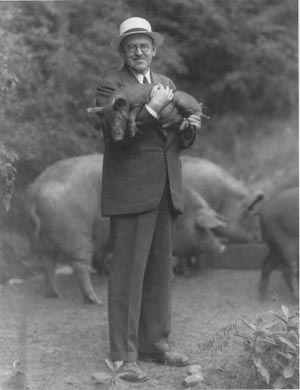
Flanders at first tried to win the Republican nomination for the Senate in 1940, made vacant by the death of Ernest W. Gibson. His battle was uphill as it was against Governor George Aiken, who was popular. The campaign became rather nasty, with Aiken’s side accusing Flanders of selling arms to Nazi Germany while Flanders’ campaign held that Aiken was excessively influenced by a pretty 24-year-old administrative assistant who was hungry for power (Porter & Terry). However, Flanders made a key mistake when he had a picture taken of himself in a suit holding a piglet. This is the picture:

This picture gave Vermonters, many who were farmers, the impression that Flanders lacked sense as he was wearing his Sunday best, and it contributed to his loss in the primary by about 10 points. From 1941 to 1946, he would serve on the Federal Reserve Board of Boston and from 1944 to 1946, he would be its president. Under his leadership the board would help establish the Boston Port Authority to help revitalize New England’s shipping industry (Flanders, 187). Flanders would get another opportunity at the Senate with the resignation of Warren Austin in 1946 to accept the post of Ambassador to the United Nations. He ran a better campaign this time and was elected. Flanders was in many ways like his predecessor in that he was an internationalist but also, largely domestically conservative particularly fiscally, although he did make some exceptions. For instance, he opposed the Knowland Amendment to the 1950 Social Security legislation which limited federal authority for determining the standards of unemployment compensation and he supported a 1950 measure to make it easier to procure credit for housing co-ops. Nonetheless, Flanders’ more favorable record on issues impacting business, such as his opposition to extending rent control in 1950 and support for legalizing “basing point” pricing (allow firms to charge base price as well as shipping costs) made Vermont businessmen much prefer him to his colleague George Aiken, a maverick who supported a lot of President Truman’s domestic policies. For foreign policy, not only did he support the Marshall Plan and aid to Greece and Turkey but also Point IV aid to poor nations in 1950 and most notably against the Bricker Amendment in 1954, which if adopted would have placed substantial limitations on the president’s ability to make executive agreements.

Ralph Flanders vs. Joseph McCarthy

Although Flanders supported several anti-communist measures and was not one of the Republican senators who joined Margaret Chase Smith (R-Me.) in her 1950 “Declaration of Conscience” against McCarthy’s methods, he increasingly came to regard them as objectionable and made his displeasure known during the Eisenhower Administration. Flanders had developed a great respect for senatorial courtesy, and he saw McCarthy as repeatedly violating the spirit of the rules of such courtesy (U.S. Senate). He came to vote against McCarthy’s pushes, such as his effort against the confirmation of Charles Bohlen as Ambassador to the USSR (the nomination was overwhelmingly approved). Another vote that was indicative of Flanders’ opposition to McCarthy was his pair against the confirmation of McCarthy supporter Robert E. Lee to the Federal Communications Commission in 1954. Among Republicans, only George Aiken of Vermont and Margaret Chase Smith of Maine joined him in his objection. On June 11th, Flanders introduced the resolution to censure Joseph McCarthy on numerous grounds, which would end up including McCarthy’s contempt for the committee looking into censuring him. His effort was quietly supported by President Eisenhower, who was sick of having to deal with McCarthy, and he was censured 67-22, with all present Democrats voting for and Republicans split evenly. He would have likely avoided censure if he had issued an apology for his behavior and not called the Democratic Party the “party of treason”. McCarthy’s influence dwindled after the censure, and although nationally celebrated for his role, the reaction in Vermont was “sour” (Porter & Terry).

Flanders During the Eisenhower Administration

During the Eisenhower Administration, Flanders seemed to move to the right on domestic policy and continued his support for increasing foreign aid. However, he also strongly opposed foreign aid for communist nations, including Yugoslavia and Soviet satellites. On economic issues, he took a market approach, including supporting stripping the Federal Power Commission of the authority to regulate the price of oil and gas and supporting flexible price supports (price floors) for agriculture. Flanders also supported most efforts to curb organized labor’s power in 1958 with revelations of union corruption from the McClellan Committee. On civil rights, Flanders was mostly favorable. He had supported ending debate on fair employment practices legislation in 1950 and opposed a Southern effort to compromise army desegregation as well as voted for the Civil Rights Act of 1957 and against the jury trial amendment added to it. However, Flanders also supported the Aiken-Anderson-Case Amendment, which denied the attorney general authority to initiate lawsuits to enforce the 14th Amendment. By 1958, he was 78 years old and ready to hang up his hat. Flanders was succeeded by Congressman Winston Prouty. The most reliable assessments of him place him from moderate to moderately conservative. He agreed with the liberal Americans for Democratic Action 35% of the time, the conservative Americans for Constitutional Action 77% of the time from 1955 to 1958, and his DW-Nominate score was a 0.175. Flanders wrote and published his memoirs in 1961, titled simply, Senator from Vermont. He died on February 19, 1970, at the age of 89.

References

ADA Voting Records. Americans for Democratic Action.

Retrieved from

Flanders, Ralph Edward. Voteview.

https://voteview.com/person/3206/ralph-edward-flanders

Flanders, R.E. (1961). Senator from Vermont. Boston, MA: Little, Brown.

Idea of the Senate. U.S. Senate.

Retrieved from

https://www.senate.gov/about/origins-foundations/idea-of-the-senate/1961Flanders.htm

Porter, B. & Terry, S.C. (1990, September 9). Down & Dirty – The Aiken-Flanders Primary of 1940. Vermont Sunday Magazine, Rutland Herald and Barre-Montpelier Times Argus.