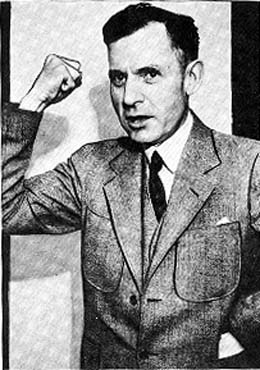
Although you could arguably say this about any state, Washington’s history has been of particular interest to me since I moved here four years ago. Many Americans would probably be surprised to know that the state was arguably more left-wing in the 1930s than it is today, with Postmaster General James Farley once half-jokingly speaking of the “47 states and the Soviet of Washington”. One of the major figures that gave Washington this reputation was Senator Homer Truett Bone (1883-1970).
Bone’s personal history made him inclined against war throughout his life. His father, James Milton Bone, fought in the War of the Rebellion and was deeply impacted by the brutal conditions of the prisoner of war camp he was held at for the rest of his life and his mother, Margaret, lost her first husband in the war (Chesley). In 1893, the family suffered a major downturn in fortunes from the Panic of 1893 and that’s when the family moved to Washington. Bone’s views were from the start not only anti-war but also left-wing populist and he started out in the Socialist Party. However, in 1916, he was read out of the party by its leadership as he was regarded as too moderate. Bone would affiliate himself with multiple parties throughout his career, including the Farmer-Labor (running for a Washington House seat in 1922 and winning) and Liberty third parties as well as the Republican Party (trying to win their nomination for the House in 1928), but he ultimately found his home in the Democratic Party in 1932. While in the state House, he pushed for and ultimately was able to get the Granger Power Act and the Bone Power Act, which permitted cities to sell power to rural areas. Although strongly ideological, he was not much one to care about party discipline, and once said, “Party labels don’t mean a thing to me” (The New York Times). Of all the domestic issues, Bone stood strongest against private power interests, supporting government-owned generation and transmission of power. He held that in Washington such utilities “monopolize the last and most valuable of the natural resources” (The New York Times).
The 1930s: A Time of Change
Although Republicans had significant presence in the state for many years, including its prominent senator and long-time incumbent, Wesley Jones, their appeal fell dramatically during the Great Depression. The Seattle Times was most notable in opposing Bone as a “socialist” but Hearst-owned newspapers strongly backed him (Chesley). However, all these editorials probably didn’t matter given the national mood. Bone defeated Jones by 200,000 votes, outpolling Franklin D. Roosevelt (The New York Times). This outcome ultimately didn’t matter much for Jones, as he died less than two weeks later.
Bone strongly supported much of the New Deal but couldn’t vote for the final version of the National Industrial Recovery Act given that it suspended anti-trust laws to allow for cartels to exist under the National Recovery Administration. His most notable accomplishment in the Senate was in 1937, when Bone sponsored the bill creating the National Cancer Institute. Although he saw himself as fundamentally progressive, this would not be the last major matter in which he would cross the Roosevelt Administration. He also opposed the Roosevelt Administration cutting veterans’ benefits to fund the New Deal and had reservations about Roosevelt’s “court packing plan” in 1937, even though he voted against killing the bill. Bone’s reservations on the latter resulted in Secretary of the Interior Harold Ickes to regard him as “a liberal of the very soft variety” (Chesley). Consistent with his views on US involvement in foreign affairs, Bone opposed the World Court in 1935. Speaking of…
Foreign Policy
Although the state of Washington was among the most supportive of the New Deal, indeed the state did not elect Republicans to Congress again until 1942, its Democrats were divided on the subject of getting involved in World War II. Even a young Congressman Henry Jackson, known in his later career as a Vietnam war hawk, voted against Lend Lease. Bone sat on the Senate Munitions Investigating Committee, which investigated the causes of World War I, Bone voted against the peacetime draft in 1940, against Lend-Lease in 1941, and against permitting entry of US convoy ships into belligerent ports. He was also notably absent during the vote to declare war on Japan, but this was due to getting surgery, not an anti-war statement. Bone’s record after was strongly pro-Roosevelt across the board. Interestingly, his DW-Nominate score was -0.047, on the center despite his mostly left-wing views on domestic views, but this was likely largely on account of his foreign policy views.
End of Career
In 1939, Bone had an accident in which he injured his hip. He never fully recovered, indeed, that’s what his 1941 surgery was about, and he dreaded the prospect of campaigning for reelection using crutches (The New York Times). That year, President Roosevelt nominated him to the Ninth Circuit Court of Appeals, and he resigned to accept, serving in this position until 1956, when he assumed senior status, a state of semi-retirement. He would fully retire in 1968 and died on March 11, 1970 at the ripe old age of 87.
References
Bone, Homer Truett. Voteview.
Retrieved from
https://voteview.com/person/843/homer-truett-bone
Chesley, F. (2023, December 28). Bone, Homer Truett. History Link.
Retrieved from
https://www.historylink.org/file/5628
Ex-Senator Homer Bone Dies; Foe of Washington Utilities, 87. (1970, March 12). The New York Times.
Retrieved from
Bonus: Homer Bone giving a quick speech.
 Mad Politics: The Bizarre, Fascinating, and Unknown of American Political History