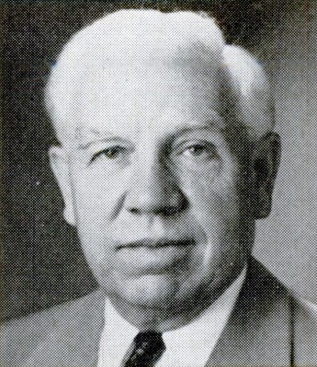
From 1950 to 1954, there were certain figures in politics who were trying to have their own anti-communist crusades, thus taking after Senator Joseph McCarthy. Kit Clardy (1892-1961) was one of them. A lawyer by profession, he made first attempt for Congress in 1950, challenging incumbent Republican William W. Blackney, but he lost. However, Blackney only wanted one more term, thus leaving the door open for 1952. Clardy had first made his mark in Republican politics when he had launched a campaign to oust incumbent Governor Alex J. Groesbeck in favor of Fred Green in the Republican primary, and he succeeded (The Grand Rapids Press). Green rewarded Clardy by making him assistant state attorney general, and he served from 1927 to 1931 and sat on the Michigan Public Utilities Commission from 1931 to 1934.
In 1952, Clardy ran for Congress, campaigning on a staunch anti-communist platform. One newspaper ad touted that there would be “no compromise with communism” and “no sympathy for socialism” (The Flint Journal). He also strongly opposed what he called “Trumanism”. In the Detroit Free Press (1952) there was a point-counterpoint between Democrat Donald Hayworth and Republican Clardy. Hayworth touted the Truman record, writing, “Real wages are the highest in history, business profits are the highest in history and farmers can now expect a decent price for their products. The social legislation and the foreign policy of cooperation withing the UN have been so sound that both parties have accepted them. I do not deny that mistakes have been made – and these must be corrected – but no one can take away the progress of the past 20 years for all sections of the country and for all economic and social groups” (15). Clardy had an answer for this, in which he points out that Hayworth glazed over the nature of the mistakes of the Truman Administration and some of the economic downsides. He wrote, “(Hayworth) supports the big government theory – the Socialist ADA line – all the way, as I predicted. There will be no change unless the Republicans win. His omissions are truly significant. Korea, graft and corruption, inflation, high taxes, and high prices are conveniently forgotten…He overlooks the record high in living costs when he talks of high wages. He forgets taxes when he talks of profits. He rejoices over the war-created false prosperity. But apparently he isn’t troubled about inflation, high taxes, or the cost of living” (Detroit Free Press, 15). On Election Day, Clardy prevailed by over 5 points.
As a member of Congress, Clardy’s record was strongly conservative. His DW-Nominate score was a 0.645, making him the third most conservative individual in the House in his day. Clardy voted 11% of the time with Americans for Democratic Action, only siding with them on their support for the admission of Hawaii and in favor of the construction of the St. Lawrence Seaway, which all Michiganders voted for. Clardy stood for more conservatism in politics and called for the US to break diplomatic relations with the USSR (Lansing State Journal). His specialty, however, was ferreting out communism and its influences domestically, particularly in government, universities, and labor unions. Clardy’s zeal for this subject resulted in him becoming known as “Michigan’s McCarthy”.
In November 1953, Clardy held hearings in Lansing, Michigan, regarding alleged communist infiltration of the University of Michigan. Three professors who refused to give information to the committee were suspended by the University Michigan, with two being fired and one being reinstated (Peters).
In Flint, he held hearings for a subcommittee of the House Committee on Un-American Activities, aiming to expose communist ties and influence within the left-wing United Auto Workers-CIO union. The proceedings were frequently heated, and there were several hostile witnesses, including Buick worker Martin Trachtenberg, who in the process of refusing to answer any questions by citing the first ten amendments of the Constitution as well as the Constitution as a whole, repeatedly banged the witness table with the Bill of Rights, shouted at the committee that the hearing was illegal, and threatened Democrat Clyde Doyle of California with a loss of political support, an outburst that resulted in a threat of citation for contempt by Clardy and a removal of the witness by police (The Flint Journal, 14). Clardy was reportedly no prince either at these hearings. He was said to have “not only abused the witnesses but incited violence against them” and favorably commented on a 1937 incident in which college students had thrown UAW-CIO organizers into the Red Cedar River. The aftermath of these hearings was a series of acts of mob violence against allegedly left-wing workers and retaliations against hostile witnesses and their families such as evictions from their homes (Moorehouse).
The 1954 midterms were highly unfavorable to McCarthy’s brand of politics, and several politicians who had hitched their wagons to such politics lost reelection. Michigan had some unfavorable results for the Republicans, with Senator Homer Ferguson losing reelection to UAW-CIO favorite Pat McNamara and Democratic Governor G. Mennen “Soapy” Williams winning reelection by over 11 points. In this environment, and with Clardy strongly targeted for defeat by organized labor, he lost to Donald Hayworth. Michigan’s 6th, by the way, was not usually a Democratic district, only electing Democrats to Congress up to that point in the 20th century in 1932 and 1936, which were dismal years for Republicans. Kit Clardy never backed down on his ways, and before exiting Congress he alleged the existence of “a gigantic” network of communists that remained in the State and Labor Departments (Pearson). The district reverted to its Republican ways in the 1956 election with the more moderate Charles Chamberlain prevailing in the Republican primary over Clardy and winning the district. He would hold it until his retirement in 1974. In his last years, Clardy lived in Redondo Beach, California and headed up We, the Peoples, an ultra-conservative anti-communist organization. He was also a member of the Board of Policy of Willis Carto’s Liberty Lobby. On September 2, 1961, Clardy went into a Redondo Beach hospital for surgery, but he succumbed to a heart attack on September 5th, aged 69.
References
Advertisement for Kit Clardy for Congress. (1952, October 29). The Flint Journal, 2.
Retrieved from
https://www.newspapers.com/image/1168908817/
Clardy, Kit Francis. Voteview.
Retrieved from
https://www.voteview.com/person/1748/kit-francis-clardy
Death Takes Kit Clardy. (1961, September 6). The Grand Rapids Press, 45.
Retrieved from
https://www.newspapers.com/image/1113729949/
In This Corner. (1952, September 14). Detroit Free Press, 15.
Retrieved from
https://www.newspapers.com/image/97457000/
Kit Clardy Is Dead in California. (1961, September 6). Lansing State Journal, 1.
Retrieved from
https://www.newspapers.com/image/210484814/
Moorehouse, B. (2018, October 22). Meet the craziest Congressman in Livingston County history, Kit Clardy. The Livingston Post.
Retrieved from
Pearson, D. Behind Swan Song of Kit Clardy. (1954, December 22). Winston-Salem Journal, 10.
Retrieved from
https://www.newspapers.com/image/935127267/
Peters, J.W. (1999, October 13). Former professor dies at age 82. The Michigan Daily.
Retrieved from
Police Remove Defiant Witness. (1954, May 14). The Flint Journal, 15.
Retrieved from
 Mad Politics: The Bizarre, Fascinating, and Unknown of American Political History