Reinhold Niebuhr, the first and only chairman of Union for Democratic Action.
One ratings system I have been very curious about from a historic perspective is the old Union for Democratic Action system, which they published in the left-wing magazine The New Republic. This organization, which was the predecessor of the left-wing Americans for Democratic Action, scored legislators on their commitments to the New Deal as well as to FDR’s foreign policy. They also embraced civil rights when it was simply an emerging issue on the left-right scale. Thus, among the votes they considered important enough to score were the 1943 and 1945 bills banning the poll tax in Federal elections, both sponsored by far-left Vito Marcantonio of New York. I was having some trouble finding concrete information on how they graded, but then I hit upon a jackpot…an article from a Greensboro, Alabama newspaper called The Southern Watchman.
The Southern Watchman complains about the trajectory of the Democratic Party as anti-Southern and bases this on the Union for Democratic Action-New Republic ratings of Congress as who is in line with FDR and the New Deal. Although the author cites, as one would expect, the poll tax ban as an example of an “anti-Southern” vote, the critique is more broad-based than civil rights as he also cites the opposition to the continuation of the Dies Committee (House Committee on Un-American Activities) and the opposition to the Hobbs Anti-Racketeering bill (regarded as anti-labor by the Roosevelt Administration and organized labor) as examples, both measures strongly supported by Southern members of Congress. This article also demonstrates that it is not true as commonly believed that FDR declined to support civil rights as president. His administration was supportive of banning the poll tax (although he had pointedly declined to opine on anti-lynching proposals). The Southern Watchman (1943) posits, “The truth of the matter is that our Southern representatives in Congress are not necessarily anti-Roosevelt or anti-Democratic; they are merely pro-Southern, and the national administration itself is guilty of being anti-Southern” (2).
Interestingly, in this article the author, whether he knows it or not, is predicting the distant future. He writes, “This condition cannot continue to exist. We cannot run with the hare and hold with the hounds. We may remain loyal to the National Democratic Party in the next presidential election, or the next after that, but this business of fighting it with one hand and befriending it with the other cannot go on forever. The South cannot continue to support, year in and year out, the party which at this moment is as radically anti-Southern as was the Republican Party in Grant’s day. We have got to recapture the Democratic Party, and reconstitute it as a party which respects the South, or we have got to disown it completely” (2). Most of the South has indeed since disowned the Democratic Party, a process that was largely actualized with the 1994 midterms. As we can see here, there were inklings of its start before the Civil Rights Act of 1964 and even before President Truman announced his support for a civil rights platform and ordered the desegregation of the army in 1948. Indeed, four Southern states would prove willing to ditch the National Democrats as early as 1948, with Alabama, Louisiana, Mississippi, and South Carolina voting for Dixiecrat Strom Thurmond. However, the process was gradual, and Republicans wouldn’t start making even modest gains in the South outside of the traditionally Republican 1st and 2nd districts of Tennessee, which have stuck with the GOP in times good and bad, until the 1950s. Most Southern politicians would find it useful to remain in the Democratic Party simply for the institutional power that they retained, and numerous Southern Democrats had built up considerable seniority. Until 1975, seniority was the sole determinant of who would get powerful committee chairmanships, and Southern politicians benefited greatly. Indeed, I contend that the Democratic rules change in 1975 that made seniority not the sole issue that determined seniority to be the beginning of the end of the conservative wing of the Democratic Party. The votes themselves are helpfully described in the article, although the vote totals are not always accurately reported. I have, however, used the highly useful Voteview function to create a spreadsheet that shows the scores and under Roll Call Descriptions shows the votes.
The UDA-New Republic’s inclusion of the poll tax ban as an issue to count for the liberal side, which only got 17 Republican nays, results in only a few representatives getting a 0%. These are:
Ben Jensen (R-Iowa), Ulysses Guyer (R-Kan.)*, Thomas Winter (R-Kan.), Frank Fellows (R-Me.), Clare Hoffman (R-Mich.), Donald McLean (R-N.J.), Francis Culkin (R-N.Y.)*, James Wadsworth (R-N.Y.), Frederick Smith (R-Ohio), Ross Rizley (R-Okla.), and Martin Dies (D-Tex.).
* – These representatives died during the session, only voting a few times.
This is a solid cross-section of some of the most right-wing legislators in this time. Clare Hoffman of Michigan was the most notable example of an extreme opponent of the Roosevelt Administration (and liberalism in general) and Frederick Smith of Ohio has one of the highest recorded DW-Nominate scores in history at 0.92.
Representatives who never got it wrong by this standard were:
George Outland (D-Calif.), Thomas Ford (D-Calif.), Cecil King (D-Calif.), George Sadowski (D-Mich.), Louis Capozzoli (D-N.Y.), Arthur Klein (D-N.Y.), Vito Marcantonio (ALP-N.Y.), Charles Buckley (D-N.Y.), James Fitzpatrick (D-N.Y.), Michael Kirwan (D-Ohio), Robert Furlong (D-Penn.), Henry Jackson (D-Wash.), John Coffee (D-Wash.)., and Howard McMurray (D-Wis.).
This is a good cross-section of the most left-wing representatives of the time, as Marcantonio was known as openly pro-Soviet and some others, such as John Coffee of Washington, were accused of being Soviet sympathizers. Howard McMurray of Wisconsin has the lowest DW-Nominate score in the 78th Congress.
Another interesting aspect is that 29 Republicans only sided with UDA-New Republic on the issue of banning the poll tax. The poll tax ban was by far the issue that was considered liberal by UDA-New Republic that got the most Republican support. Something to note about these votes is that Congress had not concluded when they were released. Thus, there were some important issues that were not included in this, such as the votes on anti-subsidy legislation as well as the vote on retaining the National Youth Administration. I would say this measure is not complete for 1943, but it nonetheless does a pretty good job of distinguishing the most liberal and most conservative legislators.
The ratings are below, + and – with underlines mean pairs for and against the UDA position:
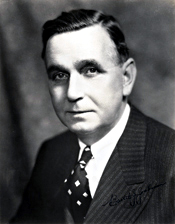
The year is 1940. Although the American public reelects President Roosevelt, he has gotten increased opposition in the Midwest, and a big reason for this is that the Midwest is the heartland of opposition to the US getting involved in World War II. Although Republicans lose a net of seven House seats, they gain six seats in Illinois. Although President Roosevelt wins the state of Illinois by over two points, non-interventionist sentiment is strong in the state, and Chicago is regarded as the isolationist capital of the US. C.W. “Runt” Bishop (1890-1971) of southern Illinois is one of the beneficiaries, defeating staunch New Dealer Kent Keller, who had been in office ten years. Keller would four times try to win his seat back, with his last effort being in 1950 when he was 83 years old, but Bishop always held on against him.
Although his birth name was Cecil William Bishop, no one knew him by that name, rather they knew him by his nickname he gained when as a youth he was a football quarterback who was 5’5” and weighed only 98 pounds, “Runt”. By the time he was in Congress, however, he was 185 pounds, but he had fully embraced the nickname and would not accept being called by any other name. His name had appeared on the Illinois ballot as “Runt Bishop” and he was certified elected by the clerk of the House as “Runt Bishop” (The Evansville Press). This insistence resulted in some difficulty, but not insurmountable. He insisted that the name “Runt” be put on his Congressional office door much to the chagrin of Capitol Hill architect David Lynn, who regarded as undignified, to which he responded, “I do not care whether it is dignified or not. I am ‘Runt’ to everybody back in Carterville, Illinois, and I am going to be ‘Runt’ here”, and he did get his way, the first time that such a thing happened in Congress (Dixon). This applied outside of politics too. Bishop insisted on be listed in the telephone book as “Runt Bishop” and it was done but only after his secretary presented the phone company with an affidavit authorizing the use of the name, and the gas company also didn’t want to send him bills under the name “Runt Bishop” but they eventually backed down (Dixon). If he had been elected president, he would have undoubtedly been sworn in as “Runt Bishop”, much like Jimmy Carter was sworn in not as James Earl Carter, but “Jimmy”.
Bishop was a tailor who had multiple shops in Illinois and ran one out of his Congressional office. Thus, when anyone had some sewing that needed to be done in Congress, they would turn to Bishop. Bishop consistently wore the finest suits, and they were so because he made them for himself. He also made dresses for his wife and his friends’ wives (Othman). His sewing helped make him personally popular among his colleagues, as they could count on him if something happened like a button fell off their suit. As Bishop himself said, “You’d be surprised how many friends you can make by sewing on a button or mending a shirt tail here and there. It pays to keep a sewing kit in your bag” (Nichols). One fellow he differed with, however, was Clare Hoffman (R-Mich.). He didn’t like that Bishop wouldn’t sew him a suit and pants that had no pockets save for the left hip, a quirk he adopted after misplacing a manuscript for a speech (Nichols). Bishop was also known as a skilled golfer and was an occasional golfing buddy of President Eisenhower despite him not being of the president’s “modern Republican” wing of the party.
The Ideology of a Runt
Bishop’s political stances are a rather interesting matter; indeed, they are why I have covered him. He was strongly opposed to extensive executive power. On June 6, 1941, he wrote that Roosevelt could potentially increase the army at will, suspend the Wagner Labor Relations Act, fix the gold content of the dollar, and set prices (Bishop). Bishop opposed all such powers. He was in many respects an extremist; he was for tariffs to the absolute hilt, save for Lend Lease appropriations during World War II, there wasn’t a foreign aid measure he approved of. Aid to Greece and Turkey and the Marshall Plan were easy nays for him. In 1947, Bishop was part of a Congressional delegation in Europe that visited the Pope. He pointedly asked him although did not get an answer, “If we vote money for relief goods to be sent here to Europe, how do we know the goods will ever get to the people who need them?” (Pearson) Thus, Bishop’s opposition to foreign aid seems to have based on skepticism that the money was being put to good use. The left-wing publication The New Republic (1942) regarded Bishop as a “colorless isolationist and reactionary”. Bishop was also a constant foe of price and rent controls as well as public housing. Indeed, most aspects of the New Deal met with his opposition. He was also one of the few Illinois politicians to oppose the St. Lawrence Seaway, the construction of which served to benefit the Midwest.
On labor issues, however, he consistently voted with organized labor and was a supporter of the Wagner Act. This support included being one of 11 House Republicans to vote against overriding President Truman’s veto of the Taft-Hartley Act in 1947. Within Bishop’s district there were coal fields and he had been a coal miner in his youth, thus it was good politics and/or personal convictions that had him back organized labor. He also opposed a successful Conservative Coalition effort to limit the impact of a 1949 minimum wage increase and the following year supported a mandatory Fair Employment Practices Committee to combat racial discrimination in employment. Speaking of, he consistently supported civil rights measures, voting five times for anti-poll tax legislation. Despite his differences on organized labor, his DW-Nominate score was a 0.609, among the highest in Congress. He agreed with the liberal Americans for Democratic Action (ADA) 18% of the time from 1947 to 1954. This was primarily due to his stances on labor, but he also supported lessening the obstruction of the Rules Committee in 1950 and 1951 after supporting the status quo in 1949, as well as voted against legislation removing price regulation of natural gas from the Federal Power Commission’s jurisdiction in 1949 and 1950.
In the 83rd Congress, Bishop was chairman of the Special Committee on Campaign Expenditures, and chairman of the Subcommittee on Accounts, the latter a committee that other committees had to go to in order to get investigations approved. Unlike in the last Congress in which he had voted against the creation of the Cox Committee to investigate tax-exempt institutions, he voted for the Reece Committee to do so. Bishop also served as an assistant whip, thus being part of efforts to line up Republicans for critical votes. However, he himself could not be counted on to support the Eisenhower Administration’s priorities down the line. While Bishop supported Hawaii statehood, the Tidelands bill, and the Eisenhower Administration’s policies on taxes and privatization of atomic power, he continued his opposition to foreign aid and opposed bipartisan legislation admitting additional refugees from Europe.
The 1954 Election
Republicans faced headwinds in the 1954 midterms, as parties with incumbents usually do in midterms. These headwinds cost them both the House and the Senate, and in Illinois Bishop was one of three House Republicans to lose reelection, losing to 30-year-old auto dealer Kenneth Gray. On a side note, this was not a good election year for either of the Congressional baseball teams. While the Republicans had lost their manager in Bishop, the Democrats lost their star pitcher in Georgia’s Don Wheeler as he had been defeated for renomination. Bishop would not run for office again, and Gray would have a long career in Washington, serving from 1955 to 1974, and again from 1985 to 1989. Bishop would serve in multiple government positions afterwards, serving as the Post Office’s liaison to Congress from 1955 to 1957, the last being conciliator for the Illinois State Labor Department from 1959 until he retired in February 1961. Bishop remained impressive in his golf game even into old age, having played in southern Illinois golf tournaments until the age of 80, when he received national recognition for having shot a hole-in-one (Southern Illinoisan). He died after a long illness on September 22, 1971.
Bishop stands as an interesting fellow to me because of his multiple talents, being a sportsman in golf and baseball as well as being a master tailor, as well as his political record. He stood as extremely conservative on most issues, but made a few important exceptions, most notably on organized labor. This combination worked well for his district, which was usually a good place for Democrats, for 14 years.
References
ADA Voting Records. Americans for Democratic Action.
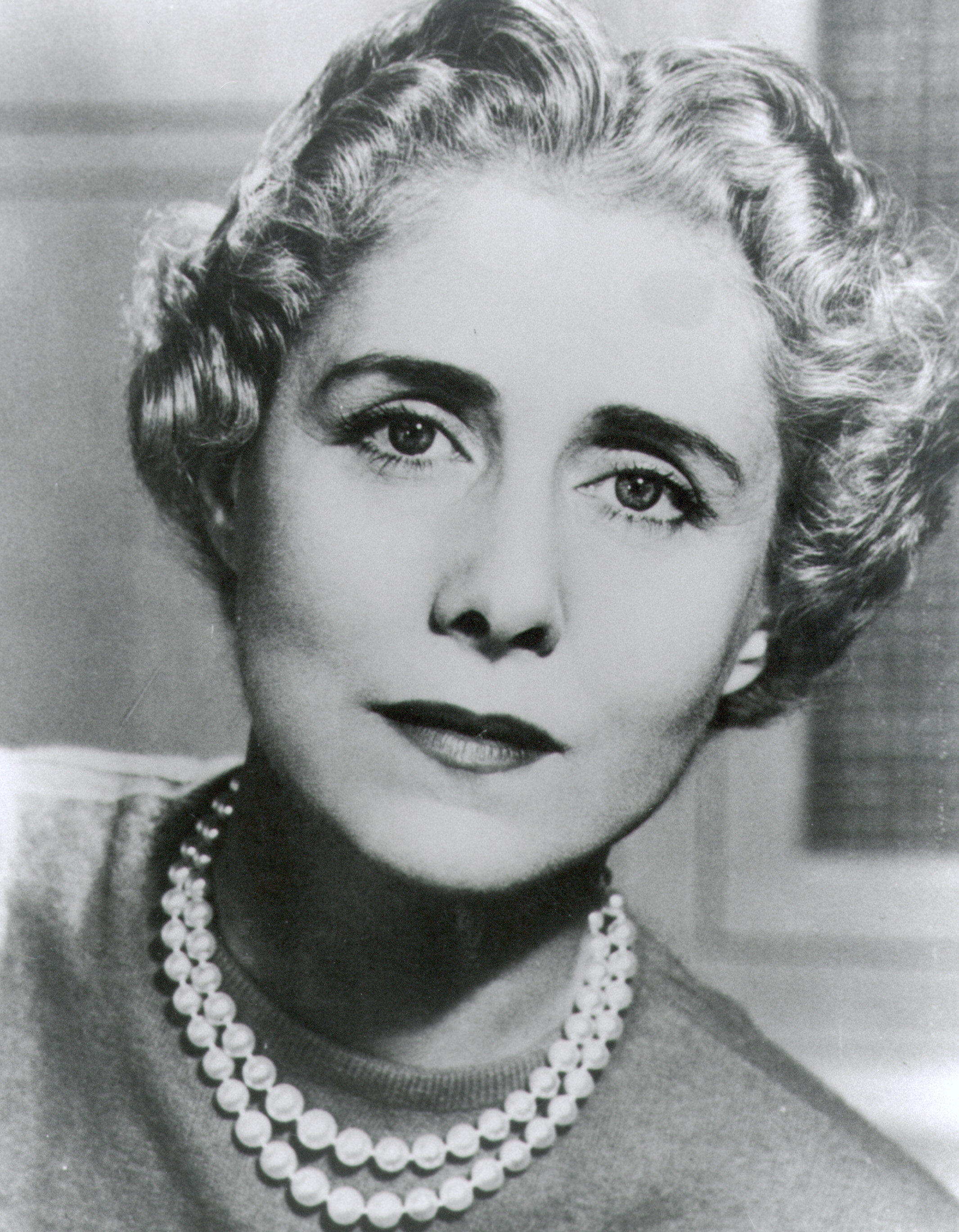
Clare Boothe Luce (1903-1987) was a rather unique woman of many talents. She was a skilled playwright, writer, magazine editor, a politician, and a socialite. Although her life in many ways was that of a feminist, she didn’t always have such a mindset, and her life reflected what can be seen as positive and negative things that people attribute to feminism.
Born Ann Clare Boothe, she had something of a difficult childhood; she was the daughter of a showgirl and her father left the family when she was 8. Her mother had great ambitions for her, and pushed her to be an actress, and appeared in the Broadway play The Dummy in 1914 as well as had a bit part in the film The Heart of a Waif the following year. As a teenager, she gained some notoriety as a suffragist, working for the National Woman’s Party. Her mother, wanting her to climb the social ladder, had arranged her marriage to the clothing heir George Tuttle Brokaw in 1923, who was 24 years her senior. They had one daughter, Ann Clare Brokaw, in 1924. The marriage was, however, unhappy as Brokaw was a violent alcoholic. As she recalled later about the marriage to journalist Dominick Dunne, “I know all about violence and physical abuse because my first husband used to beat me severely when he got drunk. Once, I can remember coming home from a party and walking up our vast marble staircase at the Fifth Avenue house while he was striking me. I thought, if I just gave him one shove down the staircase I would be rid of him forever” (Brenner). Clare asked his mother for a divorce in 1929, and it was granted, with her getting a generous settlement that made her independently wealthy. However, she had to split custody of her daughter with Brokaw for half the year. He would die six years later in a sanitarium, a consequence of his alcoholism.
Clare Boothe would go on to be the caption writer for Vogue magazine in the early 1930s, then became the editor of Vanity Fair. She wrote profiles on people, one of the first being Time and Fortune Magazine’s Henry Luce. She initially despised him, writing, “He claims he has no other interest outside of his work, and that his work fills his waking hours” (Brenner). Nonetheless, in 1935 she would after only a few meetings with him, marry him. Luce had divorced his wife explicitly to marry her. He would subsequently establish Life magazine, reportedly at her suggestion (The Eleanor Roosevelt Papers). Their marriage was not an easy one, but one that lasted. However, it lasted through them having an open marriage, with her having numerous affairs with prominent figures, including Randolph Churchill (Morris, 2014). There was a mutual respect for each other and both elevated the other in different ways. In 1936, Luce wrote the all-female satire The Women in only three days, which became a hit on Broadway. She also wrote Abide with Me (1935), Kiss the Boys Goodbye (1938), Margin for Error (1939), Child of the Morning (1951),and Slam the Door Softly (1970). Luce’s works also include three books, which were Stuffed Shirts (1931), Europe in the Spring (1940), and Saints for Now (1952) (editor). She was also known for her wit. Some quotes attributed to her include:
“Money can’t buy happiness, but it can make you awfully comfortable while you’re being miserable.”
“Simplicity is the ultimate sophistication.”
“Because I am a woman, I must make unusual efforts to succeed. If I fail, no one will say, ‘She doesn’t have what it takes.’ They will say, ‘Women don’t have what it takes.’”
“Censorship, like charity, should begin at home; but unlike charity, it should end there.”
“If God wanted us to think with our wombs, why did he give us a brain?”
“No good deed goes unpunished.”
“Nature abhors a virgin – a frozen asset.”
Luce would also be a war correspondent for Life magazine from 1939 to 1942, and her connections would result in her getting interviews with political and military leaders. She would not hesitate to issue criticism when she thought it worthy. However, Luce did get into some trouble after she mockingly likened RAF pilots to “flying fairies” in print (Morris, 1997, 458).
Politics
When Luce was in a relationship with Bernard Baruch, she, like him, supported FDR’s election in 1932. However, she became disillusioned with Roosevelt’s economic policies by his second term and switched from Democrat to Republican. In 1940, Luce endorsed and campaigned for Republican Wendell Willkie, opposing FDR not only out of ideological differences but out of a belief that the two-term tradition shouldn’t be broken. Her politics were at this point indeed similar to those of her husband. In 1942, she was recruited to run for Congress. She condemned incumbent Le Roy Downs, who had defeated her stepfather Albert Austin for reelection in 1940, as a “rubber stamp” for Roosevelt (U.S. House). Luce won in the Republican wave, but by a plurality. If the left had lined up behind incumbent Democrat Le Roy Downs, he would have won reelection; 11% of the vote had gone to the Socialist candidate. Luce’s platform was “One, to win the war. Two, to prosecute that war as loyally and effectively as we can as Republicans. Three, to bring about a better world and durable peace, with special attention to postwar security and employment here at home” (U.S. House).
Luce and FDR
Luce was publicly critical of President Roosevelt, and in the 1944 presidential campaign she charged that he was “the only American President who ever lied us into a war because he did not have the political courage to lead us into it” (U.S. House). He didn’t appreciate her barbs and was sure to campaign against her explicitly. Vice President Wallace dismissed her as a “sharp-tongued glamor girl of forty” who when running around the country without a mental protector, “put her dainty foot in her pretty mouth” (U.S. House). However, Luce and FDR were not as far apart on policy as their public relationship would suggest. While she supported overriding President Roosevelt’s vetoes of bills restraining subsidies and providing tax relief, she voted to sustain his veto of the Smith-Connally Act, which was designed to counter wartime strikes. Luce also supported retaining the National Youth Administration in 1943. She opposed increased funding for agricultural programs and supported minor restraints to price control while opposing strong efforts to hinder price controls. Luce was also an internationalist, supporting the creation of an international peacekeeping body after the war’s conclusion, an idea which would become the United Nations. Luce also was opposed to the House Committee on Un-American Activities, voting against funding it in 1943 and opposing making it a permanent committee in 1945. Her DW-Nominate score was a 0.07, making her one of the least conservative Republicans in Congress. In 1943, Luce supported repealing the Chinese Exclusion Act, which was signed into law. She was in favor of eliminating discrimination in immigration, supported desegregation of the army, and supported the Equal Rights Amendment.
Although President Roosevelt had much in good news that year with the defeats of bitter foes Senator Gerald Nye of North Dakota and Representative Hamilton Fish of New York, Luce would win reelection by one point. Like in 1942, if the left had unified behind the Democratic candidate, Luce would have lost. That year, Luce suffered a terrible tragedy when her daughter was killed in a car accident at 19 while attending university. After her daughter’s death, she turned to faith and spiritualism and converted to Catholicism but was never able to persuade her husband to do so.
In 1946, Luce sponsored with Rep. Emanuel Celler (D-N.Y.) a bill permitting naturalization of Indians and Filipinos and permitting a quota of 100 a year from each nation which was signed into law by President Truman. She was also consistently anti-communist in her foreign policy outlook. Luce argued that the Kremlin had “incorporated the Nazi technique of murder” and regarded postwar foreign policy surrounding Poland as “a partition of Poland and overthrow of its friendly, recognized constitutional Government” (U.S. House). In January 1946, she decided not to run for reelection. This farewell from politics would turn out to be temporary, as in 1952 Luce energetically campaigned for the election of Dwight Eisenhower. The following year, Eisenhower saw her as a perfect candidate to represent the United States in Italy, and nominated her ambassador. Although more conservative Italians were initially a bit put out that Eisenhower had picked a woman, in a week’s time she had won them over. This post was particularly important in the Cold War context as although Italy was on the Allied bloc, they had one of the strongest communist parties in Western Europe, and there was always a risk of a communist victory. During this time, Luce was able to negotiate a border dispute between Italy and Yugoslavia. She served in this capacity until 1956, by which time she had become very ill. This illness had started in 1954, and after she was taken back to the United States, it was found that she had been suffering from arsenic poisoning. It turned out that the arsenic paint on the ceiling of her bedroom was flaking off. By 1959, Luce had recovered and although she was confirmed Ambassador to Brazil, she miscalculated when she said just after her confirmation “my difficulties, of course, go some years back and began when Sen. Morse was kicked in the head by a horse” (McMillan). This referenced a 1951 incident in which a horse broke Morse’s jaw. The controversy that arose resulted in her resignation only three days later.
In 1964, Luce, who had become increasingly conservative over the years, briefly considered reentering politics to run for the Senate in 1964 as a member of New York’s Conservative Party, but dropped the idea. That election would be won by none other than Robert F. Kennedy. That year, Luce firmly backed Senator Barry Goldwater (R-Ariz.) for the presidency. Her husband, Henry Luce, was increasingly in poor health, and on February 28, 1967, he died of a heart attack. Afterwards, Luce moved to Hawaii where she was a prominent socialite. In 1973, President Nixon appointed her to the Foreign Intelligence Advisory Board, where she served until 1977. President Reagan reappointed her in 1982, and she served until her death. In 1983, she was awarded the Presidential Medal of Freedom.
Luce could be quite a story-teller, and this included some fiction. According to Marie Brenner (1988), she had told friends in the past that numerous prominent men had wanted to marry her and that she had slept with Strom Thurmond. Although many people would regard Clare Boothe Luce as having lived an incredible life, she reflected in her last weeks, “You know, I have had a terrible life. I married two men I really didn’t like. My only daughter was killed in a car accident. My brother committed suicide. Has my life been a life for anyone to envy?” (Brenner) Luce succumbed to brain cancer in Washington D.C. on October 9, 1987. The Washington Post eulogized her thusly, “She raised early feminist hell. To the end she said things others wouldn’t dare to – cleverly and wickedly – and seemed only to enjoy the resulting fracas…Unlike so many of her fellow Washingtonians she was neither fearful nor ashamed of what she meant to say” (U.S. House).
References
Brenner, M. (1988, March). Fast and Luce. Vanity Fair.
The 1940 election was the first gubernatorial election that ended up having an outcome that was unfavorable to Hague. Although he had openly supported Republican Harold G. Hoffman winning the nomination, Hoffman lost the primary to good government Republican Robert C. Hendrickson. As previously mentioned, Roosevelt had Hague endorse his Secretary of the Navy, Charles Edison. There were a few problems with Thomas Edison’s son for Hague, but the most important one was that Edison didn’t owe his political career to him. Thus, Edison very well could be (and was) a governor who stood independent of him in his dispensing of patronage and selections for public office, and reduced patronage for Hudson County (Murray, 34). Edison was the first governor during Hague’s time as mayor to really take a stand against him, and it was the first major blow he experienced. Edison had hoped for history to repeat itself in him being Governor Wilson and Hague being Newark’s Boss Smith (Fleming). The problem here was that Edison did not have the political command or skill of Wilson and Hague was more powerful than Smith had been at that time. He attempted to get the New Jersey Constitution updated with changes that increased the power of the governor. As Time Magazine (1944) wrote on the situation, “The 100-year-old present constitution is tailor-made for men of bad will who would make themselves the law. Under it, a governor has so little power that he cannot appoint his own cabinet; he is subject to the will of boss-appointed “department heads.” A fabulous bureaucracy has arisen: 135 separate state departments, and an archaic, top-heavy judicial setup of 17 different state court systems – many controlled by Hague. The new constitution would give the governor his own cabinet and more power, would cut the departments to 20 and the court system to six, would replace the bulky 16-man Court of Errors and Appeals with a Supreme Court of seven. Worst of all for Boss Hague: a provision requiring public officials to answer legislative inquiries or lose their jobs”. However, Hague managed to get the constitution defeated in the public referendum. Interestingly, Edison would be among the founders of the conservative organization Americans for Constitutional Action, and would serve as its first vice chairman. Still, Edison’s time as governor was a significant blow for Hague. Perhaps Hague would have a better time of it in the 1943 election, perhaps he could get his venerable man A. Harry Moore back in.
The 1943 Election: A Disaster for Hague
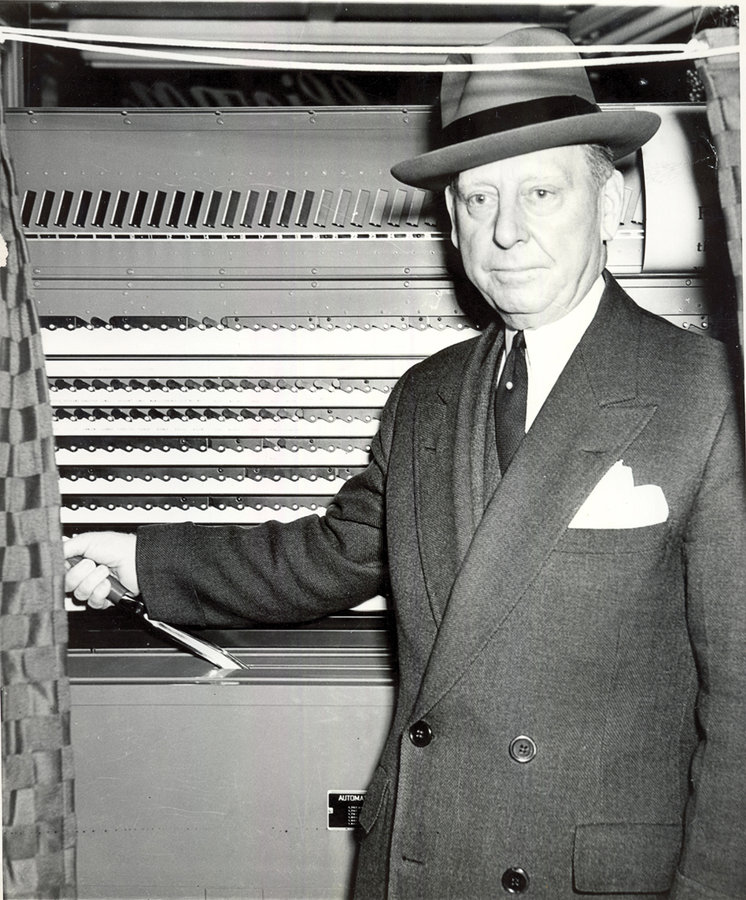
In 1943, Hague tried to recruit Moore for yet another term as governor, but Moore declined to continue running for public office, much to his dismay. Instead, Newark Mayor Vincent J. Murphy was the nominee, but he was up against someone who had done the job before: Walter Edge. Although Hudson County voted the strongest for Murphy of all counties, it was not enough, and Edge won the election by 11 points. Governor Edge proceeded to combat the Hague machine through his attorney general, Walter Van Riper, who initiated raids on a source of revenue for the Hague machine: protected horse race gambling establishments. Although Hague managed to get Van Riper indicted on trumped-up corruption charges, he was acquitted at trial, and some of the witnesses against him had probably committed perjury (Fleming). Furthermore, the Edge Administration got voting machines installed in Hudson County to crack down on fraud. However, Hague was, as mentioned in part I, quite skilled at getting turnout high without voter fraud, thus he and his machine were still able to win elections. However, a factor that had helped him win elections had started to chip away at his machine’s power: ethnicity. Hague’s rise was the rise of Irish Catholic voters, but Jersey City’s population was getting more and more Italian and Polish Catholics, and their general lack of representation in the machine was a sore spot. Another problem was that Hague was spending less time in Jersey City and more time in Florida, meaning that his deputy was increasingly serving as his mouthpiece; not quite the threat of Hague being there personally. Worse yet, the number of positions appointed by the governor that he had power over was declining since the longer he didn’t call the shots, the more people who were independent of him were appointed as the terms of his people expired. In 1946, yet another governor was elected who could not be counted on to supply patronage in Republican Alfred Driscoll, who would also succeed where Edison could not in getting the New Jersey Constitution updated, and this included replacing the New Jersey Court of Errors and Appeals with the New Jersey Supreme Court. On June 4, 1947, Hague resigned, having his nephew Frank Hague Eggers take his place. However, it was soon clear that Eggers was taking orders from Hague; Hague had racked up massive phone bills for his calls from Florida to New Jersey. Thus, he was still essentially acting as mayor, much of the time doing so from Florida.
1949: The Year of Hague’s Waterloo, and The End
In the mayoral election, it was former ally John V. Kenny, the son of saloon owner Nat Kenny who had loaned Hague money for his first ever campaign, against Frank Hague Eggers. As mentioned earlier, Italian and Polish Catholics were out in the cold from the Hague machine, and Kenny took advantage of this development as well as money he received from Republican sources. A sign of Hague’s waning power was when at a campaign event Hague, his nephew, and others in his entourage were pelted by eggs by the crowd and while the others retreated, Hague stood and stared down the crowd when a man screamed at him “G’wan back to Florida!” and he in turn pointed at the man and shouted “Arrest that man!” (Fleming) However, the police officers present were not supportive of Hague, and thus did nothing, a marked contrast to Hague’s days of power in which police would indeed arrest, and probably work over, that man. Indeed, all those who had problems with Hague and his machine lined up behind Kenny, and he did win the election. Although you might think this a happy ending, it should also be noted that although the typical vote-buying practices were used by the Hague machine to try to hold on, the Kenny campaign also bribed voters, and crucially paid more per bribe at $15, $10 more than the going rate the Hague campaign was employing (Fleming). Kenny’s victory in truth was not one for good government, even if many of his supporters saw it that way, rather it replaced one corrupt regime for another. However, Hague still had numerous public officials behind him in Jersey City, thus he still had a lot of power behind the scenes. The best way Hague could reaffirm his power at this point was to secure the election of a Democratic governor.
Up for reelection in 1949 was Republican Alfred Driscoll, and Hague had found a candidate who was pretty good on paper to run against him in former Congressman Elmer Wene, who had represented the normally Republican 2nd district, which includes Atlantic City, in Congress for three terms. If Wene had been elected, Hague could count on him to appoint a prosecutor on his side, and with Hague still having control over grand jury selection, he could get convictions on Kenny officials (Fleming). However, the man who defeated Hague here was Hague himself. He made a fatal blunder when he declared, “We’ll be back in the driver’s seat in Trenton in January” (Fleming). Republicans were thus able to campaign against Hague yet again in this election, and Wene lost. Kenny had taken lessons from Hague here on what he did in the 1916 gubernatorial election by pulling back his political machine, and Hudson County delivered less for the Democrats than usual. The power of Hague in Jersey City was now completely broken, and he stepped down as the leader of the Democratic Party in New Jersey and in Hudson County. He would nonetheless retain his post as vice chairman of the DNC until 1952. In his twilight years, Hague seemed to have some remorse over his actions in office as he would call one of his old City Hall men in the middle of the night and ask him to see if the families of people he had ruined during his time in office needed assistance, but they would invariably either slam the door on the official or flatly refuse help (Fleming). Hague only returned to New Jersey in a casket after his death on January 1, 1956. Not many sent flowers on his departure, as he was a feared, not a loved figure. One elderly woman held up a sign at his funeral that read, “God have mercy on his sinful, greedy soul” (Time Magazine, 1956). Those who supported him did so out of a feeling that Jersey City, and particularly its majority Irish Catholic residents, had needed a fighter.
Was Hague Left or Right? Does it Matter?
There are several ways to interpret Frank Hague politically. There are numerous indicators that point him to the left, including his support for Wilsonian progressivism, his steep tax increases for corporations, his high tax and spend regime as mayor, his extremely high level of public employment, and his establishment of mostly socialized medicine at his hospitals. Furthermore, he was a strong booster of FDR and the New Deal. However, Hague supported people of numerous stripes for public office along with Roosevelt. He backed liberals such as Mary Norton for Congress but also more conservative types in the Democratic Party such as Edward Edwards and A. Harry Moore for governor. He also even supported Republican Harold Hoffman for governor, who had had a conservative record while in Congress. Hague’s campaign against the CIO and communism in 1938 can certainly not be called liberal, nor can his strong use of police or his crackdown on prostitution. Yet, what we can see in these endorsements and most of his actions are moves that increased or maintained his power. Supporting FDR was the smart thing for him to do and strongly contributed to him getting to the height of power, likewise the militant Congress of Industrial Organizations he certainly saw as a threat to his power. His support of Edwards, Moore, and Hoffman were for the purposes of getting his people in public positions, thereby maintaining and growing his power. He was willing to work with anyone who would elevate his power. How does one split the ideology from Hague and what fits into his overall schemes for power? There was, I think a certain authenticity on his anti-corporate pushes as well as his crackdown on prostitution. He was genuinely supportive of pushing back against big business and his crackdown on prostitution was in line with his Catholic morality. Frank Hague was the most powerful of all the city bosses, perhaps in US history, and unlike some others such as Jim Curley of Boston and Thomas Pendergast of Kansas City, he avoided jailtime.
References
Fleming, T. (1969, June). The Political Machine II: A Case History ‘I Am The Law”. American Heritage, 20(4).
Grand Rapids, Michigan, although currently represented by a Democrat due to the 2020 redistricting, has a long history of Republican representation in Congress with few Democratic breaks in between. Its most famous politician of all time of course is Gerald Ford, and as so many others who make it to the top, he had to overcome a hurdle to get his start. This hurdle was Bartel John “Barney” Jonkman (1884-1955). On December 12, 1939, Grand Rapids’ longtime Congressman Carl Mapes (R-Mich.), died, and elected in his place in 1940 was Jonkman, an attorney who had previously served as the prosecuting attorney of Kent County.
Jonkman, much like Michigan’s senior senator Arthur Vandenberg was among the numerous Americans of Dutch heritage in the state; his father, Reverend John B. Jonkman, had immigrated to the US with his wife Sarah from the Netherlands in 1882. The district he represented even had a strongly Dutch portion known as “Little Netherlands”, which would regularly vote strongly for him (Time Magazine). On domestic issues, Jonkman was a strong Republican, staunchly opposing economic controls, New Deal programs, and seldom supporting significant liberal measures, with his vote for a school lunch program in 1946 being one of the few exceptions he made. On civil rights, Jonkman voted to ban the poll tax four times. As a member of the House Foreign Affairs Committee, he was before Pearl Harbor a voice for non-interventionism; indeed, Michiganders in general were against American involvement in World War II and the Republicans were unified against it. A competent partisan, his views were among the more relevant in Congress as a member of the Foreign Affairs Committee, and he was the subject of an analysis by Isaiah Berlin in 1943 for the British Foreign Office, who described him as “ the fourth of the Republican Opposition group on the committee. An agreeable man, shrewd, capable and very determined in his opposition to the Administration in both its foreign and domestic policies. Pure Isolationist before Pearl Harbor, and, in fact, typical of the Michigan Republican Bloc (whose most notorious member is Clare Hoffman). Seems convinced America is playing Santa Claus again in this war, and is doing his best to obtain facts and figures which will show up this fact. A Methodist; age 59. Nationalist” (Hachey).
Although Jonkman did support the idea of an international peacekeeping body after World War II, supported aid to Greece and Turkey, and supported the Marshall Plan, he was opposed to anything further. In 1946, Jonkman voted against a loan to Great Britain and the following year when the Republicans were in the majority, he pushed a cut in postwar aid to Europe that passed the House. However, the Senate overwhelmingly turned it down, with even some who were normally critics of foreign aid going against the cut. The House then agreed to the Senate’s restoration. Jonkman also voted against a bill in December 1947 providing interim aid to Europe, which Congress commandingly voted for. Despite his vote for the Marshall Plan, he would criticize the European Recovery Program (ERP), frequently referring to it as “burp” (Time Magazine). Ideologically, he sided with the liberal Americans for Democratic Action 12% of the time and his DW-Nominate score was a 0.394. While he was not a man of zero compromise like fellow Michigander Clare Hoffman, his foreign policy views attracted the opposition of 34-year old World War II veteran Gerald Ford.
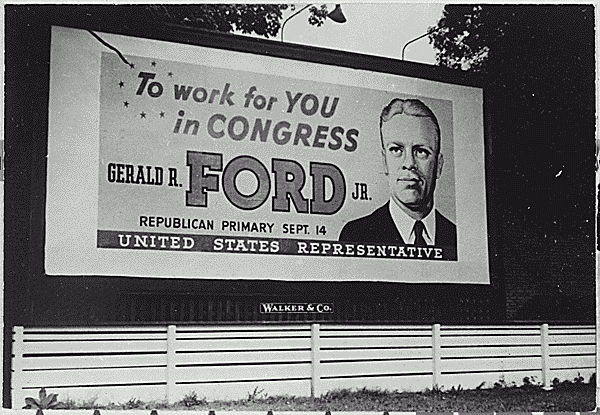
In 1948, Ford, who had dropped his non-interventionist ways while serving in World War II, challenged Jonkman for renomination, running on an internationalist platform, much like his mentor and political hero Senator Arthur Vandenberg. Both Ford and Vandenberg had been on the same page as Jonkman before Pearl Harbor; Vandenberg was one of the most notable Senate spokesmen for the non-interventionist cause and Ford was a member of the America First Committee. They had changed, and while Jonkman had too, he had not done so nearly as much. He repeatedly refused calls by Ford to debate him on foreign policy and generally dismissed his campaign (Time Magazine). This turned out to be a catastrophic underestimation of the young man, as he ran a highly effective campaign of hundreds of volunteers canvassing neighborhoods to promote his candidacy. Ford won the Republican primary by a 2-1 margin. Times had changed in Michigan, once one of the most non-interventionist states in the nation. Jonkman returned to practicing law in Grand Rapids, doing so until his death on June 13, 1955. Jonkman would not be the only man Ford would topple in Republican politics; he would win a vote to supplant Congressman Charles Hoeven of Iowa for the post of chairman of the House Republican Conference (the third highest post in House Republican leadership) in 1963 and after the 1964 election he would win a vote to oust Minority Leader Charles Halleck of Indiana from his post. This put him in the leadership position necessary to be considered for vice president with the resignation of Spiro Agnew in 1973.
References
ADA Voting Records. Americans for Democratic Action.
Hachey, T.E. (Winter 1973-1974). American Profiles on Capitol Hill: A Confidential Study for the British Foreign Office, 1943. The Wisconsin Magazine of History, 57(2), pp. 141-153.
Although Hague had managed to get the lesser of the Republicans in his view, that Republican nonetheless won the gubernatorial election and indeed New Jersey had a Republican wave with Herbert Hoover winning the state by 20 points; only Hudson County voted for Democrat Al Smith. Hague had had a good run of the 1920s up to this point, having Democrats Edward I. Edwards and A. Harry Moore as governors, who could be counted on to do what Hague wanted. The same was not true for Republican Morgan F. Larson, even though Hague had collaborated with Republican Atlantic City boss Nucky Johnson to elevate him over Democrat William Dill (Murray, 26). The Republican-controlled legislature sought to take down Hague, and they focused on an area in which he was vulnerable – taxes.
Hague’s Trouble with Taxes
Frank Hague’s city government taxed quite high for the services it provided as well as for a bloated public payroll; not all “jobs” came with functions. Indeed, the cost to taxpayers for Jersey City’s government was over four times that of Kansas City and New Orleans, also ruled by bosses and both with about 100,000 more people (Life Magazine).
As mayor of Jersey City, Frank Hague’s annual salary did not exceed $8500 annually. Yet, Hague, who came from modest means, was worth millions now, and the only income he ever reported to the Treasury was his mayoral income. In addition to other sources I mentioned in my last post, he received protection money from horse gambling establishments that ran numbers rackets, and Jersey City got the reputation of being the “Horse Bourse” (Fleming). He also would receive bribes at his office. There was a desk in which the visitor would place cash on the drawer on his side, and it would come out on Hague’s side (Isherwood). Although he was compelled to answer questions about his taxes to the New Jersey legislature, he refused to answer, and they cited him for contempt. However, the Court of Errors and Appeals ruled that the legislature lacked the authority to probe an individual for felonies, only the courts did. Hague did end up having to pay $60,000 to settle with the Federal government, and his reputation as a reformer mayor was gone. In 1929, he would face his closest call as mayor against James F. Murray, a young reform Democrat, but prevailed in an election in which between 20-30% of signatures in the poll book were fraudulent and numerous people were paid to vote multiple times (Murray, 24). Throughout his career he continued to make millions while only paying the taxes on his mayoral salary. Perhaps this would have been the beginning of the end of his reign had it not been for the Great Depression, and Republicans became highly unpopular nationwide. The Great Depression also helped Hague as his machine kept on going and kept supplying public jobs, a source of relief for numerous Jersey City residents (Fleming). He might have run into more trouble with his taxes had he not gained a crucial partner in politics…Franklin Delano Roosevelt.
FDR and Hague…a Quid Pro Quo Partnership
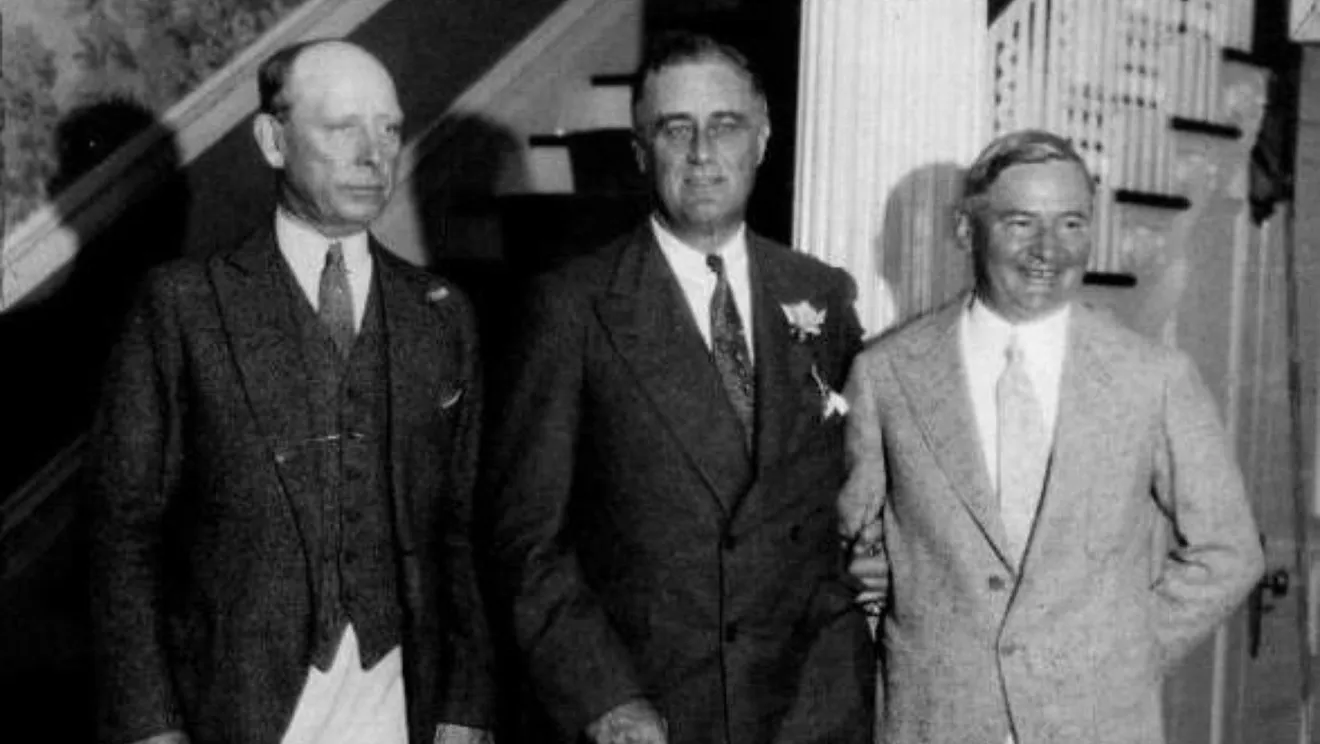
Hague, Roosevelt, and Governor A. Harry Moore, 1932
With the Great Depression in full swing, the Democrats were in the perfect position to win the next election, but who was the nominee going to be? Hague had a history of loyalty to New York’s Al Smith and indeed he initially endorsed Smith for the primary, even attacking Roosevelt by asserting that despite him being New York’s governor that he could not “carry a single state east of the Mississippi and very few in the Far West” (Fleming). However, New York City’s James A. Farley outmaneuvered him at the Democratic National Convention and FDR won the primary. Hague came around to FDR and he offered to host his first general election campaign rally. Roosevelt’s general election campaign kicked off in Sea Girt, New Jersey, on August 27, 1932, with Hague managing to get a turnout of 120,000, an incredible figure (Congressman Frank J. Guarini Library). Hague had also hosted a rally for Al Smith at Sea Girt in 1928. Although Democrats today are expected to win New Jersey in Federal elections, this was far from always the case; in 1930 Republican Dwight Morrow had won a Senate seat by nearly 20 points, and although Roosevelt’s win was a landslide in 1932, he only won New Jersey by 2 points, and that he won at all was thanks to Hudson County. Roosevelt was thankful for Hague’s help and directed Federal patronage in New Jersey to him; usually patronage went to a Democratic governor (at the start of the Roosevelt Administration it was Hague front man A. Harry Moore) or the leading Democratic senator in a state. This gave Hague all the more power, and he used the $47 million he would receive in Works Progress Administration funds for Jersey City to construct Roosevelt Stadium as well as finish the aforementioned Jersey City Medical Center. From 1936 to 1943, New Jersey would receive over $400 million in Works Progress Administration funds, one of the highest for a state (Murray, 23). Although Hague’s influence was already a bit national with his post as vice chairman of the Democratic National Committee, it was furthered now. Although Roosevelt is seen as an anti-machine politician and he denied patronage to New York City’s Tammany Hall, he let it flow to Hague’s machine. Hague also managed to get Moore elected to the Senate in 1934. In 1936, Roosevelt won reelection in New Jersey by 20 points, and Republican Senator Warren Barbour lost reelection. In 1940, Hague, along with Mayor Ed Kelly of Chicago (who ran his own corrupt machine), started up the push for Roosevelt to be nominated for a third term, which propelled him to win the primary and general election. Hague would also be of great help in the 1944 election. He was indispensable to Roosevelt, and both benefited from each other. However, this meant that sometimes Hague had to do things for Roosevelt that he’d rather not do, such as support Charles Edison for governor in 1940, but the full telling of that will be for part III.
Hague’s Other Pals
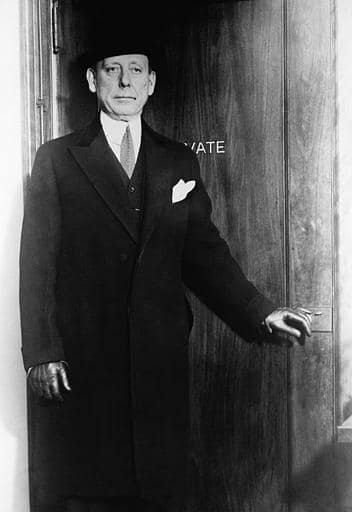
Hague managed to command many allies in New Jersey, including from both parties. Quick to court women voters once they gained suffrage, he got Mary Teresa Norton into politics, and got her elected to Congress representing Jersey City’s southern wards. Norton would be the sponsor of the Fair Labor Standards Act, also known as the law that established the Federal minimum wage. The first Democratic governor that he managed to get in, Edward I. Edwards, who served from 1920 to 1923, allowed Hague to raise taxes on corporations substantially, got him some allies on the public utility commission as well as on the Hudson County tax board and board of elections (Congressman Frank J. Guarini Library). He was allied to him until 1930, when he wanted to again be governor, but by this time Edwards’ career, finances, and general well-being were in free-fall, and after a skin cancer diagnosis the next year he took his own life. Hague’s success in electing Edwards in the 1919 election got him elected the chairman of the New Jersey Democratic Party, a position he would hold for 29 years. George Silzer was another who owed his career to Hague, serving from 1923 to 1926. He most importantly picked Hague’s choice for prosecutor of Hudson County (Frank J. Guarini Library). Hague’s greatest front man statewide, however, was A. Harry Moore, who served as governor from 1926 to 1929, 1931 to 1934, and 1937 to 1940. Hague had befriended Moore early in his career and the man had some advantages to him. First, Moore was Protestant (possibly the first Hague ever met), which made a difference in the minds of numerous voters back then as opposed to the majority Catholic population of Jersey City. Second, he had fiscally conservative tendencies (as a senator he was one of only three Democrats to oppose Social Security), which made him more palatable to Republican voters and let him get on fine with the Republican-controlled legislature. However, Moore most critically would be a party organization man up and down, meaning that he would support what Hague wanted in appointments, patronage, etc. This was especially vital when it came to getting a county prosecutor, thus Hague could direct prosecutions as he pleased. He liked Moore so much that he helped get him elected governor three times and tried to recruit him for a fourth time and got him a Senate seat. However, Moore’s credibility was damaged in his third term after he tapped Hague’s son, who had twice failed to get through law school yet passed the bar, to the Court of Errors and Appeals, the highest court in New Jersey at the time. When Moore exited the Senate in 1937 to serve again as governor, his temporary replacement, John Milton, was Hague’s longtime attorney. Speaking of the state’s highest court, he managed to get his crony, his corporate counsel Thomas J. Brogan, tapped by Governor Moore to be its chief justice, and he served from 1933 to 1946. Hague was able to get some Republican state senators to back him up, which helped him exert some influence over that legislative body, but he was never able to exert control over the Assembly, which was Republican and was just itching to find a way to get him out of office. As for his Republican friends…
“Hague Republicans”
Frank Hague not only managed to become the leading figure of the Democratic Party in Hudson County and New Jersey, he came to dominate the Hudson County Republican Party and command some statewide influence through some of his followers registering Republican in Hudson County. As I wrote in part one, 20,000 people who registered Republican in Hudson County were able to tip the results of the 1928 Republican gubernatorial primary. The Hudson County Board of Elections also had Hague Republicans at the helm, and he managed to turn Republican T. James Tumulty to supporting him (and switching parties) after offering him a job, but the most prominent Hague Republican was Harold G. Hoffman.
In 1934, Democrat William Dill was running for governor again, and although officially backed by Hague, he lost the election to Hoffman, a personally popular figure. Hague turned out to be pretty fine with Hoffman as governor as he likely knew that Hoffman had sticky fingers; per Hoffman’s confession letter revealed after his death he had throughout his political career embezzled over $300,000 from the government positions he had held (Murray, 2024, 58-60). Thus, he made deals with Hague and provided considerable patronage for his machine and came to him for support after Republicans soured on him for his backing of a sales tax. Hoffman also supported certifying the election before an investigation was done, did not support any investigations into Hudson County voting practices, and refused to back the recount of the 1937 election in which A. Harry Moore was once again elected governor (Murray, 2024, 58). Speaking of the 1937 election…
The Stolen Gubernatorial Election
In 1937, Hague faced yet another figure in the GOP he didn’t want to contend with in Lester H. Clee, who he hadn’t been able to prevent from winning the nomination. Clee was a strong opponent of the Hague machine and was eager to act against him. Hague had a lot to potentially lose, and on Election Night 1937 Clee was leading by 80,000 votes…at least until the results of Hudson County were tabulated, and Moore came out over 45,000 votes ahead statewide. The official tally had Moore leading Clee by 129,137 votes in Hudson County while Democrat William Dill had led Harold Hoffman by 89,127 votes in 1934 (Murray, 33).
The Hague machine went all out to prevent the election of Lester Clee, and the Republican legislature sought a recount. There was undoubtedly fraud that came out of the election results of Hudson County, as the number of people who were recorded as having voted exceeded the number of eligible people. Some examples of fraud included a rabbi who had moved to Massachusetts three years earlier was recorded as having voted in Hudson County, an institutionalized man was recorded as voting, and people who were confirmed dead were recorded as having voted (Johnson). The recount was performed, but Clee didn’t gain much. The case went up to the Court of Errors and Appeals, and Hague’s man, Brogan, was invaluable in defending the machine from judicial consequences, only permitting a retabulating of cast ballots, not an investigation into the integrity of the election itself (Murray, 38). The high court declined to investigate the election, thus the Assembly pursued the investigation. What the legislature needed was access to the registration list and poll books, and that was something the Hague forces blocked with numerous tactics, including a claim that Board of Elections Commissioner Charles Stoebling, a Republican tied to Harold Hoffman and had custody over the records, was desperately ill at home. Ultimately, the New Jersey legislature was unable to procure the books, as Jersey City police blocked access to the records (Murray, 53). Furthermore, the Hudson County Board of Elections stuck behind Hague (as they were wont to do) and outgoing Republican Governor Harold Hoffman, as mentioned earlier, was outspoken in his support of the election outcome, and his appointees, including the superintendent of the New Jersey State Police, were not inclined to help with the investigation. Democratic Attorney General David Wilentz, another Hague man, went against the investigation. Hoffman’s allegiance with Hague permanently damaged his standing with New Jersey Republicans, and when he sought the nomination for governor in 1940, which was publicly supported by Hague, he was defeated, the nomination going to anti-Hague Republican and future Senator Robert Hendrickson. The investigation came to a screeching halt when the Court of Errors and Appeals ruled 12-3 that it was unconstitutional (Murray, 59). In 1940, the Senate decided to investigate the 1937 gubernatorial election, but they found that when they asked for the voting books of that election that they had been burned. No, this was not customary; other voting books had not been burned.
Hague’s Quirks
Mayor Hague was eager to counter stereotypes about the Irish and drunkenness, thus he was a resolute teetotaler throughout his life. Although his political career had started out with a loan from a saloon owner, he didn’t come there to drink alcoholic beverages, rather because he had realized this was where local political discussions occurred and where the local political power was. This didn’t just apply to him, if you were seated at a table with Hague, you were not to order an alcoholic beverage, and it was known that at dinners in which Hague was in attendance that people could not start ordering alcoholic beverages until he left, which he would before everyone else (Fleming). He also did not smoke and was a hypochondriac. Although there was much vice in his political behavior, there was no evidence of him straying from his marriage. This is similar to fellow Irish Catholic boss Jim Curley of Boston, who was highly politically corrupt but faithful to his wife.
Hague vs. the CIO and Communists
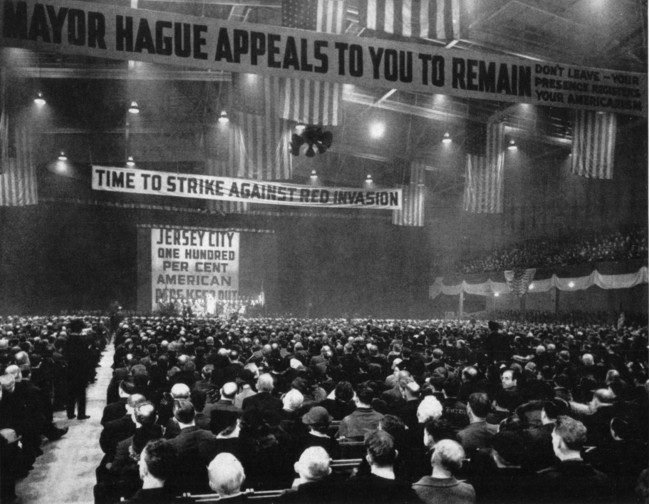
An anti-communist rally held by Mayor Hague
Frank Hague was initially a supporter of unions and could get along fine with the American Federation of Labor (AFL), which represented skilled craft laborers. However, in the 1930s a new union arose in the Congress of Industrial Organizations (CIO). This union was more radical than the AFL and represented unskilled laborers, and when they tried to get into Jersey City, Hague was hostile. He already taxed high for his government, and he was eager to attract business to the city. One way he could do that was to block the CIO. Union organizers were arrested for handing out leaflets on the streets. Hague was once alleged to have said “I am the law”, and although the truth has a little more context to it than that, it is undoubtedly true that this was the reality in Jersey City. He also banned the CIO from conducting meetings and no establishment would risk hosting them lest a city inspector come along and inevitably find code “violations” (Fleming). Hague justified his actions on the grounds that he believed that the CIO organizers were communists. His understanding of communism, however, seemed a bit limited. He said in one speech to the Jersey City Chamber of Commerce, “We hear about constitutional rights, free speech and free press. Every time I hear these words I say to myself, “That man is a Red, that man is a Communist” (Vernon, 96). Despite Hague’s stated opposition to communism, he had some similarities to them. His hospital and maternity were mostly funded with public money and his approach has even been called “municipal socialism” (Congressman Frank J. Guarini Library). During this time it was discovered that Mayor Hague was tapping phones, a part of the police state he ran. Hague used a Jersey City ordinance requiring permits from the chief of police for the leasing of any hall, which invariably would not be granted to the CIO thus preventing meetings of any substantive size, to justify his repression of the CIO. However, the case was brought to the Supreme Court, which struck down Jersey City’s ordinance as unconstitutional 5-2 in Hague v. Committee for Industrial Organization (1939). This whole affair presented a terrible difficulty for the Roosevelt Administration, which counted both Hague and the CIO as major supporters, and the Roosevelt Administration did not intervene despite calls from the CIO to do so. Hague was ultimately forced to let the CIO in. Although his understanding of communism was not impressive, it is nonetheless true that there was a significant communist presence in the CIO and some chapters were outright dominated by communists. Although Hague was brought to heel on this one by the Supreme Court, he was still in the heyday of his power. This would start to change in 1940, when Hague would have to contend with one of Thomas Edison’s sons, Charles Edison.
References
Fleming, T. (1969, June). The Political Machine II: A Case History “I Am The Law”. American Heritage, 20(4).
Murray, J.M. (2024). Research Notes: The Real “Stolen Election”: Frank Hague and New Jersey’s 1937 Race for Governor. NJS: An Interdisciplinary Journal, 57-60.
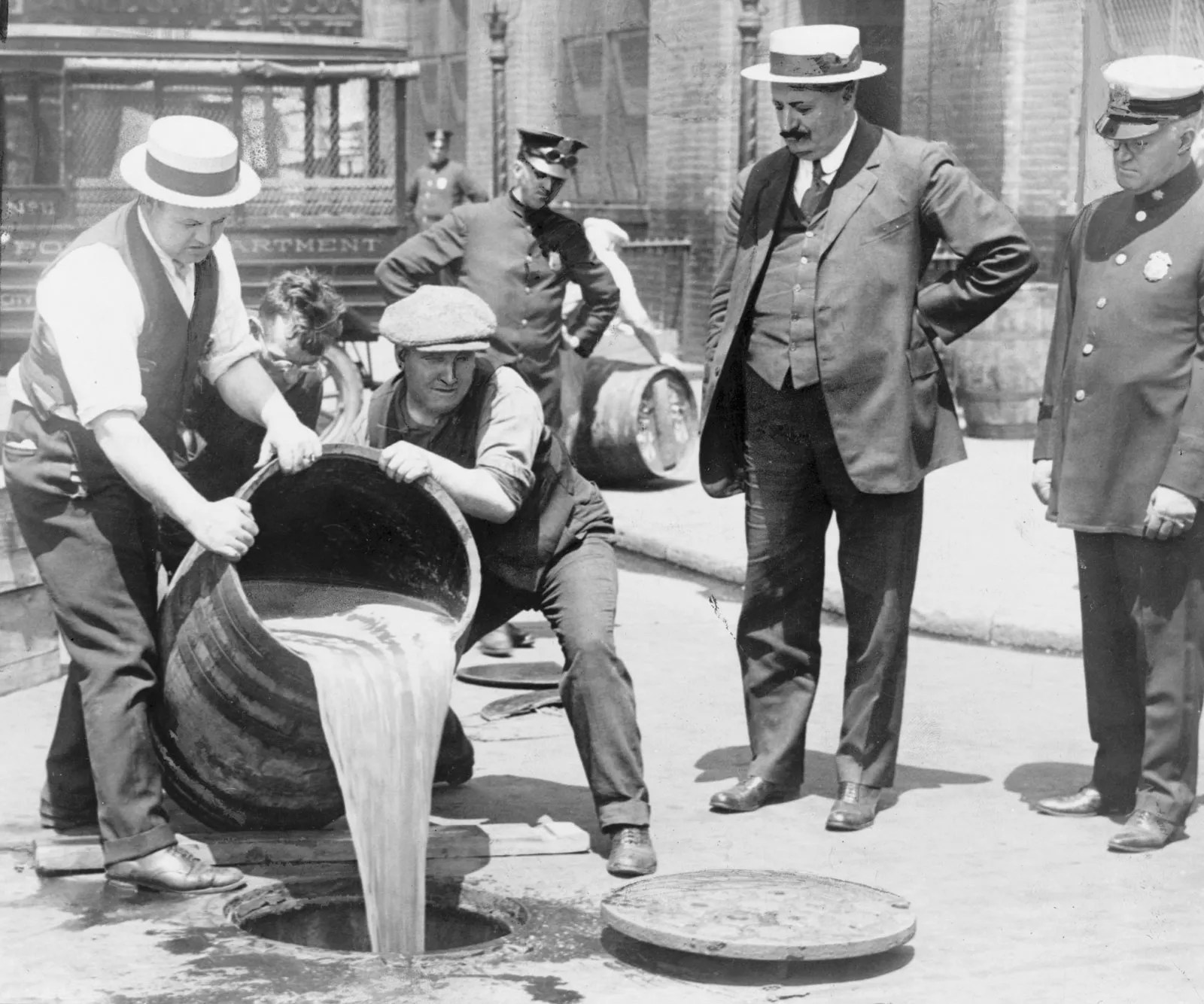
By 1917, the push for Prohibition was at its strongest. Wayne Wheeler of the Anti-Saloon League, a pioneer of lobbying tactics used today, was able to score many election wins across the country. Party didn’t matter to him as long as the individual was for Prohibition, and this plus World War I set the nation for Prohibition and against that which was German. Sauerkraut became temporarily known as “liberty cabbage” and since beer drinking is a strong part of the German culture, that was set upon too. On August 1, 1917, the Senate voted for Senate Joint Resolution 17, sponsored by Senator Morris Sheppard (D-Tex.), proposing a Constitutional amendment to prohibit the production, sale, and transportation of alcohol. The amendment was adopted 65-20 (D 36-12, R 29-8). The House followed up on December 17th, with the House side of the resolution sponsored by Charles Carlin (D-Va.) The amendment was adopted 282-128 (D 140-64, R 138-62, Prog. 2-1; Soc. 0-1; IR 1-0, Proh. 1-0). The different parties listed are Progressive, Socialist, Independent Republican, and Prohibitionist.
There was a strong rural vs. urban character to the vote on Prohibition, with major cities overwhelmingly voting against it. Although many conservatives voted for, there were a significant number of dissenters. Rural liberals were easily in favor, while urban liberals were always against. A few interesting nay votes came from Alabama, including that of Tom Heflin, who was known to favor Prohibition. Some of the votes against came out of a sense of state’s rights rather than opposition to what Prohibition was aiming to achieve. Interestingly, the most notable progressive Republicans, such as Borah, Norris, and La Follette, were supportive. Prohibition stands as a bit of an issue that can be supported or opposed from the left and right for different reasons. Indeed, alcohol does have a cost to society and progressives of the time were committed to using the forces of government to improve society, but conservatives could see this as a moralistic issue and also as a means of improving efficiency. After all, a sober worker is a productive worker. Democrats of the Jeffersonian school could see this as both treading on the states and an intrusion upon personal liberty. To examine how the votes stack up with ideology, at least as defined by DW-Nominate scaling, click the documents below. A checkmark means paired for and an “X” means paired against, bold italics means Republican, and plain text means Democrat.
Today Woodrow Wilson bashing is commonplace, with different ideological groups having their reasons to despise him. So this makes me wonder, why did the American public elect Wilson in 1912? Yes, its true that there was a divided GOP split between supporting Roosevelt and Taft and that mattered, but Wilson also won reelection in 1916. There was something else to this, and that was the one time before he held political office.
Woodrow Wilson was an academic although he had plenty to say and write about the politics of his day. For instance, his 1887 essay, “The Study of Administration”, is considered a foundational work for the establishment of Public Administration as a subject of study in the United States. However, it was his reformist tenure as Princeton’s president that got him a good public reputation. As its president, he strengthened academic standards, hired the first Jewish and Catholic professors, and created the preceptor system for education in small groups (Benbow). He also attempted to end fraternal eating clubs, which Wilson saw as elitist. In his eight years as Princeton’s president, he elevated the liberal arts college to the status that it has today as one of the top universities, which to me makes the removal of his name from the public policy school and a residential college excesses of the aftermath of the killing of George Floyd, and I’m not a Wilson fan!
By 1910, the Democratic Party in New Jersey hadn’t been doing well; the state had not voted Democratic in a presidential election since 1892, they had lost the last five gubernatorial races, and they hadn’t elected a senator from the state since James Smith Jr. in 1893. Thus, Smith, who was Newark’s political boss and Colonel George Harvey, the editor of Harper’s Weekly, approached Wilson in 1910 for a gubernatorial run. This timing was fortuitous for Wilson, who had dreamed of being president, and this presented an opportunity for him to have the public office necessary for a springboard. He agreed to do so, but on the condition that it came with “no strings attached” (Ambar). Smith and Harvey accepted this condition, as the Democrats had really needed to make a comeback, they wanted someone who was not attached to scandals of Democratic political machines, and Smith believed that since he was new to electoral politics that he could easily be influenced. Wilson pledged to be an “unconstitutional” governor of the State, in the sense that he would not abide by the status quo of the governor’s role, which was weak (Ambar). Once he won the primary, Wilson declared independence from political bosses. On the campaign trail, Wilson was charismatic and he contrasted positively with the Republican candidate Vivian M. Lewis, who was connected to several scandals, and he won by around 11 points.
After he won the election, Wilson went to battle against political machines, including that of James Smith Jr. Smith had wanted to return to the Senate, but Governor Wilson announced his support for outsider James Martine, and pushed the Democratic legislators to back him. Martine won the vote, and Smith’s political career came crashing down over the next few years. Ironically, Wilson would later be quite displeased with Martine for his independence from him as president. Colonel Harvey would also turn against Wilson during his first term.
As governor, Wilson was different from his predecessors. He would personally visit the legislature to individually lobby legislators to vote for his preferred legislation and through this method he succeeded in getting most of what he wanted in the fairly short time he was governor. Wilson succeeded in getting the Geran Act passed, which instituted primaries, thus political bosses could no longer choose nominees. He also signed into law a worker’s compensation bill, education reform, a bill regulating public utility rates, and a campaign finance law. As one of his last acts as governor, Wilson signed into law what was popularly known as the “Seven Sisters Law”, which effectively abolished trusts in New Jersey. The state had previously been a haven from anti-trust laws and Standard Oil had moved there after Ohio instituted an anti-trust law in 1892. Although this law was repealed under the next Republican governor, it helped further the trend of businesses moving to Delaware to incorporate. Wilson was thus seen as both a progressive and highly effective governor. His experiences at Princeton seemed to prepare him for his role as governor, as he reflected, “The bunch of New Jersey politicians I have been dealing with are neophytes in the arts of intrigue compared with some of these Princeton politicians” (Blackwell). The American public at the time was tired of the Old Guard of the Republican Party and quite interested in progressivism. After all, this was the time in which the Utopian novel was still a popular genre…people dreamed big, and they dreamed of government improving society. His closest possible competition in the Democratic Party was Speaker of the House Champ Clark of Missouri, and it took 40 ballots at the Democratic National Convention before Wilson was nominated, and as we all know he would go on to serve two terms as president.
References
Ambar, S. Woodrow Wilson: Life Before the Presidency. UVA Miller Center.
In 1930, the nation was entering an economic depression and Prohibition was increasingly unpopular. These developments were both bad news for Representative Louis Cramton of Michigan. Cramton, who had served since 1913, was a Republican and one of the most outspoken supporters of Prohibition in the House. Although the 7th district of Michigan was quite Republican, he was not safe from a primary challenge. Enter Jesse Paine Wolcott (1893-1969), a World War I veteran who had served as the prosecuting attorney of St. Clair County since 1927. The central issue of this campaign was Prohibition. He supported repealing it, while the bone-dry Cramton stayed the course. The primary was very close, but Wolcott came out ahead by 25 votes (Hill). A primary defeat would not be so significant in Michigan until Gerald Ford’s defeat of Bartel Jonkman in 1948.
Wolcott was initially regarded with suspicion and even hostility from some staunch conservatives. As he recalled, “I was called a radical when I first went to Congress. Some of my GOP colleagues would hardly speak to me” (Hill). Indeed, Wolcott did cast a few votes that were outside of the GOP orthodoxy in his first few years. He was always staunchly for veterans’ bonuses, going against Presidents Hoover and Roosevelt as well as many fiscal conservatives. Wolcott also supported additional funds for emergency highway construction for the purposes of increasing employment in 1932. During the Roosevelt Administration, he largely opposed the New Deal, including voting against the Agricultural Adjustment Act, the Tennessee Valley Authority, the Gold Clause Resolution, the Reciprocal Trade Act, the Securities and Exchange Act, the Public Utilities Holding Company Act, and the Fair Labor Standards Act, but voted for the National Industrial Recovery Act, the Gold Confiscation Act in 1934, and Social Security in 1935.
By 1944, Wolcott was the ranking Republican on the House Banking and Currency Committee, and as a result he was one of six members of Congress to serve as a delegate at the Bretton Woods Conference, which established the World Bank, the International Monetary Fund, and the International Bank for Reconstruction and Development. A non-interventionist before World War II, as were all Michigan Republicans of prominence, Wolcott did come to support some major measures after World War II, such as aid to Greece and Turkey and the Marshall Plan in the name of countering communism. He was also sufficiently influential to sway 61 Republicans to vote for a loan to Great Britain in 1946 (Hill). However, Wolcott opposed foreign aid beyond what he saw as necessary to address communism, including voting against Point IV aid to poor nations in 1950. Although he was overall opposed to price controls, he did see some value in keeping them to a limited degree during World War II. In 1946, Wolcott sponsored four amendments that made it to a vote on price control; the first was reducing the extension of price control by three months, the second adjusting ceiling prices to costs of production plus reasonable profit, the third a gradual reduction of agricultural subsidies, and the fourth reducing funds for farm subsidies (CQ Almanac). All were passed. However, Wolcott believed that controls and subsidies should gradually be ended, and thus opposed the Wadsworth (R-N.Y.) and Flannagan (D-Va.) amendments. The former, which was voted down, promptly removed controls on livestock and its products, and the latter, which passed, promptly ended meat subsidies and adjusted the price ceiling from there. Wolcott’s stances were not always in line with many in his party, as many wanted the end to come quicker, but for this stance he was awarded the Collier Award for Distinguished Congressional Service with a reward of $10,000 in cash, which he donated to Michigan State University to fund scholarships (Hill). The 1946 elections produced the first Republican Congress since the Hoover Administration, and it propelled Wolcott to the chairmanship of the House Banking and Currency Committee.
Robert La Follette Jr., Harry S. Truman and Jesse Wolcott.
Banking and Currency Chairman
The Banking and Currency Committee not only had jurisdiction over banking but also on economic controls and housing. Wolcott pushed an anti-inflation bill in 1947 that failed to pass under suspension of the rules that only extended economic controls over exports and rail transportation but left controls for the rest to voluntary agreements by industry as well as a housing bill in 1948 that had no public housing or slum clearance provisions but had provisions supported by the real estate industry (Americans for Democratic Action, 1948). Wolcott was opposed to the proposed Taft-Ellender-Wagner Act with public housing and although his committee voted to override him and report the bill, the House Rules Committee bottled it up. However, with the next Congress being Democratic, the bill would be signed into law by President Truman. During the 1948 presidential campaign, Truman condemned Wolcott as a “mossback Republican”, or an extreme conservative, as part of his campaigning against the 80th Congress (Hill). Although he was indeed a conservative, he was not a Clare Hoffman or Noah Mason, who were absolutely uncompromising in their views on economic controls and foreign aid, and most everything else. After the defeat of the Republican Congress and the election of Truman in 1948, Wolcott was once again in the minority, and he continued to vote against the Truman Administration on most issues. By 1952, he believed that economic controls had gone on long enough in the Korean War and voted to end both price and rent controls.
In the 83rd Congress, with Republicans again in control, Wolcott was once again chairman of the Banking and Currency Committee, but perhaps his most notable role was serving on the committee investigating tax-exempt institutions. This committee was controversial in its initiation and its implementation, and Wolcott signed onto to the majority report that accused the Rockefeller and Ford Foundations of funding “subversion”, charges which they strongly denied (Hill). This is a subject I have covered before, and I must note that subversion in this case did not necessarily have to mean “communism”. In 1956, Wolcott was one of 24 Republicans to vote against the proposed Civil Rights Act of 1956, backed by the Eisenhower Administration. This was rather unusual for him, as he had repeatedly supported other measures in the past, such as anti-lynching and anti-poll tax bills. In 1954, he faced a bit of a scare when he had his worst reelection performance, getting 52.8% of the vote. He had not fallen below 56% before and he usually won with at least 60%. Wolcott’s district, which included St. Clair, Sanilac, Huron, Tuscola, and Macomb counties, had previously long been a bastion of Republicanism but was now moving to the Democrats. Perhaps not wanting to face another difficult campaign, Wolcott opted not to run another term. His protégé, Robert McIntosh, did win in 1956, but he lost reelection two years later to Democrat James O’Hara, who would be in Congress for twenty years in part thanks to redistricting that split up his old district. On ideology, DW-Nominate figured his score at 0.324, while he only agreed with the liberal Americans for Democratic Action 10% of the time from 1947 to 1956. Most of Wolcott’s old territory is today back under Republican representation.
Although he thought he’d be retired with the end of his time in Congress, President Eisenhower called him back into service when he nominated him to be chairman of the Federal Deposit Insurance Corporation, an institution that he strongly supported, and it was a post for which he was supremely qualified. Although normally a proponent of limited government, Wolcott thought the government insuring of bank deposits to be a tremendous good, stating, “I like to think of FDIC as probably the greatest institution ever conceived by man for his own safety and protection, and the protection of bank depositors. I do not think there is any organization in the world which has done so much to establish and perpetuate and maintain an economy such as that which makes America the greatest nation in the world” (Hill). He capably served as chairman until the end of the Eisenhower Administration, and then continued to serve on the board until his retirement from public life in 1964. Sadly, Wolcott would not enjoy retirement long; in 1966 he suffered a stroke from which he never recovered (Hill). He died on January 28, 1969 at the age of 75.
References
ADA Voting Records. Americans for Democratic Action.





 Mad Politics: The Bizarre, Fascinating, and Unknown of American Political History