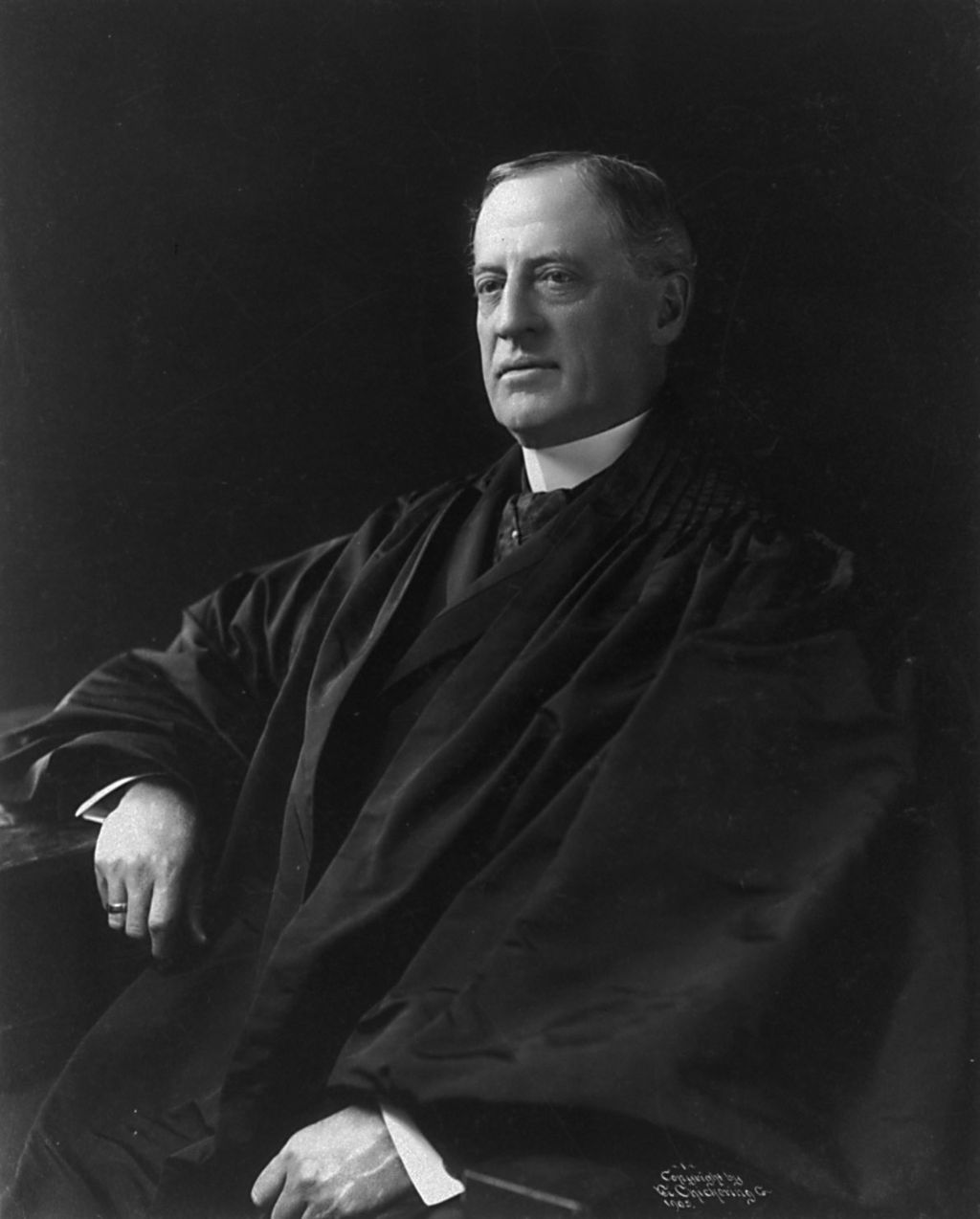
Colt as a Judge
LeBaron Bradford Colt (1846-1924) has a first name that is most unusual and a last name that is most recognizable. His last name automatically makes you think of a gun, and this is because his uncle, Samuel Colt, invented the revolving cartridge chamber in 1836, the key mechanism of the Colt revolver. This gun could fire six times without having to reload, a major advancement in firearms at the time, and was the first revolver in the US viable for mass production. The Colt revolver helped give the US army an advantage in the Mexican-American War and in westward expansion in general. Colt himself, however, did not see battle. Rather, he attended Yale University and then Columbia Law School, starting to practice law in the early 1870s in Chicago. He would ultimately settle and practice in Rhode Island, and would opt to start a political career, serving two years in the Rhode Island House of Representatives. Colt’s legal abilities were clearly highly thought of by President Garfield, who nominated him to the US District Court for the District of Rhode Island in 1881, for which the Senate confirmed him. President Chester Arthur would promote him to the First Circuit Court in 1884 and the Senate would again confirm him.
Senator Colt

Colt being a highly respected judge and out of political thicket for a long period of time helped gain him support for election to the Senate in 1913, by which time he was 66 years old. There, he was an opponent of the agenda of President Wilson generally during Wilson’s first term, voting against tariff reductions and against the Federal Reserve. He generally opposed measures that had a class tinge to them, such as a 1916 proposal to make income tax records open to public inspection. Colt also voted in favor of strengthening American defensive capability with the war in Europe raging. Appropriately, one of the committees he served on was the Judiciary Committee. Interestingly, after Wilson was reelected in 1916, he played ball with the Wilson Administration a bit more. That year, he sadly faced a loss with his son, LeBaron C. Colt, succumbing to a combination of a severe cold and possibly internal injuries as a result of an auto accident in which his car plunged into Narragansett Bay (Fall River Globe).
Colt supported entry into World War I and was one of the Republicans who sided with President Wilson on the Sedition Act, including voting against the France Amendment which would have provided a protection for telling the truth. On matters of economics, he was strongly conservative. On July 21, 1917, he was one of only 12 senators to vote against granting authority to President Wilson to control coal prices in wartime. Although Rhode Island was becoming less reliable for Republicans, especially with the Constitutional amendment for the popular vote of senators, Colt nonetheless won reelection in the good Republican year of 1918.
On the debate on the Versailles Treaty, Colt was among the mild reservationists, or those who supported the treaty but with reservations less impactful than those proposed by Majority Leader Henry Cabot Lodge (R-Mass.). He was nonetheless among all save one of the Republican senators who voted against the Versailles Treaty with no reservations. Colt also voted for the Prohibition and women’s suffrage amendments. During the 1920s, he was largely a supporter of the conservative agendas of Presidents Harding and Coolidge, and even changed his previous support of the popular bonus bill to opposition in an effort to uphold Coolidge’s veto in 1924. Another notable part of his legacy was that as chairman of the Committee on Immigration, he was opposed to the trend of trying to drastically curb immigration and opposed Japanese exclusion. Far from the same could be said for all New England Republicans; Senator William Dillingham (R-Vt.) had chaired a commission that called for strongly restrictive immigration policy on Eastern and Southern European immigrants, and Majority Leader Henry Cabot Lodge (R-Mass.) was a consistent and fervent supporter of immigration restriction. Colt was one of only two Republican senators to vote against the Immigration Act of 1924, which instituted the national origins quota, which prescribed immigration limitations based on the proportion of nationalities in the United States in 1890, which served to severely curb new immigration from people in Eastern and Southern Europe. Vito Famiglietti of the Sons of Italy wrote in praise of Colt that “although himself of old American stock, always comprehended the aims and aspirations, as well as the difficulties and problems, of immigrant peoples” (Rhode Island Heritage Hall of Fame). Colt would die four months after casting this vote of a heart attack on August 18, 1924. His DW-Nominate score overall indicated conservatism, with it standing at 0.426.
References
Colt, LeBaron Bradford. Voteview.
Retrieved from
https://www.voteview.com/person/1957/lebaron-bradford-colt
LeBaron Bradford Colt. Rhode Island Heritage Hall of Fame.
Retrieved from
https://riheritagehalloffame.com/LeBaron-Colt/
LeBaron C. Colt Failed to Rally From Injuries. (1916, May 26). Fall River Globe, p. 3.
Retrieved from
https://www.newspapers.com/image/616788119/
Sen. L. Colt Dies of Heart Attack. (1924, August 18). San Angelo Evening Standard, p. 1.
Retrieved from
 Mad Politics: The Bizarre, Fascinating, and Unknown of American Political History