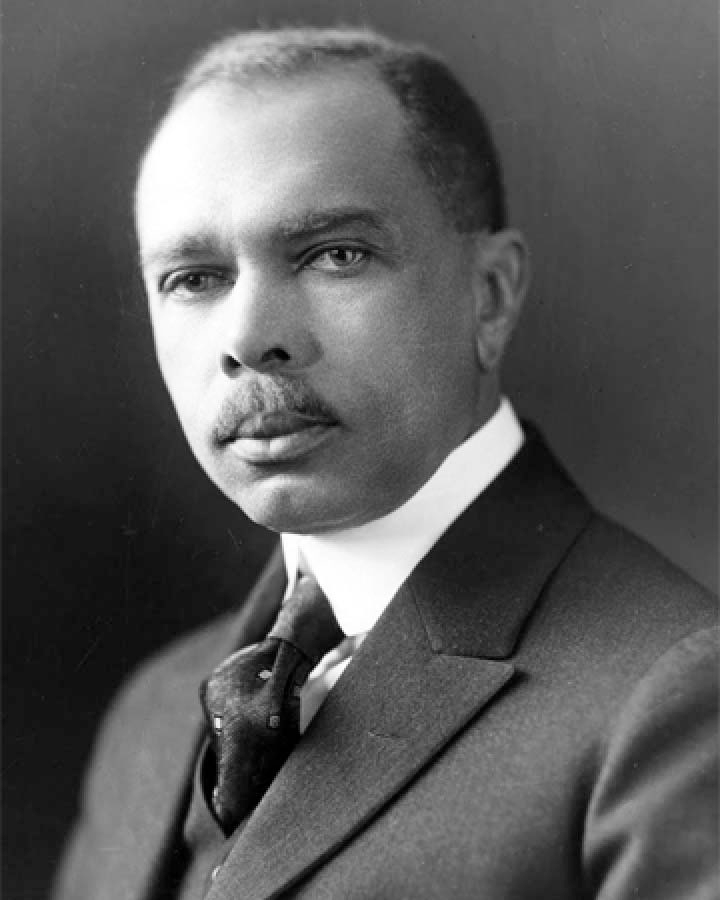
James Weldon Johnson, Executive Secretary of the NAACP Who Pushed for Anti-Lynching Legislation.
I have recently been doing a dive into trying to create what a theoretical Senate vote on the Dyer Anti-Lynching bill would have been had it came for a vote. Although the NAACP’s Executive Secretary James Weldon Johnson and other black civil rights activists laid the blame for the failure of the Dyer Bill on the Republican Senate majority for not pushing it as hard as the Southern Democrats had been resisting it and indeed this impacted the GOP’s popularity with black voters, I wonder now if such an evaluation is based on good legislative math. Let’s start with the composition of the Senate. At the time of the filibuster, Republicans held 59 seats, or 61% of the Senate and the Democrats 37. The votes needed to end debate on the filibuster was 64, as the cloture rule in the Senate in 1922 was that 2/3’s of the Senate could vote to end a filibuster. Thus, the Republican leadership could have won cloture had they no defections plus five Democratic senators, or 14% of Democrats. In the House, 93% of Republicans and 7% of Democrats had voted for the Dyer bill. However, Republicans did have defections. The most prominent was the famously independent-minded William Borah of Idaho, who had initially supported the bill until turning against it as he thought it unconstitutional. Indeed, in the Senate Judiciary Committee the vote to report the bill was 8-6 with the votes all being Republican and the dissent being five Democrats plus Borah. While we’re at counting the opposition, we can count all Southern Democrats (22 senators) by default, as all House Southern Democrats were against too. We can also count Senators James Reed of Missouri and Thomas Walsh of Montana, as they voted against the Dyer bill in committee. We also can probably safely include Augustus Stanley of Kentucky and Robert Owen of Oklahoma as opposed, as with only the exception of Rep. Ben Johnson of Kentucky Border Democrats in the House opposed. We can also probably count Henry Myers of Montana as against, as his record on race was worse than Walsh’s, having voted to exclude black women from the 19th Amendment’s coverage. Thomas Bayard Jr. of Delaware can probably be counted too, as his father was a strong opponent of civil rights measures, and he cast a vote for segregation in bathing houses in D.C. in 1924. However, it should be noted for the latter that Henry Ashurst did too, and he was known to support. William King of Utah and Key Pittman of Nevada can likely be counted as well in opposition, given that their votes on Seante consideration of anti-lynching legislation in the 1930s indicated opposition. There are also two other Republicans who can be placed in the opposition column. There is James W. Wadsworth Jr. of New York, who seriously doubted the bill’s constitutionality (The New York Age). He would subsequently oppose anti-lynching legislation in 1937 and 1940 as a member of the House. There is also George W. Norris of Nebraska, who is known to have opposed anti-lynching legislation, fearing that its enactment would result in another War of the Rebellion (Barnes, 6). Two other possibilities for opposition on the Republican side are Frederick Hale of Maine and James Couzens of Michigan. Hale was one of three Republicans in 1938 to vote to set aside the Gavagan Anti-Lynching bill for appropriations legislation, and Couzens voted with George Norris to adjourn on the Costigan-Wagner Anti-Lynching bill in 1935. So we have three, possibly even five votes against the Dyer Bill in the Senate.
For support, we can count Majority Leader Henry Cabot Lodge of Massachusetts who pushed for the bill, Senator Charles Curtis of Kansas who performed the parliamentary maneuvering to get the bill on the floor, and Senator Samuel Shortridge of California who was assigned to manage the bill. Along with Shortridge, the Republicans who voted for the Dyer bill in committee can be counted, who were Frank Brandegee of Connecticut, Albert Cummins of Iowa, Richard Ernst of Kentucky, LeBaron B. Colt of Rhode Island, Thomas Sterling of South Dakota, Knute Nelson of Minnesota, and William Dillingham of Vermont.

Henry Cabot Lodge (R-Mass.), the leader of the Senate Republicans who supported the Dyer Anti-Lynching Bill.
Although George Moses of New Hampshire sat out of the vote, he publicly stated his support. Others who publicly stated their support were Senators Medill McCormick of Illinois, James Watson of Indiana, Joseph I. France of Maryland, Charles Townsend of Michigan, Selden Spencer of Missouri, Joseph Frelinghuysen of New Jersey, John Harreld of Oklahoma, and Howard Sutherland of West Virginia. We can also count based on the NAACP’s James Weldon Johnson’s reporting, that Senators Frank Willis of Ohio, Harry New of Indiana, Walter Edge of New Jersey, Ralph Cameron of Arizona, Charles Rawson of Iowa, Holm Bursum of New Mexico, George Pepper and David Reed of Pennsylvania, Charles McNary of Oregon, Arthur Capper of Kansas, Wesley Jones of Washington, Francis Warren of Wyoming (who as territorial governor of Wyoming had tried to stop the 1885 Rock Springs Massacre of Chinese laborers), and Frank Gooding of Idaho were for, although it was the former three who were willing to speak on it. Among the Democrats we can count David Walsh of Massachusetts for it, as he condemned the Southern filibuster of the bill (The Appeal). Senator Henry Ashurst of Arizona was also known to be in favor (Fort Worth Star-Telegram).
The Republicans likely also get Atlee Pomerene of Ohio and Peter Gerry of Rhode Island in support. Pomerene supported an anti-discrimination amendment in education legislation in 1914 and Gerry was one of the few House Democrats to vote against a ban on interracial relations in Washington D.C. in 1915. This analysis leaves some mystery senators, who I wasn’t able to find having issued opinions. It is, however, heartening for this conservative to know that some of the most extremely conservative figures of that time such as Brandegee, Moses, and Dillingham were supporting this bill. To me this indicates that “law and order” as a conservative position is really for all. Although given the House passage of the Dyer bill, most to all of the remaining Republicans would have voted for it, there is the mystery group of Democrats in Gilbert Hitchcock of Nebraska, Andrieus Jones of New Mexico, and John B. Kendrick of Wyoming. Of these, Hitchcock is the most likely vote for, as he supported that 1914 anti-discrimination amendment I mentioned. Although the votes of Jones and Kendrick against a Southern push to exclude black women from the 19th Amendment may be considered suggestive, bear in mind there were known opponents of this bill, such as Charles Culberson of Texas, who voted against that too.
So if we do the legislative math in what I think the most favorable way plausible is for the Dyer Bill, meaning that it wins the votes of seven Democratic senators and keeps Republican defections down to three, this still only produces 63 votes for the bill, meaning that it loses cloture by one vote. The only way the bill wins is if Delaware’s Thomas Bayard or another one of the people I regarded as an opponent flipped and produced the 64 needed for cloture. However, eight Senate votes is pretty lopsided compared to the House’s Democratic vote, even though the Northern wing of the Democratic Party wasn’t as crippled in the Senate as it was in the House in the 67th Congress. Also, there is another interesting tidbit I found. Although he was never a senator, the influential William Jennings Bryan, three-time Democratic nominee for president and Secretary of State under Wilson, publicly stated his opposition to the Dyer bill (Ocala Banner).
References
Barnes, H.W. (1969). Voices of Protest: W.E.B. DuBois and Booker T. Washington. Smith College.
Retrieved from
Lodge Put Party Behind Dyer Bill. (1922, December 9). The Appeal (St. Paul, MN), p, 2.
Retrieved from
Lynching Bill Seems Sure of Passage. (1922, June 30). Fort Worth Star-Telegram, p. 25.
Retrieved from
Mr. Bryan on the Lynching Bill. (1922, January 20). Ocala Banner (Ocala, FL), p. 6
Retrieved from
New Jersey Senator Assures N.A.A.C.P. He Will Vote for Dyer Bill. (1922, November 11). The Dallas Express, p. 4.
Retrieved from
Senator McCormick Vigorously Defends Anti-Lynching Law. (1922, April 7). The St. Louis Argus, p. 1.
Retrieved from
Senator Spencer to Support Dyer’s Bill. (1922, April 28). The St. Louis Argus, p. 1.
Retrieved from
Senator Townsend Grateful for the Support Race Gave. (1922, October 13). The Monitor, p. 1.
Retrieved from
Sen. Wadsworth’s Position. (1922, August 19). The New York Age, p. 4
Retrieved from
To Adjourn, the Pending Business is S. 24, a Bill to Prevent Lynching, on Which the Senate Was Deadlocked. Voteview.
Retrieved from
To Amend HJR By Restricting the Right to Vote to White Citizens of United States Regardless of Sex. Voteview.
Retrieved from
To Amend H.R. 7951, By Denying Appropriations For Educational Purposes to Any State in Which A Distinction of Race or Color is Made in the Admission of Students, Except Where There Are Separate Colleges for White and Colored When Such Funds Shall Be Equally Divided. Voteview.
Retrieved from
To Amend H.R. 9559….Voteview.
Retrieved from
To Consider H.R. 8837, the Bill Making Appropriations for the Independent Offices, in Lieu of House Bill 1507, An Anti-Lynching Bill. Voteview.
Retrieved from
To Pass H.R. 1507, An Anti-Lynching Bill. Voteview.
Retrieved from
To Pass H.R. 1710. Voteview.
Retrieved from
To Pass H.R. 801, a Bill to Make Lynching a Federal Crime. Voteview.
Retrieved from
Will Support Dyer Bill; Senators Lodge, Calder, Moses, Sutherland and Watson Will Support Dyer Anti-Lynching Bill. (1922, February 23). The Black Dispatch (Oklahoma City, OK), p. 4.
Retrieved from
 Mad Politics: The Bizarre, Fascinating, and Unknown of American Political History