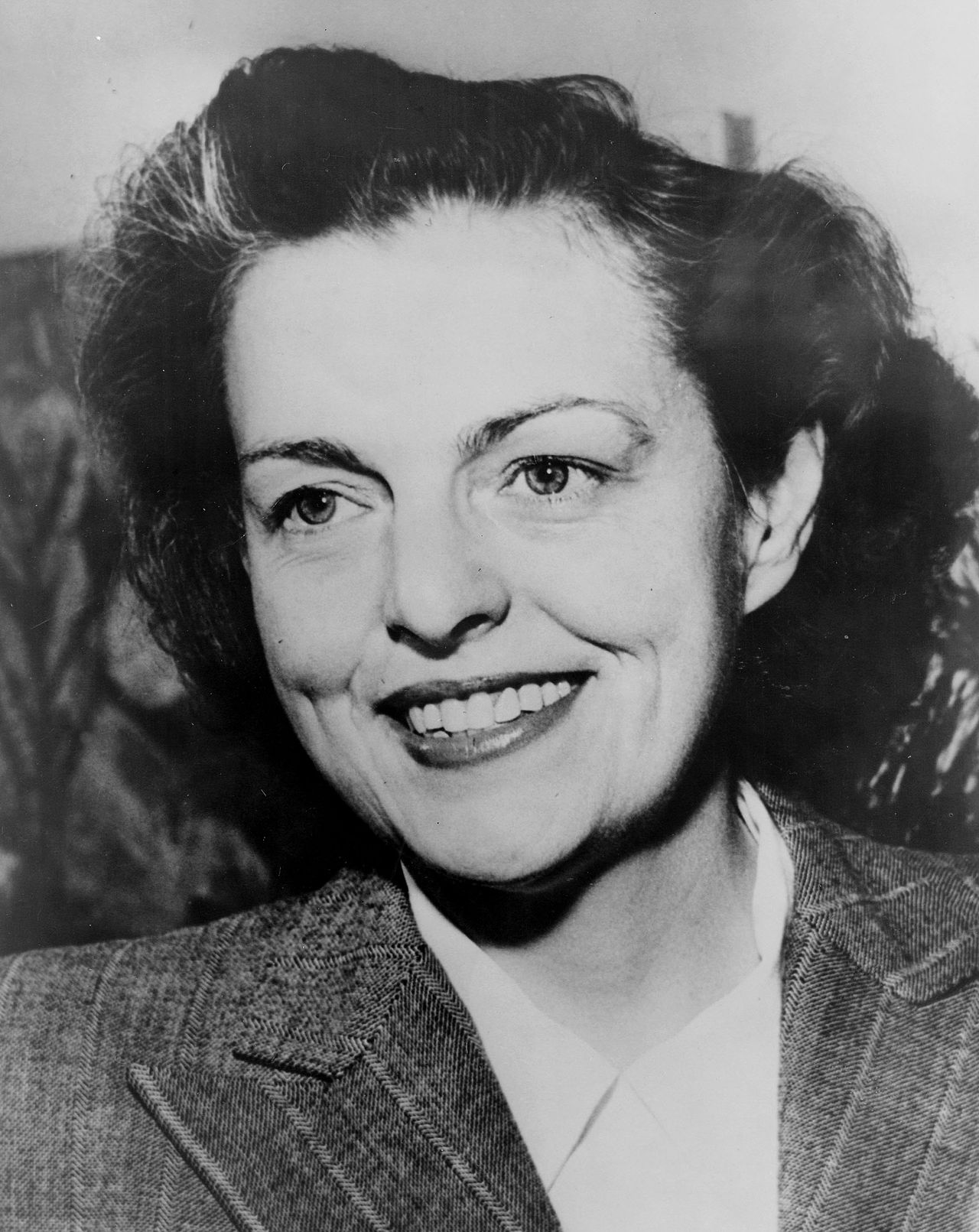
In 1944, Congressman Thomas Ford of Los Angeles opted to retire. The race for his seat was tight despite the district consistently reelecting the staunch New Dealer Ford. The Democratic candidate was Helen Gahagan Douglas (1900-1980), who had been a Broadway actress in the 1920s and a Hollywood actress in the 1930s and most notably played the inspiration for the look for the Evil Queen in the Disney film Snow White and the Seven Dwarfs (1937) from her villainess role in She (1935). Although in her younger years she had been a Republican as was her family tradition, after meeting and marrying actor Melvyn Douglas, he introduced her to Democratic politics, and she became a big supporter of President Franklin D. Roosevelt. The couple became good friends of the Roosevelts, and Eleanor mentored her in politics. She would serve as a member of the advisory committee for the Works Progress Administration and the State committee for the National Youth Administration. Douglas ran for Congress in 1944 as a staunch liberal and won the district by three points. During the campaign for Congress, Douglas got intimate with one Lyndon Baines Johnson. The two had bonded over their mutual admiration for President Franklin D. Roosevelt, and they had an affair that lasted for about five years, this being an open secret in Washington (Kendall).
As a member of Congress, Douglas voted a staunchly liberal line on domestic issues and for the most part, on foreign policy. She did differ on aid to Greece and Turkey from most liberals in her opposition, as neither Greece nor Turkey were proper democracies. Douglas did vote for the Marshall Plan, in contrast to politicians associated with the 1948 Progressive Party such as Senator Glen Taylor (D-Idaho) and Representative Vito Marcantonio (ALP-N.Y.). She was a spokeswoman for liberal causes ranging from price control to civil rights and rather than try to master the rules of the House she used her status as a former Hollywood actress to her advantage in publicity. In 1948, Douglas brought groceries before the House of Representatives to highlight rising prices and used this as an argument to implement price controls, and declared, “We’re going to reach the point where we have more babies than we have baby food. They are wonderful. Babies and mothers. But if we keep running the price up on milk and baby food, we’re going to raise a puny lot to run the world” (Nichols). That year, she also introduced a petition to get the Taft-Ellender-Wagner Housing bill out of the House Banking and Currency Committee. Its chairman, Jesse Wolcott (R-Mich.), was a staunch opponent of public housing. Douglas castigated the GOP Congress for its refusal to enact public housing legislation and strong price control, asserting that “…the fact remains that the Democratic party is concerned with the basic needs of the people and the Republicans respond today, as in the past, to the demands of special interests. This Republican Congress has been reckless, and has acted in utter disregard of the basic needs of the people, ignoring the two most vital problems, the cost of living and housing” (Wyant). Douglas voted 98% of the time with the liberal organization Americans for Democratic Action, her only dissent being on aid to Greece and Turkey. Journalist William K. Wyant Jr. (1948) wrote that she was “the Democratic party’s answer to Claire Booth Luce – the lovely lady who provided a note of satire and sex appeal for the Republican National Convention”. Douglas was also a consistent critic of the House Committee on Un-American Activities, having voted against its establishment as a permanent committee in 1945. She believed that “The fear of communism in this country is not rational. And that irrational fear of communism is being used in many quarters to blind us to our real problems” (U.S. House of Representatives). Although her staunchly liberal record on domestic issues and her liberal internationalism were popular in her Los Angeles district, as she won by increasing margins in her 1946 and 1948 reelections, whether it would prove popular statewide is a different story.
The 1950 Election: “Pink Down to Her Underwear”
In 1950, Senator Sheridan Downey, who had gotten to the Senate by toppling an oak in the Democratic Party in William McAdoo in the 1938 election, was facing a bruising renomination bid against Douglas, but then he dropped out with the official explanation being that it was for his health and endorsed Manchester Boddy for the Democratic nomination. Boddy was the publisher of the Los Angeles Daily News and had had a mixed political record, having been a Republican in the past who had opposed FDR’s election in 1932 only to subsequently have his newspaper give support to the New Deal and be the only major liberal paper in Los Angeles at the time. However, Boddy’s campaign suffered from a late start and disorganization, and he did not establish a solid campaign platform aside from advocating for public generation and distribution of power. Boddy’s campaign bears more importance for having tagged Douglas as the “pink lady”, presaging the mood of the general election. Although she won the Democratic nomination, her prospects were damaged by Boddy’s campaigning against her as soft on Communism. Additionally harming Douglas’s prospects of victory from the start was Downey publicly stating that if she won the nomination that he would support Republican Richard Nixon.
In the general election, Richard Nixon continued the campaign to portray her as pink, famously calling her “pink down to her underwear” and made effective use of a flyer known as the “Pink Sheet”. This flyer was titled the “Douglas-Marcantonio Voting Record” and compared her record to that of radical American Labor Party Congressman Vito Marcantonio of New York, who was openly pro-Soviet. It noted that she, like Marcantonio, had voted against establishing a permanent House Committee on Un-American Activities along with multiple citations the committee issued, both having twice voted against a free press amendment which would have blocked postwar aid to the USSR, against the Mundt-Nixon 1948 bill, against other anti-subversive measures, against aid to Greece and Turkey. This was what the flyer referred to as the “Douglas-Marcantonio Axis” and pointed out that Nixon had voted the opposite way. Although critics held that the voting record posted was selective and that Nixon voted a few hundred times with Marcantonio, on key issues there is a contrast and to demonstrate this I will use a standard employed by liberals at the time. If we look at the records of the liberal organization Americans for Democratic Action, their voting records show that of their top issues, Marcantonio and Douglas voted on the same side 82% of the time, while Marcantonio and Nixon voted on the same side 12% of the time. Ironically, Marcantonio was seen by ADA as voting to her right in the 1947-1950 period given his opposition to President Truman’s foreign policy and him voting against a contempt citation for conservative activist Edward Rumely in 1950. Furthermore, DW-Nominate places the two much closer to each other than Marcantonio with Nixon, with Douglas having a score of -0.588, Marcantonio having a score of -0.415 (although this accounts for his first term as a Republican of the Fiorello La Guardia school of Republican progressivism as well as his opposition to Truman’s foreign policy), and Nixon having a score of 0.162. Douglas’s campaign was further compromised by the general conservative mood of the 1950 election, and it certainly didn’t help that one of her Hollywood backers, one Ronald Reagan, switched sides late in the campaign. Nixon also catered to anti-Semitic voters by occasionally “accidentally” calling her “Helen Hesselberg” before correcting himself, or her husband’s original last name. Nixon won the election by 19 points and won all but six counties, and her loss was the end of her political career. Douglas could not even get an appointment from President Truman, even though she had very often voted in line with his administration (Truman was more liberal than people probably think). Douglas was embittered by the Nixon campaign’s tactics of character assassination, believing that it was unnecessary as she probably would have lost anyway. She would subsequently work to oppose Nixon whenever possible and popularized the nickname “Tricky Dick” for Nixon.
Douglas would get an appointment by President Johnson as “Special Ambassador” for the inauguration of William Tubman as president of Liberia, but the two would break after she came out against the Vietnam War. In 1972, Douglas campaigned for George McGovern and in 1974 she supported an impeachment trial for President Nixon. She must have taken some satisfaction at that time in seeing bumper stickers reading, “Don’t Blame Me – I voted for Helen Gahagan Douglas!”
The End
In 1973, Douglas was diagnosed with breast cancer and underwent a mastectomy. Although the cancer went into remission, it came back with a vengeance in 1977, and she died on June 28, 1980, of breast and lung cancer. Douglas was eulogized by Senator Alan Cranston (D-Calif.), who was also of a strongly liberal philosophy, stating, “I believe Helen Gahagan Douglas was one of the grandest, most eloquent, deepest-thinking people we have had in American politics. She stands among the best of our 20th-century leaders, rivaling even Eleanor Roosevelt in stature, compassion and simple greatness” (Kelly).
References
ADA Voting Records. Americans for Democratic Action.
Retrieved from
Douglas, Helen Gahagan. U.S. House of Representatives.
Retrieved from
https://history.house.gov/People/Detail/12399
Douglas, Helen Gahagan. Voteview.
Retrieved from
https://voteview.com/person/2689/helen-gahagan-douglas
Douglas-Marcantonio Voting Record. (1950). Nixon for U.S. Senate Campaign.
Retrieved from
https://en.wikipedia.org/wiki/1950_United_States_Senate_election_in_California#/media/File:Flyer-handout_for_Nixon_for_Senate_campaign,_1950.jpg
Hailey, J.R. (1980, June 28). Helen Gahagan Douglas, 79, 3-Term Member of Congress. The Washington Post.
Retrieved from
Kelly, K. Helen Gahagan Douglas (1900-1980) Actress Turned Congressperson. America Comes Alive!
Retrieved from
https://americacomesalive.com/helen-gahagan-douglas-1900-1980-actress-turned-congressperson/
Kendall, J. (2019, April 22). Robert Caro’s Blind Spot. Slate.
Retrieved from
https://slate.com/culture/2019/04/lyndon-johnson-robert-caro-affairs-misogyny.html
Marcantonio, Vito Anthony. Voteview.
Retrieved from
https://voteview.com/person/5974/vito-anthony-marcantonio
Nichols, H.W. (1948, April 28). Congresslady Goes Shopping To Take Woes Before House. The Atlanta Journal, p. 1.
Retrieved from
https://newspapers.com/image/975541690/
Nixon, Richard Milhous. Voteview.
Retrieved from
https://voteview.com/person/6939/richard-milhous-nixon
Wyant, W.K. (1948, July 11). Mrs. Helen Gahagan Douglas Is Democrats’ Answer To GOP’s Clare Boothe Luce. Springfield News-Sun (Springfield, Ohio), p. 4.
Retrieved from
 Mad Politics: The Bizarre, Fascinating, and Unknown of American Political History