Iowa is a historically Republican state, and it looks like, at least for the time being, that it has gone back to its roots. It voted for Trump twice and its entire delegation to Congress is Republican. The one senator Democrats had representing Iowa between 1857 and 1933 was Daniel Steck, a figure who identified with the moderate wing of the Democratic Party and was senator thanks to Republican defections from the conservative side on the seating vote because they didn’t want RINO Smith W. Brookhart in the Senate. However, Democrats had some more regular presence starting in the 1930s. Indeed, from 1937 to 1943, both its senators were Democrats! The most successful of the Democrats in this time was Guy Gillette, an independent-minded figure. However, the state returned to form during FDR’s third term. This is where Merwin Coad (1924- ), who turned 100 today, comes in.
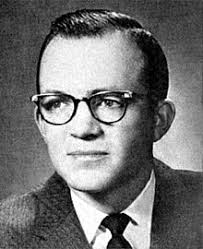
The 1956 election, although highly successful for Eisenhower, was not similarly successful for Republicans down-ticket and they on net lost two seats in the House. One of these unfortunates was Republican James Dolliver, who lost reelection to Coad by the slightest of margins, making him the first Democrat elected to the House from Iowa since 1940. Other Iowa Republicans came close to defeat, such as Henry O. Talle in the 2nd district, Karl Le Compte in the 4th district, and Paul Cunningham in the 5th district. All three seats would be won by Democrats in 1958, with Talle and Cunningham losing reelection. Coad was an appealing candidate, as he was pastor of the Central Christian Church, a boy scout leader, and a married father of four. Certainly, these are traditional markers of an upstanding citizen. He was also, contrary to many previous Democrats who sought to succeed in the state, a staunch liberal. Of 67 votes that Coad either voted or paired on that were included in Americans for Constitutional Action scores, he only sided with them four times: in 1957 he voted against funding a federal flood insurance program and against an Eisenhower-backed foreign aid increase, in 1959 he voted against recommitting the Labor-Management Reporting and Disclosure Act after it had been substituted with the Landrum-Griffin bill (he had voted against the Landrum-Griffin substitute), and in 1960 he voted against participation in and funding of the International Development Association. He did not once side with ACA during the Kennedy Administration, the agenda of which he was staunchly loyal. Coad’s DW-Nominate score was a -0.374. Appropriately for an Iowan in a rural district, he served on the House Agriculture Committee, and he advised Senator John F. Kennedy (D-Mass.) on agricultural issues. However, it was not his liberalism that caused him his troubles…it was his personal life.
The Early End of a Career
In 1961, the Des Moines Register’s Washington correspondent, Clark Mollenhoff, began to investigate Coad’s personal matters after he had quickly filed for divorce from his wife of 17 years in Double Springs, Alabama with no notice, and only two months later remarried to his chief of staff’s ex-wife, who also worked on his staff, and then raised her salary to the equivalent of $125,000 annually (Wildstein). HIs investigation found that Coad was having significant money problems. He was still speculating on the grain market as a member of the House Agriculture Committee (and not doing well), he gambled a lot and one night he lost the equivalent of $20,000 in a poker game in Washington D.C., and he bounced a $4000 check with the House Sergeant At-Arms (Wildstein). All this was rather far from the picture voters had of Pastor Coad when they first elected him in 1956. He did not opt to run for another term after these exposures. When asked whether he’d go back to being a pastor, Coad responded, “I don’t know. There are many things I have to think about” (Time Magazine). One must wonder, did the call of public service ultimately serve to lead Pastor Coad to sin?
Coad, out of electoral politics at 38, managed to secure a position in the Kennedy Administration, but once Senator Bourke Hickenlooper (R-Iowa) learned of this, he phoned the head of the Agency for international Development’s head to complain, citing his “background and history and utter lack of qualifications for the job” and the next day Coad was forced to resign.
Coad got into the real estate business, but ran into trouble again when a widow accused him of defrauding her. The judge, John J. Sirica, agreed with the widow in his ruling against his efforts to foreclose on her and he he stated, “This is just a racket…that’s all this is…just a racket. This thing smacks of fraud” (Wildstein). Coad subsequently became a pusher for no money down real estate purchasing techniques and spoke at numerous seminars, where questions were raised about his ethics. He has since retired to Florida.
References
Coad, Merwin. Voteview.
Retrieved from
Nation: Something to Think About. (1961, June 30). Time Magazine.
Retrieved from
https://time.com/archive/6830416/nation-something-to-think-about/
Shotwell, W. (1956, November 8). Pastor Coad Tells of Race For Congress. Des Moines Register, p. 9.
Retrieved from
https://www.newspapers.com/article/the-des-moines-register-rev-merwin-coad/34939893/?locale=en-CA
Wildstein, D. (2024, September 28). Grifter ex-congressman who served while Eisenhower was president is 100; has ties to New Jersey. New Jersey Globe.
Retrieved from
 Mad Politics: The Bizarre, Fascinating, and Unknown of American Political History