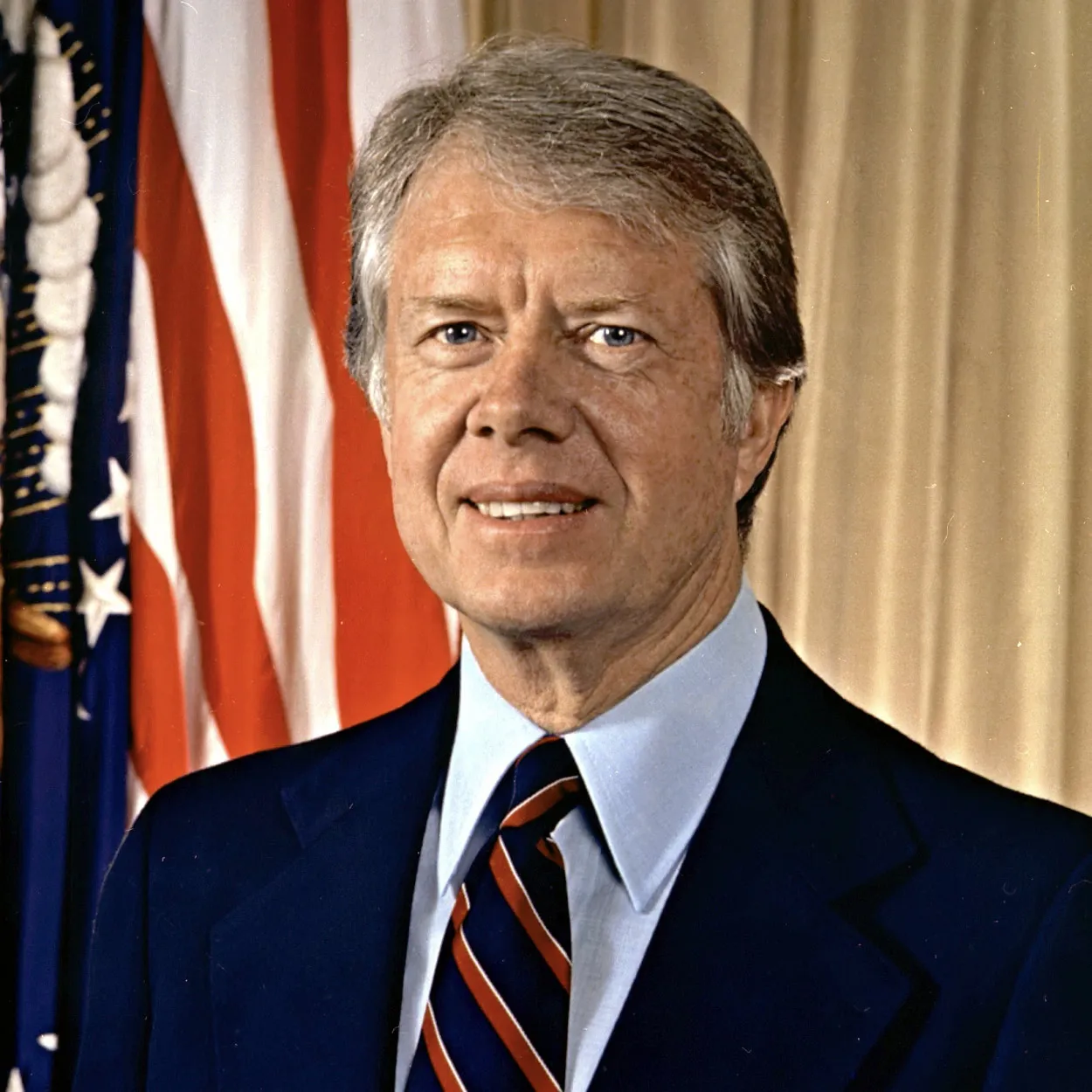
The American public was rather disheartened with “politics as usual” (1976 seems to be the norm these days in this sense) particularly after Watergate and the deeply unsatisfying outcome of the Vietnam War. In 1976, they were looking for a change. While Gerald Ford was a pleasant contrast to the Nixon crowd, his pardon of him was a constant shadow over his presidency and his campaign. The Democrats too were looking for a change, not only from the Republicans but just politics as usual, and they found their man in Georgia’s Jimmy Carter, who had been one of the state’s first politicians you might call “post racial”. These two battled head-to-head and although Carter had a massive lead early on, Ford managed to make the race close despite his debate stumble on Iron Curtain nations as well as SNL’s lampooning of his alleged clumsiness. Carter had stumbled with his Playboy interview, in which he admitted to lusting after other women in his heart.
A Race of Regions: West vs. South
This election had Carter winning all former Confederate states save for Virginia, which is the opposite of the 2016 election. Ford dominates in the West, winning all of its states save Hawaii, and makes a strong showing in New England, winning four of its six states. The Midwest is a mixed bag, with Carter winning Minnesota, Ohio, and Wisconsin, while Ford wins Illinois, Indiana, Iowa, and his home state of Michigan. Carter crucially won the electorally rich states of Pennsylvania and New York as well. West and South would in four years unite in electing Ronald Reagan.
This campaign focusing on change was certainly a last in many respects, most notably the last gasp of the “Solid South”. While it is true that the composition of the Carter voters in the South was a bit different than it had been for Democrats in many elections past (he got most of the black vote), there were still enough whites motivated by tradition to vote for Carter, and helping in this was the support of numerous Southern politicians, including George Wallace. This would, incidentally, be the last time Wallace made a run for president, running in the Democratic primary, by this time having dropped his segregationist platform. Another notable feature about this race was that in most states the margins were single digits. Carter barely squeaked by in Ohio while Ford won by the narrowest of margins in Oregon. Yet another matter of note is that in this election, both men and women favored Carter 50-48. Today, there is a gap between men and women and the parties they support, with more men going Republican and more women going Democratic. This election also saw Ford winning more states but Carter winning more electorally heavy states at 23 to Ford’s 27.
The Senate
The Senate is a mixed bag, as Republicans and Democrats alike lose reelection in different places. The Senate bids farewell to both Majority Leader Mike Mansfield of Montana and Minority Leader Hugh Scott of Pennsylvania, both who are succeeded by members of their own parties. The 1976 election marked the end of some things we haven’t seen again in the Senate. With the retirement of Hiram Fong, one of Hawaii’s first two senators, the state has never again had a Republican senator. In Maryland, the loss of J. Glenn Beall Jr. to Democratic Congressman Paul Sarbanes marked the end of the last time Republicans held both Senate seats from the state. Although Larry Hogan is the most promising candidate Republicans have had in years for the Senate, he probably will not win since many of the state’s voters don’t want the Senate to go Republican. The loss of New York’s James Buckley marked the end of a time in which Democrats did not hold either of the state’s seats in the Senate. Buckley was also arguably the last conservative to ever represent New York in the Senate (Al D’Amato is debatable). The 1976 election also sent packing Democrats Frank Moss of Utah and Gale McGee of Wyoming, and to this day they are the last Democrats to represent these states in the Senate, succeeded by Orrin Hatch and Malcolm Wallop respectively, both who would be strong Reaganites. The latter ran some of my favorite political ads, which can be found in References.
In Indiana, Democrat Vance Hartke loses reelection by double digits to Richard Lugar, Indianapolis’s popular mayor. However, a famous Republican name loses in Ohio…Robert Taft Jr., a moderate, is replaced by liberal Democrat Howard Metzenbaum. There were also some victories that would not be expected at all today. In California, Republican S.I. Hayakawa defeats Democrat John V. Tunney for reelection, the last time a Republican defeated a Democratic Senate incumbent in the state. In New Mexico, astronaut Harrison Schmitt defeated Democrat Joseph Montoya, who managed to get negative publicity over his poor performance on the Watergate Committee (also the last time a Republican defeats a Democratic incumbent in the Senate), and in Rhode Island Republican John Chafee, who had in 1972 given Democratic Senator Claiborne Pell the only tough election of his career, was elected to succeed the retiring John Pastore. In Tennessee, the victory of Democrat Jim Sasser over Republican Bill Brock would be the last time a Republican incumbent senator lost reelection in the state. Just in case you thought Democrats were roundly getting thrashed in the West, Democrat Dennis DeConcini succeeds Republican Paul Fannin to the Senate in Arizona.
The House
In the House, we for the last time saw an election in which Democrats won a supermajority…they gained one seat, as the 1974 midterms had already been excellent for them. Of course, something to bear in mind about 1976 is that the Democratic Party had a conservative wing, and it was still fairly sizeable. Thus, a 2/3’s majority isn’t to be read as 2/3’s liberal. However, the Republicans too had their moderate to liberal wing. What’s more, in the House, this was the last time the Democrats won Wyoming’s House seat. This election is also the first and only time that Ron Paul ever loses a House election, being narrowly defeated by Democrat Bob Gammage after having won a special election. Paul would defeat him in a rematch in 1978. This election also marks the first elections to Congress of two vice presidents. In Indiana, Republican Dan Quayle defeats Democrat J. Edward Roush for reelection, and in Tennessee, Al Gore at 28 succeeds Democrat Joe Evins to office with a whopping 94% of the vote. One figure who still serves in office was first elected in 1976, this being Ed Markey of Massachusetts, who serves alongside Elizabeth Warren in the Senate. Other notable first-timers include Democrat Leon Panetta, who would serve as President Obama’s CIA director and Secretary of Defense, and Republican “B-1 Bob” Dornan, noted for his staunch conservatism, frequently inflammatory rhetoric, and advocacy for the B-1 Bomber.
The 1976 election is demonstrative on the presidential level of how much politics can change…we don’t expect for instance a Republican to win California, Oregon, and Washington any time soon in a presidential election. Likewise, we don’t expect a Democrat to be winning Alabama and Mississippi at any time in the foreseeable future.
P.S.: By Saturday, I will archive all 2021 posts.
References
1976 United States House of Representatives elections. Wikipedia.
Retrieved from
https://en.wikipedia.org/wiki/1976_United_States_House_of_Representatives_elections
1976 United States presidential election. Wikipedia.
Retrieved from
https://en.wikipedia.org/wiki/1976_United_States_presidential_election
1976 United States Senate elections. Wikipedia.
Retrieved from
https://en.wikipedia.org/wiki/1976_United_States_Senate_elections
Malcolm Wallop for U.S. Senate Wyoming 1976 TV Ad. YouTube.
Retrieved from
 Mad Politics: The Bizarre, Fascinating, and Unknown of American Political History