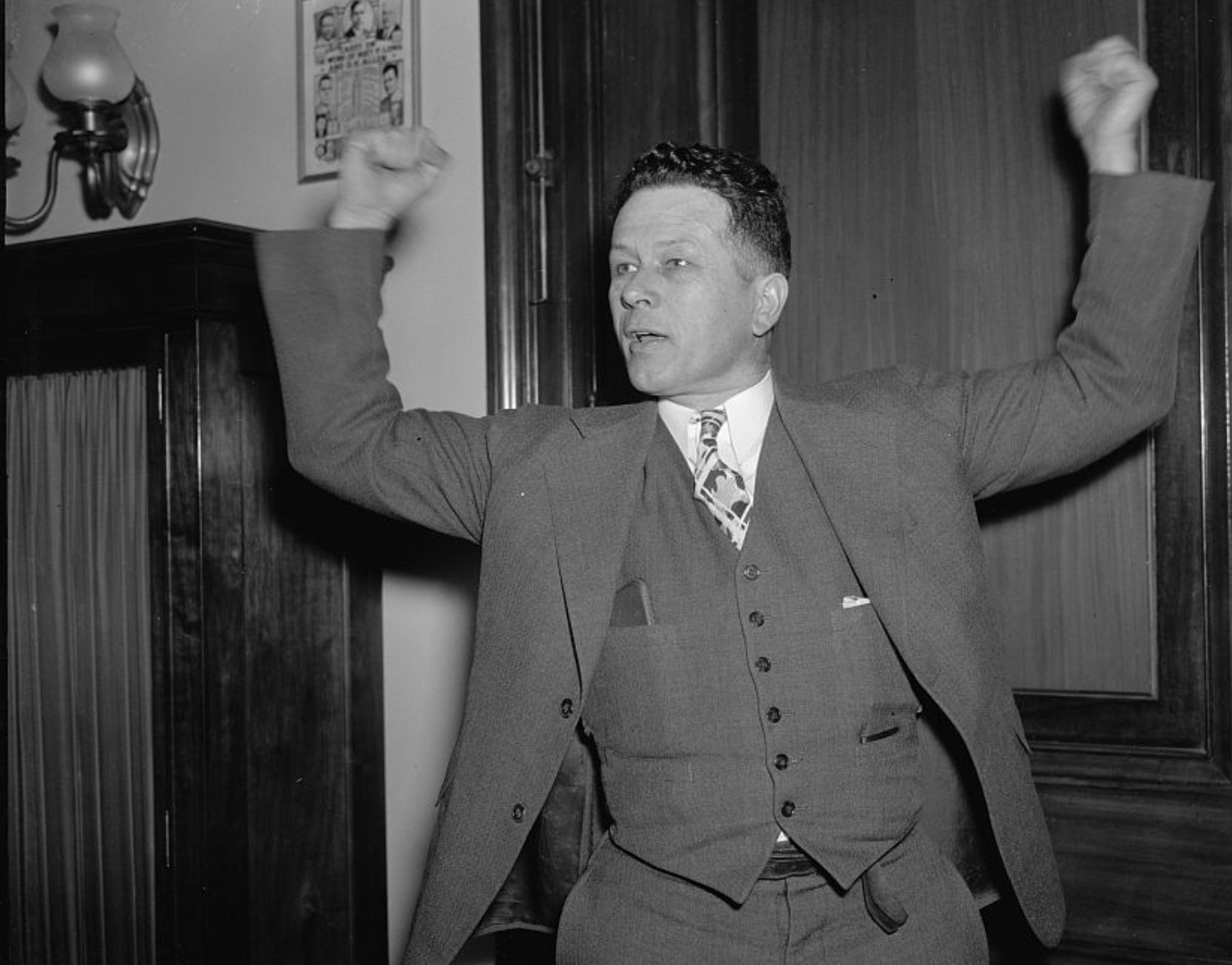
In 1928, a young and aggressive reformer won the Louisiana governorship in Huey Long. Although state legislator Allen Joseph Ellender (1890-1972) originally opposed Long’s rise, campaigning against him in 1924 and 1928, he got wise as he saw which way the wind was blowing both in Baton Rouge and among his constituents, and became a key ally (Bencel, 42-43). However, this wasn’t an easy relationship initially. In one instance, they had a nasty argument over the phone over Ellender voting against $150,000 to renovate the governor’s mansion, with Long swearing at him and Ellender threatening to slap Long if he did so in person (Bencel, 41). However, Long and Ellender would prove to have an effective working relationship, and they did have some things politically in common, including opposition to the traditional leadership of Louisiana. Ellender drafted the “Round Robin” statement that enough senators signed in 1929, which guaranteed the Senate wouldn’t vote for conviction in an impeachment trial (Alford). With Long’s support, Ellender was elected speaker of the Louisiana House in 1932.
Rise to the Senate
Ellender’s elevation to the Senate was attributable to two deaths. First, Huey Long succumbing to his assassination on September 10, 1935, and Governor Oscar K. Allen’s death on January 28, 1936. The path was clear for Ellender to run for the Senate. He had previously been denied nomination for governor because he had refused to back ethically questionable oil leases. Ellender as a senator was quite different from Huey Long towards Roosevelt, now that he was free of Long’s command. Long, although he supported some key aspects of the New Deal, often crossed swords with Roosevelt, both to his left and right. He reflected on Long, “Huey Long was personally ambitious and I saw in his feud with a president a means of advancing his own presidential ambitions. I always thought that Huey was subordinating the best interest of the state to his own ambitions” (Bencel, 74).
Staunch Ally of FDR
When Ellender first entered the Senate, he was one of the most loyal supporters of President Roosevelt, and this included being one of only twenty senators to vote to keep his “court packing plan” alive. His support of the court-packing plan can be explained by him wanting to win favor with the Roosevelt Administration (Bencel, 77). Ellender also supported the Wage and Hour bill in 1937, which numerous Southerners thought went too far on fair labor standards. Ellender also proved loyal on foreign policy matters, including backing the repeal of the arms embargo in 1939 and Lend-Lease in 1941. On civil rights, Ellender was predictably a strong foe, and fought against anti-lynching legislation. His stance on race is explained by his biographer thusly, “Ellender’s racism was essentially traditional, neither vindictive nor mean. A product of his times, he, like most white southerners, opposed granting more rights and privileges to blacks, whom he considered inferior. Like many segregationists, he professed to like blacks personally. He softened his stance somewhat by saying his real opposition was to intrusion by the federal government into the affairs of the state” (Bencel, 79). Despite his at times peppery and prejudiced takes, he was popular among his colleagues across the board, and his honesty, courtly manners, as well as his Cajun shrimp gumbo were certainly a part of it. He, like many other Southerners, would gradually grow more conservative, and this would increase during the Truman Administration.
Post-War Years
In 1946, Ellender led the defense for Senator Theodore Bilbo (D-Miss.) when the incoming Republicans sought to deny him seating for advocating the use of violence to stop blacks from voting, and managed to get Bilbo off on accusations of depriving qualified black voters the vote. One senator, however, Ellender did not defend was Wisconsin’s Republican demagogue Joseph McCarthy, holding “The fact that a man belonged to an organization that later turned semi-Red is no reason to charge him with being a Communist” (Bencel, 171).
Although Ellender backed the Marshall Plan and Greek-Turkish aid during the 80th Congress, he would become disillusioned with foreign aid starting in 1951, when he toured Europe for a fifth time. He found what he considered to be waste and extravagance, and only backed continued aid to Austria and West Germany (Bencel, 188). From then on, he voted against Mutual Security legislation. Following a 28-nation tour in 1957, Ellender condemned economic aid as having been an “abysmal failure” in all instances (Fried). That year, he voted against the establishment of the Development Loan Fund.
In other ways, Ellender was a flexible legislator, and indeed his support was key to the enactment of the 1949 Taft-Ellender-Wagner bill, providing for public housing. Taft represented the Republicans, Ellender the Southern Democrats, and Wagner the Northern Democrats. Ellender, as chairman of the Senate Agricultural Committee, was staunchly for retaining high price supports during the Eisenhower Administration, contrary to the push towards lower and flexible price supports by Eisenhower and Republicans, seeking more of a free market approach. On civil rights, Ellender found that the position of the South had weakened in the ability to stop such legislation since Brown v. Board of Education (1954) and recalled in 1971 that this ability was dealt a fatal blow with the admission of Alaska and Hawaii, which he had opposed (Cates).
Controversial Views on Developing Nations
Ellender was outspoken in his views on foreign policy, and he could be undiplomatically so when it came to developing nations. In 1956, he referred to South Koreans as no better than “bloodsuckers”, commented that a public market in Mogadishu, Somalia was “untidy”, called markets in Addis Ababa “filth”, and implied that the Nepalese were lazy (Time Magazine). In 1962, while visiting Morocco, he expressed his doubts that black Africans could self-govern. He proceeded to make numerous racist comments while touring Africa, including “Egypt hasn’t achieved anything great since the Pharaohs began practicing desegregation with their slaves”, “Ethiopia would have nothing if it weren’t for the Italians”, and “The average African is incapable of leadership except through the assistance of Europeans” (Time Magazine). The nations and their people that were targets of his undiplomatic remarks were not pleased. Ellender was barred from entering Uganda, Taganyika, and Ethiopia. However, one point Ellender would make, which he repeated in a 1971 interview that proved prescient was on the problems surrounding the concept of nationhood among Africans given the many differences among tribes (Cates). This continues to be a difficulty in the governance of African nations to this day.
Ellender and the 1960s Democratic Administrations
Senator Ellender tended to vote against budget cuts to existing programs, but would usually vote against new programs. On foreign policy, while proving an opponent of foreign aid as well as the Arms Control and Disarmament Agency, he did vote for the Partial Nuclear Test Ban Treaty in 1963. Ellender also opposed Republican efforts to block the sale of grain to the USSR and Hungary.
In 1964, Ellender participated in the filibuster of the Civil Rights Act, voted against tax reduction, voted against the Economic Opportunity Act, and voted against Senator Albert Gore’s (D-Tenn.) Medicare amendment. The following year, Ellender voted against the Appalachian Regional Development bill and the Voting Rights Act of 1965. He also opposed Medicare, but supported the Elementary and Secondary Education Act, the Housing and Urban Development Act, and rent subsidies. Ellender also supported both of Senator Dirksen’s proposed Constitutional amendments, on legislative reapportionment and school prayer. Despite his vote for the latter, Ellender was not a religious man. Although he professed a belief in God, he didn’t hold rigidly to Christian doctrines, did not attend church, and was turned off by extravagance in church ceremonies, especially in poor areas (Bencel, 150). Were Ellender alive today, he’d certainly feel a sense of revulsion towards megachurches. In contrast to his vote for the Wage and Hour bill in 1937, he voted against increasing the minimum wage in 1966. On civil rights, he regarded Brown vs. Board of Education as a tragedy and lamented that many blacks seemed to hate the South (Cates).

Later in his life, Ellender became receptive to warming relations with the USSR. As George McGovern recalled while the two were at the Senate gym getting a massage, Ellender told him, “George, when I die I want you to take up my mission of convincing the Senate and the country that the Russians are not ogres out to destroy us and that we should seek better relations with the Soviet Union” (Fried). He was largely supportive of President Nixon and although he had become vocally critical of the Vietnam War, he felt bound to support the president in a war situation, and this included him voting against the Cooper-Church (no more funds for operations in Cambodia) and McGovern-Hatfield (timetable for withdrawal from Vietnam) amendments in 1970. In 1971, Ellender became chairman of the powerful Senate Appropriations Committee. Despite being 81 years old in 1972, Ellender wanted to run for renomination, and he was making a go at it. Despite his mind and spirit being into having another term in the Senate, his heart was not, and he died on July 27th at Bethesda Naval Hospital of a heart attack. Ellender is a complex figure whose perspective, although overall turned more towards conservatism than liberalism in his last two decades in office, was a man who on numerous questions was not rigid, and in some categories such as housing was quite supportive of the liberal position. Ellender’s DW-Nominate score was a -0.089, which is rather high for a Democrat. His Americans for Democratic Action scores in by the 1950s and 1960s were showing a consistent conservatism, while his Americans for Constitutional Action scores showed him to be more of a moderate who leans conservative.
References
Alford, J. (2009, November 1). Ellender maintains stature in U.S. Senate history. Houma Today.
Retrieved from
Ellender maintains stature in U.S. Senate history (houmatoday.com)
Americans Abroad: Travel Is So Narrowing. (1962, December 14). Time Magazine.
Retrieved from
https://time.com/archive/6810575/americans-abroad-travel-is-so-narrowing/
Bencel, T.A. (1995). Senator Allen Ellender of Louisiana: a biography. Baton Rouge, LA: Louisiana State University Press.
Cates, H. (1971, April 30). Allen Ellender [Interview], Richard B. Russell Jr. Oral History Project.
Retrieved from
Ellender, Allen Joseph. Voteview.
Retrieved from
Fried, J.P. (1972, July 28). Allen J. Ellender Dies. The New York Times.
Retrieved from
ALLEN J.ELLENDER OF LOUISIANA DIES – The New York Times (nytimes.com)
 Mad Politics: The Bizarre, Fascinating, and Unknown of American Political History