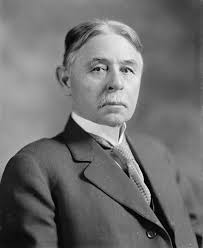
Following the end of Reconstruction, Democrats came to dominate the South, including North Carolina. Although voter intimidation, ballot fraud, and other vote restricting tactics were practiced, there were still a good number of blacks who could vote, and often North Carolina’s 2nd district, based in Scotland Neck, was represented by a black Republican. This was to the degree that it was known as “The Black Second”. However, the political situation was increasingly complicated by the rise of the Populist Party. The Populist Party, an economically left-wing party that also emphasized immigration restriction, formed coalitions with the Democratic Party in the Midwest and West, but in the South they formed an alliance with the Republican Party. In other words, they were consistently fighting against whatever party was dominant in a region. The Panic of 1893 proved disastrous for North Carolina’s Democratic Party, and a multi-racial coalition of black and white workers aligned against North Carolina’s establishment, the consequence being the election of Republicans and Populists to Congress, with Republican Daniel Lindsay Russell being elected governor. This multi-racial and multi-ideological coalition was an uneasy one motivated foremost by opposition to the Democratic Party, and the Democratic Party’s champion to regain power was Furnifold McLendel Simmons (1854-1940).
Democrats like Simmons had been willing to tolerate some black voting as long as Democratic dominance was maintained. However, but with the Democratic Party at stake in North Carolina and elsewhere in the South with the rise of the Republican-Populist fusion, Southern Democrats took harsher measures. Simmons led such official efforts.
The 1898 Election: Democratic Victory By Force and the Wilmington Coup
Simmons had been involved in Democratic politics for some time, including serving a term in the House in the 2nd district from 1887 to 1889, the product of Republican division. During this time he had been seen as a racial moderate, and indeed he pledged to represent both races, stating that he was “not one of the kind that set no value upon the colored man’s vote” (Hand). This approach won him 2,500 black votes, enough for one term. And he indeed seemed to do as he said he would in representing both the interests of blacks and whites in Congress. Yet, he lost reelection in 1888 to black Republican Henry P. Cheatham. In 1892, the Populist Party was proving a great threat to the political power of the Democratic Party, and North Carolina was where they hit the hardest. Simmons was able to successfully lead the Democratic Party’s campaign that year, getting the state into Grover Cleveland’s column. As a reward, he was appointed the Eastern District’s collector of internal revenue. However, the 1894 and 1896 elections proved terrible for the Democrats, and after the 1896 election Democrats were almost completely out of the state’s delegation to Congress, with only William W. Kitchin of the 5th district being their representation. North Carolina’s two senators were Republican Jeter Pritchard and Populist Marion Butler. The Democratic Party appealed to Simmons to lead them back to victory, and he reluctantly agreed to take back the reigns, leaving his post as collector to do so. The 1898 midterms, the Democratic effort which he headed as chairman of the Democratic Executive Committee, were characterized by aggressive racist campaigning over fears of “Negro domination”. Simmons and his campaigners portrayed leading black politicians as corrupt and unqualified for their offices (University of North Carolina).
Election Day, November 8th, was marked by intimidation from Red Shirts that kept away many blacks and white Republicans from the polls, resulting in a blowout victory for Democrats. Two days later, the Wilmington Coup occurred in which the entire government of the city of Wilmington (at the time North Carolina’s largest city) was ousted by force. There were also numerous white voters who had otherwise been previously inclined to support the Republican-Populist alliance shifting to the Democrats. Some did so as a result of the white supremacy campaign, others did so because of the unique persuasion of the Red Shirts. The Democrats won six of nine of the state’s House delegation, but most importantly they won the state legislature. The multi-racial leadership of this at-the-time majority black city was banished by an armed group led by former Congressman Alfred Waddell, who installed himself as mayor. Prominent black political leaders, successful black businessmen, and whites who had courted black support were also banished from the city. This was not a spontaneous event, rather the product of months of planning by Simmons and other leading Democrats, including Waddell and future Secretary of the Navy Josephus Daniels. Waddell had publicly called for the removal of the Republican-Populist coalition in Wilmington and advocated for white citizens to, if necessary, “choke the Cape Fear with carcasses” (NC Department of Natural and Cultural Resources). Further inflaming the situation was an article by Alex Manly in the black-owned newspaper The Daily Record. Manly was writing in response to an aggressively pro-lynching article by Rebecca Latimer Felton, holding that “poor white men are careless in the matter of protecting their women” and that “our experience among poor white people in the country teaches us that women of that race are not any more particular in the matter of clandestine meetings with colored men than the white men with colored women” (NC Department of Natural and Cultural Resources). In the ensuing violence that occurred two days after the election, at minimum 14 blacks were killed, but as many as 60 could have been killed. Many blacks, including Manly, had already fled the city in anticipation of violence, and The Daily Record’s building was burned to the ground. Appeals for help to President William McKinley went unanswered as Governor Russell hadn’t requested assistance.
Long-Term Consequences
The Republican-Populist coalition was toast, and especially so after the adoption of the state’s Jim Crow constitution. Simmons’ words to black voters, it turned out, had an expiration date. In 1901, Simmons would succeed Populist Senator Marion Butler, and in 1903 Simmons’ compatriot, Lee S. Overman, would succeed Republican Senator Jeter Pritchard. The two men, lifelong friends, would serve as North Carolina’s senators together for over 25 years. Simmons would later recall on the 1898 election, “While we dealt with graft and advocated the free coinage of silver, the keynote of the campaign was White Supremacy, and I believe I was chiefly responsible for the choice of the issue” (University of North Carolina)
As a senator, Simmons was considered highly effective and succeeded in securing funds for the Intercoastal Waterway from Boston to Wilmington, which he considered his finest achievement (Faulkner). He was a political boss and had a machine, although his machine lacked the corrupt features that many machines did. Simmons was somewhat supportive of increasing direct democracy; on June 12, 1911, he voted for the Constitutional amendment for direct election of senators but on January 31, 1913, Simmons voted against Senator Robert Owen’s (D-Okla.) proposal to end the Electoral College.
The 1912 Election, Simmons’ Height of Power, and Addressing 1920s Republican Rule
Simmons faced some strong challengers in Governor William W. Kitchin, Chief Justice Walter Clark, and former Governor Charles B. Aycock. However, Aycock died that year and Simmons’ machine easily pulled him through. The height of Simmons’ influence was during the Wilson Administration, chairing the Senate Finance Committee from 1913 to 1919, which had authority over taxation legislation. A traditional Democrat, Simmons was strongly supportive of tariff reduction, and sponsored the Simmons-Underwood Tariff of 1913, which reduced tariffs and imposed a top income tax of 7%, the first income tax adopted after the adoption of the 16th Amendment. He was generally strongly supportive of the Wilson Administration’s Southern-friendly progressivism, but he opposed, as did all of North Carolina’s legislators, the Keating-Owen Act to curb child labor, as North Carolina’s textile mills relied extensively on such labor. Simmons also voted for the Espionage Act of 1917 and the Sedition Act of 1918 to suppress wartime dissent. With the 1918 election, Republicans won Congress and Simmons lost his chairmanship. An internationalist, he supported the Versailles Treaty to the hilt on the Senate floor, but behind the scenes he unsuccessfully urged President Wilson to accept some reservations to increase its chances for passage.
During the 1920s, Simmons was something of a dissenter to Republican tax policy. He opposed the Fordney-Penrose income tax reduction bill, the Fordney-McCumber tariff increase, and in 1924 backed a top income tax rate of 40%, as opposed to Senator Reed Smoot’s (R-Utah) proposed 32%. However, Simmons did support ending the estate tax in 1926.
The 1928 Election and Simmons’ Political Fate
The selection of Al Smith of New York to head the Democratic ticket proved highly controversial in the South due to his opposition to Prohibition, his Catholicism, and the fact that he rose up the political ranks through Tammany Hall. Unlike Senator Tom Heflin of Alabama, Simmons neither objected to Smith’s Catholicism nor endorsed Republican Herbert Hoover, but he publicly stated he could not back Smith on account of his stances on Prohibition and his close relationship with Tammany Hall. In this respect, he differed from his close friend and colleague, Lee S. Overman, who publicly backed Smith. Hoover would win North Carolina in 1928, the first Republican to do so since Reconstruction. Like Heflin, however, there would be consequences for Simmons. Although Simmons had built up a political machine in North Carolina, this didn’t insulate him from the impacts of primaries, and just like Heflin, he lost renomination in 1930 over his refusal to back the Democratic ticket. He never regretted his stance against Smith, even in defeat. Ironically, the man who defeated him on the grounds of party disloyalty, Josiah Bailey, would prove far more of a dissenter to national Democratic Party policy than Simmons ever was as he rebelled against FDR’s New Deal. Yet another blow for Simmons was Overman’s death in December 1930.
Simmons in Retirement
Up until the death of his wife in 1938, Simmons was happiest in his retired years and had accepted his defeat in the primary gracefully. As W.T. Bost noted in a newspaper column on Simmons’ defeat that “He was bigger in it than he ever was in the succession of victories won at the polls and in the Congress” (Hill). Although Simmons is often regarded as a conservative, he approved of much of the liberal policies of Democratic presidents, and FDR was no exception. He approved of much of FDR’s New Deal, most of all his agricultural policy (Hill). Simmons on economic issues during his career was far from a conservative, given his history of supporting inflationary currency, increasing the income tax, and reducing tariffs. I honestly have limited regard for those said to be “conservatives” whose overall record doesn’t reflect it. His DW-Nominate score was a -0.388. Regarding Simmons’ political ethos, historian Richard L. Watson Jr. wrote that he “lacked a consistent worldview” on numerous issues of the day and that he regarded his views on white supremacy and democracy as consistent (Faulkner). Simmons struck me as a highly opportunistic individual on the subject of race; although he was undoubtedly a racist he was willing to cater to black voters when it worked in his interests, and to strip the vote from them when it suited his and his party’s interests. However, Simmons was not a pure creature of opportunism, as his opposition to Democratic nominee Al Smith proved, as it resulted in the end of his career. I cannot say that I admire Simmons, and I cannot excuse the 1898 Wilmington Coup and the extensive violence that accompanied it. Furthermore, on many things I am certainly not in agreement with him. However, I can respect capability in politics, and Simmons had that serving North Carolina in the Senate for three decades. I respect political capability even if it is towards ends to which I disagree.
References
1898 Wilmington Coup. NC Department of Natural and Cultural Resources. NC Department of Natural and Cultural Resources.
Retrieved from
https://www.dncr.nc.gov/1898-wilmington-coup
Faulkner, R.W. Furnifold McLendel Simmons. North Carolina History Project.
Retrieved from
https://northcarolinahistory.org/encyclopedia/furnifold-mclendel-simmons-1854-1940/
Furnifold Simmons: The 1898 Election in North Carolina. University of North Carolina.
Retrieved from
https://exhibits.lib.unc.edu/exhibits/show/1898/bios/simmons
Hand, B. (2023, March 30). History: the political beginnings of Furnifold Simmons. New Bern Live.
Retrieved from
https://newbernlive.org/history-the-political-beginnings-of-furnifold-simmons-p3413-219.htm
Hill, R. (2024). The Strong Man of North Carolina: F.M. Simmons. The Knoxville Focus.
Retrieved from
https://www.knoxfocus.com/archives/this-weeks-focus/the-strong-man-of-north-carolina-f-m-simmons/
Simmons, Furnifold McLendel. NCPedia.
Retrieved from
https://www.ncpedia.org/biography/simmons-furnifold
Simmons, Furnifold McLendel. Voteview.
Retrieved from
https://voteview.com/person/8514/furnifold-mclendel-simmons
 Mad Politics: The Bizarre, Fascinating, and Unknown of American Political History