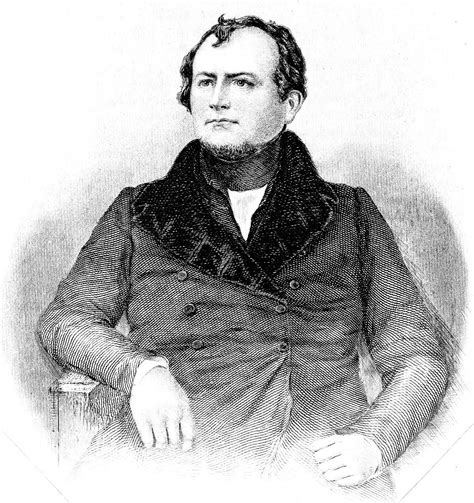
Thomas Dorr
As some who are a bit more well-versed in history of the United States will know, the United States did not start out with universal suffrage…not even for white men. What they may not know is that Rhode Island was the most restrictive of them all on this front. When Rhode Island was admitted as a state, it used for its Constitution the royal charter for the colony from 1663. This charter was quite a forward-thinking document for its day and age, and it included religious freedom (not common in that time) as well as suffrage for men who owned property. Indeed, at the time of statehood, property ownership as a requirement to vote was the norm. The requirement that such men be white, incidentally, was only added in 1822. However, by 1841, the rise of Jacksonian democracy, which established suffrage regardless of property ownership, had spread throughout the nation. That is, except for Rhode Island. Rhode Island’s political establishment were not fans of Andrew Jackson or Jacksonian democracy, and the property-owning men of the state had not once voted for him. By this point, over 60% of the white male population were barred from voting due to their lack of property ownership, and this group of citizens as well as some of the currently eligible voters rallied behind Thomas Dorr, a big fan of Andrew Jackson and an advocate of bringing Jacksonian democracy to Rhode Island. Dorr initially supported including black residents in suffrage, but his base of support insisted on them getting suffrage first, leading him to drop it, at least for the time being. The Dorr faction drew up their own reformist Constitution, but the Rhode Island Assembly formed a counter-proposal that included some concessions to the Dorrites. The Dorrite Constitution prevailed in a public vote overwhelmingly, but Rhode Island’s governor Samuel Ward King was a staunch foe of the Dorrite constitution, and refused to recognize the result of the referendum. In 1842, both the supporters of King and the Dorrites held their own elections, and both proclaimed their candidates the winner, with a strange situation existing in which different citizens of Rhode Island recognized different governors, and both issued executive orders.
This conflict was in truth quite minor; while armies were formed and moved about, ultimately only one civilian was accidentally shot and killed (Shatwell). Reactions to the Dorr Rebellion differed among the prominent names of the time. The distinct lack of combat led Frederick Douglass to describe the rebellion as merely the “Dorr excitement” (Tardiff). Others saw more importance in the event, such as Francis Wayland, a staunch conservative president of Brown University, who decried the event as almost resulting in “the horrors of civil war” and a retired Andrew Jackson, who thought the event a legitimate assertion of the power of the people (Chaput & DeSimone). A temporary party that was formed off the Whig Party was the Law and Order Party (“law and order”, like so many phrases in American politics, have had long usages), which prevailed in the next election.
Among the soldiers who helped put down the Dorr rebellion were 400 black men. Many of Rhode Island’s blacks had supported Dorr initially for his calls for expanding suffrage but changed their minds after he dropped black suffrage. These men were praised in the prominent Providence Journal, headed by future Republican Senator Henry B. Anthony. For their role, the political reward from Rhode Island’s elite was that with the revisions to the state Constitution, blacks could vote. Although the common thinking today is that black voters are largely associated with the political left given that usually about 9 in 10 black voters vote Democrat (although up to 1 in 3 consider themselves conservative), in this time they aligned themselves with the political right of their day and got rewarded.
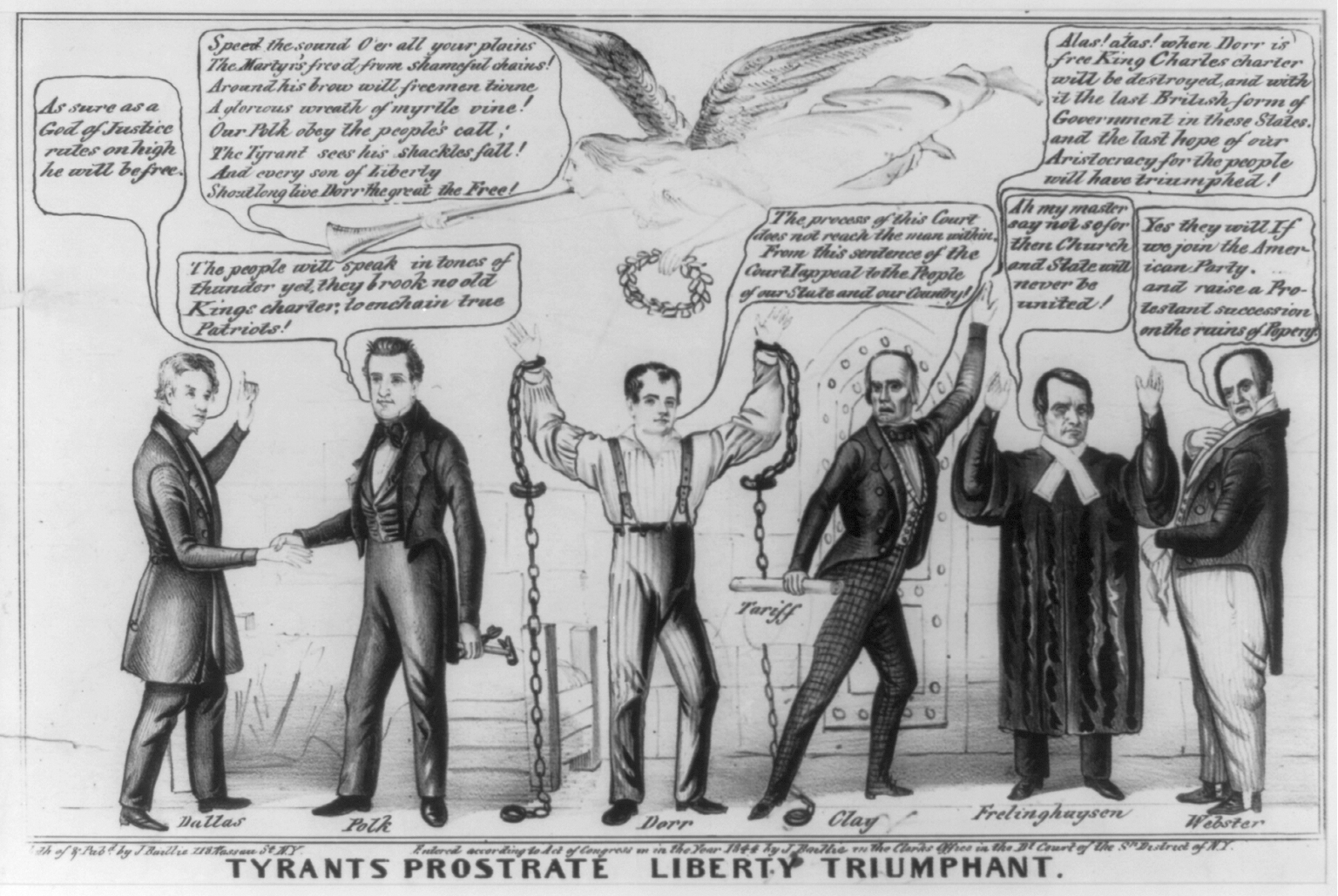
A Pro-Dorr Cartoon
In 1844, Dorr was sentenced to life of solitary confinement and hard labor for treason in a court in Newport, one that the general public considered far too harsh and protested. Only the following year amid public pressure, all participants in the Dorr Rebellion were granted amnesty. Even this one year of solitary confinement and hard labor, however, exacted a terrible toll on Dorr’s health; he would be retired for the rest of his life and died on December 27, 1854 at the age of 49. Although the rebellion was unsuccessful in making Thomas Dorr governor and in ousting the political elite of Rhode Island (the latter would not be achieved until the 1930s), the Dorr Rebellion did manage to push the state legislature to amend the state’s constitution so that Rhode Island no longer had property requirements for suffrage…for native-born men that is, provided they could pay a $1 poll tax. Foreign-born men still had to own property to vote, thus leaving many Irish Catholics out of the electorate, and this requirement persisted until 1888, when it was amended to permit foreign-born men who didn’t own property to vote. Although Southern restrictions on suffrage under Jim Crow administrations were more discriminatory and overtime proved much more dramatic in their impact (Virginia, for instance, had only about 10% of the population voting in the general election by the 20th century thanks to their onerous poll tax), Southerners pointing out hypocrisy on the rules of some Northern states like Rhode Island weren’t without a point. The power of the elites, who had been predominantly Federalist, Whig, and Republican over the history of Rhode Island didn’t start to weaken until the direct election of senators and wasn’t undone until the 1930s with the rise of FDR and the election of Governor Theodore Green. Today, Rhode Island is a staunchly Democratic state, with no Republican being elected statewide since 2006 and their voters since 1928 have only seen fit to elect Republicans to the presidency four times. Dorr himself is looked upon more favorably today, and the state of Rhode Island even recognizes him as governor during the brief time he and his supporters regarded him as governor.
References
Chaput, E.J. & DeSimone, R.J. (2010, January). Strange Bedfellows: The Politics of Antebellum Rhode Island. Common Place, 10(2).
Retrieved from
https://commonplace.online/article/strange-bedfellows/#:~:text=The%20former%20slave%20and%20staunch,was%20to%20induce%20the%20old
Shatwell, J. (2020, March 3). Dorr Rebellion – Rhode Island’s Very Own, Very Small Civil War. New England.
Retrieved from
https://newengland.com/yankee/history/dorr-rebellion/
Tardiff, E. The Dorr Rebellion. Rhode Tour.
Retrieved from
https://rhodetour.org/tours/show/29
 Mad Politics: The Bizarre, Fascinating, and Unknown of American Political History