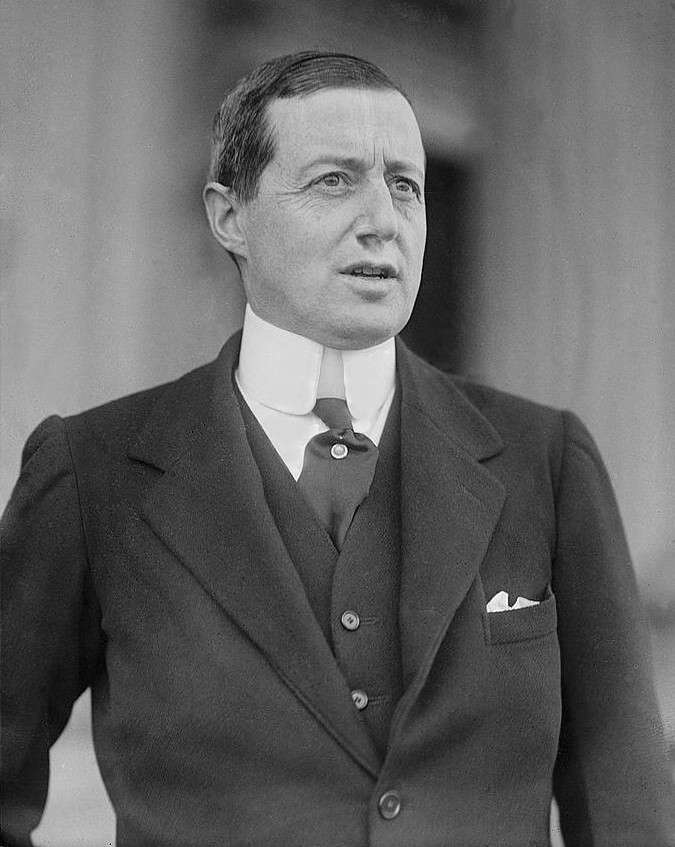
Fun fact: Rhode Island used to be what we’d call a “red state”. Rhode Island was strongly unionist as well as anti-slavery, so when the Republican Party formed in 1854, they came to dominate the state, and the last post was about the most prominent figure to come out of this rise in Henry B. Anthony. After Anthony, the state’s powerhouse was Nelson W. Aldrich, the “economic manager of the nation”, who was a strong believer in the protective tariff as well as free enterprise at home. His domination came to an end with his retirement in 1911, with him being followed by wealthy Republican banker Henry Lippitt, perhaps an even more conservative figure than Aldrich. However, in 1913 the 17th Amendment was ratified, which provided for the direct election of senators. Under the system of state legislatures electing senators, Democrats had literally no chance of electing a senator given the apportionment of the state legislature that overwhelmingly favored rural areas over cities. However, 1916 was a different story. Lippitt was to face the first popular election for a senator in the state, and his opponent was Peter Goelet Gerry (1879-1957), who had served in Congress from 1913 to 1915. Gerry, the great-grandson of the namesake of gerrymandering, Elbridge Gerry, ironically benefited from the limiting of the influence of gerrymandering and defeated Lippitt by eight points.
Senator Gerry
Gerry was a frequent supporter of President Wilson’s domestic policy but even moreso a supporter of his foreign policy, strongly supporting the Versailles Treaty, which went down to defeat in 1920. In 1922, he was reelected in an election that went poorly for Republicans. It also helped that Gerry was quite rich so he could spend his own money on his campaigns, and he helped the state Democratic Party as well this way, helping them be competitive. He was mostly an opponent of Republican policies during the 1920s, and served as minority whip from 1919 to 1929. In 1928, Gerry suffered an inverse result of the 1916 election. While in 1916, Republican presidential nominee Charles Evans Hughes won Rhode Island and Gerry won the Senate election, that year Democrat Al Smith won the state with Gerry’s help but Gerry himself lost by a point. Republicans got some wedge votes with French-Canadian voters by selecting Felix Hebert, a man born to a family of French extraction in Quebec, becoming the first one to serve in the Senate (Hill). In 1930, Gerry tried to regain his seat by running against incumbent Jesse Metcalf, who happened to own the very same Providence Journal that had helped Henry B. Anthony stay in power, but was narrowly defeated despite getting Al Smith to campaign with him. Metcalf during the campaign complained of the “Gerry money machine”, and he wasn’t wrong (McBurney). However, Republicans became deeply unpopular during the Great Depression, and by 1934 Hebert’s French-Canadian descent mattered far less to voters than his party affiliation and staunch opposition to the New Deal, and Gerry regained his seat by almost 15 points, winning all cities except Cranston and Warwick (McBurney). This was the first and only time in Senate history that a senator who had been defeated in one election beat his opponent in a rematch (McBurney).
Gerry and FDR
President Franklin D. Roosevelt pushed both the Democratic Party and overall American politics in directions that could alienate figures who previously were regular Democrats or considered good progressives, and Gerry was one of them. He would often prove a thorn in FDR’s side by voting against New Deal measures frequently; he voted against a TVA bill in 1935, the bituminous coal bill in 1935, voted to strike the “Death Sentence” clause from the Public Utilities Holding Company Act, and voted against a housing bill in 1936. Gerry did vote for Social Security in 1935 and in 1937 he voted for the minimum wage, but he was certainly among the opposition within the Democratic Party to FDR’s domestic policies. Although in a radio address on the eve of election day in 1936, Gerry urged support for the state Democrats but mentioned neither FDR nor the New Deal (McBurney). In 1937, he was among senators who offered suggestions for the drafting of the Conservative Manifesto, a document principally authored by Senators Josiah Bailey (D-N.C.) and Arthur Vandenberg (R-Mich.), which called for ten conservative policy alternatives to New Deal policy. This contrasted greatly with his colleague, Theodore Green, who had defeated Metcalf in 1936 and was the man who really put Rhode Island in the Democratic column in his term as governor. However, Senator Gerry retained his support for Wilsonian foreign policy, and thus backed Roosevelt’s foreign policy initiatives. He was also a consistent supporter throughout his career of strengthening the navy. As one might expect, Gerry’s power in the Senate in his second go was weaker in the majority in the 1930s and 1940s then it had been in the minority in the 1920s, when he had served as whip given his opposition to the New Deal as well as his absence from 1929 to 1935 preventing him from getting any chairmanships. By 1946, the state’s Democrats were tiring of Gerry’s contrarian record. This plus his declining health resulted in him opting not to run for reelection. His DW-Nominate score was a -0.187, which accounts for both his earlier Wilsonian liberalism in his first two terms as a senator and his anti-New Deal stances in his second two terms. Had he chosen to run for another term, he would have likely had an uphill battle for the Democratic nomination. Gerry is arguably the last person of a conservative bent to get elected to the Senate from Rhode Island, yet he was also the first to make the Democratic Party a genuinely strong force in the state, although the ideological consequences of this were surely not fully of his intent.
References
Gerry, Peter Goelet. Voteview.
Retrieved from
https://voteview.com/person/3544/peter-goelet-gerry
Hill, R. The Senator and Mrs. Vanderbilt: Senator Peter Gerry of Rhode Island. The Knoxville Focus.
Retrieved from
https://www.knoxfocus.com/archives/the-senator-and-mrs-vanderbilt-senator-peter-gerry-of-rhode-island/
McBurney, C. (2016, November 3). Peter Gerry, Former U.S. Senator from Rhode Island, is in the News Today. Small State Big History.
Retrieved from
https://smallstatebighistory.com/peter-gerry-former-u-s-senator-rhode-island-news-today/
 Mad Politics: The Bizarre, Fascinating, and Unknown of American Political History