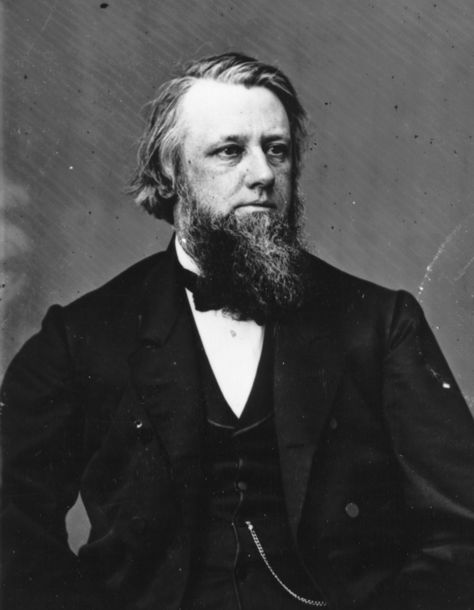
Rhode Island today is one of the most Democratic states in the nation. Although Republicans do have chances to elect governors, they haven’t had a member of Congress elected since 1992, they haven’t been able to elect a conservative to Congress since 1938, and the last time they were able to elect a conservative Republican to the Senate was in 1930. Indeed, before 1928 the GOP had a solid grip on the politics of Rhode Island. The man who established this solid grip was Henry Bowen Anthony (1815-1884).
A journalist by profession, Anthony’s editorship of the Providence Journal made him a prominent and influential citizen in the state. A Whig, he used the Providence Journal to promote such political positions as retaining property requirements for voting, limiting immigrants’ political power, and the rule of law and order as opposed to rule by mob (Ferraro). Rhode Island’s constitution at the time of Anthony’s political career was based on the old 1663 charter from the English crown. This charter included provisions that limited voting to property owners and had in the Assembly each town having one representative with no city having more than 1/6 of the legislature, and the Senate having one for each town and city (Steffens). The former resulted in a rebellion by Thomas Dorr in 1842, a figure who supported eliminating the property requirement so new immigrants could vote, hence Anthony’s emphasis on “law and order” (Warwick History, Part II). Ultimately, that year despite the failure of the rebellion to put Dorr in power as governor, the state did enact universal suffrage for those men born in the United States (foreign-born would have to own property to vote until 1888, and there would still be limitations on suffrage), the last to do so (Steffens). However, the state had not changed the township provision, thus although Rhode Island may have more immigrants who are inclined towards Democrats in cities such as Providence, the small townships have at least one representative and one senator. Thus, what one must do to secure power is please those small townships. Throughout his political career, Anthony would be sure to do so. He served as Rhode Island’s governor from 1849 to 1851 as a Whig, where he began creating his machine that he would use to dominate Rhode Island politics. He drifted into the American, or, “Know Nothing” Party after the Whig Party’s collapse and then became a Republican. Anthony was married in his younger years, to Sarah Rhodes, but after her death in 1854 he did not remarry. The couple had no children, thus the remainder of his life was free to be committed to politics, and commit himself he did.
In 1859, Anthony was elected to the Senate as an “American Republican”. There, he became known as a talented orator and his abilities as well as his political wisdom and friendliness with senators regardless of party resulted in him gaining a lot of influence. In December 1862, his colleagues elected him chairman of the Senate Republican Conference, a post he would hold for the rest of his life. In his day, the positions of majority and minority leader did not exist, but the functions of party leader were held by the chairman of the conference of their party. Anthony would also 17 times be elected president pro tempore, a position of popularity rather than seniority at the time (U.S. Senate). He was affectionately known as the “Father of the Senate”…rather than having a family, Anthony had made the Senate his family. Per Senator George Frisbie Hoar (R-Mass.) in 1903, “He had come to be the depository of [the Senate’s] traditions, customs and unwritten rules…He seemed somehow the intimate friend of every man in the Senate, on both sides. Every one of his colleagues poured out his heart to him. It seemed that no eulogy or funeral was complete unless Anthony had taken part in it, because he was reckoned [as a protecting] friend of the man who was dead” (Baker, 5-6).
The Journal Ring – The Source of His Power
Anthony’s power was unrivaled in Rhode Island as one of its senators, and he could be quite ruthless. One writer of the time wrote that he did not hesistate to use “political legerdemain and bribery” to achieve his goals (U.S. Senate). The practices Anthony engaged in were more common in his day than now. In Rhode Island a culture of bribery of people to vote was normalized, with many voters refusing to turn out if not bribed (Steffens). The official reasoning was that such payments were compensation for lost time, a defense that strikes me as especially laughable in hindsight.
Anthony’s greatest way of maintaining power, however, was through his dominating influence over the press, particularly the power of his Providence Journal, hence his machine being known as the “Journal Ring”. Given that Anthony was such a powerful figure, opinions differed on him. For his supporters, he was a skilled politician, an intellectual, a scholar, and one who would put disagreeing opinions in his newspaper. For his critics, he behaved as a typical political boss and who employed anti-Irish Catholic bigotry and ignorance to maintain control (Warwick History, Part II). The latter came in the form of supporting Governor William Hoppin, who espoused anti-Catholic conspiracy theories, and allowing anti-Catholic groups to publish material in his paper, one of which fretted that if suffrage were extended to immigrants, “civil and political insitutions and public schools would come under the control of the Pope of Rome through the medium of thousands of naturalized foreign Catholics…” (Warwick History, Part II). The conflicts between the Protestants and Catholics that had characterized Britain in the past transferred over to the United States, making Catholics in that day essentially the “Jews” of the United States. Anthony himself responded to criticisms of the system of government he supported by saying, “a republican government might be representative without being democratic” and regarded immigrants as those who “came among us uninvited and upon whose departure there is no restraint” (Warwick History, Part II). He saw such immigrants as a threat to his political power as well as to that of the GOP, and at least in the long run he wasn’t wrong. By the 1928 election their descendants would be sufficiently mobilized to vote for Democrat Al Smith over Republican Herbert Hoover and by the 1930s they would prove fatal to the GOP’s dominance of the state. Rhode Island voters have since seen fit to vote for the Republican candidate for president only four times (Ike both times, Nixon in ’72, and Reagan in ’84). Political power seems a tremendous motive in his actions on immigration, as he did not support all immigration restrictions equally, opposing the Chinese Exclusion Act of 1882, a law which attracted overwhelming support among laboring white men of the West. Anthony’s position in the Senate was guaranteed by his control of his political machine which elected the very people who elected him in the state legislature, a state legislature proportionately favorable to him and the GOP by Constitutional structure.
Anthony would occasionally have a challenge to his machine, and one such figure who did so was William Sprague, a wealthy man from a family that had already produced politicians who managed to win the governorship of Rhode Island as a member of the Rhode Island Union Party in 1860, helped greatly by spending his own money. However, after the outbreak of the War of the Rebellion, he was quick to send troops to support the Union and became a Republican. Anthony courted the at the time popular Sprague and had his machine elect him to the Senate in 1863. However, William Sprague would end up being more politically independent than Anthony liked, and in 1868 he had to be threatened with political ruin to vote to convict President Andrew Johnson (Warwick History Part III). He became one of the Liberal Republicans during the Grant Administration who backed the candidacy of Horace Greeley in 1872. After publicly lashing out against Anthony and his domination of the political scene in Rhode Island through the Providence Journal, he saw to it that he did not win another term and was able to capitalize in the Providence Journal on both his Liberal Republicanism as well as his worsening alcoholism, calling him a madman (Warwick History, Part III). In 1875, he had the legislature replace him with General Ambrose Burnside.
Anthony and Lincoln and Johnson
As the leader of the Senate Republicans, Anthony was a strong supporter of President Abraham Lincoln and his efforts both at securing the union and in opposition to slavery. After Lincoln’s assassination, he gave his support to President Andrew Johnson, even though the two had considerable disagreements on Reconstruction policy. Anthony would vote, contrary to Johnson’s positions, for the 14th and 15th amendments to the Constitution. However, Johnson decided to give patronage appointments in Rhode Island to Anthony’s foes, and thus when the time came for the vote on convicting Andrew Johnson of impeachment charges, Anthony, the first to vote, announced, “Guilty!” (U.S. Senate) He would support all subsequent presidents in his lifetime, for all of them would be Republicans; he was spared by his own death from witnessing the election of Grover Cleveland. Ideologically, he could be thought of broadly as a conservative given his positions on currency, interest rates, tariffs, and immigration, he was not necessarily uniformly so in how he voted and was far from a guaranteed vote for railroad interests. Anthony also supported the annexation of Santo Domingo (now known as the Dominican Republic). His DW-Nominate score was a 0.286, indicating a moderate conservatism by that standard.
A Successor
In the late 1870s, Anthony came to know one Nelson Aldrich, and was sufficiently impressed that he backed his rise in politics. After serving a single term in the House from 1879 to 1881, Anthony secured his election to the Senate, where he would serve for 30 years and become a titan in that body, leading its “Big Four” of conservatives who called the shots in the Senate from 1897 to 1905, and he would himself essentially lead the Senate until his retirement in 1911. Although reelected in 1883, Anthony’s health was declining, and in January 1884 he declined to be elected again as Senate pro tempore. He would die on September 2nd. Anthony’s death was followed by the single largest public funeral in the state’s history.
References
Anthony, Henry Bowen. Voteview.
Retrieved from
https://voteview.com/person/212/henry-bowen-anthony
Baker, R.A. (2007). Traditions of the United States Senate. U.S. Senate.
Retrieved from
https://www.google.com/books/edition/Traditions_of_the_United_States_Senate/PV-SvOCvC_AC?hl=en&gbpv=1&dq
Ferraro, W.M. (1999). Anthony, Henry Bowen. American National Biography. New York, NY: Oxford University Press.
Retrieved from
https://www.anb.org/display/10.1093/anb/9780198606697.001.0001/anb-9780198606697-e-0400026
Henry Bowen Anthony 1815-1884 – A brilliant editor and politician. Warwick Rhode Island Digital History Project.
Retrieved from
https://www.warwickhistory.com/index.php?option=com_content&view=article&id=270:henry-bowen-anthony-1815-1884-a-brilliant-editor-and-politician&catid=56&Itemid=125
Steffens, L. (1905). Rhode Island: A State for Sale. Small State Big History.
Retrieved from
https://smallstatebighistory.com/rhode-island-state-sale/
 Mad Politics: The Bizarre, Fascinating, and Unknown of American Political History