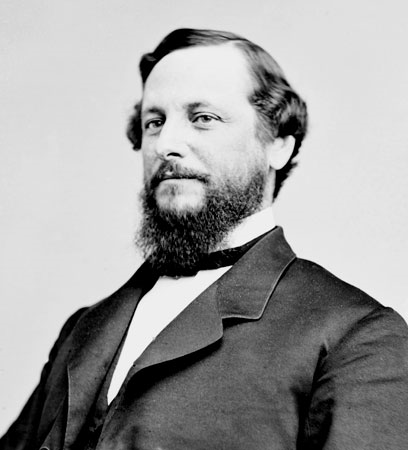
The War of the Rebellion was an expensive matter, indeed saving a nation never comes cheap. Once the war had ended, the question arose of how to pay off creditors’ bonds. At this time, Secretary of the Treasury Hugh McCulloch, an economic conservative, began contracting paper currency not tied to gold so as to clamp down on inflation and move the nation back to gold-based currency. This policy was not pleasing to everyone, particularly those who would benefit from inflation, and although debtors were major beneficiaries there were also business interests that favored currency inflation at the time. A prominent politician steps up with an alternative.
Prominent Democrat George Pendleton of Ohio, who had been a strong opponent of the Lincoln Administration and the party’s candidate for vice president in 1864, proposed in 1867 in an article for the Cincinnati Enquirer what became known as the “Ohio Idea”. His idea was to redeem bonds in paper currency instead of gold. Such a measure was inflationary and such inflation would benefit some, particularly farmers in the Midwest, many who were in debt. One of the fundamental determinants of right vs. left historically is creditors vs. debtors. People on the right pursue policies favorable to creditors so as to encourage further lending presumably so those who take on the loans can grow themselves up, while people on the left pursue policies favorable to debtors so as to ease the burden of repayment, especially if they hit upon difficulties with what they hoped to achieve with the loan. Per historian John B. Weaver (2013), “As historian Robert Sharkey observed, the “Ohio Idea”, or Pendleton Plan as it also came to be known, skillfully appealed at once to several interest groups. In one fell swoop it promised to terminate the contraction policy, overthrow the National Banking System, and strike a note of fairness in demanding “the same currency for the ploughholder and the bondholder” (44). There was distinct class motive behind this proposal and fits with the Democratic Party’s tradition as being a party of the little guy, even if at that time the little guy was for all intents and purposes white. Pendleton himself was a staunch Jacksonian, and he concerned himself with the welfare of the common man. Although Democrats had opposed the Legal Tender Act in 1862, including Pendleton, the sought after outcome could be thought of as “old wine in new bottles”. Such adaptation of changing means to achieve old ends was later seen with President Franklin D. Roosevelt, who used Hamiltonian means to achieve Jeffersonian and Jacksonian ends with the New Deal.
Opposed to the “Ohio Idea” was Ohio Republican Senator John Sherman, chairman of the Senate Finance Committee, who held that only certain class of bonds could be repaid in greenbacks, and that the existing greenbacks could be eventually transitioned from based on fiat to gold and silver backed with economic growth (Weaver, 45). Pendleton’s idea was embraced by the Democratic platform of 1868, but it fell to the wayside as they lost the election and President Ulysses S. Grant signed into law the Public Credit Act in 1869, in which debts were to be paid in gold. However, conflicts over currency inflation would continue throughout the 19th century, particularly in the backlash to the Coinage Act of 1873 and the uneasy bimetallism that followed with the Bland-Allison Act. There are some interesting things to note about Pendleton himself – he was known as the leader of the “Peace Democrats”, or as they were called, “Copperheads”, who were for signing a peace treaty with the Confederacy. He had also been George McClellan’s running mate in 1864 and had led opposition in the House to the 13th Amendment. Pendleton’s central contribution to the law would be as a senator with the Pendleton Act, making 10% of federal positions merit-based rather than spoils based, and it would cost him reelection to the Senate.
References
Mach, T.S. George Hunt Pendleton, The Ohio Idea and Political Continuity in Reconstruction America. Ohio History Journal.
Retrieved from
Weaver, J.B. (2013, April). Green, Gold, or Silver: The Money Question in Ohio Politics, 1865-1900. Ohio Academy of History.
Retrieved from
https://www.ohioacademyofhistory.org/wp-content/uploads/2013/04/2003Weaver.pdf
 Mad Politics: The Bizarre, Fascinating, and Unknown of American Political History