
There are numerous perennial candidates in American history, with the king of them easily being Harold Stassen. But at least Stassen was at one time Minnesota’s incredibly popular governor and even seriously considered for the Republican nomination for president. Lawrence Joseph Sarsfield Daly (1912-1978) of Chicago could not claim the same successes.
Daly was not exactly the guy you’d think of entering politics. He was a high school dropout who for a living manufactured barstools in his garage. Daly was also married and would have five children. Yet, there was some force in this man that motivated him to consistently seek political office, despite having no connections with the major parties.
Daly’s pursuit of public office interestingly started with a minor victory. In 1932, he ran for and won a post as ward committeeman, only to be booted from the post as it was discovered he was only 20 years old, and thus underage. Daly also became a big fan of General Douglas MacArthur, and would submit his name in the Illinois primaries every presidential election year starting in 1936, and MacArthur would routinely withdraw his name. In 1938, he ran for Cook County School Superintendent and it was in this race that he started going by “Lar” as he thought it would appeal to Swedish voters (Rudnick). His name, however, appeared as Lawrence J. Daly on the ballot, and he surprisingly got 300,000 votes as numerous Irish voters liked his name. Daly also adopted “America First” in his name to appeal to American voters. But really, it was because he consistently was opposed to American involvement in foreign affairs. Daly would frequently wear an Uncle Sam suit to enhance his image as a super patriotic candidate. Along with non-intervention, Daly stood for numerous positions throughout his perennial career, including lower taxes, shooting drug peddlers on sight (after a seven-day warning to get out of town), 100% support for Joseph McCarthy’s anti-communist investigations, imprisoning any witness who invokes the 5th Amendment (protection from self-incrimination) in their testimony, and “Christian” education in public schools, with clergymen of Catholic, Protestant, and Eastern Orthodox factions as teachers (Boese).
Daly ran in Democratic and Republican primaries for political office, but more often the latter. He ran in the following elections:
GOP primary for Illinois Governor – 1956 and 1964.
GOP and Democratic primary for Chicago Mayor, as well as candidate in general election – 1959.
GOP primary for Chicago Mayor – 1963 and 1967.
Democratic nomination for president, and in the general election for president on the “Tax Cut” and “America First” slates – 1960.
Democratic primary for Senate – 1962.
Republican primary for Senate – 1966, 1970, 1974, and 1978.
In 1950, Daly, ever the resolute anti-Communist, wrote a letter to President Harry S. Truman offering to fly to the Kremlin to drop an atomic or hydrogen bomb (The La Crosse Tribune). History tells us that Truman did not take him up on this offer. In 1952, although there was a great deal of speculation and interest in General MacArthur running for president among the political right, he had once again declined. Perhaps, Daly thought, MacArthur just needed a nudge to motivate him. He first added his name to the Illinois primary, but MacArthur had it removed. Daly tried a different tactic for the Wisconsin primary by scanning the Chicago phone book and he found a man literally named “General MacArthur”. General MacArthur was a 42-year old tank inspector who was black and had eight children. With his consent and signature, Daly submitted his name on the Indiana Republican primary ballot.
Equal Time Menace
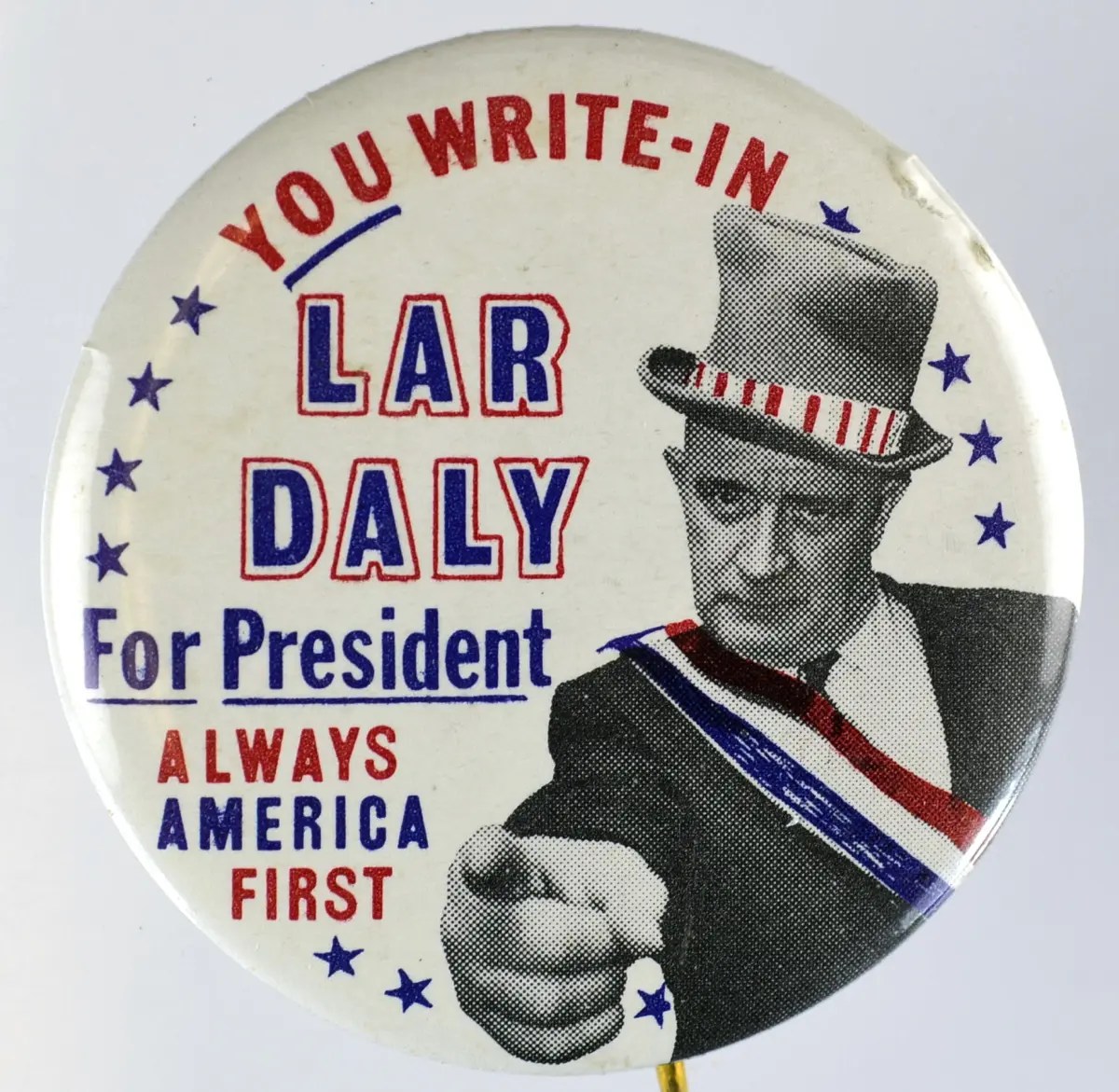
One way Daly sought to enhance his profile was in his efforts to force broadcasters to allocate him equal time to major candidates. Perhaps the thought was with publicity will come votes, and he certainly needed those if he wanted to become Chicago’s mayor.
In 1959, Daly ran for mayor of Chicago after having run for both the Republican and Democratic nominations and lost. In the process, he demanded to be given equal time to incumbent Democrat Richard J. Daley and his Republican challenger, Timothy Sheehan, and filed a complaint to the FCC about Chicago broadcasters not doing so. On a 4-3 vote, the FCC in February ruled that networks had been in error not granting Daly equal time in broadcast coverage. He ultimately only got two votes in the general election. Daly thus became the proximate cause of a change in the Equal Time Act signed into law by President Eisenhower in September 1959, which exempted routine news coverage from having to cover candidates equally. However, if candidates were invited to appear for a broadcast, equal time still applied.
In 1960, Daly ran in the Democratic primary for president, having filed just before the deadline in the New Hampshire primary. In the general election, he would again agitate for equal time to the FCC so that he too could be interviewed on the Jack Paar Tonight Show as John F. Kennedy and Richard Nixon had. Paar was livid that he was forced to accommodate this crank, and Daly showed up in his Uncle Sam costume, as you can see below:
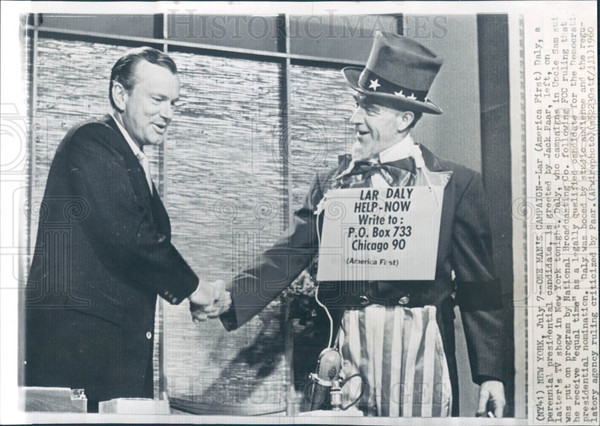
During the show he did himself no favors by calling President Eisenhower a “poor excuse” for a president and directly solicited the public for campaign contributions, provoking boos and heckling from the audience (Lindberg, 194). One audience member challenged him, “Mr. Daly, I would like to know where your supporters are located. I teach special studies in Illinois, and we’ve never heard of you” to which he responded, “Well, sir, you apparently don’t read newspapers, watch television, listen to the radio, or attend meetings, because in every Illinois campaign in which I engage, I am known as the tireless candidate” (Zurski). Daly was known for delivering his speeches in a shouting and even threatening manner. As author Hal Higdon noted, “Lar Daly is a likeable person, but one of his major flaws in his character is that when he gets in front of a microphone, he begins to shout and threaten in an attempt to intimidate the audience. With Lar Daly as his own best friend, he doesn’t need enemies!” (Lindberg, 194). He did not fail to demonstrate this in his Jack Paar appearance. Daly’s conclusion to his speech before the audience was, “Your only choice is America first – or death” (Zurski). At the end of the program, Paar apologized to the audience to which they cheered.
The Jack Paar appearance netted Daly $151.17 in donations, a fraudulent check, and three death threats (Lindberg, 194). After this appearance, Congress suspended equal time regulations for the 1960 election so Nixon and Kennedy could debate without the possibility of Daly wanting to appear too (imagine that!). Daly would receive few votes outside of his own.
In his next Senate campaign, his “six point program” was
“ – An immediate invasion of Cuba to restore its “Christian social order”.
- No aid to communist countries except food and clothing to be distributed by Catholic and Orthodox churches.
- A cut in aid to Africa and Asia, and a boost in aid to America’s own underprivileged, including Negroes and Latin-born.
- A high tariff barrier to protect American working men.
Equal federal aid to parochial schools.
- And legalized gambling” (Ebert, 1962).
In the 1973 special election for Illinois’ 7th district, Daly won a major party’s primary. However, he only won the Republican primary because no one else bothered to challenge Democrat Cardiss Collins in this heavily Democratic district. He only got 1,329 votes.
These campaigns, although a passion for him, came at a cost, and in his later years had to sell his Uncle Sam outfit. Daly’s health also was declining as he was in and out of hospitals and lost the ability to grasp objects with his hands (Anderson). In 1978, Daly again challenged incumbent Senator Chuck Percy in the Republican primary, but only got about 15% of the vote in the March 21st election. This was his last race, and although he surely would have been up for more, his health gave out and he died of a lung ailment on April 17th, less than a month after the primary.
Conclusion
Although one of the most ridiculous perennial figures in American politics, Daly is a testament to an indomitable spirit characteristic of America. Indeed, there are few people who would go as far as he did and meet with so little success. Daly’s approach was unabashed and shameless, and while on occasion he scored certain victories, they never translated into success in an election. Indeed, Father Mark Dennehy remembered him as “…the embodiment of Don Quixote” (Anderson). He was also well-liked in his community as despite his tenacity and his poorly received Jack Paar appearance, he was known to be friendly and as a devout Catholic contributed to the church every Sunday even though he was sometimes strapped for cash. However, his story also gives backing to the famous W.C. Fields quote, “If at first you don’t succeed, try, try again. Then quit. There’s no point being a damn fool about it.”
References
Anderson, J. (1978, April 22). Lar Daly remembered for what really counted. Chicago Tribune.
Retrieved from
Boese, A. (2008, October 22). Strange Candidate #6: Lar “America First” Daly. Weird Universe.
Retrieved from
http://www.weirduniverse.net/blog/comments/strange_candidate_6_lar_america_first_daly
Ebert, R. (1962, November 1). US Senate Candidate Lar Daly Presents Program Here Friday. The Daily Illini, p. 9.
Retrieved from
Lar Daly, 66, Dead. (1978, April 19). The New York Times.
Retrieved from
Lar Daly, a candidate for everything, is dead. (1978, April 19). La Crosse Tribune (La Crosse, Wisconsin), 18.
Retrieved from
Lindberg, R.C. (2020, July 28). Tales of forgotten Chicago. Carbondale, IL: Southern Illinois University Press.
Rudnick, N. (2021, June 17). The Biggest Loser: Elections Edition. The Hot Seat.
Retrieved from
https://medium.com/@rudnicknoah/the-biggest-loser-elections-edition-8dc372f6e401
Vos, T.P. & Ashley, S. (2014, December 1). Amending Equal Time: Explaining Institutional Change in American Communication Policy. Boise State University ScholarWorks.
Retrieved from
Zurski, K. (2020, November 5). Lar Daly and the Art of Losing Elections. Unremembered.
Retrieved from
Television: Equal Sequel. (1964, August 28). Time Magazine.
Retrieved from
https://content.time.com/time/subscriber/article/0,33009,876112,00.html
The Press: Free, Equal & Ridiculous. (1959, March 30). Time Magazine.
Retrieved from
https://content.time.com/time/subscriber/article/0,33009,892443,00.html
 Mad Politics: The Bizarre, Fascinating, and Unknown of American Political History
4 thoughts on “Lar “America First” Daly: The Don Quixote of American Politics”