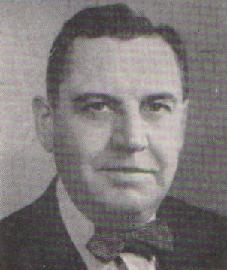
I guess New York Republican politicians have been a considerable subject of interest lately for me. Perhaps my mind is more on New York given the House special election for George Santos’s seat, which got reconfigured into a district that voted for Biden by 9 in 2020. The last few I covered differed a bit from conservatism and had ideological changes in their careers, but today’s Republican was pretty consistent.
In 1938, House Minority Bert Snell decided to call it quits, and elected in his place was Wallace Pierce. However, Pierce was not doing so well and died at the start of 1940. Although the son of New York state Republican politician Frederick Kilburn, Malone banker Clarence Kilburn (1893-1975) didn’t think he’d go into politics until as a prominent citizen he was approached to run for public office and was elected to Congress. He occupied an interesting place in American politics and one that would prove quite favorable post-war: conservative on domestic policy and internationalist on foreign policy. The 1950s as a political era was often inclined towards both, and the Conservative Coalition had a stronger bond on domestic than foreign policy. Although a staunch foe of the New Deal and its works, Kilburn voted for the peacetime draft as well as Lend-Lease in 1941. He recalled about the New Deal, “I didn’t think much of it. I never have thought much of it. It turned out that some stuff was good and some of it was terrible. And his packing of the Supreme Court was God awful, that’s all. Trying to pack it. He did not succeed” (Langlois & McGowan, 84). Kilburn thought a bit better of FDR personally but saw him as a political animal. He recalled that “He was a very charming kind of fellow, as far as that goes, but he was a politician first, last, and all the time. He did some great things, I admit that, but he was thinking politics all the time” (Langlois & McGowan, 84). After the war, Kilburn backed the conservative objectives of the 80th Congress but also voted for Greek-Turkish Aid and the Marshall Plan, regarding them as post-war necessities. He would support foreign aid but sometimes also supported cuts. Kilburn thought quite highly of Roosevelt’s ideological opposite, Barry Goldwater. He recounted, “I thought Goldwater was quite a good man myself. They all got after him to beat the band just because they said he was too conservative, but they didn’t study what he had said, but a lot of his stuff they adopted later on. People don’t realize that” (Langlois & McGowan, 168).
Kilburn seems from his account to be a solid conservative but also a bit pragmatic. He asserted that the Joint Economic Committee in Congress, set up by Senator Robert Taft (R-Ohio) in 1945 to study the economic issues of the nation, started out as “objective” but that it turned political when Senator Paul Howard Douglas (D-Ill.) became chairman, and then there would be majority and minority reports issued (Langlois & McGowan, 120-121). I wonder if he means that it got more distinctly liberal, as Douglas had a liberal record and was at times accused of being a socialist. Perhaps Douglas simply made it more political.
As a banker, Kilburn sat on the House Banking and Commerce Committee as the counterpart to Chairman Wright Patman (D-Tex.), who, true to the Jacksonian legacy of the Democratic Party, was an arch-antagonist of bankers. Kilburn would enjoy sparring with Patman on the matter and said of him that “he was just death to the Federal Reserve and death to banks, he hates the Federal Reserve — well, he gets up and makes some of the most ridiculous statements, you know” (Langlois & McGowan, 114). He did enjoy some interesting friendships among ideological opponents, including with East Harlem’s Vito Marcantonio. Kilburn, a self-identified conservative who was highly conscious of the use of taxpayer funds and defender of market capitalism was friends with the pro-Soviet Marcantonio. He recalled an occasion in which he drew a primary challenger, and Marcantonio offered to either speak for or against him, whichever would help him more (Langlois & McGowan, 90). Although many New York politicians were opposed to the St. Lawrence Seaway, Kilburn, like Bert Snell, was in favor. In 1954, he played a significant role in advocacy for the construction of the St. Lawrence Seaway (Langlois & McGowan, 152).
Kilburn vs. Civil Rights
Among Republicans in New York, Kilburn had without doubt the most negative record on civil rights. In 1945, he opposed banning the poll tax (a bill sponsored by Marcantonio) and the Powell Amendment to the School Lunch bill to bar racial discrimination in 1946. He would oppose banning the poll tax by legislative means twice more. Kilburn also opposed both the Civil Rights Acts of 1957 and 1960, rationalizing that despite the existence of the 15th Amendment, regulation of elections lay with the states. When interviewed in 1970, the subject came up and he said about it, “Well, I thought a lot of it was bunk and a lot of it was for demagogues” and “I didn’t think a civil rights bill, the provisions of it, would do any good. It didn’t do them any good here in New York State because everybody has the right to their own circle of friends and if they don’t want to be friends with people they don’t have to — if they don’t they don’t –whether they are black or yellow or what” (Langlois & McGowan, 139). He also outright got it wrong on lynching statistics. Kilburn asserted, “…you look back over the history of the negroes, 100 years ago and 75 years ago even, you had lynching stands up and there hasn’t been a lynching in the south for years and years. There is more lynching’s up north” (Langlois & McGowan, 139). From 1882 to 1968, the Tuskegee Institute’s data indicated that far more lynchings occurred in the South, and upon basic Google research, the few recent ones were happening in the South. However, his record wasn’t all negative: he voted against the Poff motion to recommit the Civil Rights Act of 1960 to delete the section making defiance of court orders for desegregation a crime and cast a pair for the 24th Amendment, banning the poll tax for federal elections and primaries.
Later Years
Among the issues Kilburn opposed, perhaps the greatest focus was on public housing, and in 1959 he attempted to kill public housing in the Housing Act of 1959 by inserting the Herlong (D-Fla.) substitute which contained no additional public housing and restricted urban renewal. Save for measures regarding foreign aid, Kilburn was an intractable foe of the agenda of the Kennedy and Johnson Administrations, including voting against Kennedy’s most popular bills; the overwhelmingly bipartisan passed legislation for educational TV and for job training in 1962. The taxpayer had quite a friend in Kilburn given how much he resisted most domestic spending. In 1964, although he was widely thought to be privately supporting Goldwater given that his record was most in line with his and holding back for Governor Nelson Rockefeller, he publicly expressed his thoughts that Pennsylvania’s Governor William Scranton, a centrist, would be the most electable candidate (The New York Times). That year, he opted to retire as he didn’t want to stay in office until he or his wife fell ill, and he found that he no longer had enthusiasm for serving.
In retirement, Kilburn approved of President Nixon and Vice President Agnew and echoed a grievance that may sound quite familiar today, “…he [Spiro Agnew] was taking on the television commentators who make instant…some of the[m] burn me up. I sit here and watch the president make a speech and right after he is done, five minutes the fellow knows all about it and what the answer is and where Nixon is wrong and everything. What the hell does he know about it? Nothing, cripes sake” (Langlois & McGowan, 124-125). Kilburn died on May 20, 1975.
References
Kilburn, Clarence Evans. Voteview.
Retrieved from
https://voteview.com/person/5235/clarence-evans-kilburn
Kilburn Explains His Leaving House; Dean of State’s Group Says He’s Lost ‘Excitement’. (1964, February 9). The New York Times.
Retrieved from
https://www.nytimes.com/1964/02/09/archives/kilburn-explains-his-leaving-house-dean-of-states-group-says-hes.html
Langlois, W.J. & McGowan, R. (1970, August 31). Transcript for Mr. Clarence Kilburn, Congressman. Reynoldston Research and Studies Collection.
Retrieved from
https://drive.google.com/file/d/0ByWDcVL3qJKRRlJBWHNrUW5ReXVvMF9HZFFzM3JiQQ/view?pli=1&resourcekey=0-wXdwC_cZBdVNO1GrlS-2yA
Lynchings: By State and Race, 1882-1968. The Tuskegee Institute.
Retrieved from
https://archive.tuskegee.edu/repository/wp-content/uploads/2020/11/Lynchings-Stats-Year-Dates-Causes.pdf
 Mad Politics: The Bizarre, Fascinating, and Unknown of American Political History