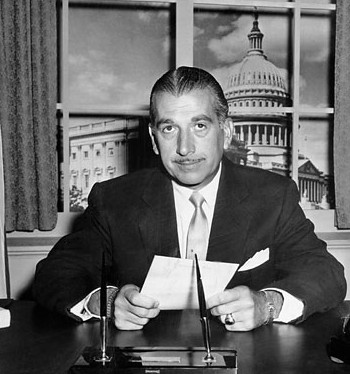
1952 was a good election year for the Republicans as the returns produced unified government for them for the first time since 1928, and an election would not do so again for them until 2000. The usually staunchly Democratic New York City saw growth in their representation in Congress, and one of the newly elected was Paul Fino (1913-2009) of the Bronx.
Fino’s district was comprised of many ethnicities, idealized in the United States as the “melting pot”. Representing such a diverse constituency, he was a bit far from your typical Republican. On many domestic issues he proved a maverick; he voted for the Area Redevelopment bill, food stamps, and public housing. Fino also could differ from his party on foreign aid and to the right; he opposed the creation of the Development Loan Fund in 1957 and that year voted against Walter Judd’s (R-Minn.) proposed increase in foreign aid backed by the Eisenhower Administration. During the Kennedy Administration, Fino was one of the most supportive Republicans; he supported the Kennedy-backed Area Redevelopment Act, a strong minimum wage, the Housing Act of 1961, and a federal aid for school construction bill that failed to pass the House. He was strongly supportive of organized labor and voted against the Landrum-Griffin substitute labor bill in 1958 and for repealing the “right to work” section of the Taft-Hartley Act in 1965. Fino retained Republicanism on questions of government ownership of public power sources, supporting a cut in the Tennessee Valley Authority in 1957, opposing the TVA Bonds bill in 1959, and opposing public power for the facility at Hanford in Washington in 1961. In 1964, Fino proposed a national lottery to fund hospitals, arguing that it could net up to $10 million annually (Hevesi). Fino’s DW-Nominate score was a 0.048, placing him in the center. His modified Americans for Constitutional Action scores ranged from a 13% in 1960 to an 85% in 1968.
Most curiously, Fino, who had up to 1965 voted for all civil rights legislation, was the only Republican in Congress to vote against the GOP substitute for the Voting Rights Act of 1965 and for initial passage only to vote against the conference report, doing so because the Senate adopted an amendment permitting Spanish-speaking citizens to vote in New York without meeting a literacy requirement as required by the New York State Constitution, although the New York State Legislature in the process of changing that (Congressional Record, 19196). However, he did have a conservative streak, and he turned against anti-poverty programs as well as Mayor John Lindsay. In 1967, Fino, as chairman of the Bronx Republican Party, called for Republicans to oppose Lindsay, and placed a billboard by Willis Avenue Bridge reading, ““Fun City Line Stops Here. Republicans of Bronx County Want No Fun Riots, Fun Taxes, Fun Crimes, Fun Mayor” (Hevesi). Although Fino’s New York Times obituary notes that he was to Lindsay’s right, and this was true in 1967, it interestingly wasn’t true in the first three years of Lindsay’s Congressional career, being fiscally to Fino’s right. Perhaps the most notable thing about Fino for politics aside from his butting heads with Lindsay was a man he hired: Kevin Phillips.
Phillips had made a study of ethnicity in US politics and predicted the rise of a Republican majority based on ethnic tensions, namely Irish and Italian ethnics coming out against spending on welfare programs that disproportionately benefited black and Latino constituents. Irish and Italian ethnics formerly clashed with WASPs which put them in the Democratic Party, but their conflict towards them waned and it waxed for black and Latino groups, ascendant in the Democratic coalition (Boyd). Phillips advised Fino on his conservative swing, and in 1966 he won big in the Irish wards. He would later serve as a strategist on the Nixon campaign and his push for the campaign to win peripheral South states was successful. Phillips would prove predictive about the South’s overall move to the GOP in the long-term.
In 1968, Fino was at his most conservative and voted against adopting Senate amendments for fair housing in the Civil Rights Act of 1968, despite having voted to keep the fair housing title in the proposed Civil Rights Act of 1966. In 1968, Fino resigned his House seat after being elected to the New York State Supreme Court, and served as a justice until 1972. While on the bench, he became notable for being tough on crime, handing down strict sentences for drug offenses (Hevesi). The Bronx has not since Fino’s departure from Congress had Republican representation…quite the contrary in fact, as its current representative is AOC.
References
Boyd, J. (1970, May 17). Nixon’s Southern strategy. The New York Times.
Retrieved from
https://www.nytimes.com/1970/05/17/archives/nixons-southern-strategy-its-all-in-the-charts.html
Fino, Paul Albert. Voteview.
Retrieved from
https://voteview.com/person/3158/paul-albert-fino
Hevesi, D. (2009, June 18). Paul Fino, Politician Who Battled Lindsay, Dies at 95. The New York Times.
Retrieved from
Voting Rights. (1965, August 3). Congressional Record. Washington, D.C.: Government Printing Office.
Retrieved from
https://www.govinfo.gov/content/pkg/GPO-CRECB-1965-pt14/pdf/GPO-CRECB-1965-pt14-5-2.pdf
 Mad Politics: The Bizarre, Fascinating, and Unknown of American Political History