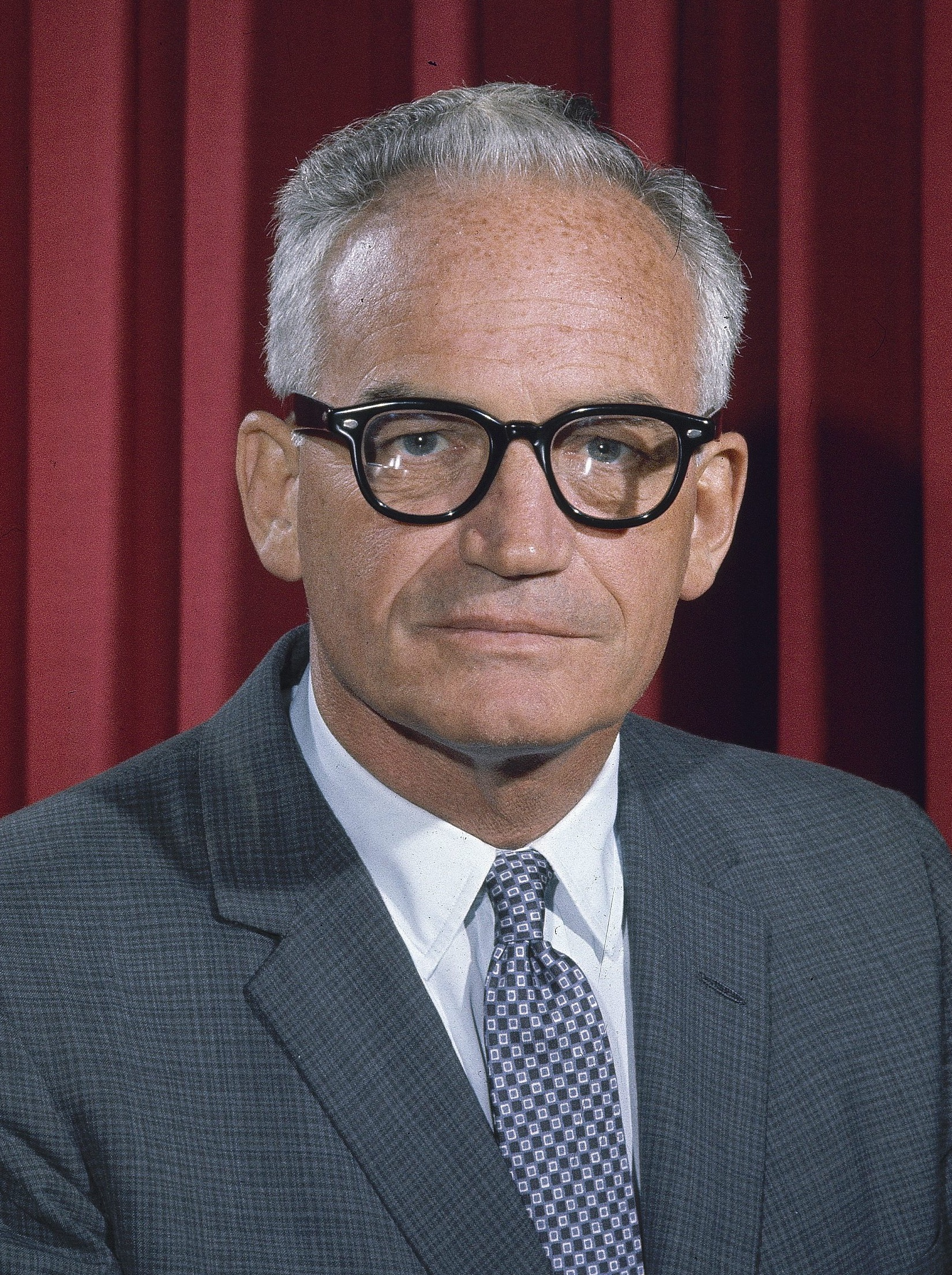
Barry Goldwater, ACA’s champion for the 1964 presidential election.
9/2/2024 Note: The bottom analysis is partly incorrect. Although the ACA scores reported would produce the 26 votes I noted below, from acquiring the 1963 ACA-Index it turns out there was a 27th vote for the Senate. In a flaw in ACA’s calculations for 1963, however, this vote somehow doesn’t get counted for 1963 but does for the legislator’s overall score. Thus, James Howard Edmondson (D-Okla.) manages to in his first year per ACA score a 26 for 1963 and a 25 cumulative despite having only been counted for 1963. I have corrected this mistake. Forget the part below about there being no 27th vote.
I have finally done it. I have finally determined the 1963 and 1964 ACA-Indexes for the Senate. Before proceeding with explanations and scores, I will highlight the multiple difficulties I had in completing them (although primarily for 1963), and it seemed downright impossible before I found that H.L. Hunt’s conservative publication Life Lines had published all the scores, which, yes, served as my lifeline here.
One of the sources I use is from Voteview Legacy which reported overall scores for 1964 from senators. Some of these scores are reported incorrectly. For instance, Senator J. Howard Edmondson’s (D-Okla.) score for 1963 and 1964 combined is reported as a “20”, but it is actually a “21”. Wayne Morse (D-Ore.) was a source of confusion as well. The numbers for 1964 came together a bit before 1963 because I simply found there was no other possible combination that produced the scores for some senators that I found reported for 1964 from numerous publications. The errors regarding 1963 were:
Arkansas’ J. William Fulbright’s and John McClellan’s votes are swapped by Voteview and Govtrack for roll call 227 in 1963, regarding guarantees for wheat sales to the USSR and Hungary and this is confirmed by the Congressional Record (Congressional Record, 25145). This is the most obvious error to catch of the ones I found, given Fulbright’s and McClellan’s stances on the other roll call counted on this issue, roll call 203.
Daniel Brewster of Maryland is incorrectly reported by Voteview (and by extension Govtrack) as having paired against rather than voted for Senator Lausche’s amendment for roll call 139 in 1963. Congressional Quarterly and the Congressional Record correctly report that he voted “yea” (Congressional Record, 18254).
Perhaps the most shocking error I found was on the Congressional Record, the ultimate resource to verify voting records. This error regards roll call 90, in which Frank Church of Idaho is recorded as “yea” in both Congressional Quarterly and the Congressional Record, but in the record regarding that vote, Senator Church made it clear that he was pairing for, rather than voting for, yet his vote was incorrectly recorded as “yea” (Congressional Record, 14478). This makes Church’s official ACA score a 0%. A most rare occurrence indeed!
Note, 9/2/2024: This paragraph is incorrect. “Vote X” as I put it turns out to have been a final vote on a foreign aid bill. Smith and Proxmire’s scores are actually reported incorrectly by ACA.
The total number of “issues” widely reported as being counted by ACA for the Senate was 27, but the scores of the senators as provided by Life Lines, which also reported a number of 27, were not possible for 27 votes. For instance, Margaret Chase Smith of Maine and Bill Proxmire of Wisconsin missed no votes yet their scores were 35% and 42%. Yet the scores they counted that were reported in other places were consistent with what was reported in other sources, such as old newspapers of the day. Before I learned of Smith’s and Proxmire’s impossible scores with 27 votes, I was feeling that there was a missing vote, a “Vote X” you might say. It turns out if the number of votes is brought down to 26, the figures provided work perfectly. “Vote X”, like the alleged planet, didn’t exist. This raises the question, was the count of issues widely reported incorrectly or was there an issue that ACA included that wasn’t a vote and did not count towards their scores? If so, what was the point of including that issue? Anyway, on to the votes.
Just a reminder, the scores I put up here are not necessarily how ACA scores them, but how senators voted, paired, and sometimes announced on such issues. This is a more complete measure of the ideology of the senators than just counting votes, and pairs themselves are essentially to be sure that a measure doesn’t lose because of legislative absences, thus vote outcomes have greater legitimacy. I research these scores because I am interested in what conservatives of the time regarded as important, not merely looking at Americans for Democratic Action (ADA) scores and reversing them, and indeed we see differences in policy emphasis. For instance, although ACA counts three civil rights votes in 1964 out of 18 total, ADA counted a whopping eight civil rights votes out of 19 total. Interestingly, ACA counted none of the civil rights votes ADA did.
The 1963 ACA-Index is particularly tough on the Senate, although this is because some issues came to it that didn’t come to the House that year. Of the senators, only two get 100% in modified scoring to account for pairings in Barry Goldwater (R-Ariz.) and Carl Curtis (R-Neb.). Even John J. Williams (R-Del.), who the first ACA-Index gave a 99% based on his 1955-1959 voting record, scores only a 73%, which is easily his lowest ever score. Far more senators get zeroes, these are:
Bob Bartlett, D-Alaska
Carl Hayden, D-Ariz.
Abe Ribicoff, D-Conn.
Daniel Inouye, D-Haw.
Vance Hartke, D-Ind.
Ted Kennedy, D-Mass.
Phil Hart, D-Mich.
Pat McNamara, D-Mich.
Hubert Humphrey, D-Minn.
Eugene McCarthy, D-Minn.
Edward Long, D-Mo.
Mike Mansfield, D-Mont.
Lee Metcalf, D-Mont.
Harrison Williams, D-N.J.
Maurine Neuberger, D-Ore.
Joseph Clark, D-Penn.
George McGovern, D-S.D.
Estes Kefauver, D-Tenn.
Jennings Randolph, D-W.V.
Gaylord Nelson, D-Wis.
While no Republicans scored zeroes, Jacob Javits and Kenneth Keating of New York come the closest with 11% each. While such a score was pretty expected of Javits, Keating had quite the decline in his score, and possible factors for this are his upcoming reelection as well as appealing to the Liberal Party for their nomination (which Javits regularly won). The Democrat who gets closest to 100% is, unsurprisingly, Strom Thurmond of South Carolina who scores a 96% and would in the next year switch to the GOP. President Kennedy scores a 0% based on official positions. This strangely enough included two votes that occurred after he was assassinated, as he was known to have supported wheat shipments to the USSR and Hungary.
The 1964 ACA-Index is a bit smaller than the 1963 one with 18 votes counted, and Southern Democrats have a significant uptick in their score, in part due to the fact that three votes on civil rights are counted this year: Senator Ervin’s (D-N.C.) proposal to delete Title VII (employment discrimination), Senator Byrd’s (D-W.V.) proposal to delete Title II (public accommodations), and passage of the Civil Rights Act of 1964. Al Gore Sr.’s score, for instance, shoots up from 4% in 1963 to 50% in 1964. Senators Edwin Mechem (R-N.M.) and Milward Simpson (R-Wyo.) score 100%. Once again, many more score zeroes, and they are:
Bob Bartlett (D-Alaska)
Carl Hayden (D-Ariz.)
Pierre Salinger (D-Calif.)
Abe Ribicoff (D-Conn.)
Daniel Inouye (D-Haw.)
Birch Bayh (D-Ind.)
Ted Kennedy (D-Mass.)
Hubert Humphrey (D-Minn.)
Eugene McCarthy (D-Minn.)
Edward Long (D-Mo.)
Mike Mansfield (D-Mont.)
Lee Metcalf (D-Mont.)
Harrison Williams (D-N.J.)
Mike Monroney (D-Okla.)
John Pastore (D-R.I.)
Claiborne Pell (D-R.I.)
Gaylord Nelson (D-Wis.)
Although no Democrats scored a 100% and no Republicans scored a 0%, the closest to 100% for Democrats were Strom Thurmond of South Carolina and Harry Byrd and Willis Robertson of Virginia at 94%. The Republicans who came closest to 0% were Thomas Kuchel of California as well as Jacob Javits and Kenneth Keating of New York, all scoring 6%. To highlight the degree to which the Republican Party was less conservative then than now is the fact that Kuchel, a protege of then Chief Justice Earl Warren, was #2 in Senate Republican leadership as minority whip. President Johnson scores a 0% based on official positions. Interestingly, the one vote that Barry Goldwater (R-Ariz.) gets wrong by ACA standards is the one George McGovern (D-S.D.) gets right, the issue of federal pay raises.
The Criterion ACA Used to Determine Scores:
Key for scoresheets:
+ – Voted for the ACA position.
– – Voted against the ACA position.
+ – Paired or announced for the ACA position.
– – Paired or announced against the ACA position.
? – No known opinion.
Republicans are in bold italics and Democrats are in plain text.
1963 ACA-Index, Senate:
1964 ACA-Index, Senate:
References
ADA World Voting Record – 88th Congress, 2nd Session. (1964, October). Americans for Democratic Action.
Retrieved from
Department of Agriculture and Related Appropriations (1963, September 26). Congressional Record. Washington, D.C.: Government Printing Office.
Retrieved from
Departments of Labor, and Health Education, and Welfare, and Related Agencies Appropriations, 1964. (1963, August 7). Congressional Record. Washington, D.C.: Government Printing Office.
Retrieved from
https://www.govinfo.gov/content/pkg/GPO-CRECB-1963-pt11/pdf/GPO-CRECB-1963-pt11-3-2.pdf
Foreign Aid and Related Agencies Appropriations, 1964. (1963, December 19). Congressional Record. Washington, D.C.: Government Printing Office.
Retrieved from
History’s Issue: Bondage or Freedom? (1964, October 28). Life Lines, 6(130).
Retrieved from
https://www.jstor.org/stable/community.28145667?seq=1
HR. 5888. Appropriate $5,495,827,250 for the Depts. of Labor, HEW, & Related Agencies. Proxmire amend. to reduce all funds. Voteview.
Retrieved from
https://voteview.com/rollcall/RS0880090
HR. 6754. Appropriations for the Agricultural Dept. Lausche motion to suspend the rules so he could offer an amend. raising the 2% interest rate on loans by the REA to 3%. Voteview.
Retrieved from
https://voteview.com/rollcall/RS0880139
HR. 9499. Pastore motion to adopt Senate Appropriations Committee amend. which deleted a House provision prohibiting Export-Import Bank guarantees of private credit for sales to Communist countries. Voteview.
Retrieved from
https://voteview.com/rollcall/RS0880227
Red Struggle Requires Hate Philosophy. (1964, May 29). Life Lines, 6(65).
Retrieved from
https://www.jstor.org/stable/community.28145603
 Mad Politics: The Bizarre, Fascinating, and Unknown of American Political History