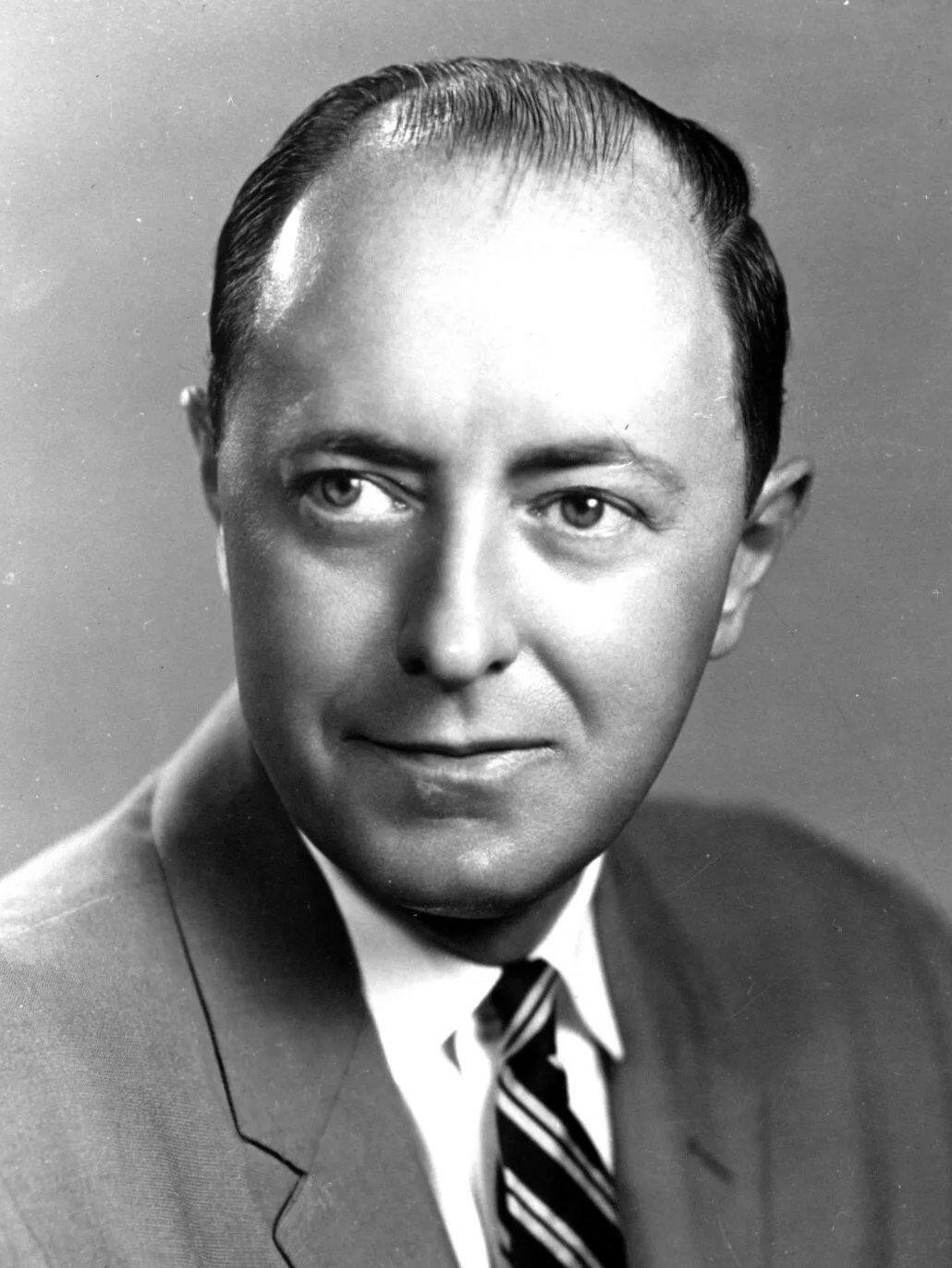
It is often said that for legislators that instead of changing Washington, they are changed by Washington, and one of the people it proved most true for was Ithaca’s Howard Robison (1915-1987). In December 1957, Congressman W. Sterling Cole, a domestic conservative and internationalist who specialized in atomic energy, resigned his office to accept heading the International Atomic Energy Agency. Elected in his place was Robison, whose conservatism was quite apparent; Robison was given a 100% by Americans for Constitutional Action based on his votes in 1958 and 1959. Notably, none of the votes counted for these years involved foreign policy or civil rights. In the following year, he would score an 80% as he voted for a Citizens Commission on NATO and for increasing foreign aid. As foreign aid began to be counted every year as an issue and civil rights came more to the forefront, Robison’s scores would go down. The change was a bit less dramatic by Americans for Democratic Action’s standards, as they counted 1950s votes on civil rights as well as foreign policy. In 1959, for instance, Robison scored 22% by ADA because of his votes for Hawaiian statehood (neither statehood for Alaska or Hawaii were considered issues of sufficient ideological importance by ACA) and foreign aid.
Although an opponent of JFK, Robison’s moderation began during his administration. He voted against the Mason motion in 1962 to merely extend the Reciprocal Trade Act as a substitute for Kennedy’s Trade Expansion Act, supported foreign aid, and voted for aid for college construction. Still, in 1964, Robison was regarded as a conservative for his voting on domestic issues. As reader Linda M. Kelley of the Star-Gazette complained in a letter to the editor for endorsing him as a counterweight to Lyndon B. Johnson, “Howard Robison does not support the President’s aims. Mr. Robison’s conservative voting record bears this out. Mr. Robison could care less for progressive legislation” (Star-Gazette). This record, however, satisfied his Republican district, and he was reelected in that difficult year for the GOP with 58.4% of the vote. Although Robison opposed much of the Great Society’s major planks such as the Economic Opportunity Act and food stamps, he did support Medicare after backing a GOP substitute and would become more accepting of such legislation over time.
By January 1968, it had become clear that Robison was moving in a more liberal direction when he thought of Governor Nelson Rockefeller as his ultimate preference for president (The Ithaca Journal). The moderate to liberal wing of the party in that day was also referred to as the “Rockefeller Republicans” Examples of his record getting more liberal include Robison’s 1971 votes against a school prayer amendment and Rep. John Ashbrook’s (R-Ohio) anti-busing amendment. He was also wavering in his support of the Vietnam War.
This phenomenon was noted by multiple groups. His 1970 opponent for reelection, David Bernstein, asserted that “the anti-conservationist of 1968, has turned into Howard Robison, the pro-conservationist of 1970” (Press and Sun-Bulletin, 1970). Conservatives in New York especially noticed, and in 1972 he got a challenge from Conservative Party candidate Patrick O’Neil, who said, “the old Howard Robison stood firmly for a limited government, for free enterprise, for countering communist aggression, and for a militarily prepared America and for vigorous exploration of space. The new Howard Robison, the man I must face this November, would scorn the old Howard Robison as a curmudgeon and a fuddy-fuddy-duddy; I praise the old Howard Robison and I represent the principles for which he stood” (Press and Sun-Bulletin, 1972). Americans for Constitutional Action, in contrast to his first two years in Congress, scored Robison a 54% in 1973 and a 29% in 1974. To what degree this is a change in ACA’s grading and to what degree this is a change in Robison is disputable, but what is not disputable is that Howard Robison did change. Although it would be strange for all of our legislators to not change an iota in their time in Congress as some may wish, he did have one of the more significant changes on Capitol Hill.
In 1974, Robison announced that he would not be running for reelection and cited his disappointment with President Nixon as a major reason (Los Angeles Times). Another reason was that Robison’s district, once a staunchly Republican territory, was reconfigured and although he had won reelection handily in 1972, the environment in 1974 was different, and indeed, he was succeeded in this new district by Democrat Matthew McHugh, who held the district for 18 years. Robison died of a heart ailment on September 26, 1987.
References
ADA Voting Record – First Session, 86th Congress. Americans for Democratic Action.
Retrieved from
https://adaction.org/wp-content/uploads/2017/11/1959.pdf
Congressman Robison: Likes Rockefeller For President. (1968, January 13). The Ithaca Journal.
Retrieved from
https://www.newspapers.com/image/255263626/?terms=%22Howard%20Robison%22&match=1
Former U.S. Rep. Howard W. Robison. (1987, October 3). Los Angeles Times.
Retrieved from
https://www.latimes.com/archives/la-xpm-1987-10-03-mn-2687-story.html
O’Neil Battles ‘New’ Robison, Thought Old One Was Fine. (1972, May 5). Press and Sun-Bulletin (Binghamton, New York).
https://www.newspapers.com/image/255505257/?terms=%22Howard%20Robison%22&match=1
Robison Endorsement Termed ‘Ridiculous’. (1964, October 31). Star-Gazette (Elmira, New York).
Retrieved from
https://www.newspapers.com/image/276187433/?terms=%22Howard%20Robison%22&match=1
Robison, Howard Winfield. Voteview.
Retrieved from
https://voteview.com/person/7995/howard-winfield-robison
Robison’s Wild Rivers Stand ‘In the Dark,’ Bernstein Says. (1970, August 25). Press and Sun-Bulletin (Binghamton, New York).
Retrieved from
https://www.newspapers.com/image/255599946/?terms=%22Howard%20Robison%22&match=1
 Mad Politics: The Bizarre, Fascinating, and Unknown of American Political History
Robison clearly changed, but it doesn’t follow that being in Washington changed him. Kevin Phillips documents that Northeastern Yankee voters in general shifted to the left in the 1950s and 1960s. Upstate New York, heavily settled by Yankees moving west from New England, historically tended to vote the same way as New England. If the folks back home, whose background Robison shared (and whose votes he needed), became less conservative during this period, it shouldn’t be surprising that he did likewise.
That is quite possible, although I was thinking of the common view that politicians change, usually away from values of their bases, when they go to Washington. The most prominent cities Robison represented I’ve learned had Democratic representation (although elections could be close) up until 2013, but redistricting placed them back to Republican representation.
Interesting Observation WHY Did Yankees Shift LEFT Then? Can’t Find Phillips Book Right Now.
Glad Mike Mentioned KP As A Staffer For Paul Fino. Best Wishes, Dave From Texas.
Small Town Southwesterner…
That would be an interesting question, I think at the moment that Yankees shifted on social issues quite a bit and most were supportive of internationalist foreign policy. Henry Cabot Lodge, Jr. is perhaps a foremost example of this phenomenon, as he started out in the Senate rather similar to his grandfather ideologically but moved away from his nationalistic politics towards internationalism, he was bipartisan in approach as opposed to partisan, and he strongly favored immigration liberalization as opposed to restriction.