There are not many politicians who can claim to have served in politics in the 1870s and 1920s, but along with Joe Cannon, a figure who I have previously discussed and find to be of great use in historical research, there is Isaac Sherwood (1835-1925) of Ohio. Since the Harding Administration has a much closer connection to our contemporary politics than the Grant Administration in relatability, we can have an idea how someone who voted a very conservative line could have voted in the time in which you had many Lincoln Republicans, of which Cannon and Sherwood were. Yet, Cannon and Sherwood went down different paths.
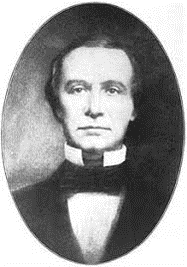
Isaac Sherwood in his youth.
Sherwood’s political career began when in 1860 he was elected probate judge of Williams County, Ohio, but on the outbreak of the War of the Rebellion, he joined the Union Army. Although he started as a private, he was an accomplished solider and by the end he was a brevet brigadier general. Sherwood resumed his political career when in 1868 he was elected Ohio’s Secretary of State and won reelection in 1870. Two years later, Isaac Sherwood is elected to Congress as a Republican. That election year is also Joe Cannon’s first. In this term, he proves supportive of inflationary currency and opposes legislation favorable to railroads. Sherwood doesn’t run for reelection in 1874, and while out of office he reevaluates his political affiliation and affiliates himself for a time with the Greenback Party, which pushed for fiat currency. However, by 1879, with Reconstruction behind the nation and economic issues more pressing, he becomes a Democrat. However, Sherwood doesn’t make his return to Congress until the 1906 election, by which time he is 71 years old.

Isaac Sherwood as an older man.
Sherwood throughout his life retains a degree of independence, and although he is of the Democratic Party, he remained faithful to his views on race relations as a Lincoln Republican; in 1915 he is one of only seven Democrats to vote against banning interracial relations in Washington D.C., and in 1916 he voted against a motion providing for segregation in D.C. probation offices. Other examples of independence during the Wilson Administration include his votes against federal licensing of cotton warehouses and for civil liberties protections during wartime. Sherwood proves a supporter of women’s suffrage as well, voting for amendments in 1915, 1918, and finally its adoption in 1919. Although there are many reforms he supports, one of them isn’t Prohibition, and he votes against the amendment as well as the enforcing Volstead Act. However, the controversial vote that causes a lot of voter anger against Sherwood is his vote against American entry into World War I. Numerous legislators suffered political consequences for this vote, an example being Republican Henry Cooper of Wisconsin, who had served since 1893 and lost renomination in 1918, only to win another election in 1920. This, plus the Republican wave of 1920, has him lose reelection to Republican William Chalmers. Although by 1922, Sherwood is 87 years old, he nonetheless runs for another term, and wins. In his last term, he supported measures reducing the power of railroads, including the Howell-Barkley bill and the Barkley proposal to prohibit railroads from adding the Pullman car surcharge to tickets. In 1924, he again loses reelection to Chalmers and dies only seven months after leaving Congress at the age of 90.
Sherwood was among the last of Union veterans to serve in Congress, with the final one, Senator Francis Warren of Wyoming, dying in 1929. It is almost unreal that Sherwood first is elected to a major political office at 33 and leaves his last at 89. If I were to defend the pop history party switch narrative, Sherwood would be an example I would cite, as he was a Lincoln Republican who moved to the Democrats over economics, similar to Benjamin Butler, thus one may argue that Republicans abandoned an egalitarian economic philosophy in the name of benefiting big business. However, one would still have to explain why he wasn’t a Teddy Roosevelt Republican (who Democrats of today would allegedly be in accord on so much) and why he supported Woodrow Wilson, a figure young Democrats are very keen on running away from given his racism, even though Wilson was thought of for the longest time as a liberal. What’s more, FDR, who I regard as the patron saint of modern liberalism, was Wilson’s protege and ideal of a young, energetic bureaucrat.
References
Sherwood, Isaac R. Voteview.
Retrieved from
https://www.voteview.com/person/8463/isaac-r-sherwood
 Mad Politics: The Bizarre, Fascinating, and Unknown of American Political History