In November 2023, the federal government operated at a $314 billion deficit. We have largely known deficits rather than anything else in recent decades given Congress not wanting to raise taxes and/or reduce spending. However, there was a time in which we had the opposite problem, one that some legislators may wish for now, having a surplus in the US Treasury instead of a debt. Such was the case in the politics of the late 1880s and early 1890s.
Along with opposing the spread of slavery, one of the founding issues of the Republican Party was the protective tariff. These tariffs were ostensibly for the purpose of continuing with Alexander Hamilton’s American System, in which tariffs were to fund internal improvements, thereby helping domestic industry grow both through protection from foreign competition and development of roads, bridges, and canals. Once the War of the Rebellion was over, slavery abolished, and then Reconstruction ended, tariffs became the central issue (although not the only) that separated the Democratic and Republican parties. The politics of the late 19th century were rather odd in the sense that partisanship was high but ideologically the parties, at least compared to today, don’t seem THAT different. Tariffs, however, resulted in growing Treasury surpluses, and this was seen as a problem because money just sitting in there just…well…sits there, not contributing to the economy. In 1889, President Benjamin Harrison stated, “while a Treasury surplus is not the greatest evil, it is a serious evil” (DiBacco). While it could have been used to retire debt, this would result in, according to economist Thomas V. DiBacco (1981), “buying securities at premium prices investors in this favorable position demanded. In this instance the government could be criticized for using public funds to reward big investors”.

Democrat Grover Cleveland wanted to reduce tariffs to lower the surplus, while Benjamin Harrison wanted to further raise tariffs but use the surplus on veterans’ pensions. The 1888 Republican platform explicitly supported protection, while supporting reducing domestic taxes and tariffs on items that cannot be made in the United States, even asserting “If there shall remain a larger revenue than is requisite for the wants of the government we favor the entire repeal of internal taxes rather than the surrender of any part of our protective system at the joint behests of the whiskey trusts and the agents of foreign manufacturers” (The American Presidency Project, Republican Party Platform). The Democratic platform, on the other hand, decried the protective tariff system. The platform held that “Judged by Democratic principles, the interests of the people are betrayed, when, by unnecessary taxation, trusts and combinations are permitted and fostered, which, while unduly enriching the few that combine, rob the body of our citizens by depriving them of the benefits of natural competition. Every Democratic rule of governmental action is violated when through unnecessary taxation a vast sum of money, far beyond the needs of an economical administration, is drawn from the people and the channels of trade, and accumulated as a demoralizing surplus in the National Treasury.
The money now lying idle in the Federal Treasury, resulting from superfluous taxation amounts to more than $125,000,000, and the surplus collected is reaching the sum of more than $60,000,000 annually” (The American Presidency Project, Democratic Platform). The Democratic platform also charged the Republicans with pushing numerous spending proposals of dubious value, materially and constitutionally, to reduce the surplus.

The 1888 election saw the victory of Benjamin Harrison and it all hinged on the state of New York. Harrison won New York thanks largely to the efforts of his campaign manager Matthew Quay. Harrison was also blessed with a Republican majority, and this majority was eager to spend the surplus. One measure was the Dependent and Disability Pension Act, which expanded pensions to all Union veterans who honorably served for at least 90 days and were unable to physically work. Others included a major expansion of the navy and more funds for internal improvements. The Congress also narrowly passed the McKinley Tariff. While all this did succeed in nearly eliminating the budget surplus, the Congress was criticized as the “Billion Dollar Congress”, to which Speaker Thomas Brackett Reed (R-Me.) responded, “This is a billion-dollar country” (NPS). The Democrats also charged that this spending was wasteful, and such a criticism is reflected in the below 1892 cartoon from the humorous Democratic magazine Puck.
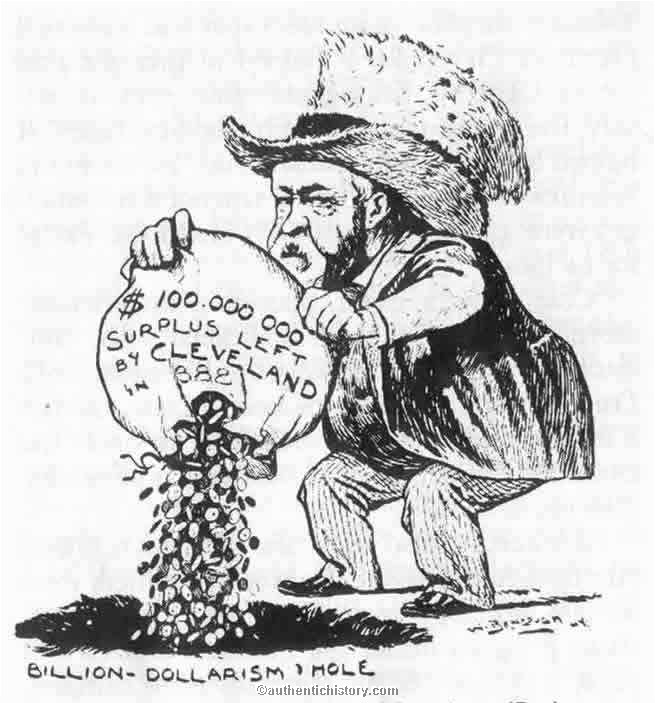
While the 51st Congress was quite productive and efficient in what they sought to achieve, namely the 1888 Republican platform, this attracted a lot of opposition, and the 1890 midterms were nasty due to the recession from the Panic of 1890, caused by the near collapse of London’s Barings Bank. Although Grover Cleveland would again be elected president in 1892, a lot of his presidency would see deficits due to the reduced revenues from the Panic of 1893 and the depression that followed.
References
Benjamin Harrison Home. National Parks Service.
Retrieved from
https://www.nps.gov/nr/travel/presidents/benjamin_harrison_home.html
Democratic Party Platform of 1888. The American Presidency Project.
Retrieved from
https://www.presidency.ucsb.edu/documents/1888-democratic-party-platform
DiBacco, T.V. (1981, September 28). Reagan May Long for a Surplus, But Some Presidents Abhorred It. The Washington Post.
Retrieved from
https://www.washingtonpost.com/archive/business/1981/09/28/reagan-may-long-for-a-surplus-but-some-presidents-abhorred-it/2166c421-53e4-4ad7-8eca-a46b66bb4a81/
Republican Party Platform of 1888. The American Presidency Project.
Retrieved from
https://www.presidency.ucsb.edu/documents/republican-party-platform-1888
Weigand, R.E. (1988, June 23). Protectionism and Ben Harrison. The Chicago Tribune.
Retrieved from
https://www.chicagotribune.com/news/ct-xpm-1988-06-23-8801090829-story.html
 Mad Politics: The Bizarre, Fascinating, and Unknown of American Political History