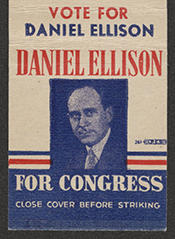
Baltimore has historically been a place in which Republicans have seldom found themselves electable in its history. The most notable Republican to come out of Baltimore was none other than Spiro Agnew, who benefited from divisions regarding race within the state’s Democratic Party at the time. One figure who managed to do quite well before Agnew was Daniel Ellison (1886-1960). In 1923, he was elected to represent the fourth council district and most of the time he was in office he was the only Republican on the city council. He managed to stay through even during the Great Depression, a testament to his popularity. Ellison was also a bit of a rarity as a Republican in that he was Jewish. Jews have a long history of voting Democratic and although this may weaken with controversy regarding the Israel-Hamas war, I don’t generally count on super-dramatic shifts.
Ellison in Congress
In 1942, incumbent Democrat John A. Meyer lost renomination to Democrat Joseph Wyatt. Had Meyer been renominated, perhaps the seat would have stayed in Democratic hands. After all, the 4th district had a very long history of electing Democrats, the last time the district elected a Republican was in 1900. Ellison resigned his seat on the city council and narrowly won in the Republican wave year of 1942. To this day, Ellison is the last Republican to have held a seat on the Baltimore City Council and the last to have represented a significant portion of Baltimore in Congress.
Ellison’s DW-Nominate score was a -0.099, an astonishingly low score for a Republican, with only Charles La Follette of Indiana and Richard Welch of California having lower scores than him. He was perhaps the most consistent Republican supporter of maintaining wartime price control, voted against funding the House Committee on Un-American Activities, voted against the Smith-Connally Act on wartime labor disputes, voted against the Hobbs (D-Ala.) anti-racketeering bill opposed by organized labor in 1943, voted to retain agricultural subsidies, and for U.S. participation in the United Nations Relief and Rehabilitation Administration. On the conservative side, he voted against increasing funds for agricultural programs, voted to revoke FDR’s wage freeze in 1943, and voted for tax relief over President Roosevelt’s veto in 1944. Ellison was yet another figure in the storied history of dissident Republicans from Maryland, perhaps the most notable one being Charles Mathias, a major irritant to the Nixon White House who would serve in the House from 1961 to 1969 and the Senate from 1969 to 1987. Ellison’s overall liberal record wasn’t enough to stop him from losing reelection in 1944 by almost 20 points.
References
Ellison, Daniel. Voteview.
Retrieved from
https://www.voteview.com/person/2930/daniel-ellison
 Mad Politics: The Bizarre, Fascinating, and Unknown of American Political History
I really wished we followed George Washington’s advice and didn’t have political parties at all. I think we would have done a lot better voting for the person rather than the ideology. Would have provided more independent thought