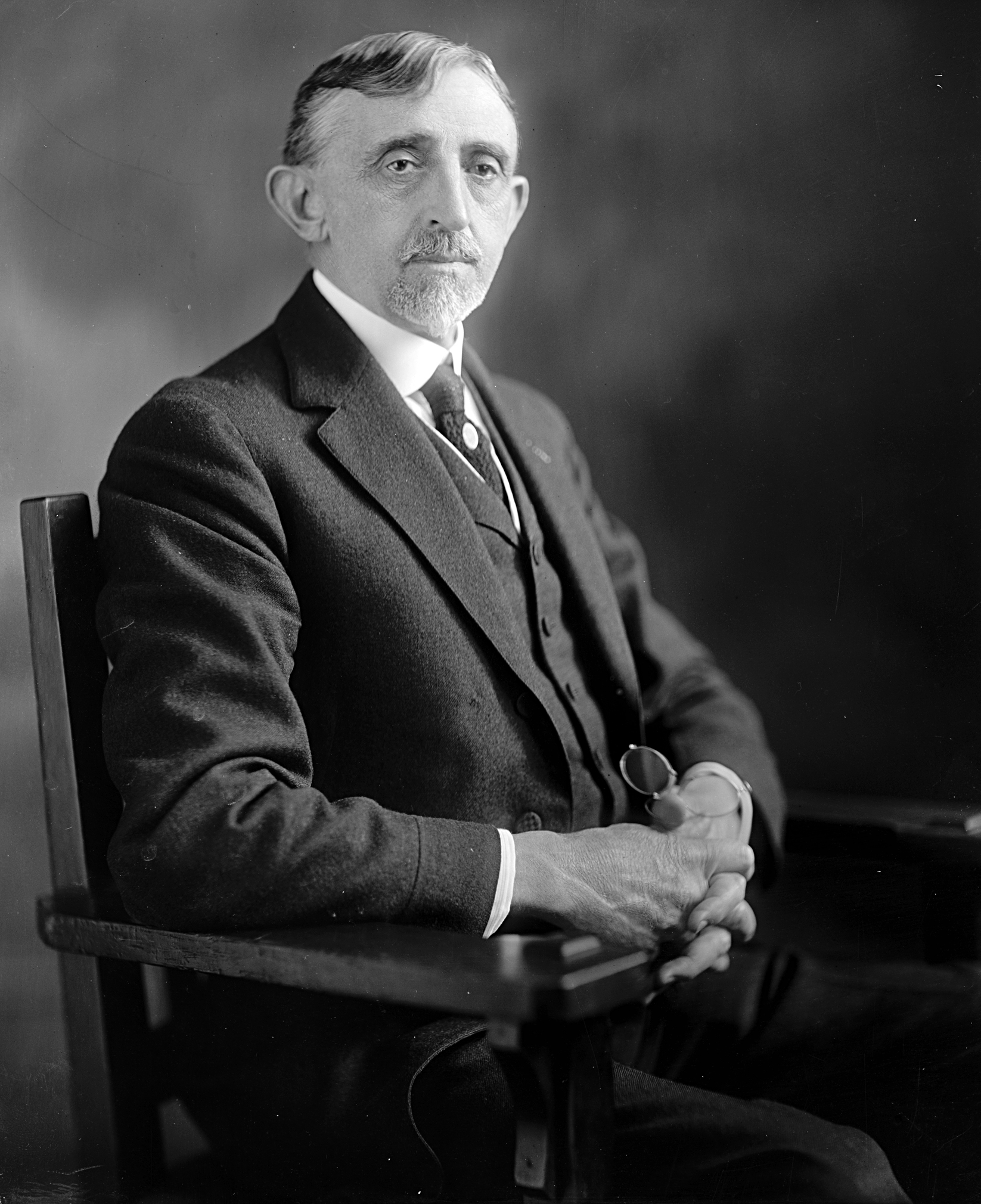
Joseph T. Deal, according to DW-Nominate, the most liberal representative of the 1920s.
In trying to examine and ascertain the ideology of the parties in the past, it can be rather difficult to translate to contemporary politics. There are some persistent themes that occur overtime, some examples being:
. Policies that empower or restrict the private sector, particularly large businesses.
. Creditors vs. Debtors
. Using the tax code for wealth redistribution.
However, there is a period that is most perplexing and is at its height in the 1920s. I read an interesting article a while back called Substantive Change in Congressional Ideology: NOMINATE and Its Alternatives, which highlights this difficulty between the scale and the history of the twenties. As noted by researchers Caughey and Schickler (2014), “Conservatives had considerable leverage within both parties in the 1920s, as evidenced by Democrats’ nomination of pro-business corporate attorney John W. Davis to face off against Calvin Coolidge in the 1924 President election. Dissatisfied with the perceived conservatism of the major parties, Robert La Follette of Wisconsin led a faction of Progressive Republicans which outflanked both parties on the “left” during these years” (3-4). Yet, figures who tend to be identified with the more conservative elements of the Democratic Party in this time, including Oscar Underwood of Alabama and Carter Glass of Virginia, are a bit more on the left than expected, with them at -0.396 and -0.304 respectively. DW-Nominate scores show much partisanship, particularly strongly from certain Southern Democrats and among urban Northern Democrats. The politician that DW-Nominate considers most liberal with a score of -0.824 is Joseph T. Deal of Virginia. Yet, Deal cast some curious votes for someone so allegedly liberal, including voting against veterans’ bonus legislation in 1922 and 1924, voting against agricultural aid, voting against the Howell-Barkley Railway Labor Disputes bill in the 68th Congress, and voting against the Sheppard-Towner Maternity Act in 1921. Such votes seem good markers for later opposition to the New Deal and when first looking at this period I thought him one of the more conservative Democrats, yet he by this standard he scores almost as liberal as Adam Clayton Powell’s (D-N.Y., 1945-71) -0.833, and he was known as a black radical. He is by DW-Nominate more liberal than any currently serving Democrat in Congress, yet his record obviously cannot be considered far left. The two members of the Socialist Party who served in the 1920s were Meyer London of New York and Victor Berger of Wisconsin. They score respectively -0.026 and 0.176. While they were a bit independent-minded and the latter could cast some votes we would consider conservative, it beggars belief that Berger was more conservative than all Democrats serving in the 1920s (and more conservative than Richard Nixon, at 0.162, when he was in Congress!). Yet, this strange phenomenon is not seen among Republicans. The most conservative representative listed in the 1920s as Charles Underhill of Massachusetts at an incredible 0.991. Underhill’s reputation by DW-Nominate is well-deserved: he voted for tax reduction, against veterans’ bonuses, against Sheppard-Towner, and opposed almost everything that could be considered progressive in his day. By the way, I emphasize the latter two issues because these were matters in which many conservative Republicans made exceptions. Both Underhill and Deal, by the way, were on the same side on the proposed Child Labor Amendment to the Constitution: against. The former did so as a manifestation of his extreme conservatism while the latter did so as a manifestation of regional priorities. The South had much more to lose economically from heavy regulation or abolition of child labor than the North. After all, as I have noted in a previous post, none other than Sam Rayburn (D-Tex.), a leading New Dealer who would support the Fair Labor Standards Act, voted against the Child Labor Amendment, while John Taber (R-N.Y.) and Dan Reed (R-N.Y.), who would both have extremely anti-New Deal records to the point of voting against the Fair Labor Standards Act and Social Security, voted for.
So what do we have here? Either in the 1920s there were a lot of votes that constituted 2nd dimension per DW-Nominate (regional, lifestyle issues) or there was a major transition underway in what it meant to be a liberal…perhaps a bit of both! I have seen on DW-Nominate two groups of people in the House who score most liberal: those Democrats who appear hyper-focused on state’s rights as a concept and voted that way and urbanites, largely from New York City, who we would easily see as liberal today and whose records were indisputably staunchly liberal during FDR’s presidency. And I think part of this involves the evolving perception of the concept of “state’s rights”. Historically, as I have written in the past, state’s rights have not always been a conservative concept. Indeed, states had a history of seeking to restrict the expansion of business while the federal government has had a history of seeking to expand it, at least that’s how it largely was until the Progressive Era and especially the New Deal. I believe now that there was a transition period between the Wilson and Roosevelt presidencies in which the meaning of what it was to be a progressive in the Democratic Party underwent a transition on some matters, namely the tolerance for the use of the federal government. Men like Deal, who appear quite liberal in their scoring yet voted conservative positions on some key issues, which in the 68th Congress also included William Boyce of Delaware and William Humphreys of Mississippi, seem to be a real mixed bag. They also defended Congressional prerogatives when opposing the Public Buildings bill in the 68th Congress, sponsored by Richard Elliott (R-Ind.), which served to streamline the process of constructing public buildings in Washington D.C. by placing it under the authority of the Secretary of the Treasury, rather than Congress voting individually on buildings. This was a way to improve government efficiency and cut down on pork, and numerous Northern Democrats, including those who would be among the staunch liberals of the New Deal era, voted for.
It should be noted that a response article was written by Nolan McCarty (2016) on the subject, “In Defense of DW-NOMINATE”, in which he acknowledges the validity of many criticisms, but he also holds that alternative methods fall short and that the case against DW-Nominate is overstated. However, I cannot ignore that some figures regarded as among the most “liberal” on DW-Nominate voted for some strangely conservative matters. However, certainly on some issues these people were liberal, such as opposition to Republican tariff policy and measures encouraging business investment in China through tax breaks.
Given this new information and article, I am seriously considering dropping using the liberal end of the DW-Nominate scale to determine ideological scores between the start of Woodrow Wilson’s presidency and the conclusion of FDR’s second term. It seems to me that the conception of what it was to be a staunch Democrat started undergoing some changes during the Wilson presidency as he focused more on the use of the federal government to attain progressive ends, and while Southern Democrats could deal with fine with someone who was known to be on their side of the issue of race and the Democratic Party still widely regarded as a “white man’s party”, this was considerably more difficult with a Democratic Party that was winning the black vote in presidential elections starting in 1936 and giving more and more focus to urban issues.
Note: All the DW-Nominate scores are available on:
Voteview.com
References
Caughey, D. & Schickler, E. (2014, September 28). Substance and Change in Congressional Ideology: NOMINATE and Its Alternatives. Massachusetts Institute of Technology.
Retrieved
http://caughey.mit.edu/sites/default/files/documents/NOM140928.pdf
McCarty, N. (2016, September 22). In Defense of DW-Nominate. Cambridge University.
Retrieved from
To Agree to the Recommendation of the Committee on the Whole to Strike Out the Enacting Clause of H.R. 7358 [Barkley-Howell Bill]. Voteview.
Retrieved from
https://www.voteview.com/rollcall/RH0680102
To Suspend the Rules and Pass H.R. 7959…[Veterans’ Bonus Bill]. Voteview.
Retrieved from
https://www.voteview.com/rollcall/RH0680041
To Pass H.R. 11791…[Public Buildings Bill]. Voteview.
Retrieved from
 Mad Politics: The Bizarre, Fascinating, and Unknown of American Political History
Dear Mike, I Agree With You About The Classification ProblemsHere. Louisiana Is Also An Interesting Case. By SomeMeasurements Huey Long Is Very Conservative While HisOpponents Are Counted As Liberals. Some Pro & Anti LongDemocrats Ended Up With Very Different Scores TOO. Finally, I Believe You Place Too Much Emphasis On Civil Rights. Odd For A Sensible Fellow Like You. Just Saying, Dave IN TEXAS.Happy Holidays, My Friend!
Ah yes, Huey Long. His DW-Nominate score is an absolutely stunning 0.251, beaten among Democrats only by Senator Rush Dew Holt (D-W.V.), who would later become a Republican. This is higher than the famously conservative Democrat Harry Byrd of Virginia, who gets a 0.188, but who in truth on so many major issues was strongly conservative. Long can be a difficult to pin down because he had both strongly right and left-wing stances. He was absolutely a nationalist on foreign policy through his opposition to the World Court and I find it highly likely that had he lived to see World War II, he would have opposed FDR on foreign policy. Long also repeatedly voted with Republicans on tariff policy and voted against the final version of the National Industrial Recovery Act. Some progressives voted against because of its suspension of anti-trust laws in exchange for businesses adopting an extensive business code, essentially the creation of a cartel. Long’s Share the Wealth program was undoubtedly left-wing, but it could also be viewed as a substitute for communism or socialism, thus people who thought of themselves as communists and socialists tended to not be in support. He also supported a lot of key New Deal legislation, including the Agricultural Adjustment Act, the Tennessee Valley Authority, gold confiscation, and inflationary policy in general.
Long had appeal to those who saw free market capitalism as doomed, a not uncommon belief in the 1930s, and thought that a “third way” needed to be found to avert the US turning to communism. This was the logic that author Lawrence Dennis used in his turn to fascism. One thing I find interesting about Long is that a number of people who strongly supported him in the 1930s would later be on the fringe conspiratorial right, particularly Reverend Gerald L.K. Smith and Plaquemines Parish boss Leander Perez, who were both extremely bigoted and backed Goldwater in 1964. And Goldwater I’d say is pretty far from Long ideologically, especially on the matter of free market economics. Long’s DW-Nominate score seems to be, oddly, predictive of the trajectory of some of his supporters.
Yeah, that part of my analysis was too brief, the change of the South was multifactorial. The national Democratic policy in other ways was straying from the region, particularly in its newfound emphasis on federal over states (although I think the commitment to state’s rights from Southerners was all too often selective) as well as organized labor getting way too strong for the South’s comfort, particularly the radical CIO, which critics accused of getting favorable treatment from the National Labor Relations Board and had some of its local branches being dominated by communists. Indeed, support for curbing the power of organized labor would be a central point of the Conservative Coalition formed by Republicans and Southern Democrats in the late 1930s.
Hello, Mike, based off a closer look at the history of protectionism vs. free trade, perhaps it’s too generic to imply Huey Long as having rightist characteristics on the trade issue, as protectionist arguments could be used as a rallying cry for the interests of the native-born working class as ferociously as it was used for a conservative defense of big business. Horace Greeley, the 1872 Liberal Republican and Democratic nominee for president, was an avid protectionist, but he was evidently not right-wing, given his openly socialist credentials. For pre-WWII and generally just pre-New Deal politics, I would classify not two groups (left and right) but rather three (arguably there are more, though this is a broad, generalized approach): old guard conservatives, progressive reformers, and liberal/left-wing populists. Thus, on the issue of trade, free trade would fall under the “progressive reform” category and thus broadly left-wing, while protectionism could either be left or right because both reactionary conservatives as well as various random left-wing populists supported it. The same applies with isolationism to an extent, I suppose, as especially some progressive Republicans were non-interventionists.
Personally (and maybe it’s just me), I would not at all use the anomalistic DW-NOMINATE ranking of Huey Long for the argument that he was possibly right-leaning as, like you said, he voted against many New Deal programs because he thought they were not leftist enough. In another example, DW-NOMINATE puts Theodore Bilbo at -0.171 even though he had a hardline liberal record only until the WWII years. As for Gerald L. K. Smith and Leander Perez, I would say their affiliation with “rightist” causes in the post-WWII era was due to the change in politics as a result of the war years. Smith undoubtedly began as a leftist, coming from a Populist family and repeating William Jenning Bryan’s anti-gold speech; and militant anti-Communism isn’t exclusively right-wing either, as the Wilson Administration under the lead of progressive Democrat A. Mitchell Palmer conducted the harsh Palmer Raids while mostly conservative Republicans opposed, for instance, the Sedition Act’s infringement upon individual liberties. So in a sense, McCarthyism in the post-WWII era (whose support unfortunately gets assailed with association fallacies) with an increased emphasis on national security and less on individual liberty is about akin to the First Red Scare and arguably a departure from “old guard” conservative principles championed by 1910s and 20s era right-wing Republicans.
As for Perez, I remember reading that he opposed federal aid to Louisiana in the FDR and/or Truman administrations, and while some liberal authors may try to argue this constitutes “conservative opposition to social liberal programs,” I believe Huey Long did the same. Perez did join the Dixiecrats and AIP, in addition to supporting Goldwater, though for one, countless Dixiecrats were once New Deal liberals who bolted from the national Democrats primarily due to race and secondarily due to the contrast between Jeffersonian “old school” progressivism and pseudo-Hamiltonian “new school” modern liberalism, so the thesis to my unfortunately nonexistent dissertation, er, I mean, half-excuse for a rant, would be that Democrats vs. Dixiecrats in 1948 was “new left vs. old left.” (yes, some neo-Bourbon Southern Dems supported the Dixiecrats, though traditionally hardline segregation and/or other extensively racist laws were instituted by the progressive wing of the Southern Democrats led by Josephus Daniels and Ben Tillman, in the 1890s opposed by some leading conservative-leaning Redeemers like Wade Hampton) And the AIP could be seen as partially syncretic since George Wallace was left-wing on economics, supporting Social Security increases, tax reform, minimum wage, unemployment compensation, and opposed “concentrated wealth and economic power.” (“Oligarchy in the Americas,” p. 86) So although the AIP was right-wing outside the South, within the region it was a mix of cultural “national-conservatism” and progressive economic leftism… kind of, sort of like the direction Trumpism is now heading towards, since the Great Tangerine King of Mar-a-Lago (yeah, I’m no longer a big fan of Trump though for unique reasons I won’t get into here in this already-long-enough posting) earlier this year ferociously defended Social Security and Medicare from internal GOP criticisms. Anyways, as for Goldwater: the 1964 campaign for Southerners was, predictably, primarily about race, on which LBJ, who presented himself as a proponent of civil rights, was evidently just trying to salvage the national party’s reputation on (but of course, while the attributed quote “I’ll have them [epithet] voting Democratic for 200 years” is disputed, his “these Negroes, they’re getting uppity…” quote, which repeats the same attitude of wanting to do barely enough for black people just to keep them collectively dependent, is recorded in Caro’s third biographical volume). And even while Goldwater was a local NAACP leader who actively supported desegregation and a moderate federal civil rights approach, supporting a weak CRA 1957 whose destruction into near-oblivion was engineered by none other than then-Majority Leader LBJ, his opposition to just two titles of the CRA 1964 (II and VII), combined with an apparent national GOP recruiting effort to gain Southern white votes that election cycle to mitigate a complete election loss, meant the traditional segregationist bloc which primarily supported the progressive wing of Southern Democracy for decades would now vote for the pro-states’ rights “New Right” Republican for being, or at least coming off publicly in the mainstream, as less (seemingly) pro-civil rights than Johnson.
Anyways, on a side note, since I unfortunately have other priorities in life now due to a belief of the world ending soon (and sadly, this is not a late April Fools prank), I don’t usually rant about U.S. political history as much nowadays despite just last year hoping to become an esteemed history professor something of the sort, having done plenty of research into various specific topics/focuses of American history’s political side. Thus, on the occasion now I find to finally share some input, I tend to post a lot of thoughts. I hope you find my thoughts and opinions still interesting and insightful to read through, Mike. I know I don’t directly comment on your articles as much nowadays, though I’ll perhaps gather more thoughts to share soon. 🙂
Thanks To LT & Mike For Your Insightful Comments! Best Wishes, Dave
LT, your commentary is always appreciated here! I will say on the trade issue that Long’s support for high tariffs was as consistent as that of many conservative Senate Republicans, but a part of that certainly involves the powerful sugar industry, which is why Louisiana politicians were the most likely among Democrats to defect on tariff votes. Americans for Democratic Action, interestingly, regarded support for lower tariffs as a liberal position up to 1970. But I do think high tariffs get over-emphasized as opposed to fundamental left/right questions surrounding FDR’s New Deal, which I unequivocally regard as “left”, whatever the protests of socialists such as Norman Thomas or communists may be to that assessment. Interestingly, I recently read something Smith wrote in 1975 in which he judged Huey Long to have been fundamentally conservative, favorably contrasting his Share the Wealth plan to the policies of that year’s Republican Party. However, that sounds to me like him trying to retroactively regard himself in that time as a man of the right.
I do think the idea is interesting of there being a third element here, and you could say that such an element was quite present during the 1930s, with legislators like Long, Burton Wheeler of Montana, and Gerald Nye of North Dakota occupying a populist space as opposed to a cosmopolitan New Deal one (same could be said for Smith). In a few areas they even supported policies to the left of FDR, but they were more supportive of tariffs, not huge fans of FDR’s use of federal power, opposed cutting veterans’ benefits to pay for the New Deal, opposed cartels, and opposed American involvement in foreign wars. Long opposed whatever could interfere with his power in Louisiana, and this motivated his longest filibuster in 1935 to require Senate confirmation for senior positions of the National Industrial Recovery Administration…he didn’t want his foes in the state getting positions by President Roosevelt, who was worried about a presidential run from him.
On LBJ, I have long seen his push for civil rights as both a matter of politics and conviction. I’d argue that both he and Goldwater saw clearly where the political winds were blowing long-term. For Wilson and anti-communism, I must say it’s far from unheard of across the world for leftists to lock up (and worse!) different sorts of leftists for political reasons.
For Horace Greeley, he was a rather odd fellow. Although he identified as a Whig initially, he would often get into radical fads of the day, including vegetarianism as well as utopian and agrarian socialism. Greeley was certainly one of the oddest picks for a presidential candidate given his long history of opinions, and this harmed him in the general election. It is true that there were some politicians who selectively supported high tariffs for certain commodities that benefited their region, such as Senator James E. Murray (D-Mont.), who had a long progressive record including sponsoring legislation that would have basically created an NHS for the United States but also backed high tariffs on wool. From the same state was one-termer Jerry J. O’Connell, who was a supporter of Republican positions on tariffs yet was also a communist fellow-traveler. I suppose in some cases tariffs historically count as a conservative position in the same way that support for bailouts for the auto industry count as liberal, in the sense that support for such a policy can strongly depend on what state or region you’re from. I cannot think of a Michigan politician aside from former Congressman Justin Amash who would dare vote against an auto bailout.
On the end of the world, is your belief based on the Israel-Hamas war? I know that’s really struck a chord among a lot of people and for different reasons, some deeply disturbing to me.
In response to Dave, no problem! And to reply to Mike, thanks for the extra clarification: I now understand why specifically Huey Long’s support for tariffs can be seen as right-wing since its nature was pro-business and not fully populist. I suppose it’s somewhat similar to Texas Democrats in that era supporting the oil depletion allowance.
In general when analyzing historical left-wing politics, there just often seems to be a rift between “liberal elite” and “left-wing populism.” Not sure if I’m overly redundant on this point, though I suppose it demonstrates how much more of a “big tent” liberalism is. American conservatism is technically just the rightward flank of classical liberalism (conservative liberalism) with sometimes classical conservative elements, while American liberalism seems to be inspired by the left wing of classical liberalism (radicalism), which over time really branches out.
As for LBJ, I personally have reservations about the idea that his turn in (professed public) “support” of civil rights was rooted in convictions even partially, given his general record and integrity (technically, the sheer lack of) widely described as highly unscrupulous, cruel, and even barbarous. A consistent theme described in Caro’s volume is that LBJ could convince the liberal he was a friend of liberal causes, and simultaneously convince a conservative he was not as liberal as he seemed. In 1948, he ran a wild campaign to the right of Coke Stevenson, casting himself as the anti-Communist, (sometimes subtly) anti-Administration, anti-liberal, and anti-labor candidate (he boasted of voting to deport Harry Bridges and likened the Communist to Stevenson as “birds of a feather flocking together”), and got the support of the “reactionary” oil baron clique. An aged senile boomer on Conservapedia, where I used to edit, told me that LBJ’s private conversations in the 1960s with various Southern politicians like Hale Boggs were full of racist “Democratic plantation” rhetoric, though I never looked into this extensively because the scope and depth of the records always seemed like too much to bother digging through.
My belief on the world ending? As for the Israel-Hamas War being the reason… yes and no. I don’t believe the “dispensationalist” concept of the war being an alleged fulfillment of Ezekiel 38-39; I instead see that Ezek. section as a prophecy about Final Judgment based off a logical application of biblical parallelism. After all, the only other place Gog and Magog are mentioned aside from the Book of Ezekiel is once in Revelation 20, concerning the Final Judgment scene — Ezek. 39:6 parallels Rev. 20:8-9 quite perfectly. As for my overall theological viewpoints, which I suppose is helpful to just specify, I am a historicist, conditionalist, seventh-day Sabbatarian (not an Adventist though, because I briefly joined a local church and found their general attitudes, at least my city’s local church hierarchy as well as their typical preachers on major outlets, to be rather arrogant, especially regarding its baptismal vow requiring affirmation of the SDAs as THE “remnant church”) who watched plenty of Walter Veith lectures (I like most of Veith’s renegade Adventist views, especially his KJV advocacy, though some of his comments on Jews and Judaism are a bit… excessive) and found them way too interesting. Long story short: under an explanation with the Hegelian model, I believe that the neo-Marxist left was instituted to drive the masses as insane and fed-up as possible until they will be desperate enough to vote in — yes — the theocratic “far right” (aka the “Christian Nationalists,” who I strongly detest due to their affinity for white nationalist identity politics, for instance), who will institute the final mark of the beast (a conglomerate worldwide Sunday Law) and deceive the whole world. Ah, there’s just too much to squeeze in a single reply. Hopefully you don’t find my eschatological views as belonging to the “deeply disturbing” category. I’m just a more or less “naive” person who never fit in with the “social mob” back in school and throughout my life pondered deep questions of morality I didn’t fully understand for so long until receiving the true light of this world, Jesus Christ, going out of atheism and into Christianity in my late 9th grade days a number of years back, thanks to an awesome Catholic friend of mine. (and yes, since I’m an eschatological historicist, I have not-so-great views about the upper Catholic hierarchy, though I tremendously respect individual everyday Catholics who are genuinely faithful with the light they are given and who try to be a light unto others, as many have been to me)