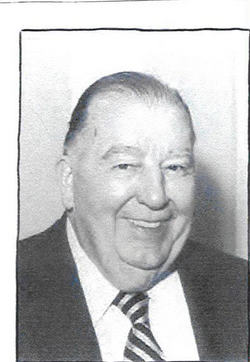
The 1932 election was nothing short of a revolution in American politics. FDR is elected president and Democrats gain 97 seats in the House. In West Virginia’s 2nd district, Congressman Frank Bowman loses reelection to Democrat Jennings Randolph (1902-1998), part of a clean Democratic sweep of the state that ends Republican primacy in the state for generations. He votes a solid New Deal line in his first term. Randolph’s philosophy of governance was, “Problems are truly wonderful, because we have the opportunity to solve them” (Weil). He only gains votes in the 1934 midterms and again, mostly votes a liberal line in the next Congress. Randolph does, however, exercise a little independence with his vote against the “death sentence” clause of the Public Utilities Holding Company Act. His record moderates considerably in the next Congresses, and he votes for a number of proposals to crack down on strikes, including the Smith-Connally Act in 1943. Randolph also votes to permanently establish the House Committee on Un-American Activities in 1945. He does, however, find the Case labor bill in 1946 to be too harsh on unions. However, his increasing moderation doesn’t prevent him from falling to the 1946 Republican wave, being defeated by Republican Melvin Snyder.
Randolph has a twelve-year hiatus from political office after this loss, and he works as an executive for Capital Airlines, now defunct. In 1958, an opportunity would present itself for him to return to politics.
Matthew Neely had long been a presence in West Virginia politics, having been in and out office since the start of the Wilson Administration and one might say that he led the Democrats to dominance in West Virginia. However, in 1957 he had a recurrence of cancer, and died on January 18, 1958. Republican Governor Cecil Underwood appointed Republican John Hoblitzell to the Senate, but he would be up for election to finish the remainder of the term. 1958 was also the year in which a recession hit the United States, and it hit West Virginia particularly hard. Republican Senators Hoblitzell and Revercomb were out, and Democratic Senators Randolph and Robert Byrd were in.
The Senate
On his return to the Senate, Randolph proved about as liberal if not even more so than he was during FDR’s first term. He did have to face Cecil Underwood in the 1960 election, but he won by over ten points. Randolph solidly backed the New Frontier and the Great Society, and unlike his colleague Byrd, he supported all major civil rights legislation. Randolph also called for the creation of the Department of Peace, a foreign policy dream for liberals. The voters of West Virginia approved of his record, and he was reelected in 1966 with a higher percentage of the vote. Randolph, like Byrd, paid his state much attention and steered billions in federal money to black lung benefits. In 1969, Randolph succeeded in getting into law the Federal Coal Mine Health and Safety Act, requiring inspections of underground and strip-mining sites (West Virginia Archives & History). He indeed focused heavily on matters related to his state. Randolph’s focus on his state was highlighted by his quote, “…I’m not what you’d call a national Senator or international Senator” (West Virginia Archives & History). However, he does have a legacy in the Constitution.
Randolph’s Contribution to the Constitution
In 1970, Congress passed, and President Nixon reluctantly signed a five-year extension of the Voting Rights Act of 1965. Nixon’s reluctance was due to a provision that granted 18-year-olds the vote in federal, state, and local elections. This was challenged in the Supreme Court, and the court struck down mandates for an 18-year-old vote in state and local elections in Oregon v. Mitchell (1970). In response, Randolph, long an advocate for lowering the voting age to 18, introduced the 26th Amendment, which applied it on the state and local level as well. This amendment overwhelmingly passed both Houses of Congress in 1971. Randolph stated on this measure, “I believe that our young people possess a great social conscience, are perplexed by the injustices which exist in the world and are anxious to rectify these ills” (West Virginia Archives & History). He won reelection by his widest margin yet in 1972, but he was widely believed given his evident aging to not be running for reelection in 1978. However, Randolph decided to give it another go. There were two complications for this plan. First, he had to wage an active campaign as he got a substantial challenger this time around in Arch Moore, who had served two terms as governor and six terms in Congress. The second was the Panama Canal Treaties, although seen as a necessity by the Carter Administration and many in the foreign policy establishment such as former Secretaries of State Dean Rusk and Henry Kissinger, were controversial with the American public as many regarded the Canal as an American achievement and that it should not be given away as a matter of national security, with future President Ronald Reagan being one of the most outspoken opponents. Randolph was one of three or four senators who would only vote for the treaties if his vote was absolutely required, and it wasn’t, so he voted against (Congressional Quarterly). Randolph won reelection with about 50.5% of the vote.
Although far from agreeing with President Reagan on many issues, seemed to have friendly relations with him and his record had again moved more to the center. In 1982, while praising Reagan for keeping compulsory draft registration he also called on him to reinstate mandatory conscription (UPI). Randolph decided not to surprise the public again by running for reelection in 1984; by this time, he is 82 years old. His DW-Nominate score was a -0.247, surprisingly a bit to the right of Robert Byrd’s -0.309 even though Byrd is a bit more associated with conservatism. When Randolph departed the Senate on January 3, 1985, so went the last politician who served in Congress when it was passing FDR’s First Hundred Days legislation. Although Claude Pepper of Florida, who served in the Senate from 1937 to 1951 and was a staunch New Dealer, was serving in the House at the time of his death in 1989, Randolph lived until May 8, 1998, and seemed to retain his lucidity throughout. Upon his death, Rep. Bob Wise (D-W.V.) praised his record, stating, “Much of his career was spent building roads, bridges, water and sewer systems the background that proved so vital to West Virginia and the nation’s growth. All Americans, no matter how young or old, owe a great debt of thanks to Senator Randolph” (CBS News).
References
Former Sen. Jennings Randolph Dies. (1998, May 8). CBS News.
Retrieved from
https://www.cbsnews.com/news/former-sen-jennings-randolph-dies/
Jennings Randolph: Your “New Dealer” for all the years! West Virginia Archives & History.
Retrieved from
https://archive.wvculture.org/history/exhibitsonline/randolph/jrnewdealerch5.html
Panama Canal Treaties: Major Carter Victory. Congressional Quarterly.
Retrieved from
https://library.cqpress.com/cqalmanac/document.php?id=cqal78-1238869
Sen. Jennings Randolph, D-W.V.A., urged President Reagan Tuesday to reinstitute the military draft. (1982, January 12). UPI.
Retrieved from
Weil, M. (1998, May 9). Former Sen. Jennings Randolph Dies. The Washington Post.
Retrieved from
https://www.washingtonpost.com/wp-srv/politics/campaigns/junkie/links/randolph.htm
 Mad Politics: The Bizarre, Fascinating, and Unknown of American Political History