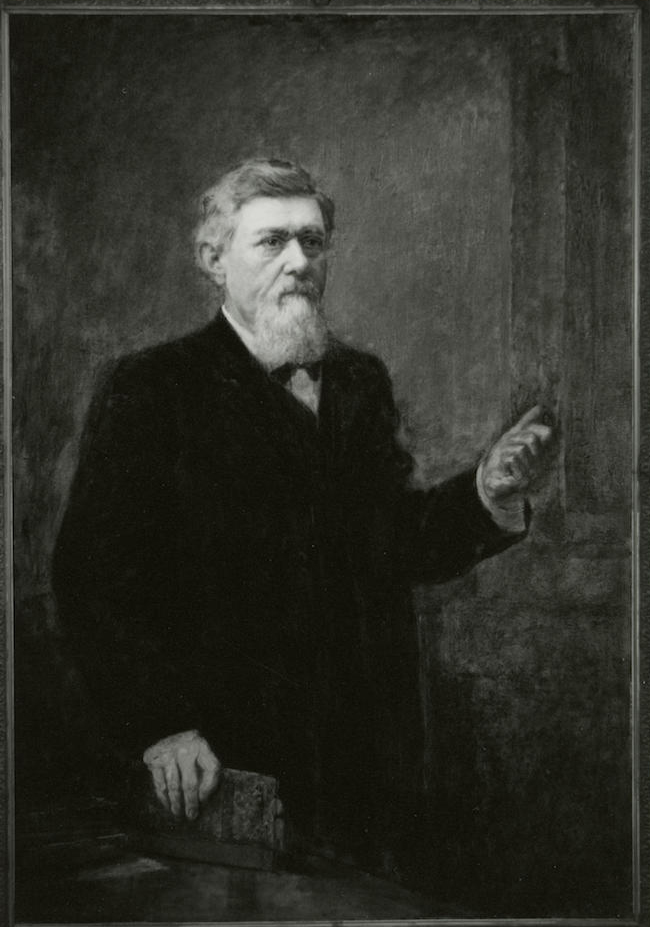
Although there were many people who contributed to the legal environment of Jim Crow in the South, there is one particular person who was most influential in the adoption of such systems in James Zachariah George (1826-1897).
George was an attorney by profession and had served as a private in the Mexican-American War. He also served as a reporter on the proceedings of the Mississippi Supreme Court, and like other prominent Southerners, he was a slaveowner. In 1861, George participated in the Mississippi Secession Convention and signed the Secession Ordinance. The conventioneers held that “Our position is thoroughly identified with the institution of slavery – the greatest material interest of the world” (National Park Service). In the War of the Rebellion, he would rise in the Confederate army to the rank of brigadier general.
Reconstruction
During Reconstruction, George would be active in the Democratic Party and would push to restore white supremacy in the state. In 1875, he convinced Governor Adelbert Ames not to arm black militias as he promised to do all in his power to make the election peaceful. What actually happened was that the Mississippi Plan was put into effect, in which numerous Democrats threatened violence, suppressed, or bought black votes.
In 1881, George was elected to the Senate, in which he garnered a good reputation among his colleagues for his debating ability and was viewed positively by many white Mississippians, who called him the “Great Commoner”. His record in the Senate was one of support for stronger regulations on railroads, support for anti-trust laws, and support for free coinage of silver. His DW-Nominate score is a -0.482. However, George’s sort of progressivism was for “whites only” and it is on the subject of race that George gained his greatest fame.
In 1890, George led the push for the adoption of a new constitution in Mississippi. Since the 15th Amendment, the status of blacks in Southern politics was in flux, especially after the departure of U.S. troops in 1877. Although blacks did vote, fraud, intimidation, and violence were frequent, and their turnout lessened overtime, or they were coerced into voting Democratic. Unlike today, Mississippi was a majority-black state in 1890, making up 58% of the population (Hanna, 3). The last Republican to be elected to Congress from Mississippi at the time, Elza Jeffords, was white and had served as single term from 1883 to 1885.
George’s proposal, in response to the potential of federal intervention through the Lodge Federal Elections Bill, aimed to kill two birds with one stone: disenfranchise black voters and curb election violence. The constitutional convention that adopted this amendment had 133 white delegates and one black delegate, Isaiah Montgomery, despite the state being majority black (Hannah, 3). Montgomery, by the way, was no spokesman for black suffrage. He had previously been a slave of Jefferson Davis’s brother and voted for disenfranchising black and some white voters (Mississippi History Timeline). George’s amendment succeeded in getting around constitutional concerns by instead of placing decisions of who gets to vote on the state, it became up to the local registrar, who would most of the time in practice reject the black applicant.
George’s constitution included some other provisions to deter black voting and curb whatever remaining political power they had:
. A literacy test requiring the voter to read a portion of Mississippi’s Constitution, which could be waived by a registrar if the voter simply “understood” the clause, a way for more poorly educated whites to get through as opposed to poorly educated blacks. 61% of Southern blacks in 1890 were illiterate (Margo, 8).
. An annual $2 poll tax. Although I was unable to find a figure for equivalency for 1890, in 1913, $2 was the equivalent of $62.18 in today’s currency.
. A secret ballot, which meant voters had to be literate.
. Disenfranchisement for numerous criminal offenses that its drafters believed blacks committed at a higher rate than whites.
. A crackdown on black firearm ownership, namely by changing right to bear arms from “all persons” to “citizens” and permitted the Legislature to prohibit carrying concealed weapons (Pettus).
Other provisions in the Constitution included mandated segregated schools and a ban on interracial relations.
The first Congressional election to occur after the enactment of George’s constitution, 1892, demonstrated that the law was effective in its purpose: 69,905 whites and 9,036 blacks voted. Despite blacks being 58% of the population, they were only 11% of the voters, and the suffrage situation would worsen over the years. In 1964, the year before the passage of the Voting Rights Act of 1965, only 6.7% of Mississippi’s black population eligible to vote was registered (Lopez). Although this law faced a challenge in the Supreme Court, George successfully defended it. Other former Confederate states followed his lead in adopting Jim Crow Constitutions between 1890 and 1908. He died in office on August 14, 1897.
To this day, George is one of the two Mississippi figures whose statue is in the Hall of Statues at the U.S. Capitol. The other is Jefferson Davis.
References
Hannah, J.A. et. al. (1965, May 18). Voting in Mississippi. A Report of the United States Commission on Civil Rights.
Retrieved from
Lopez, G. (2015, August 6). How the Voting Rights Act transformed black voting rights in the South, in one chart. Vox.
Retrieved from
https://www.vox.com/2015/3/6/8163229/voting-rights-act-1965
Margo, R.A. (1990, January). Race and schooling in the South, 1880-1950: an economic history. Chicago, IL: University of Chicago Press.
Retrieved from
https://www.nber.org/system/files/chapters/c8792/c8792.pdf
Mississippi Secession. National Park Service.
Retrieved from
https://www.nps.gov/articles/ms-secession.htm
Perman, M. (2017, July 10). Disenfranchisement. Mississippi Encyclopedia.
Retrieved from
Disfranchisement
Pettus, E.W. (2018, June 10). Gun ruling includes Mississippi history lesson from state Supreme Court justice. Clarion Ledger.
Retrieved from
Vogt, D.C. (2017, July 11). James Z. George. Mississippi Encyclopedia.
Retrieved from
George, James Z.
 Mad Politics: The Bizarre, Fascinating, and Unknown of American Political History