I suppose this blog’s subtitle could be, “You think THAT’S BAD…”, given how few things that happen in politics lack some sort of precedent. The most recent news is that Rep. Tim Burchett (R-Tenn.) alleged that former Speaker of the House Kevin McCarthy (R-Calif.) deliberately elbowed him while walking past as a form of retaliation against his vote to declare the speaker’s office vacant. If what Burchett alleges happened did happen, it is in truth small fries compared to the history of legislative violence in the U.S. Congress. In this post, I will detail some of the incidents that were more serious than this alleged occurrence.
Griswold vs. Lyon

Cartoon portraying the scuffle between Matthew Lyon (left) and Roger Griswold (right).
There was a good deal of bad blood between Federalist Congressman Roger Griswold of Connecticut and Democratic-Republican Congressman Matthew Lyon of Vermont. Two weeks before this incident, Lyon had declared himself a champion of the common man and told Griswold that Connecticut Federalists didn’t represent 90% of their constituents (would be similar today to a Democrat telling a Republican he or she only represented the wealthy) and that if he lived in Connecticut and had a printing press he would start a revolution, and in response Griswold asked if he would be fighting for his constituents with a wooden sword (New England Historical Society). This was a reference to Lyon’s court-martial and dishonorable discharge by General Horatio Gates during the Revolutionary War, which his opponents alleged was for cowardice and as punishment he had to wear a wooden sword. Lyon in response spat tobacco juice in Griswold’s face. For this act he was denounced, and Federalists had all sorts of insults for him, including that he was “a kennel of filth” and a “nasty, brutish, spitting animal” (New England Historical Society). A vote to expel Lyon for this act had failed, and this conflict of personalities reached a boiling point on February 15, 1798, when Griswold attacked Lyon with a hickory stick in retaliation for the spitting, hitting him about the head and shoulders, with Lyon brandishing a pair of tongs to defend himself. The conflict was broken up by other representatives. Lyon would later be convicted under the Alien and Sedition Acts, but his constituents would reelect him from jail, and he would cast the deciding vote for Thomas Jefferson in the 1800 election, which had gone to the House of Representatives.
Foote vs. Benton

Cartoon portraying the 1850 incident between Foote (left) and Benton (right).
The year is 1850 and the debate on the Compromise of 1850, a series of bills designed to provide peace on the question of free vs. slave states, is in full heat. Senator Thomas Hart Benton (D-Mo.), one of the founders of the Democratic Party known for his hot temper, has recently turned against slavery, against the wishes of his state and party, and opposes the Compromise as it in his view furthers slavery too much. Senator Henry Foote (D-Miss.) is on the opposite side; he supports the Compromise and is a staunch supporter of slavery. Foote is actually unique on this question from his state, as fellow Senator Jefferson Davis (D-Miss.) opposes this compromise as too limiting on slavery and the Mississippi delegation to Congress opposes it. Benton and Foote despise each other, and Foote, an obnoxious man with a history of getting into duels and fistfights, insults and rails against Benton relentlessly in his speeches for weeks. On April 17, 1850, he accuses Benton, a man who prides himself on his ethics, of taking a bribe, and this is the last straw. He storms over to Foote, who draws a pistol, cocks it, and points it at him. Although Foote at 46 has an age advantage on the 68-year-old Benton, Benton has a major size advantage on the rail-skinny Foote. Benton proceeds to open his jacket to bear his chest and shouts, “I have no pistols! Let him fire! Stand out of the way and let the assassin fire!” (Langeveld, 2016) Foote is wrestled to the floor and disarmed by fellow senators. To this day it is the only time in which a senator has pointed a gun at another senator on the Senate floor.
The Caning of Charles Sumner
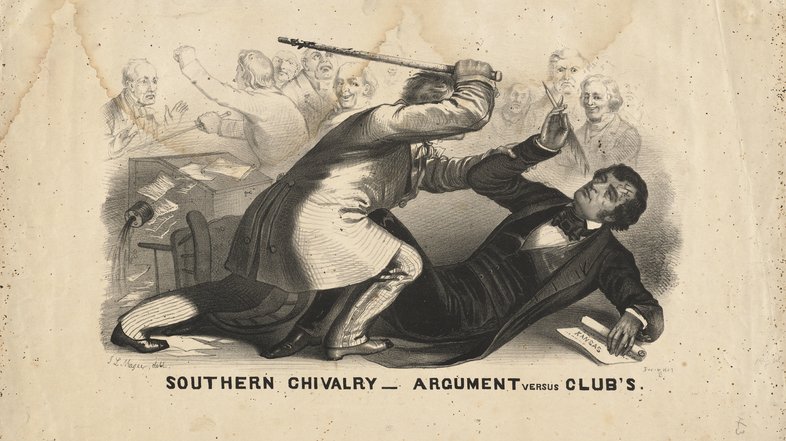
In 1856, Senator Charles Sumner (R-Mass.) delivered a speech before the Senate regarding Kansas as a free or slave state and identified two senators he found responsible for the outbreak of violence in Kansas among pro and anti-slavery settlers in Stephen Douglas (D-Ill.) and Andrew Butler (D-S.C.). He condemned Douglas as a “noise-some, squat, and nameless animal…not a proper model for an American senator” while accusing Butler of taking “a mistress…who, though ugly to others, is always lovely to him; though polluted in the sight of the world, is chaste in his sight – I mean, the harlot, Slavery” (U.S. Senate). While the speech offended many Southerners, one who was particularly strongly so was Butler’s cousin, Representative Preston Brooks of South Carolina. Brooks thought that because of his speech Sumner was not a gentleman and thus the Code Duello didn’t apply to him, so he outright decided to beat him with his cane, and that is what he did on the floor of the Senate on May 22, 1856, with Rep. Laurence Kiett (D-S.C.) holding off other senators with a gun. Brooks proceeded to beat Sumner until he broke his cane. Brooks would not be expelled but he would resign and run again, being elected. He would be convicted of assault and fined $300. Northern voters widely regarded Sumner as a martyr while Brooks was widely regarded as a hero by Southern voters. Brooks would die of croup at the age of 37 on January 27, 1857, before he could take his seat in the new Congress. Sumner would take three years to recover and served in the Senate until his death on March 11, 1874, aged 63.
The House Brawl of 1858
The cause of this incident was once again the issue of slavery. This matter surrounded the proposed LeCompton Constitution, which was supported by President James Buchanan and was pro-slavery. The debate got heated as Representatives Laurence Keitt (D-S.C.) and Galusha Grow (R-Penn.) dished out insults. When Grow went to sit on the Democratic side of the chamber next to Keitt, he told him to sit down on the Republican side and called him a “black Republican puppy”, to which Grow responded, “No negro-driver shall crack his whip over me”, which resulted in Keitt shouting, “I’ll choke you for that” (Damon). Keitt proceeded to attempt to choke him and this started a brawl among around 50 representatives. This fight ended in about two minutes when Cadwallader Washburn (R-Wis.) grabbed William Barksdale (D-Miss.) by his “hair” and threw a punch, only to miss and find in his left hand a wig (Damon). No one knew that Barksdale was bald, and in embarrassment, he put his wig on backwards to the laughter of the House, instantly ending the brawl.
1902: South Carolina Senators Don’t Get Along, Cause a New Senate Rule
Although Senators Benjamin Tillman and John McLaurin are both Democrats and both represent South Carolina, the latter has been increasingly voting with Republicans on major issues, and this royally ticks off Tillman, especially his support for annexing the Philippines. On February 22, 1902, McLaurin bursts into the Senate and accuses Senator Tillman of perpetrating “a willful, malicious, and deliberate lie” (Goodwin). Tillman promptly socks McLaurin in the jaw and the two men fought, and some senators got hit with missed punches as they tried to break up the fight. Tillman was able to hit McLaurin with a series of punches in the process, and both Tillman and McLaurin were censured by the Senate for this incident. In response, Senator George Frisbie Hoar (R-Mass.) got a provision into the Senate rules that states, “No senator in debate shall, directly or indirectly, by any form of words impute to another Senator or to other Senators any conduct or motive unworthy or unbecoming of a Senator” (Goodwin).
Clarence Cannon – Victim and Aggressor
In 1933, Representative Clarence Cannon (D-Mo.), a pugnacious and independent-minded figure, got into two incidents with fellow Missouri Democrat Andy Romjue, the two who had a mutual dislike. In the first incident, Romjue, a significantly taller man, called him a “double-crosser” and a “liar”, possibly over not getting a coveted spot on a committee, and slapped him across the face, to which Cannon responded the next day in a second incident in which after he asked for a check for the Democratic campaign fund, he followed up with, “You made an unprovoked assault on me yesterday” and punched him in the face (Hill). Another scrap he got into was with his Republican counterpart, John Taber of New York. In 1945, his argument with Taber boiled over and he punched him in the face (Henry). Cannon would remain in the House until his death in 1964, at which time he had still held the chairmanship of the Appropriations Committee.
1940: Vincent vs. Sweeney
Although Beverly Vincent (D-Ky.) and Martin Sweeney (D-Ohio) are in the same party, they are on the opposite sides of the question of FDR’s peacetime draft. After Sweeney delivers a speech hotly condemning the peacetime draft as a British plot in September 1940, he sits next to Vincent. Vincent said to him, “I’d rather you would sit somewhere else” and after Sweeney bristled, he added, “You are a traitor” and went on to call him a “son of a bitch” (Time). Sweeney then took a swing at him, after which Vincent landed a hard right on him.
1949: Cox vs. Sabath
Although 69-year-old Gene Cox of Georgia and 83-year-old Adolph Sabath of Illinois are both Democrats, their differences are many and have been heightened by the politics of the New Deal and the Fair Deal. Cox is a prominent member of the House Rules Committee and a leader in the Conservative Coalition while Sabath is the staunchly liberal chairman of said committee. Among their many differences is over housing policy, and in 1949 Cox demanded Sabath grant 10 minutes of speaking time for opposition to the Truman Administration’s public housing bill. Sabath refused, holding that seven minutes was the maximum he could grant. Cox angrily called Sabath a “liar” and punched him on the side of the head. Sabath, although an octogenarian, responded with “a short left to the jaw, then a short right cross with real steam behind it” (Time, 1949). The scuffle was then broken up and the two made up afterwards.
1955: Frustration on Education Bill Boils Over
Democrat Cleve Bailey of West Virginia is a staunch supporter of federal aid for school construction and is enraged that once again Democrat Adam Clayton Powell of New York, a man who identified as black (he was mixed-race and could have passed for white had he chosen to), has introduced an amendment to the education bill barring aid funds to segregated schools. This amendment was a regular measure that Powell introduced to education bills and such an amendment was either watered-down to meaninglessness in conference or it would kill such legislation. The adoption of such an amendment would guarantee unified opposition to the measure from Southern Democrats. Bailey punches Powell in the jaw, but the two make up, and Powell said of the matter, “Cleve Bailey and I smoke cigars together, and are old friends” (O’Hea, 45).
References
Damon (1975, December). Filibuster: A Look at the Record. American Heritage, 27(1).
Retrieved from
https://www.americanheritage.com/filibuster-look-record
Glass, A. (2011, February 15). Griswold-Lyon fight erupts on House floor, Feb. 15, 1798. Politico.
Retrieved from
https://www.politico.com/story/2011/02/griswold-lyon-fight-erupts-on-house-floor-feb-15-1798-049518
Goodwin, G.E. (2023, November 15). The last time there was a fight in the Senate, they changed the rules to ban calling each other corrupt. Business Insider.
Retrieved from
https://www.businessinsider.com/us-senate-fight-rules-changed-history-2023-11
Henry, C. (2018, July 12). The Man Who Brought Two Presidents to Town. Elsberry Historical.
Retrieved from
http://elsberryhistorical.org/items/show/163
Hill, R. Milton A. Romjue of Missouri. The Knoxville Focus.
Retrieved from
https://www.knoxfocus.com/archives/this-weeks-focus/milton-a-romjue-of-missouri/
Langeveld, D. (2016, August 28). Henry S. Foote: Two Time Traitor. Downfall Dictionary.
Retrieved from
http://downfalldictionary.blogspot.com/2016/08/henry-s-foote-two-time-traitor.html
Matthew Lyon, Vermont’s Spitting Congressman. New England Historical Society.
Retrieved from
https://newenglandhistoricalsociety.com/matthew-lyon-vermonts-spitting-irishman/
O’Hea, O. (2022). Earl Warren’s Last Stand: Powell v. McCormack, Race, and the Political Question Doctrine. Journal of Supreme Court History, 47(1), 44-64.
Retrieved from
https://muse.jhu.edu/article/874535/pdf
The Caning of Senator Charles Sumner. U.S. Senate.
Retrieved from
https://www.senate.gov/artandhistory/history/minute/The_Caning_of_Senator_Charles_Sumner.htm
The Congress: Let Harry Do It. (1949, July 4). Time Magazine.
Retrieved from
https://content.time.com/time/subscriber/article/0,33009,888523-1,00.html
The Congress: The Bitter End (1940, September 16). Time Magazine.
Retrieved from
https://content.time.com/time/subscriber/article/0,33009,764654,00.html
 Mad Politics: The Bizarre, Fascinating, and Unknown of American Political History