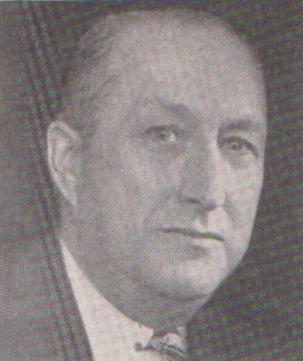
People may wonder why, aside from the weaponization of the law narrative, a significant number of Republicans may be still willing to vote for Donald Trump even if he is convicted of any of what he is charged with. Part of it is in truth just a core reality of life: that principles, rules, and other matters of importance can be waived for someone if enough people like them. Today, I present a smaller example of someone who maintained the loyalty of his voters despite running afoul of the law.
On October 19, 1941, Congressman Lawrence J. Connery of Massachusetts dies of a heart attack, merely four years after his predecessor, his brother William, died of an illness brought on by food poisoning (The New York Times). Elected in his place is State Senator Thomas Joseph Lane (1898-1994), and Lane would stick around. For the most part, he voted as a pretty standard Democrat overall, being a supporter of New Deal programs and supporting organized labor. Lane did, however, support higher tariffs, a position traditionally associated with Old Guard Republicans, as this served to benefit his industrial Lawrence-based district, which was experiencing a decline in jobs. He was thus indeed representative of the people of his district. In the 1942 election, Lane had been elected without opposition. Even in 1946, a tough year for Democrats, he’d pulled off over 60% of the vote. However, on March 5, 1956, Lane was indicted for tax evasion between 1949 and 1951, leaving the government out of a total of $38,542 in taxes (Langeveld). Caught dead to rights, Lane pled guilty on April 30th. In pleading for leniency, he stated to the court, “Deep down in my heart I know there has never been a willful evading of the tax law” (Langeveld). He was sentenced to four months in prison and a $10,000 fine. Despite this development, Lane filed for reelection while in prison, and the voters were receptive. He easily won renomination, and in the 1956 general election, he won with over 68% of the vote. Although this was a reduction in popularity from the 1954 midterms, in which Lane drew no opponent, this showed that the voters continued to appreciate their representative. Lane had no cult of personality on his side, rather just a district loyal to party in which most voters liked their representative. This made Lane only the second person in American history to be elected to Congress after serving time. However, this didn’t mean Lane was invulnerable, as another factor brought his elective career to an end.
Final Defeat
Lane’s political defeat didn’t come about due to his tax evasion, rather by that old time-honored practice named after Massachusetts’ own Elbridge Gerry, gerrymandering. The 1960 census had yielded a two-seat loss for Massachusetts, and Lane’s district was merged with that of Republican Brad Morse’s Lowell-based 5th district. This served to separate Lane from his base of power, and Morse, a moderate liberal, prevailed by 15 points (The Washington Post). See, redistricting isn’t all bad, folks. Subsequently, he would from 1965 to 1977 serve on the Governor’s Council for the Commonwealth of Massachusetts. In contrast to his predecessors to Congress, both who died in their forties, Lane lived to be 95, dying on June 14, 1994.
References
Deaths. (June 18, 1994). The Washington Post.
Retrieved from
https://www.washingtonpost.com/archive/local/1994/06/18/deaths/e831c7c9-672b-4c47-9749-18f9fa16a22c/
Langeveld, D. (2020, November 5). Thomas J. Lane: Jailhouse Incumbent Overcomes Tax Evasion Conviction. The Downfall Dictionary.
Retrieved from
http://downfalldictionary.blogspot.com/2020/11/thomas-j-lane-jailhouse-incumbent.html
W.P. Connery Jr. Dead in Capital. (1937, June 16). The New York Times.
Retrieved from
 Mad Politics: The Bizarre, Fascinating, and Unknown of American Political History