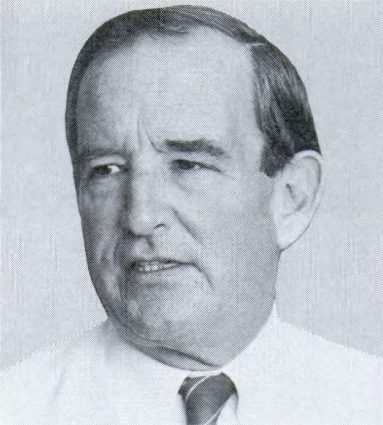
Connecticut seems to be just out of reach for Republicans. Although George Logan came close to winning a Congressional seat last year, the state hasn’t elected a Republican governor or member of Congress since 2006. Those who won office were of a distinctly moderate to liberal variety: Chris Shays was the last Republican ever elected to Congress from the state and he was often thought of as a RINO, but more so than him was his predecessor, Stewart Brett McKinney (1931-1987).
A businessman primarily focusing on cars, McKinney was well placed in the community of Fairfield, Connecticut to run for public office. Although his first effort at running in 1965 as a town selectman was unsuccessful, the following year his political career kicked off, being elected to the Connecticut State House. His chance to move up came soon, as in 1970 Congressman Lowell Weicker ran for the Senate, with McKinney going for his seat in the 4th district. Both men won their races, with the latter winning by 14 points. Indeed, the 4th district was consistently represented by a Republican from 1969 to 2009.
Congressman McKinney: A Liberal Reputation
In the House, Congressman McKinney developed a record that was supportive of social welfare measures, including government-run childcare and extending the Economic Opportunity Act in 1971. He also was supportive of organized labor, voting against amendments prohibiting food stamps for households that need assistance because the head of household is on strike. McKinney defied the Nixon Administration multiple times on Vietnam, supporting a defined pullout date. However, he also had a mixed record on busing as a means for school desegregation, supported anti-subversive legislation, and backed the B-1 Bomber. In 1973, McKinney supported the Crane (R-Ill.) proposal legalizing the private ownership of gold, but also supported raising the minimum wage over President Nixon’s veto and foreign aid. That year, he drafted the D.C. Home Rule Act, which granted D.C. residents the ability to elect their own mayor and city council. Indeed, McKinney was so passionate in his advocacy for D.C. that the district’s non-voting delegate, Democrat Walter Fauntroy, regarded him as “my vote on the House floor” (Specter & Pearson). McKinney’s modified ACA-Index scores ranged from 15% in 1977 to 54% in 1971. The American Conservative Union gave him a lifetime score of 27%.
During the 95th Congress, McKinney served on the Committee on Assassinations, and agreed with the majority conclusion that there was a fourth shot coming from the grassy knoll in the JFK assassination based on a Dictabelt recording, but this turned out not to have been a recording from Dealey Plaza (Sabato). In 1979, he led the drafting of the Chrysler bailout, and this wouldn’t be the last time he’d be involved in business bailouts. In 1984, there was a run on the Continental Illinois National Bank and Trust Co., and as Congress was conducting hearings on a bailout package, McKinney stated, “We have a new kind of bank. It is called too big to fail. TBTF, and it is a wonderful bank” (Ryssdal & Hollenhorst). His use of “too big to fail” popularized the now commonly used term.
McKinney and Reagan
Although Congressman McKinney backed a number of Reagan’s budget and tax reduction proposals, he would be one of the most visible dissenters within the GOP, including on social issues and on military spending. In 1983, he voted for the Equal Rights Amendment and against funding the MX Missile and the B-1 Bomber. It was also during this time that he would have his last achievement in the Homeless Assistance Act, which he sponsored with Representative Bruce Vento (D-Minn.). This established aid programs for the homeless and would be signed into law by President Reagan on July 22, 1987.
Personal Life and End
Although a married man with children, McKinney was bisexual and had relations with multiple men. He also struggled with his health over the years, including needing to undergo multiple-heart-bypass surgery in 1979. In 1985, McKinney was diagnosed with HIV, and on April 22, 1987, while being hospitalized for pneumonia he would be diagnosed with AIDS, dying on May 7th. McKinney’s physician Dr. Cesar Caceres stated, “I believe that Mr. McKinney contracted the disease from the many blood transfusions he received while undergoing multiple-heart-bypass surgery in 1979. This was during the period between 1978 and the spring of 1985 when no testing of blood donors for [HIV] was done” (Specter & Pearson).
References
Rep. Stewart McKinney. American Conservative Union.
Retrieved from
http://ratings.conservative.org/people/M000527
Ryssdal, K. & Hollenhorst, M. (2023, April 13). The history of “too big to fail”. Marketplace.
Retrieved from
https://www.marketplace.org/2023/04/13/the-history-of-too-big-to-fail/
Sabato, L.J. (2013, November 21). Is there more to JFK assassination? CNN.
Retrieved from
https://www.cnn.com/2013/11/15/opinion/sabato-jfk-assassination/index.html
Specter, M. & Pearson, R. (1987, May 8). Rep. Stewart B. McKinney Dies of AIDS Complications. The Washington Post.
Retrieved from
 Mad Politics: The Bizarre, Fascinating, and Unknown of American Political History