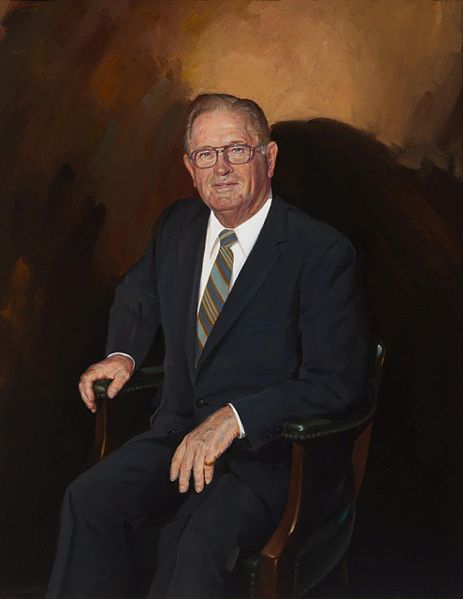
Jamie Whitten of Mississippi, who underwent a tremendous change from 1965 to 1981.
A mere two posts ago, I talked about the 89th Congress, which most notably passed the Voting Rights Act of 1965 and tried for fair housing on civil rights as well as the ideologies at play given modified Americans for Constitutional Action scores. I have done it yet again and found the scores for 1981 and 1982, and the picture painted for civil rights remains, on final passage anyway, regional but also more ideological. I will post details on the ACA-Index for 1981 and 1982 in the near future. While the final passage of the Voting Rights Act of 1965 got 74 House votes against and 18 Senate votes against, the 1982 extension got 24 House votes against and 8 Senate votes against.
The vote of the 97th Congress regarding civil rights demonstrates that as a regional issue, the Voting Rights Act was largely dead, as the opposition was minimal. It is worth noting, however, that in the House only six votes against came from outside of the South: Bob Stump (D-Ariz.), Eldon Rudd (R-Ariz.), former John Bircher John Rousselot (R-Calif.), George Hansen (R-Idaho) (who had voted against the original act), and Dan Crane (R-Ill.). In the Senate, the regional factor was negligible as four nays came from outside the South: Republicans S.I. Hayakawa of California, James McClure and Steve Symms of Idaho, and Gordon Humphrey of New Hampshire. The reason for Hayakawa’s vote was his staunch support for “English only” policies and thus he objected to bilingual ballots. The most opposed state by far was Virginia, with nine of ten representatives voting against extending as well as Senator Harry Byrd Jr. A “nay” that would come back to haunt him later would be Trent Lott (R-Miss.), who later as Republican Senate Majority Leader would get in hot water after his ill-considered approach to praising Strom Thurmond on his 100th birthday. The most opposed among the senators were easily North Carolina’s Jesse Helms and John Porter East. The former repeatedly voted against civil rights measures throughout his career and the latter, who had been the only senator on the Judiciary Committee to vote against sending the bill to the floor, condemned the Voting Rights Act as “punitive and vexatious” and a “slap in the face to the South” (CQ Press).
Of the elected officials listed, only Joe Biden (D-Del.), Chuck Grassley (R-Iowa), Ed Markey (D-Mass.), and Chris Smith (R-N.J.), Chuck Schumer (D-N.Y.), and Ron Wyden (D-Ore.) are in elected office today. There were also some interesting changes from 1965 to 1982 on voting on the Voting Rights Act as well as ideology. Senators Russell Long (D-La.), John Stennis (D-Miss.), Strom Thurmond (R-S.C.), John Tower (R-Tex.), and Robert Byrd (D-W.V.) had opposed both votes on the Voting Rights Act of 1965 but voted for the 25-year extension. The same went for Representatives Jack Edwards (R-Ala.), Don Fuqua (D-Fla.), Jamie Whitten (D-Miss.), Larry Fountain (D-N.C.), and Jim Broyhill (R-N.C.). Truth be told, many of the old foes of the Voting Rights Act were out of Congress by this point, although Bill Dickinson (R-Ala.) and George Hansen (R-Idaho) continued to oppose. There were also some notable ideological changes in 17 years; Paul Findley of Illinois, who I have written about before, went from 89% and 81% for 1965 and 1966 respectively to 58% and 48% for 1981 and 1982 respectively. Jamie Whitten of Mississippi’s change was even greater, going from 85% and 91% in 1965 and 1966 respectively to 35% and 33% in 1981 and 1982 respectively.
Vote on Voting Rights Act Amendments with modified ACA scores:
References
Voting Rights Act Extended, Strengthened. CQ Almanac 1982.
Retrieved from
https://library.cqpress.com/cqalmanac/document.php?id=cqal82-1164618
 Mad Politics: The Bizarre, Fascinating, and Unknown of American Political History