People may wonder why, aside from the weaponization of the law narrative, a significant number of Republicans may be still willing to vote for Donald Trump even if he is convicted of any of what he is charged with. Part of it is in truth just a core reality of life: that principles, rules, and other matters of importance can be waived for someone if enough people like them. Today, I present a smaller example of someone who maintained the loyalty of his voters despite running afoul of the law.
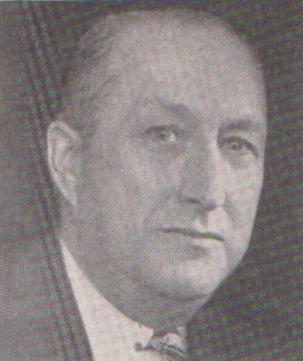
On October 19, 1941, Congressman Lawrence J. Connery of Massachusetts dies of a heart attack, merely four years after his predecessor, his brother William, died of an illness brought on by food poisoning (The New York Times). Elected in his place is State Senator Thomas Joseph Lane (1898-1994), and Lane would stick around. For the most part, he voted as a pretty standard Democrat overall, being a supporter of New Deal programs and supporting organized labor. Lane did, however, support higher tariffs, a position traditionally associated with Old Guard Republicans, as this served to benefit his industrial Lawrence-based district, which was experiencing a decline in jobs. He was thus indeed representative of the people of his district. In the 1942 election, Lane had been elected without opposition. Even in 1946, a tough year for Democrats, he’d pulled off over 60% of the vote. However, on March 5, 1956, Lane was indicted for tax evasion between 1949 and 1951, leaving the government out of a total of $38,542 in taxes (Langeveld). Caught dead to rights, Lane pled guilty on April 30th. In pleading for leniency, he stated to the court, “Deep down in my heart I know there has never been a willful evading of the tax law” (Langeveld). He was sentenced to four months in prison and a $10,000 fine. Despite this development, Lane filed for reelection while in prison, and the voters were receptive. He easily won renomination, and in the 1956 general election, he won with over 68% of the vote. Although this was a reduction in popularity from the 1954 midterms, in which Lane drew no opponent, this showed that the voters continued to appreciate their representative. Lane had no cult of personality on his side, rather just a district loyal to party in which most voters liked their representative. This made Lane only the second person in American history to be elected to Congress after serving time. However, this didn’t mean Lane was invulnerable, as another factor brought his elective career to an end.
Final Defeat
Lane’s political defeat didn’t come about due to his tax evasion, rather by that old time-honored practice named after Massachusetts’ own Elbridge Gerry, gerrymandering. The 1960 census had yielded a two-seat loss for Massachusetts, and Lane’s district was merged with that of Republican Brad Morse’s Lowell-based 5th district. This served to separate Lane from his base of power, and Morse, a moderate liberal, prevailed by 15 points (The Washington Post). See, redistricting isn’t all bad, folks. Subsequently, he would from 1965 to 1977 serve on the Governor’s Council for the Commonwealth of Massachusetts. In contrast to his predecessors to Congress, both who died in their forties, Lane lived to be 95, dying on June 14, 1994.
The 1982 midterms didn’t go so well for Republicans in the House. Thanks to an effective strategy by Democratic Congressional Committee chief Tony Coelho (D-Calif.), they lost 26 seats. The more Democratic House was oppositional to Reagan in many ways and sought to further limit the Reagan tax cuts, restrict military spending, restrict Reagan’s support for the Contras in Nicaragua and for the government of El Salvador in its efforts to defeat a communist rebellion backed by the USSR, Cuba, and Nicaragua. Weapons development and procurement is also a prominent issue, with votes included on the B-1 bomber and MX missile. Americans for Constitutional Action in this Congress strongly supported Reagan’s policies in Central America, supported school prayer, supported retaining the Reagan tax cuts, supported keeping tax brackets adjusted for inflation.
Curiously, ACA had nothing to say about the Martin Luther King Jr. holiday despite ACU and ADA both counting the vote on their scorecards and didn’t count the House vote on the proposed Civil Rights Act of 1984 despite ACU and ADA counting it. This is a marked contrast to the organization’s stance in the Great Society Congress, in which they counted four major civil rights votes in the House. They once again counted raising the debt limit and the closest thing they had anything to an opinion on abortion was their opposition to the 1983 vote on the Equal Rights Amendment, in which a proposal for an “abortion neutral” amendment was the centerpiece of the debate. President Reagan improves his numbers in this Congress over the last in the Senate and has a slight downturn in the House. His House and Senate scores for 1983 and 1984, respectively, are: 89%, 83%; 80%, 92%.
In 1983, the following legislators did no wrong by ACA standards:
House
Norman Shumway (R-Calif.) Chip Pashayan (R-Calif.) Carlos Moorhead (R-Calif.) David Dreier (R-Calif.) Dan Lungren (R-Calif.) Larry McDonald (D-Ga.) Larry Craig (R-Idaho) George Hansen (R-Idaho) Barbara Vucanovich (R-Nev.) Thomas Hartnett (R-S.C.) James Hansen (R-Utah)
Senate
Bill Armstrong (R-Colo.) Steve Symms (R-Idaho) Jesse Helms (R-N.C.) John Porter East (R-N.C.)
In 1984, the following legislators did no wrong by ACA standards:
House
Norman Shumway (R-Calif.) Chip Pashayan (R-Calif.) Carlos Moorhead (R-Calif.) David Dreier (R-Calif.) William Dannemeyer (R-Calif.) Dan Lungren (R-Calif.) Dan Schaefer (R-Colo.) Larry Craig (R-Idaho) George Hansen (R-Idaho) Phil Crane (R-Ill.) Dan Crane (R-Ill.) Dan Coats (R-Ind.) Danny Burton (R-Ind.) Gerald Solomon (R-N.Y.) Bob McEwen (R-Ohio) Denny Smith (R-Ore.) Robert Walker (R-Penn.) Phil Gramm (R-Tex.) Bill Archer (R-Tex.) Jack Fields (R-Tex.) James Hansen (R-Utah) Howard Nielson (R-Utah) Jim Sensenbrenner (R-Wis.)
Senate
Jeremiah Denton (R-Ala.) Pete Wilson (R-Calif.) Steve Symms (R-Idaho) Jacob Hecht (R-Nev.) Paul Laxalt (R-Nev.) Jesse Helms (R-N.C.) John Porter East (R-N.C.) Strom Thurmond (R-S.C.) Jake Garn (R-Utah) Orrin Hatch (R-Utah) Bob Kasten (R-Wis.)
Some names you might know today scored thusly, including the president and the top two Senate Democrats today. I must note that these ACA scores, as has been noted in previous postings on this subject, are modified to include pairs for and against legislation. I see it as a more complete assessment of ideology. The people and scores:
Barry Goldwater, R-Ariz.
1983 – 77 1984 – 90
John McCain, R-Ariz.
1983 – 81 1984 – 85
Joe Biden, D-Del.
1983 – 26 1984 – 17
Newt Gingrich, R-Ga.
1983 – 85 1984 – 90
Dick Durbin, D-Ill.
1983 – 15 1984 – 19
Bob Dole, R-Kan.
1983 – 74 1984 – 88
Chuck Schumer, D-N.Y.
1983 – 11 1984 – 10
John Kasich, R-Ohio
1983 – 86 1984 – 95
Al Gore, D-Tenn.
1983 – 42 1984 – 25
Ron Paul, R-Tex.
1983 – 63 1984 – 65
Note: Paul’s score takes a bit of a beating given the emphasis on issues surrounding the military.
Some time ago I wrote about politicians who were absentee, those who saw being a representative either as another status symbol or as a mere springboard to something else. Such folks include William Randolph Hearst, Joseph Pulitzer, and William Sharon. Today, however, I cover the opposite, someone who was always present for votes and always at work. While many people may think Congress consists of a bunch of bums, this could not be said for Democrat William Huston Natcher (1909-1994) of Kentucky.
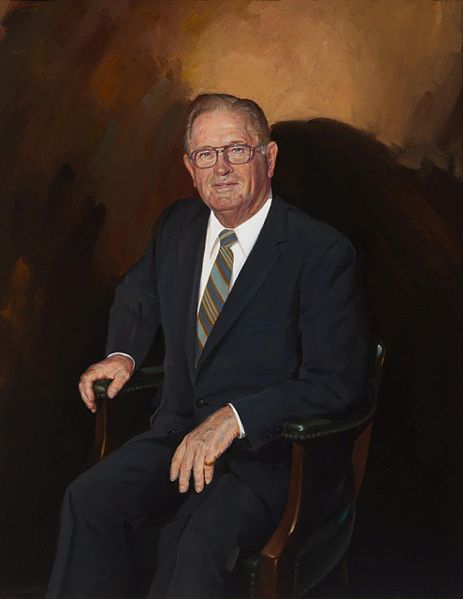
Something that is not remembered so well about Kentucky, today the state of Mitch McConnell and Rand Paul, is that it was once a predominantly Democratic state. Such was especially the case with the state’s second district, based in Bowling Green, one of two House seats that didn’t go Republican when the Hoover landslide swept Kentucky in 1928. Natcher was serving as Kentucky’s attorney for the Eighth Judicial District when on April 30, 1953, his district’s representative, Garrett Withers, died unexpectedly. He was nominated and won a special election that year. Natcher would prove so popular that he would face no opposition in the 1954 midterms. He was a man dedicated to his work for his district and would not accept campaign contributions; what few campaign expenses he had, came out of his own pocket. Natcher spread the word of himself as a representative by personally traveling around his district and talking to people, and this in-person approach worked wonders. President Bill Clinton called him a “citizen legislator”, and there’s nothing I’ve read about him so far that contradicts this label. Natcher’s philosophy was simple, and he described it in 1992, “When we got to Washington we talked about the assignment and we decided we’d try to do it right. And that’s the way I’ve done, I’ve tried to do it right” (Modlin). Natcher indeed followed this approach sitting on the Appropriations Committee, and over the years became an expert on budgetary issues, including being able to memorize portions of budgets.
Ideology
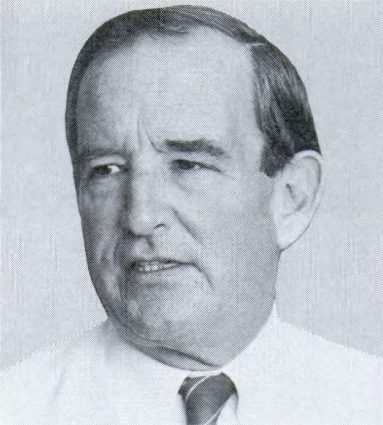
Natcher was very much a traditional Democrat: pro-New Deal and looking out for his district, namely through his support for infrastructure projects, including the cable bridge between Indiana and Kentucky ultimately completed in 2002. Sometimes he clashed with others in his support for highway projects, including Washington D.C. officials as chairman of the D.C. subcommittee of the Appropriations Committee for insisting that certain highway projects be funded before Metrorail funds (Barnes). He also tried to get the proposed Three Sisters Bridge over the Potomac River authorized for construction before any release of Metrorail funds, but this effort was thwarted by a group of representatives after massive public opposition from D.C. and Congress narrowly voted to fund Metrorail over his objections on December 2, 1971 (Eisen). He also was a strong supporter of federal funding for libraries. Natcher was most notable for never having missed a vote from his first day in office to March 3, 1994, having cast a total of 18,401 consecutive votes (Barnes).
Natcher on the Issues
Natcher was supportive of JFK’s New Frontier and LBJ’s Great Society programs, although he did oppose federal aid for mass transit. However, on some social issues Natcher proved conservative, such as his support for school prayer. He was also supportive of spending on the military, including for funding the B-1 Bomber and MX Missile. This translated to Natcher being, on net, a moderate liberal – his ACA scores ranged from an 8% in 1961 to a 59% in 1969. On environmental issues, he had a mixed record, with the League of Conservation Voters giving him a 45%.
Natcher and Civil Rights
Congressman Natcher was on civil rights very much a man of his region in the 1950s and 1960s. While he supported certain voting rights measures such as the 24th Amendment and the Voting Rights Act of 1965, he opposed the McCulloch-Celler Amendment for federally appointed voting referees, joined all but one member of the state’s House delegation in opposing the Civil Rights Act of 1964, and voted against fair housing. However, he curiously voted to strengthen the 1964 act’s anti-employment discrimination enforcement through the proposed Equal Employment Opportunity Act of 1966. Natcher would ultimately go along with the Democratic leadership on most civil rights questions in later years, including opposing an anti-racial quota and an anti-affirmative action amendment in 1978. Natcher also voted for the Equal Rights Amendment in 1971 and 1983. He did, however, maintain opposition to busing as a means of desegregation.
At Long Last…Chairman of the Appropriations Committee and the End
Although Natcher served for a long time, he had the misfortune of having people ahead of him in seniority for the House Appropriations Committee: the man immediately senior of him, Appropriations Chairman Jamie Whitten of Mississippi, would serve in Congress for 53 years, while Whitten’s predecessor, George Mahon of Texas, had served in Congress for 44 years. Natcher’s chance finally came in 1992; Chairman Whitten, who like Natcher was an octogenarian, suffered a stroke in February 1992 and was months later persuaded to step down. Although being chairman was the pinnacle of his career, his time would only be long enough for the start of the Clinton Administration, for by 1994 his health was failing. On March 6th, he was brought into the House on a gurney connected to tubes and an oxygen tank to cast his last votes. Natcher died of heart failure on March 29th, with the only votes he ever missed being on account of his final illness. President Clinton attended his funeral. Political Science Professor Ed Yager of Western Kentucky University assessed his legacy thusly, “He was an absolute expert on parliamentary procedure and he was also an expert on the budget and had many parts of the budget memorized. And so this professional competence was extremely important. But on the other hand he also had the personal qualities which were extremely important to getting things done in the House of Representatives. He was civil. He thought of himself as an American first, and as a Democrat second” (Modlin).
Although he holds the record for most consecutive votes, believe it or not, he’s not Kentucky’s longest serving representative. That goes to Republican Hal Rogers, who has served in Congress since 1981. Kentucky’s move from Democratic to Republican state was occurring about the time of Natcher’s death, and although in 1992 Natcher had won reelection by over 60% of the vote, his successor was Republican Ron Lewis, who won by over 10 points. The 2nd district has been represented by a Republican ever since. Natcher came from a different era of Democratic politics, coming to Congress in the age in which the New Deal coalition was still alive and well and the Austin-Boston Connection (named for Speaker Sam Rayburn of Bonham, Texas and Majority Leader and later Speaker John W. McCormack of Boston, as well as for Speaker Tip O’Neill of Boston and Majority Leader Jim Wright of Fort Worth) was effective.
References
Barnes, B. (1994, March 31). Rep. William H. Natcher Dies at 84. The Washington Post.
Connecticut seems to be just out of reach for Republicans. Although George Logan came close to winning a Congressional seat last year, the state hasn’t elected a Republican governor or member of Congress since 2006. Those who won office were of a distinctly moderate to liberal variety: Chris Shays was the last Republican ever elected to Congress from the state and he was often thought of as a RINO, but more so than him was his predecessor, Stewart Brett McKinney (1931-1987).
A businessman primarily focusing on cars, McKinney was well placed in the community of Fairfield, Connecticut to run for public office. Although his first effort at running in 1965 as a town selectman was unsuccessful, the following year his political career kicked off, being elected to the Connecticut State House. His chance to move up came soon, as in 1970 Congressman Lowell Weicker ran for the Senate, with McKinney going for his seat in the 4th district. Both men won their races, with the latter winning by 14 points. Indeed, the 4th district was consistently represented by a Republican from 1969 to 2009.
Congressman McKinney: A Liberal Reputation
In the House, Congressman McKinney developed a record that was supportive of social welfare measures, including government-run childcare and extending the Economic Opportunity Act in 1971. He also was supportive of organized labor, voting against amendments prohibiting food stamps for households that need assistance because the head of household is on strike. McKinney defied the Nixon Administration multiple times on Vietnam, supporting a defined pullout date. However, he also had a mixed record on busing as a means for school desegregation, supported anti-subversive legislation, and backed the B-1 Bomber. In 1973, McKinney supported the Crane (R-Ill.) proposal legalizing the private ownership of gold, but also supported raising the minimum wage over President Nixon’s veto and foreign aid. That year, he drafted the D.C. Home Rule Act, which granted D.C. residents the ability to elect their own mayor and city council. Indeed, McKinney was so passionate in his advocacy for D.C. that the district’s non-voting delegate, Democrat Walter Fauntroy, regarded him as “my vote on the House floor” (Specter & Pearson). McKinney’s modified ACA-Index scores ranged from 15% in 1977 to 54% in 1971. The American Conservative Union gave him a lifetime score of 27%.
During the 95th Congress, McKinney served on the Committee on Assassinations, and agreed with the majority conclusion that there was a fourth shot coming from the grassy knoll in the JFK assassination based on a Dictabelt recording, but this turned out not to have been a recording from Dealey Plaza (Sabato). In 1979, he led the drafting of the Chrysler bailout, and this wouldn’t be the last time he’d be involved in business bailouts. In 1984, there was a run on the Continental Illinois National Bank and Trust Co., and as Congress was conducting hearings on a bailout package, McKinney stated, “We have a new kind of bank. It is called too big to fail. TBTF, and it is a wonderful bank” (Ryssdal & Hollenhorst). His use of “too big to fail” popularized the now commonly used term.
McKinney and Reagan
Although Congressman McKinney backed a number of Reagan’s budget and tax reduction proposals, he would be one of the most visible dissenters within the GOP, including on social issues and on military spending. In 1983, he voted for the Equal Rights Amendment and against funding the MX Missile and the B-1 Bomber. It was also during this time that he would have his last achievement in the Homeless Assistance Act, which he sponsored with Representative Bruce Vento (D-Minn.). This established aid programs for the homeless and would be signed into law by President Reagan on July 22, 1987.
Personal Life and End
Although a married man with children, McKinney was bisexual and had relations with multiple men. He also struggled with his health over the years, including needing to undergo multiple-heart-bypass surgery in 1979. In 1985, McKinney was diagnosed with HIV, and on April 22, 1987, while being hospitalized for pneumonia he would be diagnosed with AIDS, dying on May 7th. McKinney’s physician Dr. Cesar Caceres stated, “I believe that Mr. McKinney contracted the disease from the many blood transfusions he received while undergoing multiple-heart-bypass surgery in 1979. This was during the period between 1978 and the spring of 1985 when no testing of blood donors for [HIV] was done” (Specter & Pearson).
References
Rep. Stewart McKinney. American Conservative Union.
I have written about this subject before, namely that I regard the narrative that Nixon of being a liberal as a myth, rather that he was moderately conservative, but there are some greater details I’d like to delve into, namely how he fared with the top two interest groups that issued ratings based on liberalism and conservatism: Americans for Democratic Action and Americans for Constitutional Action. Some takeaways: Ideologues were not pleased with Nixon’s first two years. For conservatives, the complaints included that under his administration there was the largest expansion of the federal government since 1945 (Kotlowski). However, like I’ve covered before, some of these changes such as the Endangered Species Act and the Clean Air Act amendments, received consensus support to the degree that such votes are rendered worthless for ascertaining liberalism and conservatism among legislators.
If Nixon was counted by ACA and ADA scorecards based on the positions he took on their votes, this is how it would come out:
Years
ADA (S)
ADA (H)
ACA (S)
ACA (H)
1969
13
17
22
30
1970
21
44
75
67
1971
17
8
55
91
1972
14
29
100
55
1973
11
11
100
80
1974
33
17
89
60
Average
18
21
74
64
The scores regarding Americans for Constitutional Action can be searched on this website under Americans for Constitutional Action Project: An Update. For Americans for Democratic Action, the votes counted can be looked up on Voteview’s website for Nixon’s positions. However, the vote count is incompletely presented for 1970 and 1974 on ADA’s website, so I have filled in the blanks. The 1970 ADA file available consists of interim ratings designed to influence voters for the 1970 midterms, which ADA regarded as of the utmost importance. The complete version, released later, had 25 House votes rather than 18 and 32 Senate votes rather than 20.
The missing roll call votes for 1970 in the House, with the pro-ADA position, are: 335, Yea; 382, Nay; 383, Nay; 400, Nay; 404, Yea; 410, Yea; 439. Yea.
The missing roll call votes for 1970 in the Senate, with the pro-ADA position, are: 483, Yea; 496, Yea; 501, Yea; 503, Yea; 553, Yea; 559, Nay; 571, Yea; 596, Yea; 608, Yea; 623, Yea; 642, Yea; 647, Yea.
The missing roll call votes for 1974 in the House, with the pro-ADA position, are: 699, Yea; 701, Yea; 707, Nay; 739, Yea; 776, Yea; 779, Nay; 796, Yea; 861, Yea; 862, Yea; 863, Yea; 874, Yea; 897, Nay; 933, Yea; 947, Nay; 971, Nay; 988, Nay.
The missing roll call votes for 1974 in the Senate, with the pro-ADA position, are: 671, Nay; 713, Yea; 750, Yea; 784, Yea; 799, Yea; 804, Yea; 806.
1969 provides a fascinating contrast between how liberals and conservatives saw Nixon: both groups thought he was bad news but for different reasons. Of particular note is how low he scores with Americans for Constitutional Action, which was achieved by him only siding with them on three of ten issues in the House and two of nine in the Senate. Nixon’s sins from a conservative perspective included:
Accepting too high raises of the debt ceiling.
The Family Assistance Plan.
Compromising with Republican liberals on the issue of busing as a means of desegregation.
Leading otherwise conservative Republicans into taking more liberal positions to be in line with the president.
Supporting increases in foreign aid.
Supporting extensions of anti-poverty programs without their functions being transferred to states.
Supporting farm subsidy payments.
1970 strangely has Nixon moving in a rightward direction from ACA but a leftward direction from ADA.
ADA’s problems with Nixon were many, but among some more notable ones:
His support for Supersonic Transport, which ACA didn’t regard as sufficiently indicative of conservatism to count in their ratings.
Vietnam War policy.
His support for altering the Voting Rights Act to make application nationwide as well as his opposition to a voting rights extension over the inclusion of an 18-year-old vote provision. Although it is true that Nixon signed into law an extension of the Voting Rights Act, he did that in spite of the 18-year-old vote provision, which was struck down by the Supreme Court and thus necessitated a Constitutional amendment.
Nixon does better by ACA in both Houses in 1970, and afterwards did much better. After being reelected, he looks downright princely in the Senate by ACA standards and just okay in the House. Overall, Nixon figures as a moderate by ACA standards in the House and as a moderate conservative in the Senate. By ADA standards, he figures as a conservative in the Senate and as a moderate conservative in the House. I have noticed that when looking at historic figures for liberalism, a standard that seems akin to that of radical conservatives Kent and Phoebe Courtney, whose 1961-1962 ratings I have covered, is often used. Such a standard ought to cause them to blush, were they still alive, and it doesn’t account for where conservatives and liberals were standing at the time. ACA itself was already considered very conservative, yet by their standards Nixon doesn’t do too shabbily.
References
Kotlowski, D.J. (2002, June 9). Was Richard M. Nixon a closet liberal? The Baltimore Sun.
Senator Charles Sumner (R-Mass.), most noted as an abolitionist, was also a supporter of the proposed Christian Amendment to the Constitution.
Lately, we have heard some GOP showhorses talk about the United States as a “Christian nation”. Lauren Boebert of Colorado, for instance, said last year that she was “tired of this separation of church and state junk – that’s not in the Constitution”, while adding that “The church is supposed to direct the government” and not the other way around (Dress). Non-Republicans lament of what the GOP has become over such a sentiment and others, seeming to believe that the GOP was once a more secular party. The Senate GOP’s 29-3 vote for a school prayer amendment to the Constitution in 1966, which I have covered before, says otherwise. Although the latter part of Boebert’s statement about church directing government is completely off as to the intentions of the Founding Fathers, she is on solid ground with holding that government is not supposed to direct the church as well as the first part as the phrase “separation of church and state” does not appear in the Constitution, rather Thomas Jefferson’s letter to the Danbury Baptists. Her sentiments on religion and state also have more in common with founding figures of the Republican Party than such non-Republicans think. From the adoption of the United States Constitution, there were those who saw the absence of God in it as a deficit, and during the 1860s a number of Republicans saw fit to do something about it.
Proposing the Christian Amendment
In 1861, eleven representatives from Protestant denominations met and saw the War of the Rebellion as a form of divine punishment for failure to include God in the Constitution, and proposed to alter the preamble to mention God. The following year the National Reform Association was founded to push this amendment and proposed it to President Lincoln, who was noncommittal. The proposed amendment would add, “We, the people of the United States, humbly acknowledging Almighty God as the source of all authority and power in civil government, the Lord Jesus Christ as the Ruler among the nations, His revealed will as the supreme law of the land, in order to constitute a Christian government, and in order to form a more perfect union, establish justice, insure domestic tranquility, provide for the common defense, promote the general welfare, and secure the inalienable rights and the blessings of life, liberty, and the pursuit of happiness to ourselves and our posterity, and all the people, do ordain and establish this Constitution for the United States of America” (Allison). Prominent supporters included such big names in the early Republican Party as Senators Charles Sumner of Massachusetts, Zachariah Chandler and Jacob Howard of Michigan, B. Gratz Brown of Missouri, John Sherman of Ohio, and Justin Morrill and George Edmunds of Vermont.
Despite this promising start of support, the War of the Rebellion was consuming the time of government, and the assassination of President Lincoln further disrupted any push forward this amendment might have had. There was also some growing hesitation among its supporters. Charles Sumner, for instance, grew concerned about how his Jewish constituents would respond (Allison). The proposed amendment suffered a great blow when Lyman Trumbull (R-Ill.), chairman of the Judiciary Committee, regarded the amendment as unnecessary in 1865 and cited examples of the Constitution indirectly supporting the notion of God, including public oaths for office and a right for free exercise of religion. Trumbull then asked for the Judiciary Committee to be discharged from the duty of consideration of the amendment and it was agreed to (Allison). Efforts persisted, with petitions being presented by numerous members of the House and Senate. Senator Richard Yates (R-Ill.), stated in his support,
“So far as I am concerned. I must say that this nation is too much indebted to the Christian religion for its national superiority for it to ignore Christianity. This is the religion which aroused our fathers in the old country and caused them to migrate to this continent and to lay here the foundations of religion and freedom. It crossed the ocean with our Pilgrim fathers; it has carried our institutions to the distant frontier; it has erected temples dedicated to the true God. The spirit of its philanthropy has filled our land with colleges and school. Its benevolence has established institutions for the relief of the disabled and the diseased, and for the amelioration of our race. And now, sir, nine-tenths of the people of my State demand that there shall be an amendment to the Constitution by which the supremacy of God shall be acknowledged by this great nation to that Being to whom we are indebted for all that we are — for our successes in many wars, and for the establishment of equal rights and liberty throughout the land” (Allison).
The amendment was not without its opponents, including Senators Francis P. Blair (D-Mo.) and Carl Schurz (LR-Mo.) who objected to consideration with the latter citing petitions from over 10,000 people in opposition. No action was taken over concerns that the amendment had potential to impair free exercise of religion.
The nation that existed when this amendment was proposed was an overwhelmingly Protestant one, with Protestantism being taken as a given with Catholic and other religious schools being regarded as “sectarian”. There have been periodic efforts since to amend the Constitution to make it more of a Christian document, with the most recent example being school prayer, which I have covered before. Although the school prayer amendment is on its face neutral and could potentially be neutral in application, the motivation for it comes from Protestants who want prayer in the classroom, as it existed in many American schools before the 1962 Supreme Court decision Engel v. Vitale.
References
Allison, J. (1998). The NRA (National Reform Association) and the Christian Amendment. The Constitutional Principle: Separation of Church and State.
Dress, B. (2022, June 28). Boebert says she is ‘tired’ of separation between church and state: ‘The church is supposed to direct the government’. The Hill.
The election of Ronald Reagan to the presidency in 1980 provided a real promise of conservative governance, with a conservative president, a Republican Senate, and a House that although was not Republican, promised to be majority conservative. However, what was the score for Reagan and the Congress on the issues? They counted for the 1981 and 1982 House 24 and 23 votes respectively, and for 1981 and 1982 Senate 21 votes for both years. Among the issues, they supported indexing tax brackets for inflation, retaining funds for the B-1 Bomber and MX Missile, the Solomon Amendment, overturning a Federal Trade Commission regulation requiring used car sellers to inform their customers of major known defects with automobiles, a Balanced Budget Amendment to the Constitution, and school prayer. They opposed busing, the proposed American Conservation Corps, raising the debt ceiling, bilingual ballot requirements, US participation in international development banks, and overriding President Reagan’s vetoes on spending bills. President Reagan himself gets, based on issues he made his opinion known on, an 80 and 100 in the House in 1981 and 1982, and a 70 and 73 in 1981 and 1982 in the Senate respectively. A bit lower than expected, honestly, but ACA finds him having gone wrong by supporting raising the debt limit in 1981 and 1982, supporting US involvement in international development banks in 1981, supporting the Tennessee-Tombigbee Waterway in 1981, opposing Sen. Harrison Schmitt’s (R-N.M.) amendment on disapproving federal regulations in 1982, and opposing a debt ceiling amendment to the Balanced Budget Amendment in 1982.
Some notable figures and their ACA scores, modified to count pairs for and against:
Barry Goldwater, R-Ariz. 1981 – 81 1982 – 72
John Rhodes, R-Ariz. – House Minority Leader 1981 – 74 1982 – 76
The ACA made their scores particularly tough to get all right or all wrong. In the 1981 Senate, for instance, only Chris Dodd of Connecticut scored a 0 and no senators scored a 100. In 1982, only Bill Armstrong of Colorado scored a 100 and no senators scored a 0. Jesse Helms of North Carolina missed one vote for each year. His sins by the standards of ACA? Voting to raise the debt limit in 1981 and voting to table an amendment allowing states to veto a nuclear waste storage site unless both Houses of Congress overrode the state’s veto.
Americans for Constitutional Action continued not to count abortion as an issue, a significant difference with the emerging new right It also counted the House vote for the conference report on the Tax Equity and Fiscal Responsibility Act in 1982 as a vote FOR the conservative position, as opposed to Americans for Democratic Action, which considered it a vote FOR the liberal position and American Conservative Union, which considered it a vote AGAINST the conservative position. This highlights a difference in the emphasis ACA put on deficit reduction to tax reduction. This wasn’t the only issue in which the organization sided with Americans for Democratic Action in this Congress: they shared their opposition to the Tennessee-Tombigbee Waterway, a project President Reagan favored.
Note: Errors
The data I used to ascertain the issues behind these scores comes from Voteview legacy’s website as well as the Almanac of American Politics 1984 edition. There were some errors in the process that I discovered, and this was through being unable to replicate the exact set of ratings. The 1981 Senate one given how much does fit I am 99% sure about.
The Senate has multiple instances, including:
Paula Hawkins (R-Fla.) – Improper in both 1981 and 1982, 1982 possibly a repeat of Lawton Chiles’ (D-Fla.) 57 score. Charles Mathias (R-Md.) – His 1981 score appears to be erroneously a repeat of his 1982 score of 14. Paul Tsongas (D-Mass.) – His 1981 score is listed as a 13, but appears to be a 16 instead. Claiborne Pell (D-R.I.) – His 1981 score appears to count a pair for ending debate on an anti-busing amendment as a vote for. Howard Baker (R-Tenn.) – He is counted as 67, but has an absence for the Metzenbaum amendment on oil price deregulation, which he was for.
The House’s issues:
In 1981, Bill Hefner (D-N.C.) was listed as having a score of 49. This is not mathematically possible with 24 votes, he scored a 48. In 1982, Beryl Anthony (D-Ark.) was listed as having a score of 65. This happened to be the same as neighboring Congressman John Paul Hammerschmidt (R-Ark.) and I was unable to find a proper combination of votes that would give Hammerschmidt and Anthony both a 65. I conclude this score was put in by mistake as a duplicate of Hammerschmidt’s.
Despite these, I believe I have hit upon an accurate counting of ACA’s scores, as I have found no other way to reconcile how all the other senators’ scores can be achieved at the same time. It was a truly tall order to find how ACA counted ultra-conservative Steve Symms’ (R-Idaho) score as an 81 in 1981, meaning he voted against their position four times. Same goes for ultra-liberal Ted Kennedy (D-Mass.) getting three votes right by their standards that year. What strikes me as interesting about these ratings is that they show how less ideological partisanship was in times past. Admittedly, the ACA has picked a few oddball votes for counting conservatism that contribute to this, but I can see how a case could be made for them.
Jamie Whitten of Mississippi, who underwent a tremendous change from 1965 to 1981.
A mere two posts ago, I talked about the 89th Congress, which most notably passed the Voting Rights Act of 1965 and tried for fair housing on civil rights as well as the ideologies at play given modified Americans for Constitutional Action scores. I have done it yet again and found the scores for 1981 and 1982, and the picture painted for civil rights remains, on final passage anyway, regional but also more ideological. I will post details on the ACA-Index for 1981 and 1982 in the near future. While the final passage of the Voting Rights Act of 1965 got 74 House votes against and 18 Senate votes against, the 1982 extension got 24 House votes against and 8 Senate votes against.
The vote of the 97th Congress regarding civil rights demonstrates that as a regional issue, the Voting Rights Act was largely dead, as the opposition was minimal. It is worth noting, however, that in the House only six votes against came from outside of the South: Bob Stump (D-Ariz.), Eldon Rudd (R-Ariz.), former John Bircher John Rousselot (R-Calif.), George Hansen (R-Idaho) (who had voted against the original act), and Dan Crane (R-Ill.). In the Senate, the regional factor was negligible as four nays came from outside the South: Republicans S.I. Hayakawa of California, James McClure and Steve Symms of Idaho, and Gordon Humphrey of New Hampshire. The reason for Hayakawa’s vote was his staunch support for “English only” policies and thus he objected to bilingual ballots. The most opposed state by far was Virginia, with nine of ten representatives voting against extending as well as Senator Harry Byrd Jr. A “nay” that would come back to haunt him later would be Trent Lott (R-Miss.), who later as Republican Senate Majority Leader would get in hot water after his ill-considered approach to praising Strom Thurmond on his 100th birthday. The most opposed among the senators were easily North Carolina’s Jesse Helms and John Porter East. The former repeatedly voted against civil rights measures throughout his career and the latter, who had been the only senator on the Judiciary Committee to vote against sending the bill to the floor, condemned the Voting Rights Act as “punitive and vexatious” and a “slap in the face to the South” (CQ Press).
Of the elected officials listed, only Joe Biden (D-Del.), Chuck Grassley (R-Iowa), Ed Markey (D-Mass.), and Chris Smith (R-N.J.), Chuck Schumer (D-N.Y.), and Ron Wyden (D-Ore.) are in elected office today. There were also some interesting changes from 1965 to 1982 on voting on the Voting Rights Act as well as ideology. Senators Russell Long (D-La.), John Stennis (D-Miss.), Strom Thurmond (R-S.C.), John Tower (R-Tex.), and Robert Byrd (D-W.V.) had opposed both votes on the Voting Rights Act of 1965 but voted for the 25-year extension. The same went for Representatives Jack Edwards (R-Ala.), Don Fuqua (D-Fla.), Jamie Whitten (D-Miss.), Larry Fountain (D-N.C.), and Jim Broyhill (R-N.C.). Truth be told, many of the old foes of the Voting Rights Act were out of Congress by this point, although Bill Dickinson (R-Ala.) and George Hansen (R-Idaho) continued to oppose. There were also some notable ideological changes in 17 years; Paul Findley of Illinois, who I have written about before, went from 89% and 81% for 1965 and 1966 respectively to 58% and 48% for 1981 and 1982 respectively. Jamie Whitten of Mississippi’s change was even greater, going from 85% and 91% in 1965 and 1966 respectively to 35% and 33% in 1981 and 1982 respectively.
Vote on Voting Rights Act Amendments with modified ACA scores:
Florida right now is on a bit of a conservative kick, and it seems to be growing. There was, however, a time in which not only Florida was part of the Solid South for the Democrats, but also in which its voters statewide elected Claude Pepper (1900-1989).
The Florida Senatorial Deaths and Succession
The year 1936 saw both of Florida’s longtime senators die: Park Trammell on May 8th, and Fletcher Duncan on June 17th. Although the immediate successor for the latter was William Luther Hill, he was a mere placeholder. The man who won the 1936 election to succeed him was attorney and former state legislator Pepper. This had not been his first try for the Senate; in 1934 he had won the first round in the Democratic primary against incumbent Park Trammell thanks to his talented oratory, and Trammell only narrowly fended off defeat in the runoff.
Pepper became known for his staunch support of the New Deal, including the Fair Labor Standards Act. However, he also voted to kill the “court packing plan” in 1937, a point of contention with Roosevelt. The following year, Pepper won a full term in a victory for President Roosevelt in his toughest election year yet with over 58% of the vote (Hill). He would support Roosevelt in most matters and was one of the most outspoken interventionists, sponsoring Lend-Lease in 1941. Roosevelt was a big fan of Pepper’s, even once telling him, “Claude, if you were a woman, I’d kiss you!” (Mormino) Like the president, Pepper saw the federal government as a tremendous force for aiding poor Americans with tax dollars. His spirit of politics was expressed thusly, “My colleagues, when you go home tonight and you close your eyes and you sleep and you ask, ‘What have I done today to lighten the burden upon those who suffer,’ at least you could say, ‘I helped a little bit today; I voted to help those who needed help.’ It may not answer all the problems, and it does not, but it will give comfort. It will cool the brow of many who suffer. It will give hope to many who almost are despaired” (The Claude Pepper Foundation). Although Pepper was reelected in 1944, his strongly liberal views on domestic issues was taking its toll. He had won the Democratic primary with slightly over 51% of the vote when the challenger was the little known and poorly financed J. Ollie Edmunds (Hill).
Early Civil Rights Supporter
Claude Pepper was the first Southern Democrat to support civil rights legislation. Although he had opposed an anti-lynching bill in 1937 (which he later regretted), he would support banning the poll tax. Although Florida had no poll tax, the state was expected to stand with the rest of the South over a federal poll tax ban lest it open the door to other federal interventions on civil rights. He even sponsored the 1942 bill, which fell to a Senate filibuster.
Pepper and Communism
While many politicians were always suspicious of the USSR and saw Stalin as a threat, Pepper saw a potential long-term ally in Stalin and a global partner in the USSR. He saw himself as filling in the role of international statesman and, he hoped, FDR’s eventual heir to the White House. Pepper even visited Moscow, interviewed Stalin, and delivered a speech praising the USSR, stating, “Probably nowhere in the world are minorities given more freedom, recognition, and respect than in the Soviet Union and nowhere in the world is there so little friction, between minority and majority groups, or among minorities” (Hill). He would also call for the destruction of all atomic weapons, received praise from The Daily Worker for a pro-Soviet speech, and according to one FBI report he had spoken before 23 communist front groups (Clark, 77-79). Worse yet, according to FBI files, Pepper used economist Charles Kramer, who had worked in the Roosevelt Administration as part of his “brain trust”, as a speechwriter and advisor during the 1940s (Orlando Sentinel). Kramer was, per FBI files, a Soviet agent. He had participated in the Ware Group Soviet spy ring.
Pepper’s stance on the Soviets was deeply unpopular in Florida, and he was aware of this, believing that he would be able to mend fences in time to win reelection in 1950. In 1947, he voted against the Greek-Turkish Aid Act, which was a core component of Truman’s foreign policy, objecting to the aid not going through the UN. In the Republican 80th Congress, Pepper was otherwise a staunch liberal Democrat, and this included voting to sustain President Truman’s veto of the Taft-Hartley Act, standing alone among Florida politicians to do so. While Floridians in the past were more amenable to his liberal views, especially during the Great Depression, they had become far less so with the years.
“Red Pepper” vs. “Gorgeous George” Smathers: The 1950 Election
Pepper, never held in high esteem by President Truman, really crossed him by making it known that he tried to lobby General Dwight Eisenhower to replace him for the Democratic nomination, and he backed photogenic Congressman George Smathers to take him on. Pepper faced an uphill battle given the nation’s anti-communist mood and the stagnating war effort in Korea. Although “Gorgeous George” was far from the most conservative of Florida politicians, he aggressively ran against his record on communism in one of the most negative campaigns in the state’s history and joined others in calling Pepper “Red Pepper” for his prolonged support of the Soviets. Despite this, Pepper did vote to sustain a loan to Spain’s Francisco Franco in 1950. While it is fair to question his judgment regarding Stalin, the Soviets, and some of his associations, a communist he was not. Pepper lost renomination by nearly 10 points.
A Comeback and Remaking of Image
Although Pepper’s defeat for renomination in 1950 might have been the end, he made a remarkable comeback. Although he lost his bid to defeat Spessard Holland in the primary in 1958 by 14 points, after twelve years of absence in Congress he was elected to the House in 1962, representing Miami. Although still a New Dealer on domestic issues, he voted for a number of anti-communist measures on foreign policy. No doubt a factor in this was the staunchly anti-communist Cuban American population in his district. In 1964, he was the only member of the Florida delegation to Congress to vote for the Civil Rights Act. Pepper was the state’s most unflinching supporter of the Great Society as well and stood as a staunch advocate for maintaining Social Security, Medicare, and other programs for the elderly. He could be said to be one of the people who effectively made Social Security a third rail of American politics.
A Power in the Reagan Years
Claude Pepper’s second act was perhaps his greatest as he found himself in quite a position of power in the House in the 1980s; from 1983 to 1989, he was chairman of the House Rules Committee. Instead of a maverick as he was in his youth, he was now a major player in the Democratic Party’s establishment. The Los Angeles Times wrote of him, “As chairman, Pepper can bottle up legislation he considers obnoxious, and he can attach his pet causes to virtually any bill” (Rosenblatt). Even in his eighties, he proved a powerful campaigner. Pepper was considered by Democratic Congressional Campaign Committee Chairman Tony Coelho (D-Calif.) to have been “…our most potent weapon, more responsible than any other individual in our party” for the Democrats gaining 26 House seats in the 1982 midterms and he went on to state that “In 1984, he protected Democrats when the issue was very tough, and in 1986 all the Senate winners used him” (Rosenblatt). Pepper’s peak of power in the House coincided with the presidency of one of the greatest challenges New Deal politics had ever faced in Ronald Reagan, but Pepper remained a New Dealer to the last, writing in his autobiography, “I was a New Dealer before there was a New Deal. I remained one when the ideology behind it came under bitter attack. I remain one today” (Rosenblatt).
On May 26, 1989, President Bush awarded Pepper the Presidential Medal of Freedom. Four days later, he passed away at the age of 88, 39 years after suffering a defeat that would have ended many a politician’s career and 20 years after the man who bested him had retired from politics. Pepper was a liberal contender for some time, but in the end the reality of Florida politics only allowed him to continue as a representative, albeit a successful one. In numerous ways Pepper stood alone among Florida colleagues, including when not politically expedient to do so, and that in itself merits some respect. He is also one of those examples of persistence paying off.
References
A Report Card for 80th Congress. (1947). Americans for Democratic Action.
One of my motivators, one that has been present since I was a teenager, has been to set the record straight regarding conservatives and civil rights, as I felt they got a bad shake and the implication of this approach is, “You were wrong on these issues, so you’ll be wrong on all the others” regardless of how out there, how anti-capitalist, or coercive certain proposals are. The 89th Congress presents an interesting picture on both ideology and civil rights. While conservative Republicans are mostly supportive of the Voting Rights Act, it should be noted that Americans for Constitutional Action counted a vote for the Voting Rights Act as against their position. There’s a bit of an uncomfortable dual reality for modern conservatives to face regarding civil rights: although historically the record pf conservative Republicans gets savaged far more than deserved, it was a post-World War II truth that major conservative organizations and numerous prominent thinkers opposed the civil rights legislation of the 1960s. While for some thinkers, such as Southerners Medford Bryan Evans and James J. Kilpatrick, it was about defending segregation, for others it was about defending wider concepts such as property rights, freedom of contract, and yes, state’s rights. Americans for Constitutional Action (ACA) was on record against the Civil Rights Act of 1964, the Voting Rights Act of 1965, and fair housing laws. Their issues were the ones that applied nationally, although ACA assistant director John J. Synon was with Evans and Kilpatrick. They also were against granting the attorney general sweeping powers of enforcement. William F. Buckley Jr. himself underwent a major change between 1957 and 1965 on the subject. An interesting piece on Buckley’s change is listed in references, and its worth a read.
Many conservative officeholders on the Republican side, however, didn’t heed the call of these organizations on the Civil Rights Act of 1964, most of them didn’t on the Voting Rights Act (only two Republican senators, both from the South, did), but many did on fair housing. The latter two issues can be seen in this document, and the Civil Rights Act of 1966 would indeed not make it past the Senate, with fair housing having to wait until 1968. The latter issue was a far more national one than the previous two, both of which involved remedies for racial discrimination that primarily applied in the South, whereas housing discrimination was a far more national phenomenon. The GOP’s point man on civil rights, Bill McCulloch of Ohio, got an 85% in both 1965 and 1966, respectable scores from a conservative standpoint. One should bear in mind that for the House, of the five votes I include, four were counted by ACA. For voting rights, the regional character of support and opposition is quite striking as there were only five Republican representatives outside the South who were on record opposing both House passage and the conference report: H. Allen Smith of Glendale, California, James B. Utt of Santa Ana, California, George Hansen of Pocatello, Idaho, H.R. Gross of Waterloo, Iowa, and Robert McEwen of Ogdensburg, New York. Of these three, Gross and McEwen would support at least one other civil rights measure in the 89th Congress. Interestingly, times have largely changed for these districts, two are currently represented by Democrats: Glendale is currently represented by Adam Schiff of all people and Democrat Lou Correa represents Santa Ana. Ogdensburg is represented by Elise Stefanik, head of the House Republican Conference. There were only two Democrats outside of the former Confederacy to oppose the Voting Rights Act of 1965: Representative Paul C. Jones of Kennett, Missouri, and Senator Robert Byrd of West Virginia. The former represented an area of Missouri that was culturally Dixie and today is represented by Republican Jason Smith, and Byrd had a past in the KKK.
The ACA scores I have here are modified to count for officially recorded pairs and on occasion, announcements for or against. I do this because I consider it a more complete picture on ideology. CQ polls for and against are not counted ideologically, although they are displayed for the listed civil rights votes. The file is below:






 Mad Politics: The Bizarre, Fascinating, and Unknown of American Political History