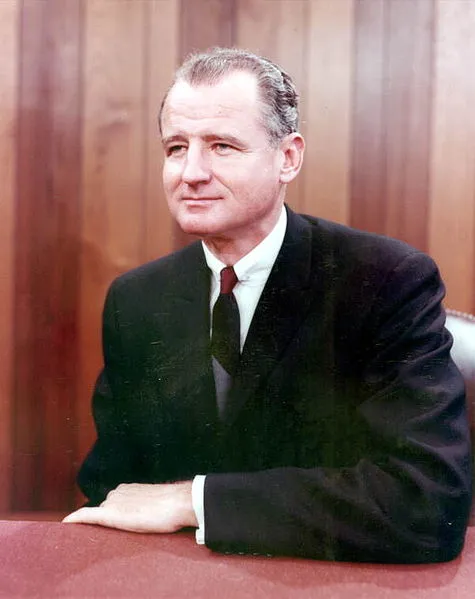
A legend exists in Florida politics that in one campaign, a speech called the “redneck speech” was delivered to a group of poorly educated North Florida voters: “Do you know that Claude Pepper is known all over Washington as a shameless extrovert? Not only that, but this man is reliably reported to practice nepotism with his sister-in-law and he has a sister who was once a thespian in wicked New York. Worst of all, it is an established fact that Mr. Pepper, before his marriage, habitually practiced celibacy” (Then New York Times). This little story is what politician George Smathers (1913-2007) was most known for, despite him having never delivered it. Even the Time Magazine reporter who brought this speech to public attention referred to it as a “yarn” and Smathers offered a $10,000 reward if it could be proven that he delivered this speech, a reward that was never collected (Raines; Brotemarkle). It would be like if George Washington was most known as “the guy who chopped down the cherry tree”. But what was the real story behind Smathers and what did he actually do?
The Start of Politics
Smathers’ first experience with politics, ironically, was in helping Claude Pepper get reelected in 1938 by organizing Gainesville and all of Alachua County. After graduating from law school at the University of Florida, he quickly became district attorney in Miami and was a vigorous prosecutor. Smathers managed to nail the local chief of the Office of Price Administration, a state’s attorney, and a county solicitor, a role he later saw himself as a bit overly ambitious (Szanton). By World War II, Smathers was married and had a son, and although he served for some time in the Marines, he cut his service short, an act that had potential to cause political problems. He contacted Tom Clark and one of Florida’s senators to get off of duty early. Smathers would point out to anyone who addressed this was that under draft rules he could have gone for a deferment given his status as a husband and father rather than serve at all (Szanton).
Smathers to Congress
In 1946, Smathers ran in the Democratic primary against Congressman Pat Cannon. He was confident about his prospects of defeating the young upstart, saying to him, “I’ve defeated 14 guys already, and you’ll be the 15th” (Szanton). However, this confidence was misplaced as Smathers beat him and was elected to Congress, serving as a freshman along with future presidents John F. Kennedy (D-Mass.) and Richard Nixon (R-Calif.). Fortune would smile on him within two years of being in office, as Senator Claude Pepper, known as strongly left-wing, tried to recruit General Dwight Eisenhower as a primary candidate against President Truman. Smathers recollected that after being reelected, Truman summoned him to the White House and told him to “beat that son-of-a-bitch Claude Pepper” (Barnes). Also compelling to Democratic voters to go against him was his record. He believed that Stalin would be a good post-war ally for too long and pushed for further relations with the Soviets. Pepper even interviewed Stalin for one hour on September 14, 1945, and then went on Soviet radio to praise him, stating, “I have had the honor to meet and talk to Generalissimo Stalin, one of the great men of history and of the world…Russia’s greatest era lies not in her glorious past but in her future…The people of America and good men and women everywhere owe a great debt to Generalissimo Stalin, to the Red Army and to the people of the Soviet Union for their magnificent part in turning back and destroying the evil Nazis” (Clark, 4-5).
This visit and praise were heavily criticized at home, yet he continued his advocacy and to speak for the Soviets, including before the National Citizens’ Political Action Committee (NC-PAC), which backed the Henry Wallace line of unity between the USA and USSR (Clark, 6). Pepper’s highly naive stand on the USSR would haunt him in an increasingly anti-communist environment. Worse yet for him, the conservative newspaper New York Mirror nicknamed him “Red Pepper” in 1946, and it stuck and made him particularly vulnerable in 1950 (Clark, 16).
Smathers and the 1950 Election
1950 was a particularly bad year for liberals, with some strong ones like Glen Taylor (D-Idaho) and Elbert Thomas (D-Utah) losing reelection to conservative Republicans. There were also a number of heated anti-communist campaigns and Smathers campaigned hard against his staunchly left-wing record and his friendly attitude to the USSR. Pepper lost renomination on May 2nd, with Smathers winning by 9.56%. This was the start of Smathers’ career in the Senate, but hardly the end of Pepper’s career; after an unsuccessful comeback bid to the Senate in 1958, in 1962 he would be elected to the House representing Miami and would serve until his death on May 30, 1989.
Smathers and Politics
Smathers was without doubt to Claude Pepper’s right, but how did he fare? While he was often regarded as a moderate, he also got seen as a conservative, and there’s some justification to each perspective on him. His average score from the liberal lobbying group Americans for Democratic Action (ADA), not counting unopinionated absences, is a 41%, although the reason it’s even this high is because he often voted in line with the Truman Administration but per ADA his record was more hostile to liberalism after. Although Smathers represented a state with many retirees, he voted against Medicare proposals in 1960, 1962, and 1964 before voting against killing Medicare Parts A & B in 1965. He did, however, vote for quite a number of Democratic programs, including JFK’s accelerated public works program in 1962 and the Economic Opportunity Act in 1964. Smathers also specialized in Latin American issues given an increasing population of Cubans, managing to secure aid and permanent visas for people fleeing communist Cuba, contributing ideas to Kennedy’s Alliance for Progress program, and President Kennedy praised him as “one of the first Americans to recognize the importance of Latin America” (Crispell, 102-112, 174-176). Smathers was overall one of the more amenable Southern Democrats to liberal legislation pushed by national Democrats. Americans for Constitutional Action was not so impressed with his record, and his scores by year ranged from 18% in 1962 to 73% in 1968.
Smathers and Kennedy
I noted earlier that Smathers and JFK were elected to the House in the same year, and they became close friends for the rest of Kennedy’s life, with Smathers being the only non-family member at wedding party for his marriage to Jackie. In 1959, however, when despite heading up the committee in the South to elect Kennedy, he launched his own bid for president which he did with the approval of Majority Leader Lyndon B. Johnson (D-Tex.) in the name of uniting Florida Democrats. Smathers recalled that this was a bump in the road of their friendship: “To make a long story short, he (Kennedy) kept after me to withdraw. “I want you to withdraw. I want you to withdraw…Damn it to hell, what kind of friend are you?” and so and so. I said, “Look, I’m not going to stand here and take all this abuse, so I’m going to go out. I’m leaving”” (Simkin). Smathers would support Kennedy in the general election. He reflected after Kennedy’s assassination, “A lot of joy and pleasure went out of my life when Kennedy was assassinated…I miss the guy something fierce” (UF Law).
Kennedy’s secretary, Evelyn Lincoln, reported after his assassination that before his trip to Dallas, he had told her he wanted to drop Johnson from the 1964 ticket. She stated that he would have replaced LBJ with Smathers or North Carolina Governor Terry Sanford. In the 1964 election, Smathers seconded Senator Hubert Humphrey’s (D-Minn.) nomination for vice president at the Democratic National Convention (Time). He counted LBJ as a personal friend as well.
Smathers and Civil Rights
George Smathers was one of the more moderate Southern politicians on civil rights. Despite signing the Southern Manifesto in 1956, he voted for the Civil Rights Act of 1957, the 24th Amendment, and the conference report of the Voting Rights Act of 1965 after voting against the original bill. He took part in the filibuster of the Civil Rights Act of 1964 and proposed several weakening amendments, including exempting beauty parlors from the law’s provisions. Smathers was also a critic of Martin Luther King Jr., and after being called a racist for it, he responded, “I don’t like bigotry and intolerance…But they do exist and I don’t think you’re going to get them out by passing laws” and would later state, “There wasn’t any doubt that before 1964 if Spessard Holland (Florida’s other senator) or I had voted for civil rights – you couldn’t do it and survive” (Simkin). These words are consistent with Smathers’ at the time words in private and votes in public. Despite voting for every weakening amendment and against final passage of the Civil Rights Act of 1964, Smathers strategized with Johnson on passage and said to him regarding ending debate, “I hope that he [Senate Majority Leader Mike Mansfield] has done his counting and that he has the votes” (LBJ Presidential Library). However, Smathers also paired against the confirmation of Thurgood Marshall to the Supreme Court (Voteview). This was a stance exclusively taken among those who voted against the Civil Rights Act of 1964.
The End of His Senate Career
In 1968, Smathers along with Senator John J. Williams (R-Del.) sponsored a successful amendment placing a 10% surcharge on individual and corporate income taxes while placing a $180.1 billion ceiling on fiscal 1969 spending (CQ Almanac). This move, supported by President Johnson, ensured that the government’s approach to reducing debt would not only rely on increasing taxes. While Smathers had backed Kennedy in 1960 and Johnson in 1964, he backed Richard Nixon in 1968. This endorsement would normally come with political consequences, but he knew he wasn’t running for another term, and it served as a sign of a Florida that was politically changing from its previously default Democratic allegiance. Smathers was also a friend of Nixon’s and introduced him to Bebe Rebozo in 1950, who would be his best friend for life. He also sold his home in Key Biscayne to Nixon. To further highlight the change Florida was undergoing, he would be succeeded by Representative Edward Gurney, the first Republican senator since Reconstruction.
References
Anderson, C. (2017, October 27). 10 surprising facts about John F. Kennedy. Cleveland 19 News.
Retrieved from
https://www.cleveland19.com/story/36698592/10-surprising-facts-about-john-f-kennedy/
Barnes, B. (1989, May 31). Claude Pepper, Crusader for Elderly, Dies. The Washington Post.
Retrieved from
Brotemarkle, B. (2015, November 3). Iconic, Legendary Speech Probably Never Happened. Florida Today.
Retrieved from
https://myfloridahistory.org/frontiers/article/93
Clark, J.C. (1995). Claude Pepper and the Seeds of His 1950 Defeat, 1944-1948. Florida Historical Quarterly, 74(1).
Retrieved from
Confirmation of nomination of Thurgood Marshall, the first negro appointed to the Supreme Court. Voteview.
Retrieved from
https://voteview.com/rollcall/RS0900176
Crispell, B.L. (1999). Testing the limits: George Armistead Smathers and Cold War America. Athens, GA: University of Georgia Press.
George A. Smathers, 93. (2007, January 21). The Washington Post.
Retrieved from
George A. Smathers: A Man for the Times. (2014, June 27). UF Law.
Retrieved from
George A. Smathers
HR 10606. Kerr motion to table Anderson amend. providing health insurance for most persons 65 and over, to be financed by an increase in the Social Security tax. Govtrack.
Retrieved from
https://www.govtrack.us/congress/votes/87-1962/s297
HR. 11865. Social Security Amendments of 1964. Gore amend. authorizing a new program of medical care for persons 65 & over financed through an increase in the Social Security tax & wage base & from general revenues. Govtrack.
Retrieved from
https://www.govtrack.us/congress/votes/88-1964/s509
HR. 12580. Anderson amend. providing medical benefits for all Social Security retirees 68 and over, to be financed by an increase in the Social Security payroll tax. Govtrack.
Retrieved from
https://www.govtrack.us/congress/votes/86-1960/s407
LBJ Presidential Library, Vol. 7, June 1, 1964 – June 22, 1964, p. 13.
Politics: All Over? Or Just Starting? (1964, September 4). Time Magazine.
Retrieved from
https://content.time.com/time/subscriber/article/0,33009,830550-1,00.html
Raines, H. (1983, February 24). Legendary Campaign: Pepper vs. Smathers in ’50. The New York Times.
Retrieved from
S. 2642. Passage. [Economic Opportunity Act of 1964]. Govtrack.
Retrieved from
https://www.govtrack.us/congress/votes/88-1964/s452
Senate Votes on the Williams-Smathers Amendment And on Moves To Ease Its Spending and Job Limits. CQ Almanac.
Retrieved from
https://library.cqpress.com/cqalmanac/document.php?id=cqal68-1282265
Simkin, J. (1997). George Smathers. Spartacus Educational.
Retrieved from
https://spartacus-educational.com/JFKsmathers.htm
Szanton, A. (2023, June 6). George Smathers of Florida: The Making of a U.S. Senator. Medium.
Retrieved from
To Amend H.R. 6675, the 1965 Social Security Amendments, by striking from the bill its Medicare provisions, Parts A and B. Govtrack.
Retrieved from
 Mad Politics: The Bizarre, Fascinating, and Unknown of American Political History