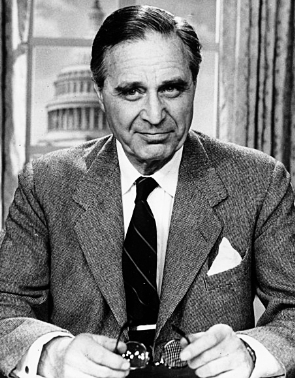
With President Eisenhower’s 1952 election to the presidency comes both of Connecticut’s Senate seats. One of the victors is President Eisenhower’s frequent golfing buddy, a prominent businessman, and a political moderate. Although he will always be overshadowed by his son and grandson for their roles in American history, Prescott Sheldon Bush (1895-1972) still bears writing about.
The source of the initial wealth of the Bush family did not come from Prescott, rather his father, Samuel Prescott Bush, who made his fortune as a steel and railroad executive. However, Prescott wanted to make his own way and got into the field of banking, notably capitalizing on his father-in-law George Herbert Walker’s connections, which got him a leading position in Brown Brothers Harriman.
Prescott Bush and Connection to Nazi Germany
If you are to search “Prescott Bush” and “Nazis” it is difficult to find a source on the first page of search results that isn’t ideologically motivated and was posted during the presidency of George W. Bush. The least ideologically motivated source I could find was a South African article on the matter. At the time of W.’s presidency, some of these quite a bit was made out of Prescott Bush becoming one of the directors of Brown Brothers Harriman, including holding a share in Union Banking Corporation (UBC), of which he was a director and was a clearinghouse for the German industrialist Fritz Thyssen. Thyssen had, believing that Hitler was the best shot Germany had against communism, been one of the people who had bankrolled his rise.
Prescott Bush did not actually own his single share of Union Banking Corp., he had held it on behalf of Dutch Bank voor Handel en Scheepvaart N.V., the owner of the UBC. However, he was also one of its seven directors. On October 20, 1942, UBC’s assets were seized under the Trading with the Enemy Act, under suspicion that the Dutch bank had come under the control of the Nazis, as the Netherlands was by this time under Nazi occupation. By this time, it should be noted, Thyssen himself was being held as a political prisoner by the Nazis; he had politically broken with them over Kristallnacht. Bush was involved in the war effort himself, heading up the U.S.O. and the National War Fund campaign (USDOT).
Politics
Once Bush had paid off his children’s tuition, he decided to get into politics. His motivation was that he thought America needed a robust two-party system and that the Democrats had remained in power too long. From 1947 to 1950, Bush served as the chairman of the Finance Committee of the Connecticut GOP. This positioned him to run for the Senate in 1950 against interim incumbent William Benton. Although 1950 was a bad year for Truman and particularly liberal Democrats, journalist Drew Pearson, a New Deal Democrat, anti-anti-Communist, and bane of many politicians in Washington, published an article days before the election that highlighted Bush’s involvement with Planned Parenthood and claimed he was pushing birth control (Federal Highways Administration). Although Bush denied that he was pushing birth control, this charge was damaging in Connecticut at the time, which had many Catholic voters, and he lost by 1000 votes. Conservative columnist Westbrook Pegler had written earlier that year on Bush that he “is coming on to be known as President Truman’s Harry Hopkins [FDR’s close advisor]. Nobody knows Mr. Bush and he hasn’t a Chinaman’s chance” (Pegler) And although he suffered another setback when Republicans chose William Purtell over him to run against Benton, on July 28, 1952, Democratic Senator Brien McMahon died of lung cancer and Republicans nominated Bush to finish his term. Bush narrowly won the 1952 election against Congressman Abe Ribicoff, running well behind Eisenhower in the state.
Senator Bush
If I were to give you an example of the ultimate Eisenhower Republican aside from President Eisenhower himself, I’d give Prescott Bush. Eisenhower even thought of him a good candidate for president in the future. He was staunchly internationalist, opposing the Bricker Amendment, and in 1954 he voted to censure Joseph McCarthy. Bush argued that he had “caused dangerous divisions among the American people because of his attitude and the attitude he has encouraged among his followers: that there can be no honest differences of opinion with him. Either you must follow Senator McCarthy blindly, not daring to express any doubts or disagreements about any of his actions, or, in his eyes, you must be a Communist, a Communist sympathizer, or a fool who has been duped by the Communist line” (TIME, 1954). His scores from Americans for Democratic Action, a liberal lobbying group, ranged from 23% to 58%.
Bush was involved in the passage of the Interstate Highway Act in 1956 and voted to keep the prevailing wage provision for public highway projects objected to by conservatives. His role in aiding passage was significant enough that Theodore H. White, a writer at the time, commented that he was “an able and distinguished man making his mark for the first time upon the Senate and nation in an issue of national significance” (Federal Highways Administration). During the Kennedy Administration, he cosponsored the legislation establishing the Peace Corps.
On civil rights, Bush could be counted firmly in support. He voted against both key amendments weakening the Civil Rights Act of 1957, the O’Mahoney-Kefauver-Church jury trial amendment and the Anderson-Aiken amendment striking of 14th Amendment implementation, and even against a pre-arranged maneuver in 1960 to strip the attorney general of authority to issue injunctions in civil rights cases, initiated by Majority Leader Lyndon B. Johnson (D-Tex.) and supported by Eisenhower. In 1962, he voted for the 24th Amendment (ban poll taxes for federal elections) as well as a bill prohibiting literacy tests to vote and establishing a sixth-grade education as a presumption of literacy.
Other Issues
Although Bush voted for an effort to weaken a minimum wage bill in 1960, he voted against a similar effort in 1961. He voted against Medicare both in 1960 and 1962. Bush’s response to the Kennedy Administration was mixed, as indeed it was for many New England Republicans who were both moderate and recognized President Kennedy’s popularity in the region. This included former Speaker of the House Joe Martin (R-Mass.), once regarded as an arch-foe by liberal activists who was now an Eisenhower Republican in inclination. Bush was also among a minority of Republican senators who voted against a 1954 bill for statehood for both Hawaii and Alaska. He only voted for Hawaii statehood after Alaska had been admitted, the latter he had voted against.
Retirement
In May 1962, Bush announced that he would not run for reelection. He stated that he lacked “the strength and vigor needed to do full justice to the campaign ahead, or to the responsibilities involved in serving another six years in the Senate” (TIME, 1962). Bush had been facing a tough reelection as Abe Ribicoff had announced he was going to resign his post as Secretary of Health, Education, and Welfare to run for the seat. Internal polling from both campaigns found Ribicoff to be leading Bush (TIME, 1962). Indeed, Ribicoff did win the election against Congressman Horace Seely-Brown by 2.5 points.
Although Bush was for a time bullish on Nelson Rockefeller and wanted him for president, his divorce disgusted him, and he asked, “Have we come to the point in our life as a nation where the governor of a great state… can desert a good wife, mother of his grown children, divorce her, then persuade the mother of four youngsters to abandon her husband and their four children and marry the governor?” (Simkin). Many Republicans thought the same, which contributed to Nelson Rockefeller being unable to clinch the 1964 presidential nomination. Although Bush initially favored Henry Cabot Lodge Jr. for the nomination, once nominated he supported Barry Goldwater’s candidacy. He had been a lifelong smoker, dying on October 8, 1972 of lung cancer, twenty years after the same illness felled McMahon.
References
A Bush at Both Ends: Before and After the Interstate Era. Federal Highways Administration.
Retrieved from
Bush and the Hitler Connection. (2004, September 25). Mail & Guardian.
Retrieved from
https://mg.co.za/article/2004-09-25-bush-and-the-hitler-connection/
Ex-Senator Prescott Bush Dies; Connecticut Republican Was 77. (1972, October 9). The New York Times.
Retrieved from
Mansfield, S. (2003). The Faith of George W. Bush. EReader.
Retrieved from
https://web.archive.org/web/20070926234407/http://www.ereader.com/product/book/excerpt/16982
National Affairs: Splendid Job. (1954, December 13). TIME Magazine.
Retrieved from
https://content.time.com/time/subscriber/article/0,33009,935382,00.html
Pegler, W. (1950, August 22). Fair Enough. Burlington Daily News-Times (North Carolina).
Politics: How Now, Nutmeg State? (1962, May 25). TIME Magazine.
Retrieved from
https://content.time.com/time/subscriber/article/0,33009,896220,00.html
Simkin, J. (1997). Prescott Bush. Spartacus Educational.
Retrieved from
https://spartacus-educational.com/MDbushPR.htm
 Mad Politics: The Bizarre, Fascinating, and Unknown of American Political History