I get the sense from reporting on the subject that 2023’s new party, No Labels, is for people who both want a break from Trump and the social justice obsessives and are roughly center to center right in orientation. Liberals and that parade of has-been Biden sycophants known as The Lincoln Project are alarmed by this development and they should be. Third parties tend to be detrimental to the party holding the White House, although the 1948 election was arguably an exception, as the perception of Truman’s distance from the nationally unpopular pro-Soviet Progressive Party and the segregationist State’s Rights (Dixiecrat) Party may have won him votes that would have otherwise gone to Dewey. This exception certainly did not apply to the 1980 election, and a contributing factor to Carter’s loss was a “tell it as it is” style independent candidate in Congressman John B. Anderson (1922-2017) of Illinois.
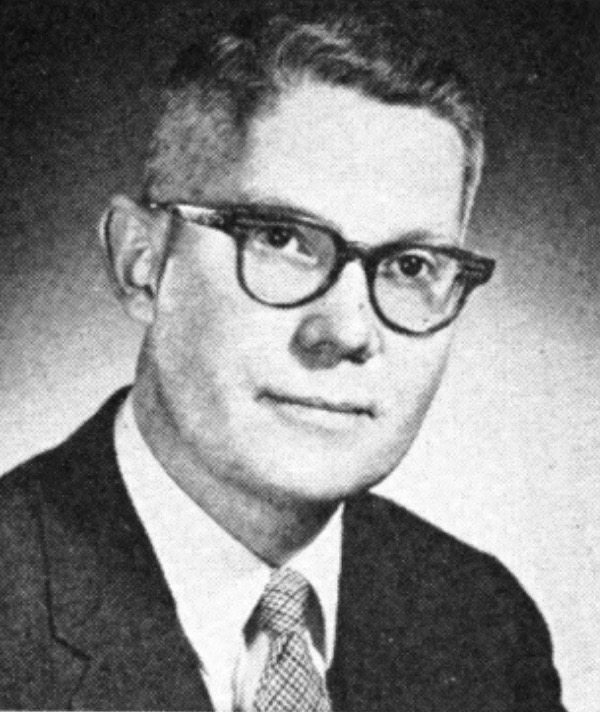
Anderson in 1965.
When Anderson was first elected to Congress in 1960 from a staunchly conservative rural Illinois district, succeeding longtime conservative Leo Allen, there was little thought that his record would be any different. And indeed, for a time, it wasn’t and if anything, more conservative. From 1961 to 1964, Americans for Democratic Action counted only one selected vote of his favorably: the Civil Rights Act of 1964. In the 87th Congress (1961-1962) Anderson only disagreed with John Birchers John Rousselot and Edgar Hiestand of California on one issue on Americans for Constitutional Action’s 23 selected votes. Indeed, they wrote on him, “He stands firm against the liberal pressures of Washington, the wild spending schemes, and the permissive society offered by the proponents of the Great Society” (Mason, 14). Anderson stood as an intellectual and articulate voice for conservatism in the 1960s, and if we were to look only at his record during the Kennedy and Johnson years, he stands as an easy candidate for a great conservative from American history. Indeed, his record was so impressive to the Republican leadership at the time that they made him number #3 in party leadership in the House as chairman of the House Republican Conference in 1969, the post that Elise Stefanik now occupies and figures such as Gerald Ford, Mike Pence, and Dick Cheney occupied in the past. However, by this point Anderson was already starting to turn away from conservatism.
A Turn to the Left
The classic story is that people who run for Congress pledging to change Washington become more changed by Washington than they change it. This was certainly the case for Anderson. In 1968, he flipped on a highly controversial issue: open housing. As former Congressman Don Manzullo recalls, “He was on the Rules Committee and under a lot of pressure to vote against bringing open housing to the House floor. But he was very touched by the plight of black Americans facing discrimination. At one point, he read a letter from a black husband and wife in Rockford who were teachers and had answered more than 100 advertisements for an apartment. They were turned away from all. That really moved him” (Gizzi). In 1966, Anderson had voted against that year’s civil rights bill over the open housing provisions, regarding it as a homeowner’s right to sell to who they want to sell to, whether their criterion was racially discriminatory or not. However, on April 9, 1968, only five days after MLK’s assassination, he cast the deciding vote for the bill to leave the Rules Committee and move to the floor and from that point forward his record would be consistently in support of civil rights measures. Anderson would repeatedly vote for busing and in 1978 he voted against curbing racial quotas. He also in 1968 voted for the Housing and Urban Development Act, providing extensive housing aid to low-income families along with other provisions. His turn to the left on social issues was also pronounced, as in 1971 he voted against the Wylie School Prayer Amendment; Anderson had previously sponsored multiple amendments for school prayer. Anderson proved supportive of environmental legislation as well, supporting environmental protection of Alaska lands and opposing compliance deadline for vehicle emission standards to 1977 in 1973, voting for a comprehensive land use bill in 1974, and voting to override President Ford’s veto of a strip-mining control bill in 1975. He did, however, regard the Reuss (D-Wis.) proposal in 1972 to require firms to have the latest water pollution control technology by 1980 to be excessive. By contrast, in 1961 Anderson had voted for the Cramer (R-Fla.) proposal to cut grants for water pollution facilities and in 1963 he had voted against the Clean Air Act.
Anderson also went liberal on foreign policy, opposing importing Rhodesian chrome, easing up on opposition to Export-Import Bank loans for communist nations in 1971 (he had voted multiple times against Ex-Im Bank funding for grain purchases for communist nations in 1963), and voted supportively of the Panama Canal treaties in 1976. As opposed to his early-mid 1960s record, he also voted for foreign aid measures. What’s more, he proved supportive of the creation of the Legal Services Corporation and supported a version of a proposed Consumer Protection Agency. To add to the laundry list of key issues Anderson backed that elicited hearty conservative complaints was his votes for New York City bailouts in 1975 and 1978. He bears a good deal of similarity to his Illinois colleague also elected in 1960, Paul Findley, but Anderson’s change was more dramatic.
His 1978 primary opponent, Rev. Don Lyon, came to believe that Anderson’s change was “Like a lot of ambitious Republicans, he wanted The Washington Post and The New York Times to like him. And, he wanted the money of the Rockefellers behind him. So he moved liberal” (Gizzi).
Where Anderson Kept Conservatism
Anderson hadn’t gone full to the left, of course, he voted to sustain many of President Nixon’s spending vetoes and remained a bit wary of anti-poverty and food stamp expenditures; in 1974 he proposed an amendment prohibiting food stamps for college students who were claimed as dependents by their parents. However, Anderson did vote for Nixon’s Family Assistance Plan in 1970. He supported Nixon on the subject of impoundments, a practice his critics regarded as being abused for political reasons and after Watergate Congress passed a severe curb on impoundments. Anderson also backed his 1973 veto a bill increasing the minimum wage and proved an opponent of price controls on oil, voting against the Emergency Energy Act in 1974 and voting for deregulation proposals in 1975 and 1977.
Increasing Dissatisfaction with the GOP
One source of constant support for Anderson despite his turns was the affable Gerald Ford, both as minority leader and as president, but Ford’s loss in 1976 to Carter took him out of the picture. By this point, conservatives were moving forward on primarying moderates and liberals, and they would prove successful in ousting Senators Clifford Case of New Jersey and Jacob Javits of New York in 1978 and 1980 respectively. Although Anderson bested his conservative primary challenger in 1978 by almost 10,000 votes, he was feeling done with Congress.
Anderson for President

Anderson in 1980
Anderson was getting a rather tired of the House and he had in 1979 been moved out of leadership in favor of arch-conservative Samuel Devine of Ohio. He resolved to either win the Republican nomination for president or be out of political office after 1980.
Anderson was often the odd man out in the Republican primary, bucking numerous conservative shibboleths in the primary debates. He supported raising the gas tax and supported the licensing of firearms (Neuman). Anderson also opposed lowering income taxes and supported the ratification of the Equal Rights Amendment, which at this point had become associated with abortion. And yes, Anderson did support government funding of abortions. However, Anderson, like other Republicans, focused against inflation. He hit both Carter and Reagan, for the former calling him a “mean and evasive” campaigner who was using recession to fight inflation, and he regarded Reagan as a dispenser of “slick and simplistic” campaign one-liners (Neuman). Anderson presented an alternative for the Republican Party’s weakening liberal wing. As the Washington Post noted at the time, “Anderson has built his success so far around what he calls “the Anderson Difference” — a willingness to take firm, sharp stands on such controversial questions as gasoline taxes and gun control (which he favors) and the MX missile system (which he opposes). Paradoxically, his position on the economy is not as distinct, because it consists of a complex mixture of orthodox Republican conservatism and liberal activism” (The Washington Post). After losing the primary, Anderson couldn’t back Reagan, but he wasn’t giving up yet.
Instead of backing Reagan, he runs as an Independent, focusing on his liberal positions to bleed support from Carter. However, he is no match in a debate with him. Anderson also selects a rather odd choice for running mate in Wisconsin’s former Democratic Governor Patrick Lucey. Ultimately, the Anderson-Lucey ticket only nets 6.6% of the popular vote in the general election. His ticket, does, however, have an interesting impact. It puts Reagan over the top in some states that he may not otherwise have won. In the following states Reagan’s margin of victory was less than the Anderson vote:
Arkansas
Connecticut
Delaware
Maine
Massachusetts (Reagan barely won the state while Anderson got 15% of the vote)
Michigan
Mississippi
New York
North Carolina
South Carolina
Tennessee
Vermont (Reagan won by six but Anderson got 15% of the vote)
Anderson would later sue the state of Ohio for their early filing deadline for independent candidates, and the statute was struck down by the Supreme Court in Anderson v. Celebrezze (1983) as unconstitutional. His foremost regret in Congress was his vote for the Gulf of Tonkin Resolution in 1964.
By 1984, Anderson had left the Republican Party and endorsed Democratic nominee Walter Mondale. He remained a political independent albeit a left-leaning one: in 2000, he endorsed Ralph Nader and in 2008 he supported Barack Obama for president. In 2012, Anderson played a minor role in the creation of the left-wing Justice Party, which ran former Salt Lake City Mayor Rocky Anderson for president. In 1992, he had founded Citizens for Proportional Representation, which has since changed its name to FairVote. This organization calls for instant run-off voting and proportional representation as well as universal voter registration. Anderson also voiced opposition to the Tea Party movement in 2010, stating, “I break out in a cold sweat at the thought that any of those people might prevail” (Clymer). Anderson died on December 3, 2017.
Just as a note of curiosity. The 1979 and 1980 ACA scores I have not mapped out, although information available on Voteview’s legacy website indicates Anderson’s 1979 and 1980 official ACA-Index scores.
| ACA (Modified) | ADA (Modified) | |
| Kennedy-Johnson Era | ||
| 1961 | 100 | 0 |
| 1962 | 91 | 0 |
| 1963 | 100 | 0 |
| 1964 | 79 | 8 |
| 1965 | 91 | 12 |
| 1966 | 88 | 0 |
| 1967 | 81 | 13 |
| 1968 | 68 | 17 |
| Average | 87 | 6 |
| Nixon-Carter Era | ||
| 1969 | 38 | 36 |
| 1970 | 68 | 29 |
| 1971 | 63 | 36 |
| 1972 | 43 | 54 |
| 1973 | 42 | 38 |
| 1974 | 33 | 38 |
| 1975 | 58 | 61 |
| 1976 | 33 | 53 |
| 1977 | 38 | 47 |
| 1978 | 44 | 65 |
| 1979 | 37 (Official) | 80 |
| 1980 | 0 (Official) | 100 |
| Average | 42 | 53 |
References
For my citations of votes, check my posted ACA-Indexes of the years I mention.
Voting Record Supplement (1964). ADA World 19(1).
Retrieved from
Clymer, A. (2017, December 4). John Anderson, Who Ran Against Reagan and Carter in 1980, Is Dead at 95. The New York Times.
Retrieved from
https://www.nytimes.com/2017/12/04/us/politics/john-anderson-who-ran-against-reagan-and-carter-in-1980-is-dead-at-95.html
Gehrke, R. (2011, November 30). Rocky Anderson returns – this time shooting for president. The Salt Lake Tribune.
Retrieved from
Gizzi, J. (2017, December 24). Remembering Ex-Rep. John B. Anderson: Why Did He Move From Hard Right to Strong Left? NewsMax.
Retrieved from
Greenfield, J. (2017, December 28). John B. Anderson: The Great Independent Hope. Politico.
Retrieved from
Mason, J. (2011). No holding back: the 1980 John B. Anderson presidential campaign. Lanham, MD: University Press of America.
Neuman, S. (2017, December 5). John Anderson, Independent For President In 1980, Dies At 95. NPR.
Retrieved from
 Mad Politics: The Bizarre, Fascinating, and Unknown of American Political History