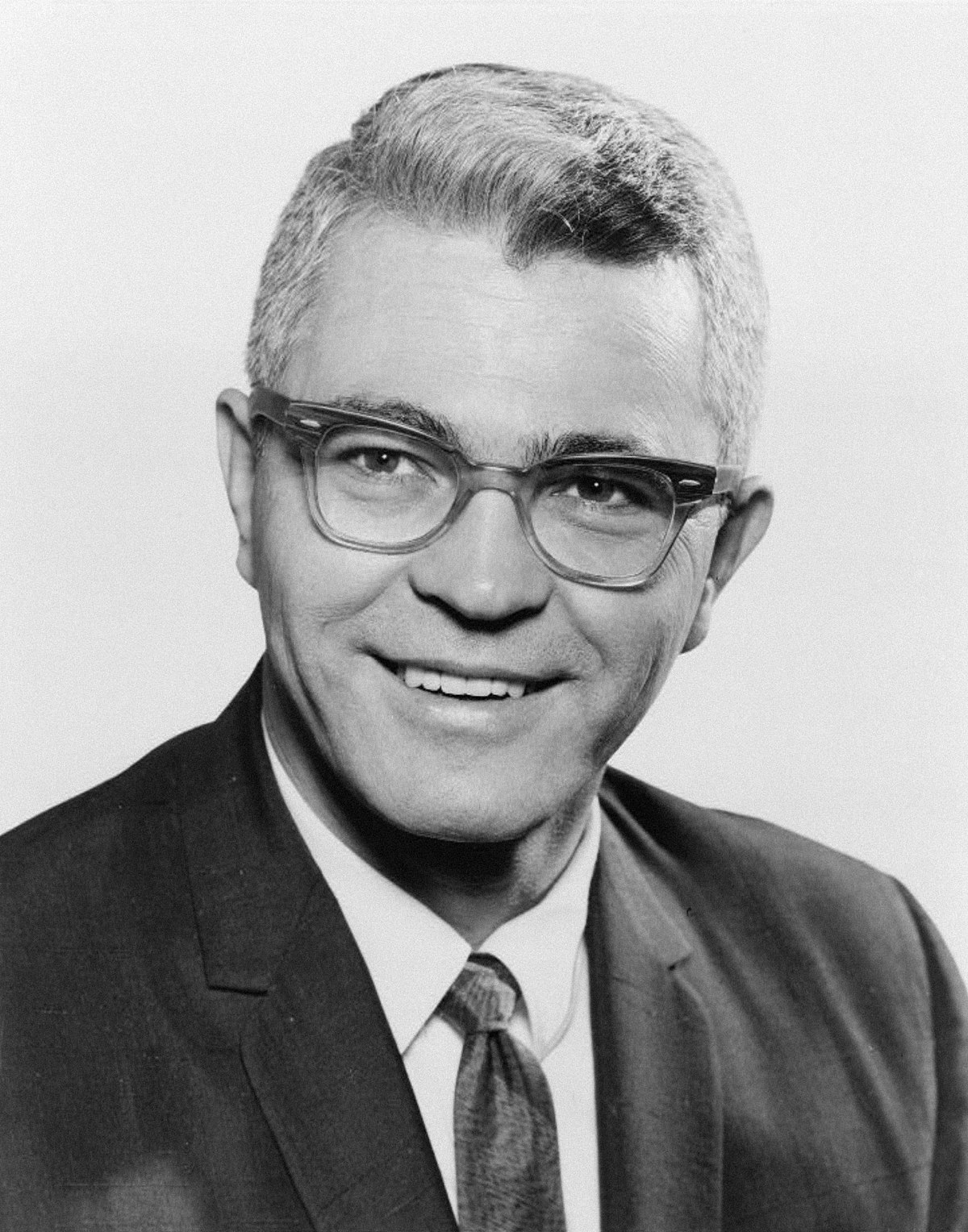
The year 1966 was one of backlash to the Johnson Administration, and the midterms showed it, both in Republican gains and in Democratic primaries in the South. One of these places was Louisiana’s 6th district. Its representative, James Morrison, was a racial moderate who had staunchly backed the Great Society and even voted for the Voting Rights Act of 1965. Out to challenge him was Judge John R. Rarick (1924-2009). Rarick as a judge had a history of racism, including telling one black lawyer who entered his courtroom, “I didn’t know they let you coons practice law” (Time). However, Louisiana’s 6th District had had enough of Morrison, and he was defeated in the primary. Rarick overwhelmingly won the election against Republican Crayton “Sparky” Hall and proceeded to become quite extreme even by Southern Democratic standards.
For him, Justice Thurgood Marshall was a “scamp”, a “cheat”, and a “user of false evidence” (referring to the admittedly questionable “doll test” presented in Brown v. Board of Education) although he clarified that “There are also Negro lawyers who are morally and professionally honest” (Spiegel). He wasn’t any kinder to MLK. For him, he was “an errand boy” for “international communism” who engaged in a “lifetime of subversions and immorality and exploitation” (Spiegel). Rarick found no civil rights measure that met his approval, and was one of the few legislators to vote against prohibiting age discrimination in 1967 and voted against prohibiting racial discrimination in juries in 1968. Rarick was a favorite legislator of Willis Carto and Liberty Lobby, speaking on multiple occasions at their events. In 1969, journalists Drew Pearson and Jack Anderson reported that Carto through his United Congressional Appeal had contributed $3000 to his reelection, only two other (Republican E. Ross Adair of Indiana, possibly for his leadership in opposition to foreign aid, and Republican Jimmy Quillen of Tennessee) representatives commanding such a high contribution. Rarick would also speak before the John Birch Society on multiple occasions. He was frequently accused of racism as well as anti-Semitism. This was due to his rhetoric, his voting record on race, and his insertions into the Congressional Record. He was also a member of the Ku Klux Klan at the time he was elected to Congress (Perlstein). Rarick not only associated himself with Carto, but also Richard Cotten, a radio broadcaster with his virulently anti-Semitic publication and radio program Conservative Viewpoint, who had urged him to run for Congress. He was popular enough among the extreme right for a pamphlet to be published in 1968 titled “Stand Up! You Are An American”, a collection of his quotes and speeches with a foreword by American Independent Party politician Tom Anderson.
Assassination Attempt and Other Controversies
In 1967, after less than a year of service in Congress, Rarick challenged Governor John McKeithen for renomination, but only won 17.3% of the vote in the primary. During this campaign, he was for reasons unknown nearly the victim of a drive-by shooting, with a car speeding past him and 3-4 men firing shots at him, with him recounting, “The whole thing happened about like the flip of a finger. At first it sounded like someone threw a cherry bomb. Then I turned around and looked at this car. This fellow was pointing a gun right at me. The shots kept coming. I jumped between cars … I couldn’t even tell you how many shots were fired” (The Washington Post). That year, he introduced H. Res. 208, asking Congress to renounce the 14th Amendment and presented evidence gathered by Plaquemines parish boss Leander Perez purporting to show that the amendment was illegally adopted. In 1968, Rarick endorsed the independent candidacy of George Wallace, for which he was penalized by having his only two years of seniority stripped.
On October 26, 1969, Rarick inserted into the Congressional Record remarks from retired Lieutenant General Pedro del Valle, an associate of Willis Carto, who warned against a “one-world government dreamed up in the Protocols by the Elders of Zion” (Spiegel). In 1971, he defended Captain Jerry B. Finley, who was facing dismissal for refusing to shake a black officer’s hand, by stating that in Louisiana “it is not considered in good taste for a white person to shake hands with a black stranger” (The New London Day). On December 6, 7, and 15, he inserted into the Congressional Record quotations from a 1953 anti-Semitic diatribe, “Zion’s Fifth Column”, by Jack B. Tenney. By this time deceased, Tenney had been a California state legislator known for investigating communism in the state and in his later years out of office aligned himself with the notoriously bigoted Minister Gerald L.K. Smith. That year, he was condemned by Rep. Charles C. Diggs (D-Mich.), the chairman of the Congressional Black Caucus, as “the leading racist in this [92nd] Congress” for his opposition to home rule for Washington D.C. based on political activites of Black Muslims; blacks made up 77% of the city (The Baltimore Afro-American).
Yet More Controversies
In 1971, Rarick introduced an amendment to the draft extension to prohibit the prosecution of soldiers for killing during wartime in response to the conviction of 2nd Lieutenant William Calley for the My Lai Massacre, holding that “We must tell every mother we shall not let another soldier be disgraced in this manner”, adding, “Isn’t premeditated murder what war is all about?” (The Tuscaloosa News) His amendment was defeated by voice vote. He would also regularly put in the Congressional Record material about Viet Cong terror tactics and was a staunch supporter of the Vietnam War effort. That year, he was one of 19 representatives to vote against the 26th Amendment, granting 18-year-olds the vote. Rarick also later that year was one of 24 representatives to vote against the Equal Rights Amendment. However, he wasn’t against all amendments to the Constitution; he voted for the school prayer amendment that year.
Rarick on Military and Foreign Policy
Rarick was a truculent opponent of foreign aid, stating, “In my three terms in the House I have never seen a foreign aid bill that deserved passage. I have always felt that we should have Americans helping Americans first, not after they got through helping everyone else” (The New York Daily News). Curiously, Rarick sponsored with liberal Reps. Robert Leggett (D-Calif.) and Parren J. Mitchell (D-Md.) a Constitutional amendment requiring a public referendum for the U.S. to go to war, which had originally been sponsored by Rep. Louis Ludlow (D-Ind.) in 1938.
Defeat and Descent Into Obscurity
Although Rarick won reelection in 1972, 1974 was in general a bad year for conservative candidates, and the Democratic Party in the state was growing more liberal. This permitted radio broadcaster Jeff LaCaze, a liberal, to defeat him for renomination. The seat would be won by Republican W. Henson Moore in one of the few Republican pickups of that year. Rarick’s DW-Nominate score was a 0.333, making him one of the most conservative Democrats in American history. His adjusted ACA-Index average score is a 93%. The American Conservative Union only found error with his record in 1973, when he twice voted against their position, once on agriculture and the other regarding food stamps for strikers.
In 1976, he ran for the nomination for president under the American Independent Party ticket, which was won by former Georgia Governor Lester Maddox. After his loss of nomination, he attempted to return to Congress by running in Louisiana’s 1st district, which almost certainly cost Republican Bob Livingston the race. However, the winner, Richard Tonry, was so scandal-plagued that Livingston would win a special election in 1977. In 1980, Rarick won the American Independent Party’s nominee for president, but he was only on the ballot in eight states. He won 40,906 votes, thus coming in seventh place. Rarick’s total was so low that he wasn’t even counted in most publicized tallies. He continued to associate with fringe movements and in 1991 he supported David Duke for governor, speaking at several of his rallies. Rarick died of cancer on September 14, 2009.
References
Fighting Wars on Credit. (1971, September 20). The New York Daily News.
Four Shots Fired at Rep. Rarick. (1967, November 3). The Washington Post.
House Approves Draft Extension. (1971, April 2). The Tuscaloosa News.
Retrieved from
https://news.google.com/newspapers?id=TBYfAAAAIBAJ&pg=3088,170692
Pearson, D. & Anderson, J. (1969, April 20). Hitler Fan Aids Congressmen. The Washington Merry-Go-Round.
Retrieved from
Spiegel, I. (1971, November 24). Jews Call Rarick a Costly Racist. The New York Times.
Retrieved from
Lawyers: Harassment in the South. (1968, August 16). TIME Magazine.
Retrieved from
https://content.time.com/time/subscriber/article/0,33009,838559,00.html
Perlstein, R. (2008, May 7). Louisiana Represents. The American Prospect.
Retrieved from
https://prospect.org/article/louisiana-represents./
Rarick called worst racist in Congress. (1972, February 12). The Baltimore Afro-American.
Rarick Continues Inserting Anti-jewish Diatribes in Congressional Record. (1972, January 20). Jewish Telegraphic Agency.
Retrieved from
Rarick Continues Inserting Anti-jewish Diatribes in Congressional Record
White Officer Faces Dismissal Over Handshake. (1971, February 12). The New London (Connecticut) Day.
 Mad Politics: The Bizarre, Fascinating, and Unknown of American Political History
One thought on “John R. Rarick: Fever-Swamp Fringe Congressman”